Short answer. You searched for an SOP format, or a sample, or an example. Almost everyone does. That is exactly the problem, and it is worth understanding before you write a word.
An admissions committee reading applications from India sees the same document over and over. Same opening about a childhood fascination with technology. Same middle section listing projects already visible on the CV. Same closing about contributing to the university’s esteemed research community. Not because Indian applicants lack originality, but because everyone found the same template, and the template is doing the writing.
Have a gap since your degree? Here is how to explain a study gap for a master’s abroad.
Before writing a different SOP for each programme, read how to shortlist universities in four passes.
This page will not give you a template. It covers what the reader is actually doing with your SOP, why the standard structure fails, the specific risk that AI writing now creates for non native English speakers, and how to build something that reads like a person. It is longer than a template and it will take you more work. That is the point.
Before you write the SOP, fix your intake, because it decides how much runway you actually have. See how much runway each intake needs.
The rest of your application
These three documents are assessed by different people for different reasons, and using one in place of another is a common and expensive mistake.
- the letter of recommendation, including the write it yourself problem
- the SOP for a student visa, which is a different document with a different reader
What the reader is actually doing
Start here, because most SOP advice never tells you.
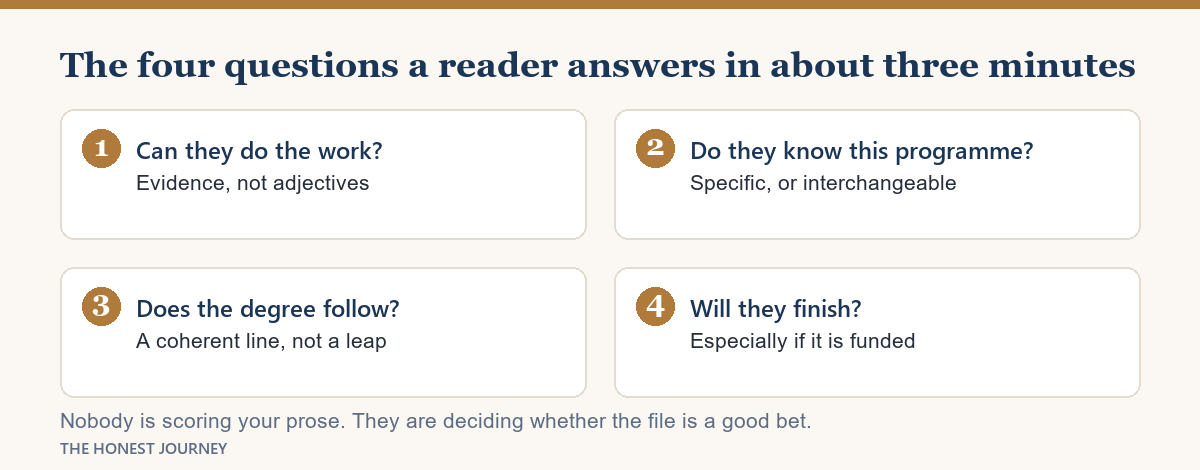
Your statement of purpose is read by an admissions committee, usually faculty in the department you applied to, occasionally an admissions officer doing a first pass. They are reading a large stack. Two to four minutes per document is realistic at many universities, less during peak weeks.
In that time they are answering four questions:
- Can this person do the academic work? Evidence, not adjectives.
- Do they know what they are applying to? Specific to this programme, or generic.
- Is there a reason this degree follows from their background? A coherent line, not a leap.
- Will they finish? Especially for research degrees and anything funded.
They are not scoring your prose. They are not moved by passion. They are checking whether the file in front of them is a good bet, and your SOP is the only part of the application where you get to explain the reasoning behind your own choices.
Faz's ruleNobody is reading your statement of purpose for pleasure. They are reading it to decide whether you are a good bet, in about three minutes, with forty more to go.
Write for a tired specialist who already knows the field, not for an audience that needs to be impressed. That single shift fixes most of what is wrong with the average SOP.
Why the standard format fails
The template that circulates in Indian applicant groups looks roughly like this: a hook about early inspiration, a paragraph on your bachelor’s, a paragraph on projects, a paragraph on why this university, a closing on career goals.
There is nothing wrong with that shape. The problem is that it is the shape everyone uses, so it carries no information. A reader who has seen it four hundred times is not reading it any more, they are skimming for the parts that differ.
Three failures show up again and again.
The childhood hook. “From a young age I was fascinated by machines.” This is the single most common opening in the entire category and it tells the reader nothing they can use. It also burns your strongest real estate. The first two sentences are the only ones you can be confident are read closely.
The CV in prose. Listing your projects, marks and internships in paragraph form duplicates documents the reader already has. It wastes the one place where you could have explained why you made those choices, what went wrong, and what you learned that is not visible from a transcript.
The flattery paragraph. “Your esteemed university’s world class faculty and state of the art facilities.” Every applicant writes this and it can be swapped between universities with a find and replace, which is precisely how readers treat it. If your “why this programme” paragraph would still make sense with a different university name pasted in, it is not doing any work.
The AI problem, which is messier than you have been told
This is worth a proper section because the advice circulating on it is mostly wrong in both directions.
What is actually true as of 2026:
- Roughly 40% of four year colleges use some AI detection tool, with Turnitin the most common, and GPTZero and Copyleaks also in use.
- Around two thirds of admissions offices have no AI policy at all. A 2025 Kaplan survey of 220 offices found 68% silent on it.
- Policies that do exist vary enormously. Georgia Tech permits AI for brainstorming and editing provided the final content is yours. Northwestern treats unauthorised generative AI use as plagiarism. The University of Michigan Law School has told applicants to avoid it.
- Some institutions have abandoned detection entirely. UCLA, UC San Diego and Johns Hopkins stopped using AI detectors after false positive rates around 4%.
So the honest picture is not “you will be caught.” It is that the rules are inconsistent, the tools are unreliable, and nobody can tell you your specific university’s position with confidence.
The false positive risk falls on you specifically
Here is the part that matters most for Indian applicants and almost nobody says it.
A 4% false positive rate is not distributed evenly. AI detectors work by flagging writing that is unusually uniform, grammatically regular and low in idiosyncrasy. That description also fits a great deal of careful, formal writing by capable non native English speakers who learned English academically.
In other words, the writing style that Indian applicants are most often taught to produce for formal documents is the style most likely to trip a detector, whether or not any AI was involved. You can write every word yourself and still be flagged.
Two practical consequences. First, do not sand your writing into perfect neutral formality, because that is both duller and riskier. Specific detail, concrete numbers and a genuine voice reduce false positive risk and read better. Second, keep your drafts. Version history in a document is the simplest evidence that a human wrote it over time, and it costs you nothing.
Faz's ruleThe AI detectors are not very good, and the writing they flag most often is careful formal English by non native speakers. That risk lands on Indian applicants whether or not they used AI.
The defence is not to write more formally. It is to write more specifically. Real numbers, real failures, real decisions. Those are the things a generator does not know about you.
What to write instead
Not a template. A set of questions whose honest answers become the document.
1. What is the specific problem you want to work on
Not the field. The problem. “Machine learning” is a field. “Reducing false alarm rates in cardiac monitoring, because the ICU rotation I did showed me how much alarm fatigue costs” is a problem, and the second one tells the reader more in one sentence than three paragraphs of enthusiasm.
If you cannot name a problem, that is useful information about whether you are ready to apply.
2. What in your background actually led here
The reader is looking for a coherent line. It does not have to be a straight one. A commerce graduate moving into data science has a perfectly good line if they can explain what they saw in their first job that made the move necessary.
What breaks is an unexplained jump. If your degree, your work and your target programme do not obviously connect, the SOP is where you connect them, and failing to do so is the most common reason a competent applicant gets rejected.
3. What went wrong, and what you did about it
Most applicants hide their weak points. A gap year, a bad semester, a failed project, a switch of field. The instinct is to leave them out.
Readers notice gaps in a transcript without your help. An unexplained weak semester becomes a question mark. The same semester explained in one honest sentence becomes evidence that you can assess yourself, which is exactly what they are trying to find out. If you have a backlog or a low average, our page on studying abroad with an average academic record covers how much it actually costs you.
4. Why this programme, provably
The test is simple. Could this paragraph be pasted into an application to a different university without changing anything? If yes, rewrite it.
Name two or three faculty whose work genuinely overlaps with the problem you named in question one, and say what specifically connects. Name a lab, a course sequence, a research group. This requires actually reading the department page, which takes an hour per university and is the single highest return hour in the whole application.
5. What happens after
Be concrete and be plausible. “I want to work on X in industry, and this programme’s Y prepares me for that” is fine. Grand claims about transforming a sector are not.
For funded research programmes this question carries more weight, because they are assessing whether you will finish and whether their investment produces something.
Length, structure and the practical details
| Question | The practical answer |
|---|---|
| How long | 800 to 1,200 words unless the university states otherwise. Follow their stated limit exactly. |
| How many drafts | Four or five over two to three weeks. First drafts are always too general. |
| One SOP for all universities | No. The core can be shared, the “why this programme” section must be rewritten each time. |
| Formatting | Plain paragraphs, no headings unless asked, no decoration. Readable beats designed. |
| First person | Yes. It is your statement. |
| Quotes and epigraphs | Skip them. They spend your opening on somebody else’s words. |
MS, MBA and PhD are different documents
The same file does not work across degree types, and the differences are substantive rather than cosmetic.
For an MS, the emphasis is technical readiness and fit with specific coursework or labs. Name the subfield. Show that your undergraduate preparation covers the prerequisites. If you are switching fields, the burden is on you to show you can handle the load.
For an MBA, the emphasis moves to trajectory and impact. Admissions is assessing your professional progression, what you have been responsible for, and what the degree unlocks that your current path does not. Numbers matter here more than anywhere: team sizes, budgets, revenue, measurable outcomes. If you are a working professional weighing the cost, our page on the MBA abroad maths covers whether it pays at all.
For a PhD, this is closer to a research proposal than a personal statement. Fit with a specific supervisor is often the deciding factor, and a generic PhD SOP is usually rejected regardless of marks. Expect to write a different one for each department, and expect to have read the supervisor’s recent papers.
The university SOP is not the visa SOP
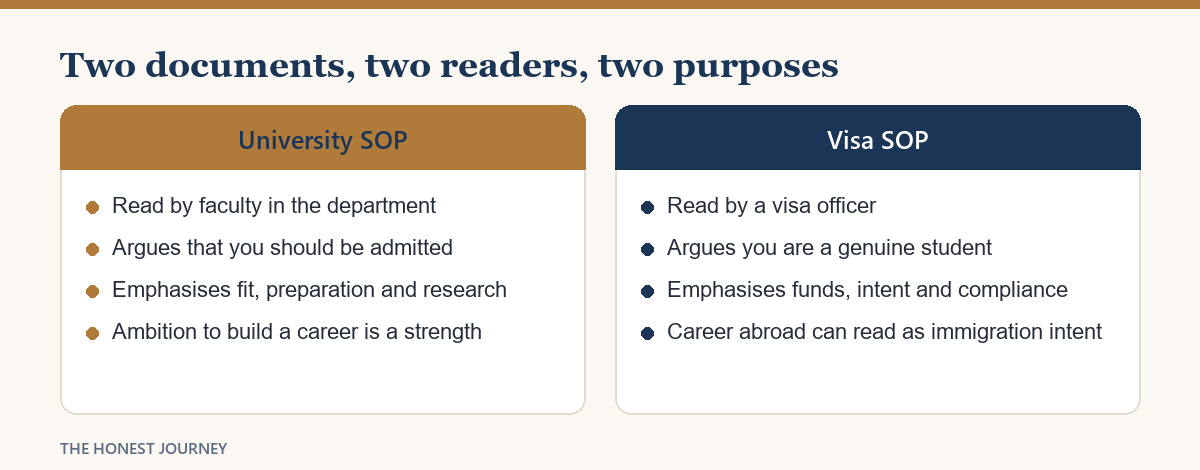
Two different documents, two different readers, two different purposes, and confusing them is a common and costly error.
The university SOP argues that you should be admitted. The visa SOP, sometimes called a statement of intent or cover letter depending on the country, argues that you are a genuine student who will comply with the conditions and, in several countries, that you have reasons to return home.
Submitting your admissions SOP to a visa officer is a real mistake, because an admissions essay about your ambition to build a career abroad can read as immigration intent. We cover the visa document in detail on the SOP for a student visa, including where the loan file asks for a purpose note.
Why this is a money question
It is easy to treat the SOP as an admissions chore rather than a financial one. It is both.
A rejection cycle costs you a year. For most Indian applicants that is a year of forgone salary, another round of application fees at roughly ₹8,000 to 15,000 per university, and test scores that may need retaking. If you were planning to fund this with a loan, the sanction timeline moves with it.
The heavier version is a visa refusal, which is where the two documents meet. A refusal after you have paid a tuition deposit can put that deposit at risk depending on the institution’s policy, and refusal records complicate subsequent applications. Our page on student visa rejection reasons covers what actually triggers them.
Set against that, four or five drafts over three weeks is cheap. This is one of the few parts of the process where unpaid effort genuinely substitutes for money.
Frequently asked questions
What is a statement of purpose?
An essay of usually 800 to 1,200 words submitted with a university application, in which you explain what you want to study, why it follows from your background, and why this specific programme. It is read by faculty or admissions staff deciding whether to admit you, typically in two to four minutes.
Is there a standard SOP format?
There is a widely circulated one, and using it is a disadvantage rather than an advantage because readers see it constantly. Follow any structure the university specifies. Otherwise, plain paragraphs answering what you want to work on, how you got here, what went wrong, why this programme, and what follows.
Can I use ChatGPT to write my SOP?
Policies vary widely and roughly two thirds of admissions offices have no stated position. Some universities permit AI for brainstorming and editing but require the final content to be yours, and some treat unauthorised use as plagiarism. Beyond the rules, a generated SOP is generic by nature, which is the main thing you are trying to avoid.
Can universities detect AI in an SOP?
Around 40% of four year colleges use detection tools, though several major universities including UCLA, UC San Diego and Johns Hopkins have stopped after false positive rates near 4%. The bigger risk for Indian applicants is being falsely flagged for careful formal English written entirely by hand. Specific detail and kept drafts are the practical defence.
How long should a statement of purpose be?
800 to 1,200 words unless the university states a limit, in which case follow theirs exactly. Exceeding a stated limit is an easy and avoidable negative signal.
Can I use the same SOP for every university?
The core can be reused. The section explaining why this specific programme must be rewritten every time, naming real faculty, labs or courses. If that paragraph would survive a find and replace of the university name, it is not working.
Should I mention a low GPA or a gap in my SOP?
Yes, briefly and without excuses. Readers see the gap in your transcript regardless. One honest sentence explaining it, plus what you did about it, converts a question mark into evidence of self awareness.
The honest closing
The uncomfortable truth is that the thing you searched for, a format or a sample, is the thing most likely to hurt you. Not because structure is bad, but because a borrowed structure filled with generic content produces a document indistinguishable from thousands of others, and indistinguishable is the worst possible outcome for a file competing for a limited number of places.
What actually works is unglamorous. Name a real problem. Explain the real path that led you to it. Be honest about what went wrong. Read the department page properly. Write it yourself, specifically enough that no generator could have produced it, and keep your drafts.
That takes maybe fifteen hours across three weeks. Against a degree costing ₹30 lakh or more, and a rejection costing a year, it is the cheapest leverage available anywhere in this process.