Short answer. In my experience most student visa rejections come down to money, not grades. Roughly 60 to 70 percent trace to financial weaknesses like sudden large deposits or funds that fail the seasoning requirement of three to six months of steady balance. For the US, the second big ground is failing to prove non-immigrant intent under section 214(b).
The hardest part of a student visa rejection is not the rejection itself. It is that nobody tells you the real reason. You get a one-line refusal, a vague reference to a section of the law, and a consultant who says “try again next intake” without explaining what actually went wrong. So you reapply with the same file, get refused again, and now you have two refusals on your record instead of one.
Heading to a US interview? See the F-1 visa interview questions and what each one tests.
I have watched this happen enough times to know that most student visa rejection reasons trace back to money, not to grades or admits. This post explains the real reasons honestly, by category, and gives you a reapply playbook that fixes the specific weakness instead of resubmitting the same mistake.
If you just got refused, read this before you do anything else.
The most common student visa rejection reasons are financial: sudden large deposits in your bank account, funds that fail the seasoning requirement, or money that does not match your full cost of attendance. The second big ground, mostly for the US, is failure to prove non-immigrant intent under section 214(b). Almost everything else is documentation or interview error.
For the full guide, read Studying Abroad From India: Cost and Funding Guide.
A statement that contradicts the rest of your file is a refusal trigger in its own right. If you are writing yours now, the statement of purpose covers what the reader is checking for.
Building a no-IELTS plan on a Duolingo score your visa authority rejects is a refusal waiting to happen. See the two-gate problem before you commit.
The pre-Fall visa-appointment crush is where rushed applications break. A quieter intake eases it. See how the intake affects your visa timing.
Why most student visa rejections are really about money
Embassies and visa officers are not assessing whether you are a good student. Your university already did that when it gave you an admit. The visa officer is assessing two things: can you genuinely pay for this, and will you actually leave when the course ends. The first question is where the majority of student visa rejection reasons live, and it is the part Indian families get wrong most often, usually with good intentions.
Here is the pattern I see again and again. A family decides their child is going abroad. Relatives chip in. Someone sells a plot. An uncle wires money from the Gulf. Three weeks before the visa appointment, the student’s bank account jumps from ₹2 lakh to ₹35 lakh. To the family this is a proud moment of collective effort. To a visa officer it is a red flag that screams “borrowed funds, arranged for show, will be sent back after the visa is stamped.”
The officer is not being cruel. They process thousands of files and they have seen every version of arranged funds. So they look for money that has been sitting quietly in the account, growing through visible salary credits and genuine savings, not money that landed last week from five different sources.
Faz's ruleA visa officer trusts boring money. Sudden wealth right before the appointment is the single most common reason honest students get refused.
I have seen students with genuine funding get refused purely because the money looked arranged. The fix is timing. Move the money in, let it settle for the seasoning window, keep the paper trail clean, and a perfectly legitimate file stops looking suspicious.
The financial rejection reasons, by category
Let me break the money side into the specific failures, because “show more funds” is useless advice. Each of these is a distinct problem with a distinct fix.
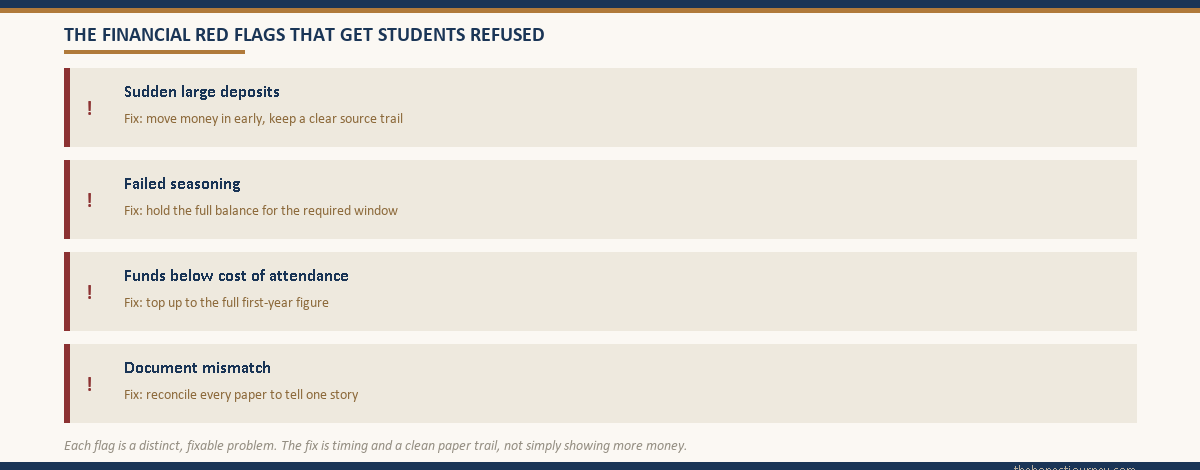
Sudden large deposits
Any large credit that appears shortly before your application, with no salary or income trail behind it, gets flagged. Gift money, a plot sale, borrowed cash, an NRI relative’s transfer: all legitimate, all suspicious if they arrive at the wrong time. The officer cannot tell the difference between a genuine gift and money rented for the appointment, so they treat both with caution.
The seasoning failure
This is the one that hurts honest applicants most. Several countries require that your funds have been held for a minimum period before you apply. The UK is explicit: the money must sit in the account, available to you, for at least 28 consecutive days, and your closing balance during those 28 days must never dip below the required amount. Move money in on day 20 and your clock resets. Canada looks for a settled balance and a clean history rather than a fixed number of days, but the principle is identical. If your funds are not seasoned, they do not count, no matter how real they are.
Funds that do not match cost of attendance
Your proof of funds must cover the full first-year cost, which for the US means tuition plus living expenses exactly as stated on your I-20, and for other countries means tuition plus a defined maintenance amount. Showing tuition but not living costs, or showing the previous year’s figure when the I-20 has increased, is a common technical refusal. The number on your funds documents has to meet or exceed the number the institution and the government expect.
Weak or mismatched documentation
A loan sanction letter that does not name you, a bank statement that does not match the affidavit, a sponsor whose income cannot plausibly support the funding claimed. These are not fraud. They are mismatches, and a mismatch reads as either carelessness or concealment. If your file says one thing and your supporting documents say another, the officer resolves the doubt against you.
For the full breakdown of what each country counts as acceptable funds, see the proof of funds for a student visa post, and for using a loan letter specifically, the education loan sanction letter as proof of funds post walks through what the letter must state.
The 214(b) ground: the US intent problem
The second giant category, and the one unique to the United States, is section 214(b) of the Immigration and Nationality Act. Under US law, every applicant for a non-immigrant visa, including the F-1 student visa, is presumed to be an intending immigrant until they convince the officer otherwise. You can read the official explanation on the US Department of State travel site. A 214(b) refusal means the consular officer was not satisfied that you have strong enough ties to India to overcome that presumption that you will return home after your studies.
This is where money and intent overlap. If your funding looks shaky, the officer assumes you plan to work illegally to survive, which means you plan to stay. If you cannot articulate why you chose this specific course, or what you will do with the degree back in India, you sound like someone using a student visa as a migration route. The interview is short, often under three minutes, and a 214(b) refusal usually comes down to a few weak answers about your plans and your ties.
The honest truth here is uncomfortable: if your real plan is to migrate and stay, the F-1 visa is the wrong door, and an officer who senses that is doing their job. But plenty of genuine students get 214(b) refusals simply because they were nervous, vague, or over-coached into sounding rehearsed. Strong, specific, calm answers about your course and your reasons for returning are what overcome it.
Faz's ruleA 214(b) refusal is about your story, not your documents. Fix the answer, not the file.
I have seen students reapply for a 214(b) refusal by adding more bank statements. That is the wrong fix. The officer was not doubting your money, they were doubting your intent to come home. Practise answering why this course, why now, and what you do afterward in India, in plain sentences.
The non-financial reasons that still matter
Money and intent cause most refusals, but a few process failures show up often enough to mention. A genuine-student credibility doubt, where your chosen course does not fit your academic history, sinks files across the UK, Canada, and Australia. The UK runs a credibility interview, and answering it like a script rather than a person triggers refusals. The official rules sit on the UK student visa pages.
Then there are the avoidable ones: an incomplete application, missing supporting documents, an expired or damaged passport, a previous overstay or visa violation anywhere in the world, or false information that gets caught. False information is the one refusal you cannot recover from cleanly, because a misrepresentation finding can bar you for years. Canada is particularly strict on this, and the IRCC site lists misrepresentation as a multi-year inadmissibility. Never let a consultant “improve” a document for you.
| Rejection reason | Where it bites hardest | Severity for reapplying |
|---|---|---|
| Sudden large deposits | All countries | Fixable, needs time |
| Failed seasoning (28-day rule) | UK, Canada | Fixable, needs time |
| Funds below cost of attendance | US, all countries | Fixable quickly |
| 214(b) non-immigrant intent | US only | Fixable, change the story |
| Genuine-student credibility doubt | UK, Canada, Australia | Fixable with preparation |
| Misrepresentation / false documents | All, Canada strictest | Serious, often multi-year bar |
For Australia, the genuine student requirement replaced the older genuine temporary entrant rule, and the criteria are published by the Department of Home Affairs. The same logic applies: your study plan has to make sense for you specifically.
The honest reapply playbook
The biggest mistake after a refusal is rushing back in. A reapplication with the same file gets the same answer, and now you have a refusal history that every future officer can see. Here is how to do it properly.
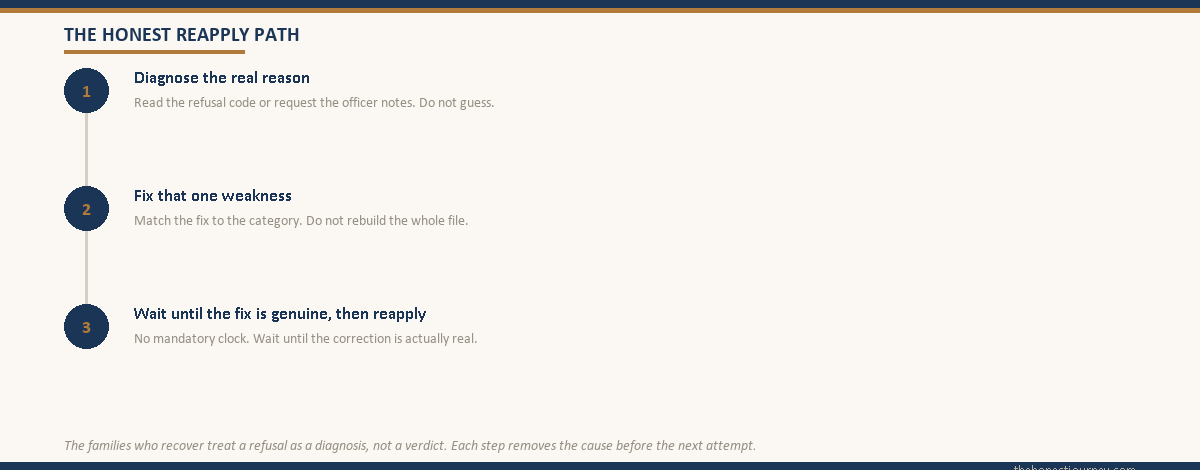
Step one: diagnose the actual reason. Read your refusal letter for the specific code or ground. The US gives you a 214(b) letter. The UK and Canada give written refusal reasons, and Canada applicants can request the GCMS notes, which contain the officer’s actual remarks. Do not guess. Find the real reason before you touch anything.
Step two: fix the specific weakness, only that weakness. A refusal for one reason does not mean you rebuild the whole file. Match the fix to the category.
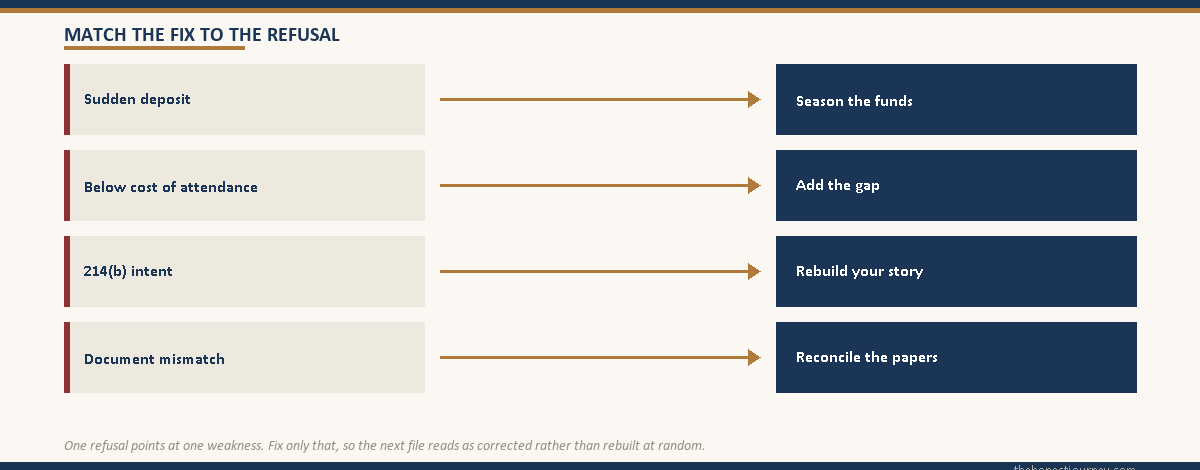
| If you were refused for | The real fix is | Wait before reapplying |
|---|---|---|
| Sudden deposit | Let funds season fully, build a paper trail for the source | 1 to 3 months minimum |
| Failed seasoning | Hold the required balance for the full window, then apply | Until the window clears |
| Funds below cost | Top up to full cost of attendance, document the source | Weeks, after seasoning |
| 214(b) intent | Strengthen ties, rewrite and practise your answers | Only when your story changes |
| Document mismatch | Reconcile every document so they tell one story | Weeks |
Step three: do not rush. There is no fixed mandatory waiting period in most systems. For the US, you can technically reapply the next day, but reapplying without a material change in your circumstances almost guarantees the same 214(b) result. The honest waiting period is however long it takes for your fix to be real. If your problem was seasoning, you wait until the money has genuinely sat for the required window. If your problem was 214(b) intent, you wait until you can honestly demonstrate stronger ties, not just rehearse better lines.
Faz's ruleReapply when something has genuinely changed, not when you feel impatient. A second refusal costs more than the wait.
The clock you should watch is not a mandatory waiting period. It is whether the thing that got you refused is actually fixed. Reapplying with an unchanged file just adds a second refusal to your record for the next officer to see.
Does a rejection ruin your future applications?
This is the question that keeps families awake, so let me answer it plainly. A single visa refusal does not blacklist you. You must declare it on future applications, because lying about a prior refusal is itself misrepresentation, but an honest disclosure of one refusal that you then corrected is not fatal. Officers see refusal histories constantly. What they look for is whether the underlying problem was resolved.
What does cause lasting damage is a pattern of repeated refusals with no change between them, or any finding of fraud or misrepresentation. The first signals a weak case the applicant refuses to fix. The second can trigger a multi-year bar. So the goal is never to hide a refusal. The goal is to make sure your next application is genuinely stronger, so the officer sees a corrected file rather than the same problem resubmitted.
One worth flagging: a visa refusal and a loan refusal are different animals with overlapping roots. If your funding is shaky enough to sink a visa, it is often shaky enough to have caused trouble at the bank too. The drivers there, weak co-applicant income, mismatched documents, and over-leverage, are laid out in the education loan rejection reasons post, and fixing one often fixes the other.
And if you are reading this before you have even applied, the deeper question worth sitting with is whether the financials make sense in the first place. A refusal driven by stretched funding is sometimes the system telling you the loan and the course were oversized for your situation. The is studying abroad worth it post works through that math honestly.
The honest closing take
Most student visa rejection reasons are not bad luck and they are not bias. They are signals. A sudden-deposit refusal is the system telling you your money looked arranged. A seasoning refusal is telling you that you applied too early. A 214(b) refusal is telling you that your story did not convince a stranger in three minutes that you will come home. Each one points at a specific, fixable thing.
The families who recover from a refusal are the ones who treat it as a diagnosis rather than a verdict. They read the actual reason, fix the actual weakness, wait until the fix is real, and reapply with a file that has genuinely changed. The families who get refused twice are the ones who took the same documents back to the counter and hoped for a different officer.
Get the money right first, because that is where most refusals start. Season your funds, match the full cost of attendance, keep your documents telling one clean story, and be able to explain in plain words why this course and why you are coming back. Do that, and a refusal becomes a delay rather than a dead end.
Most refusals trace back to a rule the applicant never read for that specific country. The full requirement list per destination is in our student visa guides for Canada, the USA, the UK and Australia.
FAQ
Why do student visas get rejected?
The most common reason is financial: sudden large deposits that look arranged, funds that fail the seasoning requirement, or money that does not cover the full cost of attendance. For US applicants, the second major ground is section 214(b), where the officer is not convinced you will return home after studying. Beyond those, refusals come from weak documentation, document mismatches, credibility doubts about your study plan, and avoidable errors like incomplete applications or misrepresentation. Money and intent account for the large majority.
Can I reapply after a student visa rejection?
Yes. A refusal is not a ban. You can reapply for almost every student visa, and most countries have no mandatory cooling-off period. The key is to reapply only after you have diagnosed the specific reason for the refusal and genuinely fixed it. Reapplying with the same file that was just refused will almost always produce the same result and leaves you with two refusals on record instead of one, which is harder to recover from.
How many times can I reapply for a student visa?
There is no hard legal limit on the number of times you can reapply in most systems. Practically, though, each refusal with no meaningful change between applications weakens your case, because officers can see your refusal history and a repeated pattern signals an unresolved problem. Quality matters far more than quantity. One well-corrected reapplication beats three rushed ones. Fix the underlying issue properly and you usually only need to apply a second time.
Does a visa rejection affect future applications?
A single refusal that you honestly disclose and then correct does not blacklist you. You must declare prior refusals on future applications, since hiding one is itself misrepresentation. What causes lasting harm is a pattern of repeated unchanged refusals or any finding of fraud, which can trigger a multi-year inadmissibility, especially in Canada. Officers expect to see refusal histories. They are looking for evidence that the original problem was resolved, not for a spotless record.
What is 214(b) in a US visa refusal?
Section 214(b) of the US Immigration and Nationality Act presumes every non-immigrant visa applicant intends to immigrate until they prove otherwise. A 214(b) refusal means the consular officer was not satisfied that you have strong enough ties to India to overcome that presumption that you will stay. It is about intent, not documents. The fix is to demonstrate genuine ties and to clearly explain why you chose your course and what you plan to do back in India after graduating.
What is the 28-day rule for funds?
The 28-day rule, used most explicitly by the UK, requires that the money you show as proof of funds has been held in your account for at least 28 consecutive days before you apply, and that your balance never dipped below the required amount during that window. If you deposit funds late and apply too soon, the clock resets and the money does not count. Canada applies a similar settled-funds principle. It exists to filter out money arranged purely for the appointment.
How long should I wait to reapply after a rejection?
There is usually no fixed mandatory wait. The honest waiting period is however long it takes for your fix to become real. If you were refused for failed seasoning, wait until your funds have genuinely sat for the required window. If you were refused under 214(b), wait until you can demonstrate stronger ties rather than just rehearse better answers. Reapplying before the underlying problem has actually changed almost always produces a second refusal, so let the correction be genuine.
Can a sudden deposit cause a student visa rejection even if the money is real?
Yes, and this is the cruel part for honest families. A visa officer cannot tell a genuine gift or plot sale from money rented for the appointment, so a large credit that lands shortly before you apply, with no income trail behind it, gets treated with suspicion regardless of its source. The fix is timing and paper trail: move the money in well ahead, let it season, and keep documentation of where it came from so the deposit reads as legitimate rather than arranged.
Faz · The Honest Journey · 2026