Short answer. Studying in Dubai or the wider UAE costs an Indian student anywhere from roughly fifteen lakh rupees a year at an Indian-origin branch campus to fifty or seventy lakh for a Western branch or an IIM, so the single biggest decision is not the country, it is which type of campus you pick.
The two questions every agent skips are the ones that decide whether the money is well spent: will an Indian bank actually fund this course, and will India recognise the degree afterwards through UGC equivalence. Price it campus by campus in rupees, settle the loan and tax math first, and confirm the recognition step before you pay a deposit. The UAE is genuinely close, safe, and English-medium, but the cost spread between campus tiers is the part the brochures blur.
A parent messaged me last winter, relieved. His daughter had an offer from a Dubai branch of a well known university, the agent had called it “a UK degree at half the price and an hour from home,” and the family was ready to sign. I asked two questions. First, had he seen the tuition on the university’s own fee page, not the agent’s PDF. Second, had he checked whether the degree would be treated as equivalent in India if she ever wanted a government job or a PhD seat back home. He had no answer to either. We found the real tuition was nearly double the quote, and the recognition step was a process nobody had mentioned. The course was still a reasonable choice. It was just not the one he thought he was buying.
This post is the honest version of the Dubai and UAE study decision for Indian students. I do not earn anything whether you go or stay. I am going to price it the way a parent actually has to, by campus type and in rupees, walk through the visa and work rules as the government states them, and be straight about the two things that decide whether it is worth it: lender behaviour and Indian recognition.
For the wider picture across destinations, the studying abroad from India cost and funding guide sits alongside this one, and if you are still choosing a country, the best country to study abroad guide frames where the UAE fits.
Why the UAE pulls Indian families in
The appeal is real, so let me state it fairly before I get to the catches. The UAE is a short flight from most Indian cities, the time zone is ninety minutes ahead so families stay in easy contact, and the country is overwhelmingly English-medium for instruction and daily life. There is a large, settled Indian community, so the cultural distance is small, and for many parents that safety and familiarity is worth a premium on its own.
The other draw is the branch campus model. Instead of flying to the United Kingdom, Australia, or India’s own elite institutes, a student can attend a Dubai or Abu Dhabi campus of a foreign or Indian university and, in theory, get a similar degree closer to home. Whether that theory holds depends entirely on which campus, and that is the heart of this post.
The visa, exactly as the government states it
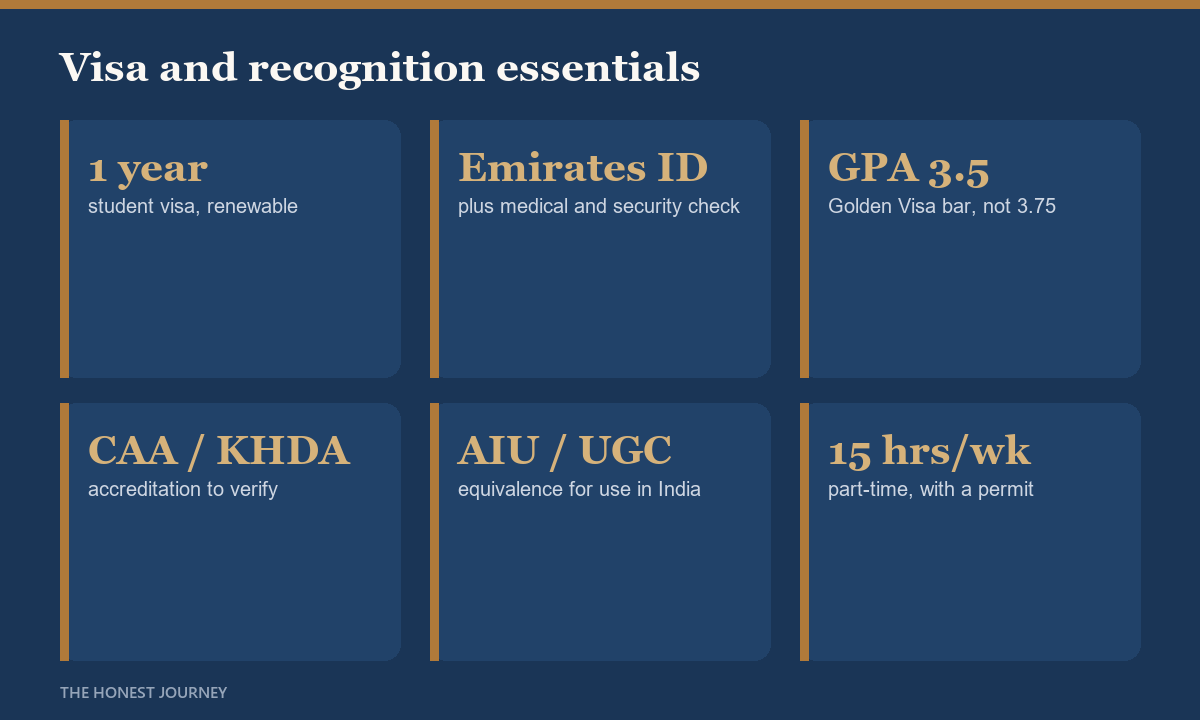
The student residence visa is issued one year at a time and is renewable on proof that you are still enrolled and progressing in your studies. The sponsor is either the university or college you attend, or a parent or guardian who is already a UAE resident. This is set out on the official UAE Government portal, and it matters because a one year renewable visa means your stay is tied to continuous enrolment, not granted for the whole degree up front.
If you are eighteen or older, the process before the visa is issued includes a medical fitness test, a security check, and an Emirates ID issued by the Federal Authority for Identity and Citizenship, the ICP. The medical screens for communicable diseases, the security check is standard, and the Emirates ID is your day to day identity document in the country. Budget two to three weeks for processing and a few thousand dirhams for the visa, medical, and ID together. None of this is a degree cost, but it is real money in your first months. You can read the official rules on the UAE Government student residence visa page.
Faz's ruleThe student visa is renewed yearly on proof of continued study, not granted once for the whole degree. Keep your enrolment clean, because a gap or a failed year can put the renewal at risk.
Families assume a study visa covers the full course the way a US F-1 broadly does. In the UAE it is issued one year at a time and the university or a resident parent sponsors it. That is not a problem if you stay enrolled and progressing, but it means academic trouble has an immigration consequence attached, and it means the sponsorship relationship with your university is something to keep in good standing.
The Golden Visa, and the 3.5 GPA myth agents repeat
Outstanding students can get a ten year Golden Visa without a sponsor, and it can include family. This is the genuinely attractive long term pathway, and it is also where agents quietly inflate the bar. The figure you will hear repeated is a cumulative GPA of 3.75. The official requirement for graduates of a UAE university is a GPA of 3.5 at a Ministry of Education Class A rated institution, with a higher 3.8 for Class B institutions. For graduates of a top international university, the threshold is also 3.5. So 3.75 is not the line for most students, and getting that number wrong has discouraged people who actually qualified.
The other conditions are concrete: the university must be Ministry of Education A or B rated, your graduation must be MoE accredited and the degree attested by the Ministry, you need a recommendation, and you must apply within two years of graduating. That two year window is firm. Miss it and you fall out of the student category regardless of your marks. The authoritative source is the UAE Government portal, not a consultancy blog, so confirm the current criteria on u.ae before you build a plan around it.
Faz's ruleThe Golden Visa GPA bar for outstanding students is 3.5 at a Class A UAE university, not the 3.75 agents quote. Check the official u.ae criteria, not a brochure, because the wrong number talks qualified students out of applying.
I keep meeting students who assumed they were a quarter point short of a Golden Visa when they were actually over the line. The 3.75 figure circulates because it sounds authoritative and nobody checks the government page. The real conditions are a 3.5 GPA at a Ministry rated Class A university, an attested and accredited degree, a recommendation, and an application within two years of graduating. If that describes you, the ten year visa with family included is a serious benefit, so do not let a wrong number decide it for you.
Working while you study
Here is where I have to be careful, because the internet is full of confident single sentences about student work hours that do not match how the UAE actually runs this. The clear rule is that working without a work permit from the Ministry of Human Resources and Emiratisation, MoHRE, is illegal, and the employer is the one who applies for that permit. Part time work of around fifteen hours a week is commonly permitted in practice, but it tends to run through the university and the MoHRE route rather than from a single federal student hours statute that applies to everyone identically. The honest framing is to treat part time work as a university policy matter: ask your specific university what it allows and what it will sponsor, and never work informally without a permit.
Do not build your budget on part time earnings. Treat any income as a small offset, not a funding pillar, and read the realistic numbers in the cost and funding guide before you assume work will close a gap. The MoHRE and university route exists, but the wage and the hours rarely add up to a meaningful dent in Dubai living costs.
Accreditation and recognition, the two layers that matter
There are two separate questions hiding inside “is the degree any good,” and they have different answers from different authorities.
The first is UAE accreditation. Academic programmes in the UAE are accredited by the Commission for Academic Accreditation, the CAA, under the Ministry of Education, and you can check a programme on caa.ae. In Dubai specifically, free zone and private campuses are licensed and quality rated by the Knowledge and Human Development Authority, KHDA, whose listings are on khda.gov.ae. Before you do anything else, confirm your exact programme appears with the right regulator, because a campus being well known does not guarantee every programme it runs is accredited.
The second question is the one agents bury, and it is the more important one for many Indian families. If you intend to use the degree back in India for a government job, a competitive exam, or further study such as a PhD or a public university seat, India needs to recognise it. That recognition runs through equivalence. Historically this was the job of the Association of Indian Universities, the AIU, at aiu.ac.in. As of April 2025, the University Grants Commission notified the Recognition and Grant of Equivalence to Qualifications Obtained from Foreign Educational Institutions Regulations, 2025, which set up a UGC equivalence process. Note that professional qualifications regulated by statutory councils, such as medicine, law, nursing, pharmacy, and architecture, sit outside this general equivalence route and have their own rules.
The practical point is simple and it is the honest hook of this entire post: a UAE degree, including from a branch campus, may need an equivalence step before it carries full weight in India, and that step is not automatic. If your plan ends in a private sector job in Dubai or the Gulf, this matters less. If your plan involves the Indian government, Indian academia, or an Indian public university seat later, confirm the equivalence pathway for your specific qualification before you enrol, on the official UGC and AIU portals, not on an agent’s assurance.
The cost spread nobody shows you in rupees
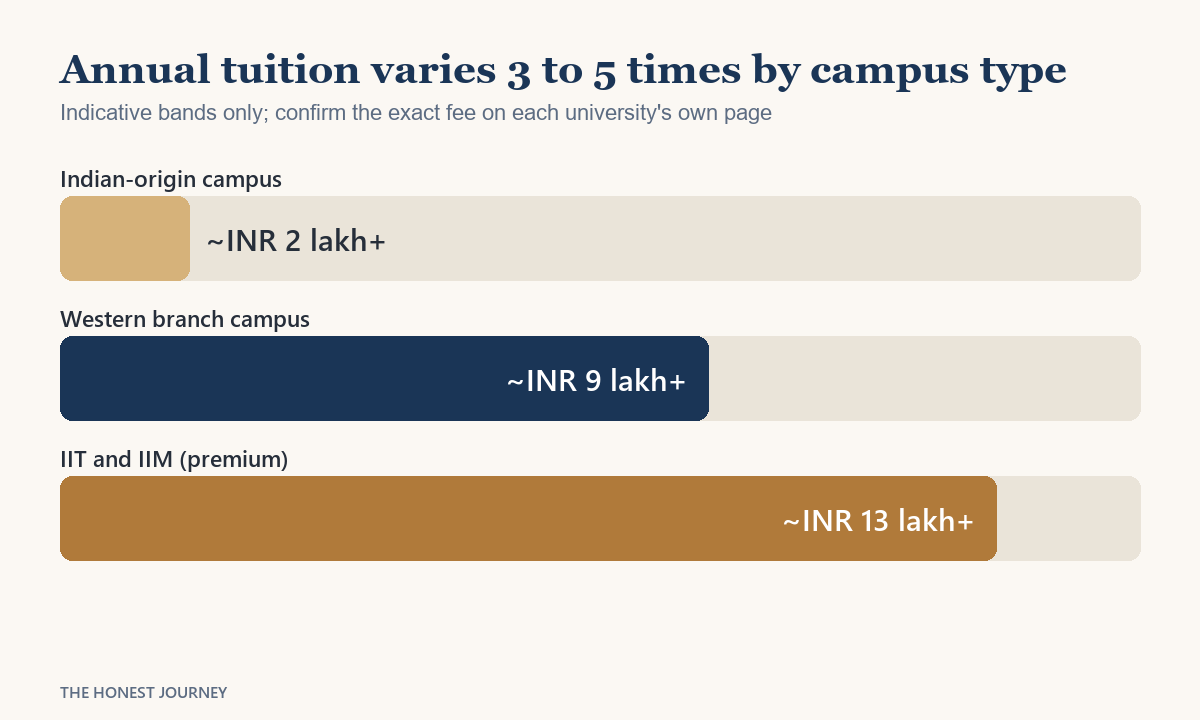
This is the section that decides everything, and it is the section every aggregator blurs into a single misleading range. The truth is that Dubai and the UAE do not have “a” tuition. They have at least three very different campus tiers, and they sit three to five times apart. I am going to show the shape of it, with the explicit instruction to confirm each number on the university’s own fee page, because branch campus tuition moves and aggregator figures are unreliable.
The cleanest publishable figure is the IIM Ahmedabad Dubai one year MBA. Its programme fee is US dollars 80,000, and that is inclusive of tuition, books and course material, visa fees, medical insurance, and use of facilities, with a September intake. That is confirmed on the official IIMA Dubai fees page. At current rates that single year is roughly sixty seven lakh rupees, all in, before your own living and travel beyond what the fee covers.
At the other technical end, IIT Delhi runs a campus in Abu Dhabi, and its scholarship structure is published. Tier I is a full tuition waiver at a cumulative GPA of at least 8.00 out of 10, Tier II is a 50 percent waiver at a CGPA of at least 6.00, and below 6.00 there is no waiver. Students admitted through JEE Advanced pay the same tuition as they would at IIT Delhi in India. The exact dirham tuition figure is not something I will assert, because it is not stated cleanly on the official page in a way I can stand behind, so confirm it on the IIT Delhi Abu Dhabi fees and scholarship page directly.
Then there are the branch campuses that most students actually consider: Indian origin campuses such as BITS Pilani Dubai and Manipal Academy of Higher Education Dubai, and Western branch campuses such as the University of Birmingham Dubai and Heriot-Watt Dubai. These three groups, Indian origin, Western branch, and the IIT and IIM tier, are roughly three to five times apart per year, and that gap is the single most important thing to understand. I am not going to print precise tuition for each, because the honest answer is that it changes and that aggregators get it wrong. Pull each number from the university’s own official fee page before you compare. The table below shows the structure and rough rupee shape, and tells you exactly where to confirm.
| Campus type and example | Indicative annual tuition | Rough rupee equivalent per year | Where to confirm |
|---|---|---|---|
| Indian origin branch (BITS Pilani Dubai, MAHE Dubai) | Lower tier, broadly AED 45,000 to 65,000 | Roughly ₹10 to 16 lakh, confirm on the university fee page | The university’s own official Dubai fee page |
| Western branch campus (Birmingham Dubai, Heriot-Watt Dubai) | Mid to upper tier, broadly AED 65,000 to 100,000 plus | Roughly ₹16 to 25 lakh plus, confirm on the university fee page | The university’s own official Dubai fee page |
| IIT Delhi Abu Dhabi (undergraduate) | Figure not asserted here, scholarship tiers apply | Confirm on the official page, scholarships can change it sharply | iitdabudhabi.ac.ae fees and scholarship page |
| IIM Ahmedabad Dubai (one year MBA) | US dollars 80,000 all inclusive | Roughly ₹67 lakh for the year, all in | Confirmed on iima.ac.in Dubai fees page |
Read that table as a warning, not a price list. The indicative tuition bands for the branch campuses are rough and must be verified on each university’s own fee page, because they move and because that is the number agents misquote most. What is solid is the shape: an Indian origin branch, a Western branch, and the IIT or IIM tier are different financial decisions entirely, and conflating them into “Dubai costs around X” is how families get surprised. On top of tuition, budget living costs in Dubai or Abu Dhabi of broadly AED 40,000 to 70,000 a year for shared accommodation, food, transport, and the rest, which is roughly ten to seventeen lakh rupees, and more if you want your own flat.
Will an Indian bank actually fund it
This is the question that quietly kills more UAE plans than tuition does, and there is no official source to cite, so I will be precise about that. From what I see in practice, Indian lenders often treat the UAE differently from the United States, United Kingdom, Canada, or Australia. Some apply lower loan caps, some are more collateral hungry, and several classify branch campuses inconsistently, sometimes funding the parent university’s home country degree readily but hesitating on its Dubai campus. I cannot give you a hard rule, because there is not one, and any number a site quotes here is invented. The honest instruction is to confirm with your specific bank, in writing, for your specific campus and programme, before you commit.
What you can do is go in prepared. If you have collateral, a secured loan from a public sector bank is usually the cheapest route and is worth pricing first. If you do not, the collateral free route exists but is narrower and pricier, and the lender’s view of the UAE and of branch campuses specifically becomes the deciding factor. The education loan India complete guide lays out the whole landscape, and if collateral is your constraint, the education loan for abroad studies without collateral guide is the one to read next to it. Ask the bank one direct question: do you fund this exact campus and programme, at what cap, and on what security. A vague answer is itself information.
The India money rules: LRS, TCS, and forex
Once a lender is on board, the remittance rules apply the same way they do for any country. Under the Reserve Bank of India’s Liberalised Remittance Scheme, a resident individual can remit up to US dollars 250,000 per financial year for permitted purposes including education, which comfortably covers UAE tuition and living costs for almost every student. Confirm the live limit on the RBI site, because it is the kind of figure that can be revised.
On tax collected at source, the Finance Act 2025 changed the picture from 1 April 2025. The threshold below which no TCS applies on LRS remittances was raised to ten lakh rupees per financial year, education remittances funded by a loan from a specified financial institution carry zero percent TCS, and self funded education remittances above the threshold attract a lower rate than the old slab. Because these rates and the exact mechanics matter to your cash flow, verify the current position on the Income Tax Department’s material and the Finance Act, not on a news summary. The plain English walkthrough is in the TCS on education loan guide, and the mechanics of remitting are in the A2 form, LRS, and forex for students guide.
One more practical document point. The UAE student visa and university will, at various stages, want evidence that you can fund the course, and your bank or consulate may ask for proof of funds. Get that paperwork right early, because a clean proof of funds file removes a common source of last minute panic. The proof of funds for student visa guide covers how to present it.
Who Dubai and the UAE is genuinely right for
Being honest about fit is the whole point of this site, so here it is plainly. The UAE works well when several of these are true at once.
- You want to stay close to India, in an English medium, culturally familiar, safe environment, and you value that proximity enough to pay for it.
- Your plan points toward a career in the UAE or the wider Gulf, where a locally accredited degree and the contacts you build carry direct weight, and where the Golden Visa pathway is a real long term option.
- You have a clear eyed read on which campus tier you are buying, you have verified the tuition on the university’s own fee page, and the rupee number genuinely works for your family.
- You have confirmed that your specific bank will fund your specific campus, or that you can self fund within the LRS limit without straining the household.
- You are targeting the strong options on their merits, an IIT Delhi Abu Dhabi or IIM Ahmedabad Dubai seat, or a branch campus whose accreditation and recognition you have checked, rather than choosing Dubai by default because it is near.
The UAE is probably not the right call when these apply instead.
- Your plan ends in India in a government job, a competitive exam track, Indian academia, or a public university seat, and you have not confirmed the UGC equivalence pathway for your qualification. The recognition step is real and you should settle it before you enrol, not after you graduate.
- You are choosing a Western branch campus mainly to get “a UK or Australian degree cheaper,” without checking that the branch tuition is actually lower once you price it on the official page, because the saving is often smaller than the pitch suggests.
- Your funding depends on an Indian bank that has not yet confirmed it will lend for your campus, or on part time work that the rules will not reliably let you do at the scale you are assuming.
- Your field is a statutory regulated profession such as medicine, law, or architecture intended for practice in India, where foreign equivalence and licensing are a separate and harder problem.
The honest summary is that the UAE is a strong, comfortable choice for the right student and a quietly expensive misfit for the wrong one, and the line between the two is drawn by three things the brochures skip: which campus tier, whether your bank funds it, and whether India recognises it. Price it in rupees on the official fee pages, settle the loan and the equivalence question first, and the decision becomes clear rather than emotional.
Once you have settled on the UAE, the visa is the step most people underestimate. The permit route, fees and funds proof for the UAE sit in the UAE student visa guide.
FAQ
How much does it really cost an Indian student to study in Dubai per year?
It depends entirely on the campus tier, which is the part most quotes hide. An Indian origin branch such as BITS Pilani Dubai or Manipal Dubai tends to sit at the lower end, broadly ten to sixteen lakh rupees a year in tuition, while a Western branch such as Birmingham Dubai or Heriot-Watt Dubai runs higher, and the IIM Ahmedabad Dubai one year MBA is US dollars 80,000 all inclusive, roughly sixty seven lakh for the year. Living costs in Dubai or Abu Dhabi add broadly ten to seventeen lakh rupees a year on top. Confirm tuition on each university’s own official fee page, because aggregator numbers are unreliable and the bands move.
What is the UAE student visa and how long does it last?
The student residence visa is issued one year at a time and is renewable on proof that you are still enrolled and progressing. It is sponsored either by your university or college, or by a parent or guardian who is already a UAE resident. Applicants aged eighteen and above must pass a medical fitness test and a security check and obtain an Emirates ID from the Federal Authority for Identity and Citizenship, the ICP. Processing usually takes two to three weeks. Because it is renewed yearly on continued study, keeping your enrolment in good standing matters for your immigration status, and you should confirm current rules on the UAE Government portal.
Is the Golden Visa GPA requirement 3.75 for students?
No, and this is a common myth. For graduates of a UAE university, the Golden Visa for outstanding students requires a GPA of 3.5 at a Ministry of Education Class A rated institution, with 3.8 for Class B, and the threshold for top international university graduates is also 3.5. The other conditions are an MoE accredited and attested degree, a recommendation, and an application within two years of graduating. The ten year visa can be obtained without a sponsor and can include family. Always confirm the current criteria on the official u.ae portal rather than relying on a consultancy that may quote the wrong number.
Can I work part time as a student in the UAE?
Working without a work permit from the Ministry of Human Resources and Emiratisation, MoHRE, is illegal, and the employer is the one who applies for that permit. Part time work of around fifteen hours a week is commonly permitted in practice, usually through the university and MoHRE route rather than a single uniform federal student hours rule, so confirm what your specific university allows and will sponsor. Treat any earnings as a small offset, not a funding pillar, because the hours and wages will not meaningfully cover Dubai living costs. Never work informally without a permit, as the consequences fall on you.
Will my UAE degree be recognised in India?
For private sector work in the UAE or the Gulf, an accredited UAE degree generally stands on its own. For use in India in a government job, a competitive exam, Indian academia, or a public university seat, you will typically need an equivalence certificate. This was previously handled by the Association of Indian Universities, and as of April 2025 the University Grants Commission notified equivalence regulations setting up a UGC process. Statutory regulated professions such as medicine, law, and architecture sit outside this general route and have their own rules. Confirm the equivalence pathway for your specific qualification on the official UGC and AIU portals before you enrol, not after you graduate.
Will an Indian bank fund a UAE or Dubai branch campus?
Often yes, but not always cleanly, and there is no official rule to cite here. Indian lenders sometimes treat the UAE differently from the United States or United Kingdom, with lower caps, more collateral demands, or inconsistent classification of branch campuses, where a bank may fund the parent university’s home degree readily but hesitate on its Dubai campus. Because this varies by lender, confirm with your specific bank, in writing, for your exact campus and programme before you commit. If you have collateral, price a secured public sector bank loan first, as it is usually the cheapest route, and read the complete education loan guide to go in prepared.
How do LRS and TCS apply to UAE education costs?
Under the Reserve Bank of India’s Liberalised Remittance Scheme, a resident individual can remit up to US dollars 250,000 per financial year for permitted purposes including education, which covers UAE tuition and living costs for almost every student. From 1 April 2025, the Finance Act 2025 raised the no TCS threshold on LRS remittances to ten lakh rupees per financial year, set zero percent TCS on education remittances funded by a loan from a specified financial institution, and applied a lower rate to self funded education above the threshold. Verify the current limit and rates on the RBI site and the Income Tax Department material, because these figures can be revised.
Is studying in Dubai cheaper than the UK or Australia?
Sometimes, but far less reliably than agents suggest, and only at the right campus tier. An Indian origin branch campus can be genuinely affordable, while a Western branch campus in Dubai is often closer to its home country pricing than to a discount once you read the official fee page rather than the brochure. The real advantage of the UAE is proximity, safety, English medium, and a familiar community, plus the Golden Visa pathway, rather than a guaranteed cost saving. Decide on the rupee number from the university’s own fee page and on whether your bank will fund it, not on the assumption that Dubai is automatically the cheaper version of a Western degree.
Faz · The Honest Journey · 2026