Short answer. For Indian students, the UAE student visa is not an embassy stamp but an institution-sponsored residence visa, arranged by your university or academic free zone, not a consulate. As of the 2026 intake the all-in cost runs roughly AED 3,000 to AED 6,000 depending on the emirate and sponsor.
There is no lump-sum funds bar shown to a visa officer; financial proof goes to the sponsoring institution, and a mandatory medical fitness test can block issuance.
A cousin of a friend I mentor moved to Dubai for a business degree, and he kept asking me which embassy he should book his visa appointment at. He spent a week hunting for a slot that did not exist. In the UAE there is no student visa queue outside a consulate. His university handled the whole thing once he accepted the offer and paid, and the only parts he personally showed up for were a medical test and his Emirates ID biometrics. He had built stress around a process that, for him, mostly happened inside the admissions office.
This post stays strictly in the visa lane: the visa type and terminology, the entry-permit-then-status-change route, the fees, the funds-proof reality, the medical fitness test, Emirates ID, processing time, work rights, and the honest issuance reality. If you want the wider picture on universities and whether the UAE is the right call, that lives in the study in UAE for Indian students guide. Here we only talk about getting the residence visa.
First, it is an institution-sponsored residence visa, not an embassy visa
People say “UAE student visa” and picture a consular application like Canada or the UK. That mental model is wrong, and the confusion costs people time. What you actually get is a student residence visa, sponsored by your accredited university or the academic free zone your institution sits inside, for example Dubai International Academic City. The UAE government is explicit: a student stays under a resident parent’s sponsorship or under the sponsorship of the accredited university or college. There is no separate embassy interview, and no consular officer sits in judgment of your bank balance.
The whole process runs through the Federal Authority for Identity, Citizenship, Customs and Port Security, the ICP, and in Dubai through the General Directorate of Residency and Foreigners Affairs, the GDRFA. Everything official, the entry permit, the status change, the residence stamp, lives on the government portals at icp.gov.ae and gdrfad.gov.ae. Treat those two as your only source of truth. Fees and rules shift between intakes, so as of the 2026 intake every number in this post is a planning figure you should confirm on the official portal the week you apply.
The entry-permit-then-status-change route
The single most useful thing to understand is that the UAE issues the residence visa in two stages, and which stage you do where depends on whether you are inside or outside the country when you start.
First comes the entry permit. Once you accept your offer and the institution begins sponsoring you, they apply through the ICP or GDRFA for an entry permit, the document that lets you legally enter the UAE to study. If you are applying from India, you travel on this entry permit. If you are already inside the UAE, on a visit visa for instance, you skip the travel and move straight to the next stage.
Second comes the in-country status change. Once you are physically in the UAE on the entry permit, your status is changed from entry permit to residence. This is where the medical fitness test and Emirates ID enrolment happen, and once those clear, the residence visa is stamped or linked to your Emirates ID. This second half happens inside the UAE, not at a consulate back home. The visa is typically valid for one year and renewed annually for the length of your programme. Confirm current validity and renewal terms on the official portal, because they vary by emirate and sponsor.
Faz's ruleStop looking for an embassy appointment. The UAE student visa is sponsored by your university, and half the process happens after you land, not before.
The most common wasted week I see is a student hunting for a consular slot that does not exist. Your institution is the sponsor and the entry permit is the front door. The medical test and Emirates ID come once you are inside the country, so plan your arrival around them, not the other way round.
The UAE student visa fees, in INR
Let me put the money on the table first. These are the government and processing fees tied to the residence visa, not your tuition, which lives in the study-in guide. The planning rate through this article is ₹23 per AED. It moves, so re-check it the week you transfer money.
| Item | AED (typical) | INR (at 23) | Frequency |
|---|---|---|---|
| Entry permit | ~1,000 to 1,200 | ~23,000 to 27,600 | One-time |
| Status change (in-country) | ~600 to 900 | ~13,800 to 20,700 | One-time |
| Medical fitness test | ~310 to 700 | ~7,130 to 16,100 | Annual |
| Emirates ID | ~370 | ~8,510 | Annual |
| Health insurance | ~700 to 1,500 | ~16,100 to 34,500 | Annual |
| All-in (typical) | ~3,000 to 6,000 | ~69,000 to 1,38,000 | First year |
The honest read of this table: the entry permit and status change are the one-time costs of your first residence visa, while the medical test, Emirates ID, and insurance recur every year you renew. Many universities bundle the whole thing into a single processing charge, and some sponsors quote a higher packaged number, around AED 8,000 to 10,000, that folds in twelve months of insurance and administration. Ask your sponsor for the itemised list so you know what is a government fee and what is their markup. The body image below splits the same items so you can see which are one-time and which repeat annually.
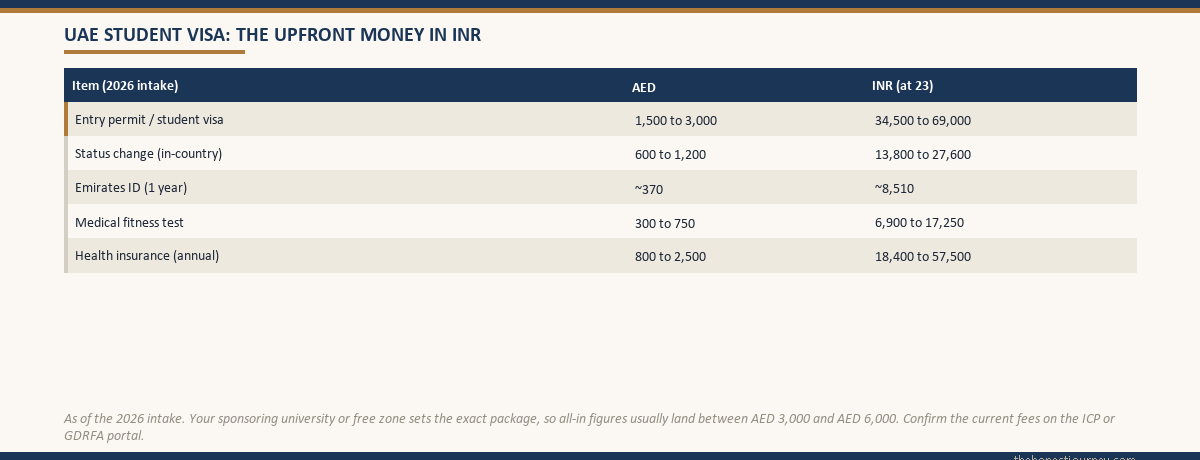
Note what is not here. Your tuition is paid to the university and is not part of the visa cost, and the full rupee picture for tuition and city living sits in the study in UAE guide. On this page, money appears only as the fees and the proof you show your sponsor.
The funds-proof requirement, and why it is different here
This is where the UAE genuinely differs from the West, and where a lot of Indian students overworry. There is no consular officer demanding a fixed lakhs-level bank balance to grant the visa, the way an Australian or Canadian officer would. The financial proof is shown to the sponsoring institution, not to an immigration officer, and it is mostly about confirming you can pay tuition and support yourself while you study.
In practice your sponsor may ask for recent bank statements, a parent sponsor letter, or evidence of paid tuition before they process the entry permit. There is no single published funds figure the way Germany or Sweden publish a monthly maintenance number, because the institution sets its own comfort level. What matters is that the money to cover fees and living is real and documented. The broader principles of presenting funds proof, seasoning, source, and a clean paper trail, are in the proof of funds for a student visa guide, and they apply here even without a fixed number.
Because there is no lump-sum bar for the visa itself, the practical question shifts to how much cash you should physically arrive with for the first few weeks of setup, deposits, and the visa fees. I have written that out in the how much money to carry abroad guide. The absence of a visa funds bar does not mean the UAE is cheap, so if budget is your main lever, weigh it against the cheapest country to study abroad comparison before you commit.
The four-step process, end to end
Here is how the institution-sponsored residence visa actually runs, in the order it happens. The step flow below maps the same four stages at a glance.
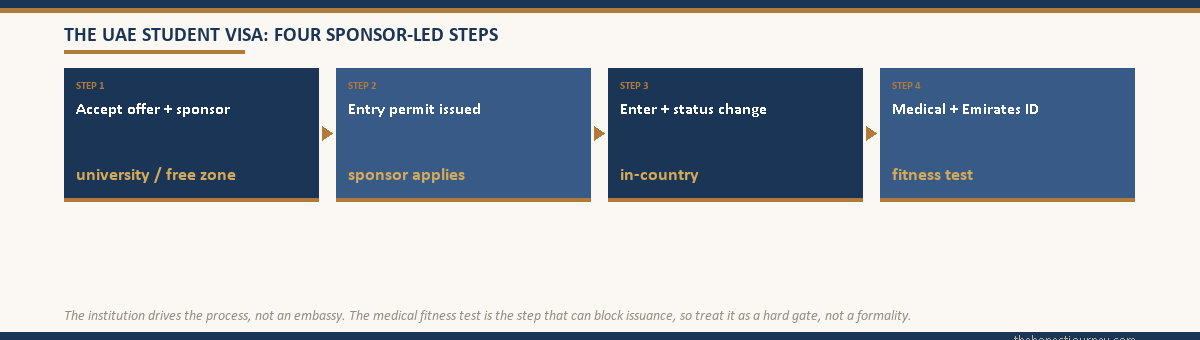
Step one: accept your offer and get sponsored. You accept an admission offer from an accredited UAE university or a college inside an academic free zone, pay the tuition deposit, and submit your passport copy, photos, and any financial documents they ask for. At this point the institution becomes your sponsor, and they, not you, drive the government paperwork. Confirm early that your institution sponsors student visas directly, because a few smaller providers route it differently.
Step two: entry permit issued. Your sponsor applies through the ICP or GDRFA for your entry permit, the document that lets you legally enter the UAE for study. It typically takes a few working days to a couple of weeks. If you are in India, you travel on this entry permit once it is issued. If you are already inside the UAE, you move to the next step without leaving.
Step three: enter and change status. You arrive on the entry permit, and your status is then changed from entry permit to residence from inside the country. Your sponsor handles the submission, but you must be physically present, because the next step needs you in the room.
Step four: medical fitness test and Emirates ID. You complete a mandatory medical fitness test at a government-approved centre and enrol for your Emirates ID with fingerprints and a photo. Once the medical clears and the ID is processed, the residence visa is stamped or linked to your Emirates ID, and you are a legal resident student. This final stage usually runs a week or two.
The mandatory medical fitness test, Emirates ID, and documents
Two in-country steps decide whether your residence visa actually issues, and both catch students who assume the paperwork is purely administrative. The medical fitness test is compulsory and must be done at a government-approved health centre, a DHA centre in Dubai, an ICP-linked centre in Abu Dhabi, or a Ministry of Health centre elsewhere. It typically includes blood tests and a chest X-ray to screen for tuberculosis and certain communicable diseases. This is not a formality. A flagged screening can delay or block your residence visa, the single honest risk in an otherwise smooth process. As of the 2026 intake the test costs roughly AED 310 to AED 700 depending on the emirate, confirm the current figure on the official portal or through your sponsor.
The Emirates ID is your national identity card and primary proof of residency, and enrolment involves fingerprints and a photo, with a fee of around AED 370 as of the 2026 intake. You will use it for everything from opening a bank account to signing a lease. Beyond the medical and the ID, the documents that carry weight are your admission letter, a passport with adequate validity, photos to the required specification, and the financial or sponsor documents your institution requests. Your sponsor gives you the exact checklist, which can vary by emirate, so follow theirs. What a student medical test screens for, and how to prepare, is in the medical test for a student visa guide.
Faz's ruleThe medical fitness test is the one gate that can actually stop your visa. Everything else is paperwork your sponsor handles, this is the part that depends on you.
In the UAE the process is fast and institution-driven, so the only real point of failure most students face is the medical screening. Do not treat it as a rubber stamp, and do not leave it to the last week. If there is anything in your health history you are unsure about, get honest advice before you fly, not after.
Processing time and the honest issuance reality
The UAE student visa is one of the faster routes an Indian student can take. From entry permit application to a stamped residence visa, the whole thing commonly runs about four to six weeks, with the entry permit often issued in a few working days to two weeks, the medical taking a few days, and the Emirates ID and residence stamp another week or two. Against the multi-month waits and refusal anxiety of some Western routes, this is genuinely quick, and that speed is a real UAE advantage. Confirm current timelines on the official portal, because they shift with volume around intakes.
Now the honest part most promotional guides skip. Because the visa is sponsored by the institution rather than adjudicated by a consular officer weighing your intent, outright refusals of the visa itself are far less common than in the Canada or Australia systems. Two things actually derail a UAE student visa: first, the medical fitness test flagging a screened condition, and second, your sponsoring institution’s own compliance, because if the provider is not properly accredited or your file is incomplete, the government paperwork stalls. Pick an accredited institution, complete every document your sponsor asks for, and clear the medical, and issuance is usually a formality.
The other quiet reality is renewal. This is an annual visa, so you repeat the medical, the Emirates ID, and the insurance every year for the length of your degree. Budget for that recurring cost from the start rather than treating year one as the whole bill.
Work rights and the Golden Visa note
Work rights on a UAE student visa are more restricted than in Europe, and you should plan around that honestly. Students can take part-time work, typically requiring a permit arranged through the relevant authority or free zone, and the rules differ between the mainland and the free zones where many universities sit. This is not a route where a student wage meaningfully offsets tuition, so do not build your budget on it. Treat any work as experience and pocket money, and confirm the current rules for your emirate and institution on the official portal.
The bigger prize for strong students is the Golden Visa. The UAE government explicitly issues the ten-year Golden Visa to outstanding students, and the criteria typically reward high academic standing, for example a strong cumulative GPA and, in some pathways, study at a highly ranked university. This is a long-term residency route, separate from the annual student visa, and it belongs to the wider decision rather than this visa page, so I will only flag it and point you to the study in UAE guide.
Arrival and status change: finalising the visa when you land
One last thing people miss. The entry permit is not your residence visa. It only lets you enter, and the actual residence visa is finalised inside the UAE after your status change, medical, and Emirates ID are complete. So plan your arrival with a buffer of a few weeks, because your first job on landing is not classes, it is completing the in-country steps. Keep your admission letter, passport, entry permit, and financial documents in your hand luggage, and follow your sponsor’s timetable for the medical and ID appointments, because missing those windows is the most avoidable delay in the process.
The honest take on the UAE student visa
The UAE student visa is one of the least stressful study routes an Indian student can take, and I say that as someone allergic to promotional framing. There is no consular interview, no fixed lakhs-level funds bar shown to an officer, and no months-long refusal anxiety. Your institution sponsors you, drives the paperwork, and the process is fast. That is a genuine, structural advantage, not marketing.
The catch is precisely that it is institution-driven, so your choice of an accredited, well-organised sponsor matters more than anything you personally submit, and the one gate that depends on you, the medical fitness test, is the part to take seriously. Budget for the annual renewal, not just year one, confirm every fee on the official ICP or GDRFA portal because they move between intakes, and clear the medical without drama. Do that, and the UAE residence visa becomes a process your university executes for you rather than a hurdle you sweat over.
If the UAE appeals for being close to home and lower cost, Malaysia is the other Asian route in that bracket. The Student Pass steps and fees sit in the Malaysia student visa too.
FAQ
How much does a UAE student visa cost for Indian students?
As of the 2026 intake, the all-in cost typically runs AED 3,000 to AED 6,000, roughly ₹69,000 to ₹1,38,000 at ₹23 per AED, covering the entry permit, status change, medical fitness test, Emirates ID, and health insurance. Some universities quote a higher packaged figure that folds in twelve months of insurance and administration. Ask your sponsor for the itemised list and confirm current fees on the official ICP or GDRFA portal, as they change between intakes.
How much proof of funds do I need for a UAE student visa?
There is no fixed funds figure shown to a visa officer, because the UAE student visa is sponsored by your institution, not adjudicated at a consulate. Financial proof, usually bank statements or a parent sponsor letter, goes to the sponsoring university to confirm you can pay tuition and support yourself. As of the 2026 intake, confirm your specific institution’s requirement directly with them, and see the proof of funds guide for how to present a clean, well-sourced paper trail.
Is there a medical test for the UAE student visa?
Yes, and it is mandatory. After you enter on the entry permit, you must complete a medical fitness test at a government-approved centre, typically including blood tests and a chest X-ray to screen for tuberculosis and certain communicable diseases. As of the 2026 intake it costs roughly AED 310 to AED 700 depending on the emirate. A flagged screening can delay or block your residence visa, so it is the one step that genuinely depends on you.
How long does a UAE student visa take to process?
The UAE route is fast. From entry permit application to a stamped residence visa, the whole process commonly runs about four to six weeks. The entry permit itself is often issued within a few working days to two weeks, the medical takes a few days, and the Emirates ID and residence stamp add another week or two. Timelines shift with intake volume, so confirm current estimates on the official ICP or GDRFA portal before you plan your travel.
Who sponsors a UAE student visa?
Your accredited university or the academic free zone your college sits inside sponsors it, for example Dubai International Academic City. The UAE government is explicit that a student stays under the sponsorship of the accredited university or college, or a resident parent. There is no separate embassy application for the residence visa. This is why choosing a properly accredited institution matters, because an unaccredited or disorganised sponsor is the main thing that stalls the government paperwork.
Can I work on a UAE student visa?
Part-time work is possible but restricted, and it usually requires a permit arranged through the relevant authority or free zone, with rules that differ between the mainland and the free zones where many universities sit. A student wage will not meaningfully offset tuition, so treat any work as experience and pocket money rather than a funding plan. Confirm the current work rules for your specific emirate and institution on the official portal, because they vary and change.
Can students get the UAE Golden Visa?
Yes. The UAE government issues the ten-year Golden Visa to outstanding students, a long-term residency route separate from the annual student visa. The criteria typically reward high academic standing, for example a strong cumulative GPA and, in some pathways, study at a highly ranked university. It is not automatic, and it belongs to the wider study decision rather than the standard visa process. If long-stay residency is your goal, factor it in early and confirm current eligibility on the official portal.
Do I apply for the UAE student visa at an embassy in India?
No, and this is the biggest misconception. There is no consular student visa queue to book in India. Your institution applies for your entry permit through the ICP or GDRFA once you accept your offer, and you travel on that entry permit. The actual residence visa is then finalised inside the UAE after your medical fitness test and Emirates ID enrolment. So the process is driven by your university, with the in-country steps completed after you land.
Faz · The Honest Journey · 2026