Short answer. For Indian students, the “Malaysia student visa” is actually a Student Pass, and your institution applies for it on your behalf through EMGS (Education Malaysia Global Services) before you travel. EMGS issues a Visa Approval Letter, or VAL, and the Student Pass itself is endorsed in your passport after you arrive, once you pass a medical screening.
As of the 2026 intake, budget roughly RM 1,500 to 2,500 all in for EMGS processing, the pass, the i-Kad, medical and insurance, plus a nominal single-entry visa. Confirm every figure on the official EMGS portal.
A cousin of a family friend went to Kuala Lumpur two years ago, and I remember her father calling me in a mild panic because he could not find where to “apply for the visa”. He kept looking for a consulate appointment, the way you would for the UK or Australia, and there was none to book. It took me a while to explain that in Malaysia the university does the heavy lifting through a body called EMGS, and that the family’s job was mostly to send clean documents and pay fees on time. Once he understood that the process is institution-led, not applicant-led, the whole thing stopped feeling like a wall and started feeling like a checklist.
This post stays strictly in the visa lane: what a Student Pass is, how EMGS runs it, the VAL then endorsement route, fees in rupees, funds proof, the step order, the medical, processing reality, work rights, and the honest take. Malaysia does not yet have a full study-in decision guide on this site, so if you are still weighing whether it belongs on your shortlist, the wider money comparison sits in the cheapest country to study abroad guide. Here we only cover getting the pass.
First, it is a Student Pass through EMGS, not a visa you apply for
People type “Malaysia student visa” out of habit, and that is fine as a search phrase, but the document you actually hold is a Student Pass, endorsed in your passport, giving you the legal right to study and stay for the length of your course. There is a separate single-entry visa for Indian nationals too, but that is a small, nominal thing that rides along with the main process. The Student Pass is the real object.
The part that surprises Indian families most is who applies. You do not walk into a consulate and lodge a file yourself. Your Malaysian institution, through EMGS, submits the Student Pass application for you before you leave India. EMGS is the government-linked one-stop agency that handles international student passes for most Malaysian institutions. Everything official, fees, the document list, your application status, lives on the EMGS portal at educationmalaysia.gov.my, and the immigration rules behind it sit with the Malaysian Immigration Department at imi.gov.my. Treat those two as your only source of truth. As of the 2026 intake, every number here is a planning figure you should confirm on the official portal the week you apply.
So the mental model is simple. You supply clean documents and prompt payments, and your institution plus EMGS is the engine. Get that straight early and the rest calms down.
The VAL first, then the Student Pass after you land
The route runs in two clear halves, and mixing them up is where confusion starts.
The first half happens while you are still in India. Your institution submits the Student Pass application to EMGS with your offer letter, passport, photos, health declaration and fees. EMGS processes it and, when approved in principle, issues a Visa Approval Letter, the VAL, delivered electronically as an eVAL. It confirms that Malaysia has approved your Student Pass in principle and that you may travel. With the VAL in hand, Indian nationals then obtain a single-entry visa to enter the country, a nominal formality applied for through the official eVisa channel.
The second half happens after you arrive. The VAL is not the Student Pass. Once you land, you complete a post-arrival medical screening at an EMGS panel clinic, submit your passport through your institution, and only then is the Student Pass endorsed into your passport. You also collect your i-Kad, the international-student identity card. So the sequence is VAL in India, travel, medical on arrival, then endorsement. Do not book a flight the day your VAL arrives without leaving room for these arrival steps.
Faz's ruleThe VAL lets you fly. It is not the Student Pass. The pass is only endorsed after you land and clear the medical, so plan your first week in Malaysia around that, not around the VAL date.
The mistake I see is treating the VAL like a finished visa. It is really a boarding pass for the process, not the end of it. Your Student Pass gets stamped only after the arrival medical, so keep your passport and papers handy in that first week and let your institution guide the endorsement.
The Student Pass fees, in INR
Let me put the money on the table first. These are the EMGS and immigration fees tied to your pass, not your tuition or living costs. The planning rate through this article is ₹19 per Malaysian ringgit. It moves, so re-check it the week you transfer money. EMGS also bundles a mandatory medical insurance into the process, which is why the all-in number is higher than the headline pass fee.
| Item (Student Pass via EMGS) | RM | INR (at 19) |
|---|---|---|
| EMGS processing, pass and insurance (all in, typical) | ~1,500 to 2,500 | ~28,500 to 47,500 |
| Student Pass endorsement (within the above) | ~60 | ~1,140 |
| i-Kad, student identity card (within the above) | ~50 | ~950 |
| Post-arrival medical screening | ~150 to 350 | ~2,850 to 6,650 |
| Single-entry visa (Indian nationals) | ~15 to 20 | ~285 to 380 |
The honest read of this table: there is no single big scary fee here, which is one of Malaysia’s genuine attractions. The all-in EMGS charge, roughly RM 1,500 to 2,500, already folds in the processing, the pass endorsement, the i-Kad and the mandatory insurance, so treat that band as your realistic first-year visa budget. The medical is paid to a panel clinic separately, and the single-entry visa is almost a rounding error. The body image below lays the same items side by side. Confirm the exact bands on the official EMGS portal, as they shift by level and nationality.
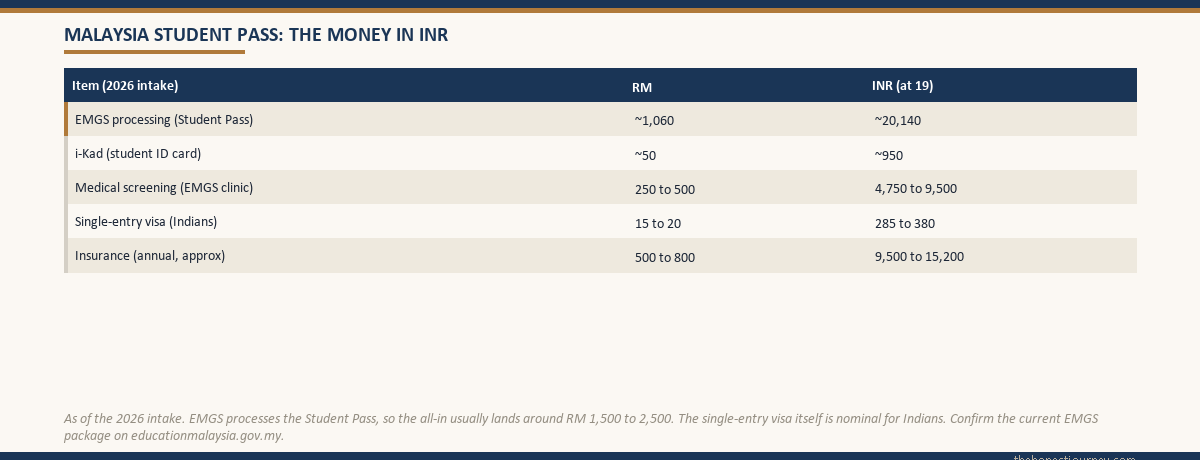
One line not in this table is the personal bond. Your institution lodges a refundable security bond with immigration, an amount fixed by nationality, returned when you leave and cancel your pass correctly. It is your money held, not a fee you lose, but budget for it as an upfront outlay all the same.
Proof of funds: fees plus living, shown honestly
Malaysia’s funds expectation is gentler than the Western routes, but it still exists. The principle is the same everywhere: show that you can genuinely pay for your studies and your living without needing to work illegally.
In practice that means being able to evidence your first-year tuition plus living costs. Living costs in Malaysia are famously low by international standards, which is exactly why it lands on so many Indian shortlists, but you still need bank statements or a sponsor letter showing the money is there and makes sense. As of the 2026 intake, EMGS and your institution will tell you the exact statement period and amount they want to see, so confirm that on the official portal. The general principles of presenting a clean funds file, seasoned balances and a clear source, sit in the proof of funds for a student visa guide. A balance that appeared last week, with no explanation, reads as borrowed for show, so build the story before you build the balance.
For the separate question of how much cash and card balance to carry for your first weeks on the ground, the practical breakdown is in the how much money to carry abroad guide.
The four-step process, end to end
Here is how the Student Pass actually runs, in the order it happens. The step flow below maps the same four stages, and notice how the first two happen in India and the last two in Malaysia.
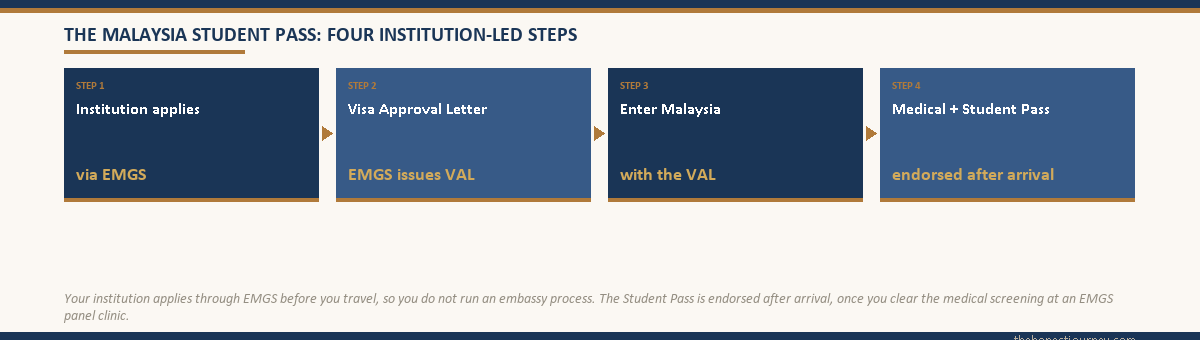
Step one: the institution applies through EMGS. You accept your offer, pay any deposit required, and hand over your documents: passport copy, photos to specification, offer letter and a health declaration. Your institution then lodges the Student Pass application with EMGS. Your job here is speed and accuracy, since a wrong photo size or a missing page is the classic reason a file stalls at the start.
Step two: the VAL is issued. EMGS processes the application and, on approval in principle, issues the Visa Approval Letter electronically. Once you have the eVAL, Indian nationals apply for the single-entry visa through the official eVisa channel to enter the country. This is the point at which you can safely book travel, not before.
Step three: enter Malaysia. You travel on your single-entry visa with your VAL, passport and offer letter in hand luggage, not checked baggage. At the airport you present these and are admitted as a student who is about to have their pass endorsed.
Step four: medical screening and Student Pass endorsement. After arrival you complete the medical screening at an EMGS panel clinic, your institution submits your passport, and the Student Pass is endorsed. You collect your i-Kad. Only now is the process complete and your status secured for the course.
The arrival medical, the i-Kad, and the documents that matter
Two arrival steps catch students who assume the VAL was the finish line. The first is the medical screening. The one that counts for endorsement is done after you arrive, at an EMGS panel clinic, not just your pre-departure declaration in India. It is a standard check, paid to the clinic directly, and it is a hard gate before your Student Pass is endorsed. The broader picture of what these student medicals check, and how to prepare, is in the medical test for a student visa guide.
The second is the i-Kad, your official international-student identity card, issued through EMGS after endorsement. Carry it, because it is your everyday proof of legal student status. Beyond those, the documents that carry weight are your offer letter, valid passport, correctly sized photographs, funds evidence, and the health declaration. Follow the exact checklist EMGS and your institution give you, because it updates between intakes and a single format error can delay the VAL by weeks.
Processing time and the honest reality
Here is where I have to be straight with you. EMGS processing times vary, sometimes a lot, and the biggest variable is not EMGS itself but how clean and prompt the paperwork is between you and your institution. A complete, correct file can move through in a handful of weeks. An incomplete one, missing a document or with a photo that fails specification, can drag on while it bounces back and forth. So do not hope for speed. Remove every reason for delay from your side.
The practical advice is the same as for every route: start early. Submit your documents to your institution the moment you accept your offer, well ahead of the intake, so that even if something bounces there is time to fix it before term begins. Chase your institution’s international office politely for status, and check the EMGS portal, which lets you track your application stage directly.
None of this is a character test the way Western refusal reasons can feel. Malaysia’s route is administrative rather than adversarial. But administrative processes punish sloppiness quietly, through delay, so treat every document as if a small error could cost you a month.
Work rights while you study
Malaysia does allow student work, but the rules are tighter than in the West, so read this carefully. As of the 2026 intake, Student Pass holders may work part-time up to 20 hours per week, and only during semester breaks and holidays, not during regular teaching weeks. That is the key restriction to absorb: this is holiday-and-break work, not term-time work. There are also conditions on the type of workplace and approval requirements, so confirm the current rules on the official portal before you count on any income.
The honest framing is the one I give for every country. Student work here is a small supplement, not a way to fund your degree, and the break-only limit makes that doubly true. Treat it as pocket-money breathing room, never as the plan that closes a funding gap. The wider view on how much part-time work realistically contributes is in the part-time work while studying abroad guide.
After you graduate
Malaysia does not offer the long, generous post-study work runway that Canada or the UK dangle, and you should factor that in honestly. Your Student Pass is tied to your studies, and once your course ends the pass is meant to be cancelled, which is also when your security bond is returned. There are graduate and professional pathways for those who find sponsored employment, but they are separate processes with their own rules, not an automatic extension of your student status. If a long post-study stay is central to your plan, weigh Malaysia against the routes that build that runway in before you commit.
Faz's ruleMalaysia is institution-led, so your outcome depends on your file being flawless and your international office being responsive. Choose an institution experienced with EMGS and submit clean documents the moment you accept your offer.
The single lever you fully control here is the quality of your paperwork. EMGS timelines vary, but a complete, correctly formatted file rarely gets stuck. Pick a university that handles international students well, send everything early, and be the applicant whose file never causes a hold-up.
The honest take on the Malaysia Student Pass
Malaysia’s real advantage is twofold. It is genuinely cheaper than the West, on the visa side and on living, and the process is institution-led, which means you are not carrying the whole application on your own shoulders the way you would for a self-lodged consular visa. For a student who wants an English-medium, internationally recognised degree without a Western price tag, that is a legitimate reason it sits on so many Indian shortlists.
The honest caveat is the flip side of institution-led. Because EMGS timelines vary and your institution is in the loop at every step, your outcome depends heavily on prompt, clean paperwork and a responsive international office. Choose an institution experienced with EMGS, submit a flawless file early, and keep your funds story clean. Confirm every fee and rule on the live EMGS portal, because they shift between intakes. Do that, and the Student Pass becomes a process you execute smoothly rather than a bureaucratic maze.
FAQ
How much does a Malaysia Student Pass cost through EMGS for Indian students?
As of the 2026 intake, budget roughly RM 1,500 to 2,500 all in, about ₹28,500 to 47,500 at ₹19 per ringgit. That band already covers EMGS processing, the Student Pass endorsement, the i-Kad and the mandatory insurance. On top of it you pay a small post-arrival medical screening and a nominal single-entry visa. Confirm the exact figures on the official EMGS portal, as they vary by level and nationality.
What is the Visa Approval Letter, or VAL, for Malaysia?
The VAL is the Visa Approval Letter that EMGS issues once your Student Pass is approved in principle, delivered electronically as an eVAL. It confirms Malaysia has cleared your pass and that you may travel. With the VAL, Indian nationals then obtain a single-entry visa to enter the country. Importantly, the VAL is not the Student Pass itself, which is only endorsed after you arrive and clear the medical.
Do I need a medical test for a Malaysia Student Pass?
Yes. There is a pre-arrival health declaration, and then the screening that counts for endorsement is done after you arrive, at an EMGS panel clinic, not your family doctor. It is a standard health screening paid directly to the clinic, roughly RM 150 to 350 as of the 2026 intake. Your Student Pass is only endorsed once you clear it, so treat it as a hard arrival step and confirm the current requirement on the official portal.
How long does EMGS take to process a Malaysia Student Pass?
EMGS timelines vary, and the biggest factor is how clean and prompt your paperwork is. A complete, correct file can clear in a handful of weeks, while a file missing a document or with a wrong photo size can drag on much longer. Apply the moment you accept your offer, well before the intake, track your status on the EMGS portal, and confirm current timelines there.
Can I work on a Malaysia Student Pass?
Yes, but within tight limits. As of the 2026 intake, Student Pass holders may work part-time up to 20 hours per week, and only during semester breaks and holidays, not during regular teaching weeks. There are also conditions on the type of workplace and approval requirements. Treat it as a small supplement, never as a way to fund your degree, and confirm the current rules on the official portal before relying on any income.
Is a Malaysia Student Pass the same as a student visa?
Not quite. People search “Malaysia student visa”, but the document you actually hold is a Student Pass, endorsed in your passport for the length of your course. There is a separate single-entry visa for Indian nationals, but that is a small, nominal entry formality that rides along with the process. The Student Pass, applied for by your institution through EMGS and endorsed after arrival, is the real object that gives you the right to study and stay.
Who applies for the Malaysia Student Pass, me or my university?
Your university applies, through EMGS, on your behalf, before you travel. This is the biggest difference from Western routes: you do not book a consular appointment and lodge a file yourself. Your job is to supply clean documents, passport, photos, offer letter, funds evidence and a health declaration, and to pay fees on time. That is why choosing an experienced institution matters so much.
What is the i-Kad and do I need it?
The i-Kad is your official international-student identity card in Malaysia, issued through EMGS after your Student Pass is endorsed. It is your everyday proof of legal student status, and you will be asked to show it, so carry it at all times once issued. The fee is small, around RM 50, and is generally folded into the all-in EMGS charge.
Faz · The Honest Journey · 2026