Short answer. A medical test for a student visa is mandatory when your course runs longer than 6 months, and must be done by a government-approved panel physician listed by the destination country. It usually covers a chest X-ray for tuberculosis, basic blood work, and a physical exam.
In India it costs roughly ₹2,000 to ₹7,500 depending on the country, and the report stays valid for 3 to 12 months.
The first time a student asked me which clinic to book for their visa medical, they had already paid a “premium fast-track” agency ₹12,000 for an appointment they could have made themselves for the cost of the test alone. The agency did not lie to them. It just let them assume the medical was complicated and gatekept, when in reality it is one of the more straightforward steps in the whole visa process.
This post explains the medical test for a student visa honestly: when it is actually required, what is tested, what it costs in India by country, how long it stays valid, and how to find the official panel physician yourself so you never pay a middleman to book a government-approved doctor.
A medical test for a student visa is required mainly when your course is longer than 6 months. It usually includes a chest X-ray to screen for tuberculosis, basic blood tests, and a general physical by a government-approved panel physician. In India it costs roughly ₹2,000 to 7,500 depending on the country, stays valid for 3 to 12 months, and must be done at an officially listed clinic, never a random hospital.
For the full guide, read Studying Abroad From India: Cost and Funding Guide.
When a medical test for a student visa is required
The single rule that decides whether you need a medical exam at all is course duration. Almost every destination country sets the trigger at a stay longer than 6 months. If your program runs under 6 months, you can usually skip the full panel medical entirely, though a tuberculosis screening may still apply depending on where you are coming from.
India sits on the list of high tuberculosis incidence countries for nearly every major destination, which is the real reason Indian students get pulled into the medical requirement so consistently. It is not personal and it is not a comment on your health. It is a public health screening that applies to everyone arriving from a high-incidence country for a longer stay.
Here is how the trigger works across the main destinations:
| Country | When the medical is required | Who decides |
|---|---|---|
| Canada | Stay over 6 months (Immigration Medical Exam) | IRCC, done by a Panel Physician |
| United Kingdom | Stay over 6 months (TB test certificate for India) | UKVI, done at an approved clinic |
| Australia | Most student visas (health examination) | Home Affairs, done by a Panel Physician |
| New Zealand | Stay over 6 months (chest X-ray) or over 12 months (full medical) | Immigration NZ panel |
| United States | No pre-visa medical for F-1; vaccination records needed by the university | University requirement, not visa |
The United States is the useful outlier here. There is no government-mandated medical exam to get an F-1 student visa. What you will face instead is an immunization and health form that your university requires before you can register for classes. So if you are headed to the US, do not pay anyone for a “US visa medical.” It does not exist as a visa step.
Faz's ruleThe 6-month rule decides everything. Under 6 months and you usually skip the full medical. Over 6 months and India's high TB incidence means you almost always need it.
Check your exact course duration on your admission letter before you book anything. A 5-month certificate course and a 2-year master’s are treated completely differently. Booking a full panel medical for a short course wastes money you do not need to spend.
What the medical test actually checks
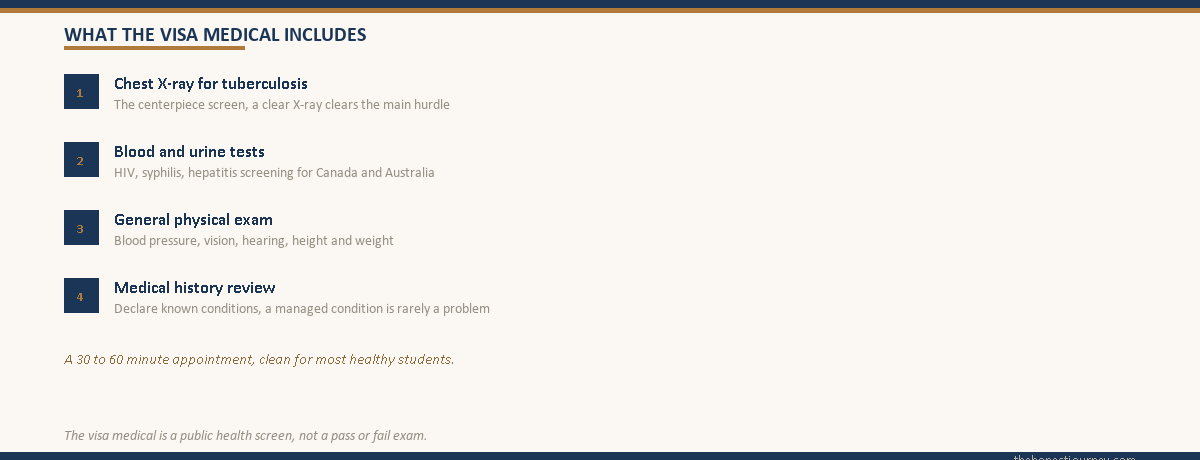
People imagine the visa medical as some intensive examination they could fail. For the overwhelming majority of healthy students, it is a 30 to 60 minute appointment that produces a clean certificate. Here is what it genuinely covers.
Chest X-ray for tuberculosis. This is the centerpiece of the whole exercise and the reason the requirement exists. The clinic takes a chest radiograph to screen for active TB. If the X-ray is clear, you are done with the main hurdle. If it shows anything, you may be asked for a sputum test or further evaluation, which is uncommon but not rare. Pregnant applicants are handled differently and should tell the clinic in advance, since X-ray protocols change.
Blood and urine tests. Depending on the country, the panel runs basic bloodwork. For Canada and Australia this commonly includes an HIV test and sometimes syphilis and hepatitis screening, plus a urinalysis. The UK TB certificate route is narrower and focuses on the chest X-ray, not a full blood panel.
General physical examination. The panel physician checks height, weight, blood pressure, vision, hearing, and does a routine physical. They review your medical history and any existing conditions. This is the part that feels like an ordinary doctor visit, because it essentially is one.
What it does not check, despite the anxiety I hear: it is not an intelligence or fitness test, there is no trick to it, and a common cold or a treated past illness does not disqualify you. The screening exists to catch active communicable disease and to flag conditions that might place an excessive demand on the destination country’s health system, which for a young student is almost never a concern.
What the visa medical costs in India
This is where the agency markup lives, so it is worth seeing the real numbers. The fee you pay is set by the panel clinic and varies by city and country protocol. None of the numbers below should come with an “appointment booking fee” attached, because you book the clinic directly.
| Country | Typical cost in India (Rs) | What it covers |
|---|---|---|
| United Kingdom (TB certificate) | 2,000 to 3,500 | Chest X-ray plus certificate |
| Canada (IME) | 4,500 to 6,500 | X-ray, blood, urine, physical |
| Australia | 5,000 to 7,500 | X-ray, blood, physical, eMedical upload |
| New Zealand | 3,000 to 6,000 | Chest X-ray, full medical if over 12 months |
So the entire medical, even at the top end, runs about ₹7,500. If a service is charging you ₹15,000 to 20,000 and calling most of it a facilitation or fast-track fee, you are paying for something the government provides through its own approved clinic at the listed rate. The clinic is the same. The doctor is the same. The certificate is the same.
One genuine caveat: these are out-of-pocket costs that sit outside your education loan and outside your proof of funds for a student visa calculation. They are small relative to tuition, but budget for them as part of your pre-departure spend so they do not surprise you. The same goes for biometrics fees and the visa fee itself.
Faz's ruleThe medical fee is fixed by the panel clinic, not negotiable and not something a middleman can fast-track. Pay the clinic directly.
I have watched students pay double the real cost because an agency wrapped a ₹5,000 test in a ₹15,000 package. The panel doctor is government-approved and books directly. There is no faster lane to buy.
How to find the official panel physician (do not trust search results)
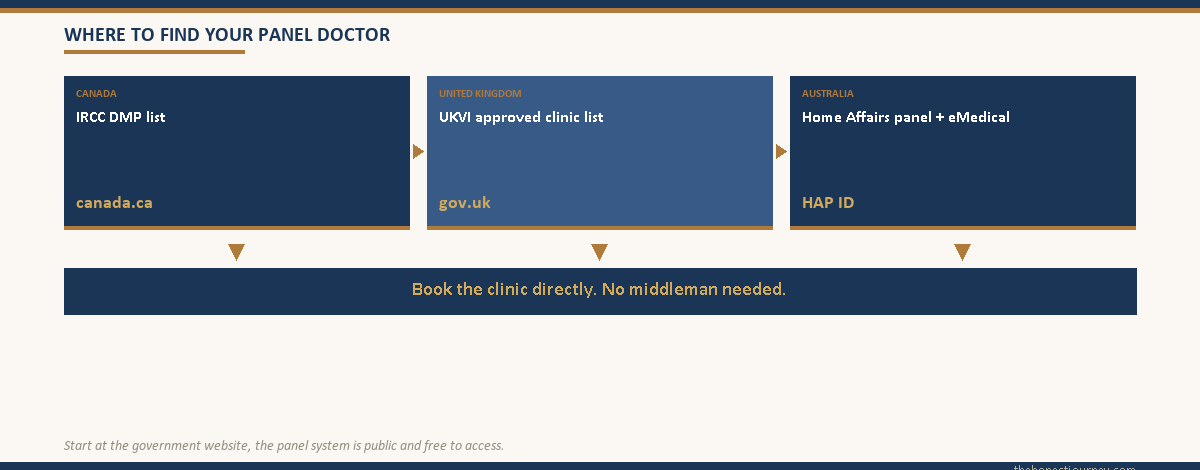
This is the most important practical section, because the clinics that rank highest when you search are often agencies that resell appointments, not the official panel itself. Every destination country publishes its own approved list. Use only these.
Canada. IRCC requires the Immigration Medical Exam to be done by a doctor on their official Panel Physician list, often called a Designated Medical Practitioner or DMP. You find them through the IRCC panel physician search on the official Government of Canada immigration site at canada.ca. A medical done by any non-panel doctor will not be accepted, no matter how reputable the hospital is otherwise.
United Kingdom. For the UK you need a TB test certificate from a clinic approved by UKVI in your country. The list of approved clinics for India is published on the official UK government TB testing page at gov.uk/tb-test-visa. Only certificates from these specific clinics are valid for your visa application.
Australia. Australia uses panel clinics and an electronic system called eMedical. You arrange your health examination through the panel physicians listed on the Department of Home Affairs site at immi.homeaffairs.gov.au. Many applicants receive a Health Assessment ID called a HAP ID that the panel clinic uses to upload your results directly into the system.
The rule across all three is identical. Start at the government website, find the official list, pick a clinic near you from that list, and book directly with the clinic. You never need an intermediary to access a panel physician, because the entire point of the panel system is that the government has already vetted and listed them publicly.
How long the medical stays valid and timing it right
A visa medical is not valid forever, which means doing it at the wrong time can force you to repeat it. The general validity is 12 months for most full immigration medicals, including Canada’s IME and Australia’s health examination. The UK TB certificate is also typically valid for 6 months from the date of the X-ray, so timing matters there.
The practical sequencing question is whether to do the medical before or after you submit your visa application. The answer differs slightly by country. For Australia, you often complete the health examination after lodging the application using the HAP ID generated by the system. For Canada, students frequently do an upfront medical before applying so the results are ready in the system. For the UK, the TB certificate must be obtained before you apply, because you upload it as part of the application.
My honest advice: do not do the medical too early in the process. If your validity is 6 to 12 months and your course intake is more than a year away, an early medical can expire before you travel and you will pay for a second one. Sequence it with your visa submission window, not with the day your admission letter arrives. This is the same discipline that applies to your funds documents and your documents required for an education loan, where freshness and timing matter as much as the document itself.
Can you fail the medical, and what happens if something shows up
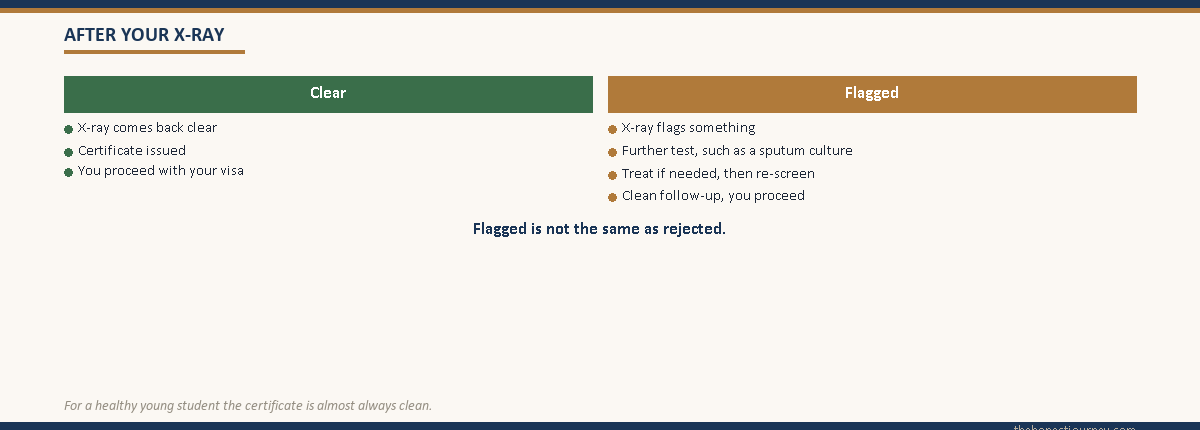
For a healthy young student, the realistic answer is no, you will not fail. The medical is a screening, not a pass or fail exam, and the vast majority of certificates come back clean. But it is worth being honest about the edge cases so you are not blindsided.
If the chest X-ray suggests possible active tuberculosis, you are not rejected on the spot. You are typically asked for further testing, such as a sputum culture, and treatment if TB is confirmed. Active TB can delay your visa until it is treated and cleared, but treatment followed by a clean follow-up generally lets you proceed. A latent or past, treated infection is handled very differently from active disease.
For HIV or other conditions detected in the bloodwork, the destination country’s rules vary. Most major study destinations do not refuse students purely on an HIV-positive result for a temporary stay, though disclosure rules apply. The genuine concern across all countries is a condition that would impose an excessive cost on the public health system, which for a student on private health cover is rarely a factor.
The thing to avoid is concealment. If you have a known condition, declare it and let the panel physician document it properly. A condition disclosed and managed is almost never a problem. A condition hidden and later discovered is a credibility problem, and credibility issues are exactly what derail visa files, which is the same lesson that runs through studying in Canada for Indian students and studying in Australia for Indian students.
Faz's ruleDeclare any known condition. A disclosed and managed condition is rarely a problem. A hidden one becomes a credibility problem, and credibility is what sinks visa files.
The panel doctor is not trying to catch you out. The system is a public health screen, not a trap. Honesty in the medical is the same honesty the rest of your visa file lives or dies on.
The honest closing take
The medical test for a student visa is one of the least scary parts of the whole journey, and that is exactly why it gets oversold by people who profit from your uncertainty. The test is fixed in price, the doctors are publicly listed by the government, the appointment is yours to book, and the result is almost always clean. The only real ways to get it wrong are to use a non-panel clinic whose certificate gets rejected, to do it so early that it expires before you travel, or to pay a middleman for access that the government provides for free.
So treat it like the simple administrative step it is. Confirm your course is over 6 months, go to the official government website for your destination, find the panel clinic nearest you, book directly, budget ₹2,000 to 7,500, and time it with your visa submission. Keep the certificate safe alongside your other visa documents. That is the entire process, and no one needs to charge you ₹15,000 to walk you through it.
Whether a medical is even required, and which panel clinic counts, depends entirely on the country. Where it fits in the wider process is covered in our student visa guides for Canada, Australia, New Zealand, the UK and Ireland.
FAQ
Is a medical test required for a student visa?
It depends on your course length and destination. For most countries, a medical or tuberculosis screening is required when your stay exceeds 6 months, which covers almost every degree program. Because India is a high tuberculosis incidence country, Indian students are very commonly required to do at least a chest X-ray. The United States is the main exception, with no government medical for an F-1 visa, only university immunization requirements. Always confirm the rule on your destination’s official immigration website.
What tests are included in a student visa medical?
The core test is a chest X-ray to screen for tuberculosis. Depending on the country, the panel also runs blood tests, which may include HIV, syphilis, and hepatitis screening, plus a urine test and a general physical covering blood pressure, vision, hearing, height, and weight. The panel physician reviews your medical history too. The UK TB certificate route is narrower and centers on the chest X-ray, while Canada and Australia run the fuller panel.
How much does a student visa medical cost in India?
The cost ranges from roughly ₹2,000 to 7,500 depending on the country. A UK TB certificate is the cheapest at around ₹2,000 to 3,500, the Canadian Immigration Medical Exam runs about ₹4,500 to 6,500, and the Australian examination is around ₹5,000 to 7,500. These are the panel clinic fees set by the government-approved provider. You should not pay extra booking or fast-track fees, since you book the clinic directly.
How long is a student visa medical valid?
Most full immigration medicals, including Canada’s IME and Australia’s health examination, are valid for 12 months. The UK TB certificate is typically valid for 6 months from the X-ray date. Because of this, you should not do your medical too early. If your course intake is more than a year away, an early medical can expire before you travel and force you to pay for and repeat the test. Sequence it with your visa submission window.
Where do I find an official panel physician?
Always start at your destination’s official government immigration website, never a search engine ranking. Canada publishes a Panel Physician or Designated Medical Practitioner list on the IRCC site. The UK lists UKVI-approved TB testing clinics for India on gov.uk. Australia lists panel clinics on the Department of Home Affairs site and uses the eMedical system with a HAP ID. Pick a listed clinic near you and book directly. A medical done by a non-panel doctor will be rejected.
Can I fail a student visa medical?
For a healthy young student, you will almost certainly not fail. The medical is a screening, not a pass-fail exam, and most certificates come back clean. If the chest X-ray flags possible active tuberculosis, you are asked for further testing and treatment rather than rejected outright, and a clean follow-up generally lets you proceed. The main concern across countries is active communicable disease or a condition imposing excessive cost on the health system, which rarely applies to students.
Do I need a medical test for a US student visa?
No, there is no government-mandated medical exam to get an F-1 student visa for the United States. What you will need instead is an immunization and health form required by your university before you can register for classes, which usually lists required vaccinations. So do not pay any agency for a “US visa medical,” because it does not exist as a visa step. Check your university’s health services page for the exact vaccination and form requirements.
Should I do the medical before or after applying for the visa?
It varies by country. For the UK, you must obtain the TB certificate before you apply, because you upload it with the application. For Canada, students often complete an upfront medical so results are ready in the system before applying. For Australia, you frequently complete the health examination after lodging the application using a HAP ID the system generates. The safe approach is to follow your destination’s official guidance and time the medical close to your submission so it does not expire.
Faz · The Honest Journey · 2026