Short answer. Studying in Sweden as an Indian student is not free, it is not a “visa,” and the famous Swedish Institute scholarship that every blog tells you to chase does not accept Indian citizens at all.
Indians from outside the EU pay both an application fee of SEK 900 per semester and full tuition, the amount of which varies by programme and is never published as one national number, plus you must prove maintenance of at least SEK 10,656 a month for 2026 to the Swedish Migration Agency for a residence permit, not a visa. Add the often-forgotten cost of moving rupees abroad, and the honest all-in figure is far larger than the “cheap Europe” headline suggests. I checked Sweden’s own official portals for this guide so an agent cannot burn you with a number they made up.
Sweden has a clean reputation among Indian families. Safe, English-friendly at the master’s level, strong in engineering and design, and quietly assumed to be cheap or even free because it is Scandinavian and the Nordics give things away. The search results for “study in Sweden for Indian students” are almost entirely agents and lenders, and a lot of them repeat three claims that are wrong or out of date. So I sat down with the Swedish government’s own pages, the universityadmissions.se portal, the Swedish Migration Agency, and the Swedish Institute, and wrote down what they actually say.
This is the honest picture: what Sweden really costs an Indian student, the scholarship myth that needs killing, the residence-permit rules that changed in 2026, and the part nobody budgets for, which is the cost of getting your money out of India. I do not earn anything if you apply, enrol, or borrow. This is the conversation I would want before you pay a single fee.
Myth number one: Sweden is “free”
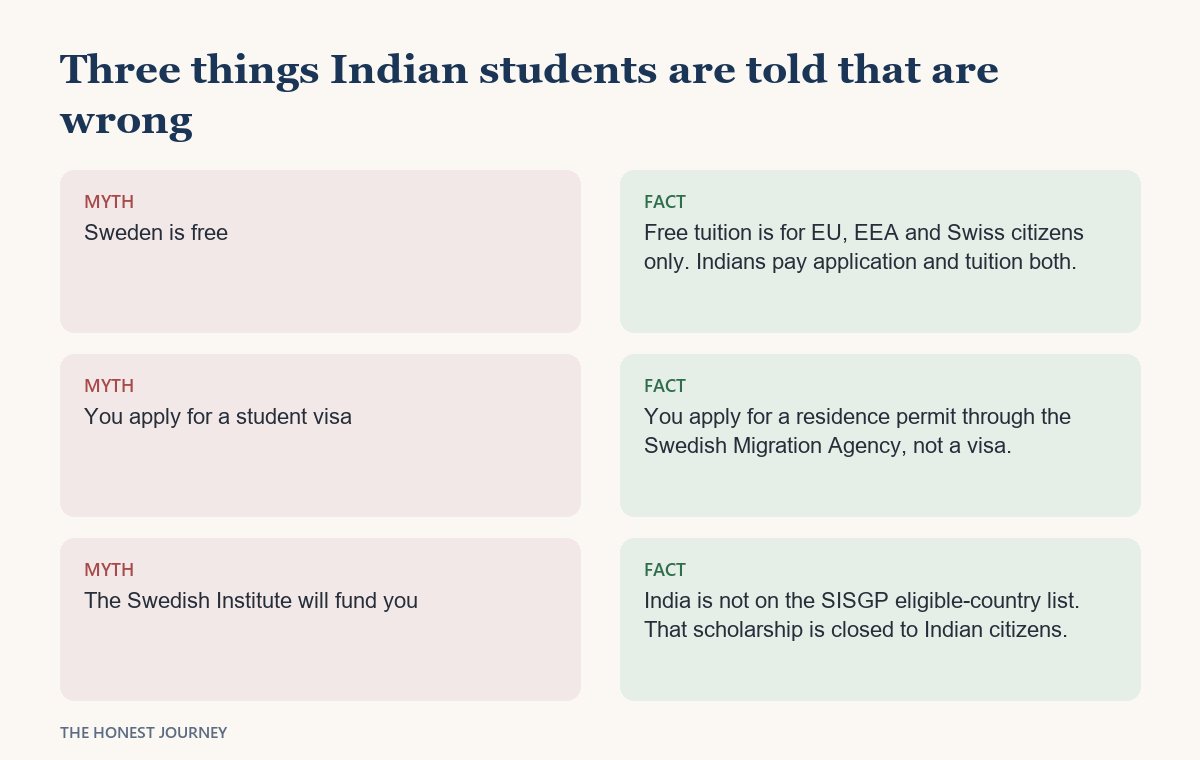
Free tuition in Sweden is real, but it is real only for citizens of the EU, the EEA, and Switzerland. Indians are none of those. The universityadmissions.se page on who pays fees is blunt about it: if you are not an EU, EEA, or Swiss citizen, you pay both an application fee and tuition fees. There is no ambiguity and no loophole based on your course or your university. As an Indian passport holder, you are a fee-paying student from the day you apply.
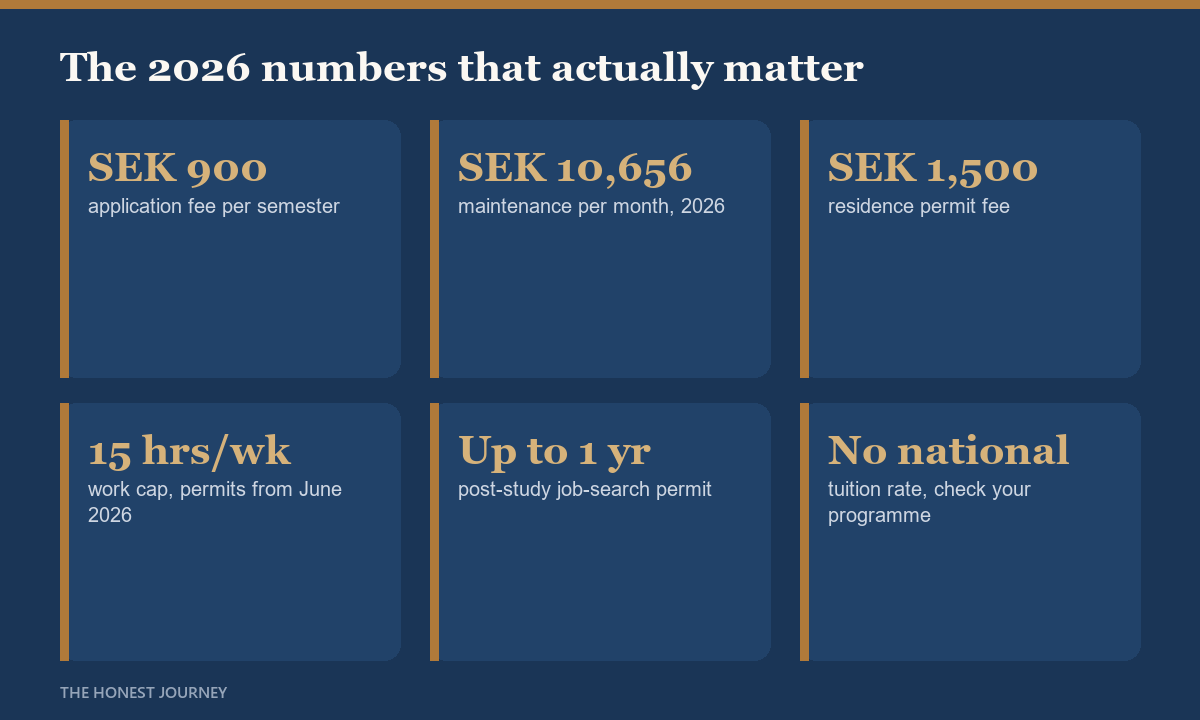
The application fee is SEK 900, and you pay it once per semester no matter how many programmes you apply to in that round. Apply to one programme or eight, it is still SEK 900 for that semester. That part is small and predictable. Tuition is where the real money sits, and this is where the official portals deliberately refuse to give you a single figure.
There is no national tuition rate in Sweden. Each university sets its own fees, and they vary by programme, with technical and medical fields usually costing more than humanities. The University of Gothenburg, for example, publishes its tuition on its own fee page rather than pointing you to a countrywide number, and every other Swedish university does the same. So when a blog confidently tells you “tuition in Sweden is X lakh per year,” treat that as a guess. The only honest source for your number is the fee page of the specific programme you are applying to. Find the programme, open the university’s official tuition page, and read the figure there. Anything else is someone filling a blank with a number that looks authoritative.
Faz's ruleGet your tuition number from the university's own programme fee page, never from a guide. Sweden publishes no national tuition rate, so any single figure you see quoted in a blog is invented to fill the gap.
The “Sweden is free” line is true for Europeans and false for you. As an Indian you pay application and tuition both, and the tuition depends entirely on which programme you pick. I will not quote a fake all-Sweden number here because there isn’t one. Open the official fee page for your exact programme and your exact intake year, and write that figure into your budget. That is the one number an agent cannot fudge once you have read it yourself.
Myth number two: it is a “visa” and the Swedish Institute will pay for you
Two corrections here, and both matter for money.
First, Sweden does not give international students a “student visa” in the way Indian families use that word. You apply for a residence permit for higher education, and you apply for it through the Swedish Migration Agency, not a consulate stamp on your passport. The distinction is not pedantic. The residence permit has its own fees, its own maintenance proof, and its own work rules, all set by Migrationsverket, and if you go looking for “Sweden student visa requirements” you will find pages that describe a process that does not formally exist under that name. The residence-permit fee is SEK 1,500 for an adult and SEK 750 for a child.
Second, and this is the single most important honest fact in this guide, the Swedish Institute Scholarships for Global Professionals, the SISGP, the scholarship that almost every Indian-targeted blog tells you to apply for, does not accept Indian citizens. The Swedish Institute publishes the list of eligible countries on its own si.se page, and India is not on it. The eligible list runs to a few dozen countries across Africa, Asia, Eastern Europe, and Latin America, and the Asian countries on it include Bangladesh, Indonesia, Malaysia, the Philippines, Thailand, and Vietnam, but not India. If you are an Indian citizen, you cannot apply for SISGP. Full stop.
I am stressing this because the SERP gets it wrong constantly. Page after page lists “Swedish Institute Scholarship” as a top funding route for Indian students, and it simply is not available to them. If you build your funding plan around SISGP, you are building it around a door that is locked to your passport. Check the eligible-country list yourself on si.se before you believe anyone who tells you otherwise.
So what scholarships can Indians actually get?
The realistic scholarship route for Indian students in Sweden is university-specific. Many Swedish universities offer their own tuition-fee reductions or scholarships for fee-paying international students, and these are open to Indians because they are run by the university, not by the Swedish Institute’s country-restricted programme. The amounts vary widely, some cover a percentage of tuition, a few cover full tuition, and the criteria differ by institution.
The honest method is the same as for tuition itself. Go to the specific university you are applying to, find its scholarships page, and read what it offers fee-paying non-EU students for your intake. Do not assume a number. A scholarship that knocks 25 percent off tuition at one university says nothing about what another offers. For a broader sense of how to hunt these down across countries, our guide to scholarships for Indian students to study abroad walks through the approach, but the Sweden-specific answer is always on the individual university’s own pages.
Treat any scholarship as a discount on a real cost, not as a reason to choose Sweden. If the funding only works because you assumed a scholarship you have not yet won, the plan is fragile.
The maintenance requirement, the number that surprises people
To get the residence permit, you have to prove to the Swedish Migration Agency that you can support yourself. For 2026 applicants the requirement is at least SEK 10,656 per month, and for 2025 applicants it was SEK 10,584 per month, so the figure ticks up each year and you should check the live number for your application year on the Migrationsverket higher-education page. Crucially, the funds must cover the entire period you are applying for. If you are applying for a full year, you have to show roughly twelve times the monthly figure, not one month of it.
There are small reductions if your housing or food is genuinely free, but for most students arriving fresh, none of that applies, and you should budget the full monthly maintenance amount. This is proof-of-funds money in the same family as the German blocked account or the UK 28-day balance rule, and the principles are identical: it must be real, it must be documented correctly, and it must be there when you apply. If you have never dealt with this before, read our guide to proof of funds for a student visa first, because the way you show the money matters as much as having it.
The maintenance figure is not a fee you lose. It is your own money that proves you can live in Sweden. But you still have to assemble it, usually from savings or a loan, and that is where the rupee cost begins.
The part nobody budgets: moving the money out of India
Here is the cost that agents and most blogs leave out entirely, and it is real money. When you send tuition or living funds from India to Sweden, you are remitting under the Reserve Bank of India’s Liberalised Remittance Scheme, the LRS, and outward education remittances attract Tax Collected at Source, TCS, under Indian tax rules.
I am deliberately not quoting you a single TCS percentage here, because the rules and thresholds have been changed in recent budgets and the exact figure depends on whether your remittance is funded by a recognised education loan, how large it is, and the rules in force for your year. What I can tell you honestly is the shape of it: education remittances funded by a loan from a recognised financial institution are treated more favourably than self-funded ones, there is a threshold below which no TCS applies, and TCS is not a permanent tax, it is adjustable against your income tax and can be claimed back when you file your return. The Government of India’s own Press Information Bureau and the Income Tax Department publish the current rates, and those are the only sources worth trusting for the exact number in your year.
The practical lesson is that TCS plus the forex spread your bank charges on the rupee-to-krona conversion is a genuine line item, and on a large transfer it is not trivial. Before you move money, read our explainers on TCS on an education loan in India and the A2 form, LRS, and forex for students, because doing the remittance correctly, and through a loan where it helps, can save you real rupees and a lot of paperwork.
Faz's ruleBudget the cost of moving your money, not just the money. TCS under LRS and your bank's forex spread are real rupee costs on every transfer, and the TCS treatment is better when the remittance is funded by a recognised education loan.
Families plan the tuition and the rent and then act shocked when the bank adds TCS and a fat forex margin on top of a large transfer. That is avoidable if you plan for it. Funding through a recognised education loan changes the TCS treatment in your favour, and TCS itself is recoverable when you file your return, so it is a cash-flow hit more than a permanent loss. Confirm the current rate on the Income Tax Department’s own pages for your year, and never let an agent quote you a TCS number off the top of their head.
A realistic INR cost picture for one year
Because Sweden publishes no national tuition rate, I cannot give you one true total. What I can do is show the honest structure of the cost in a worked example, with an assumed tuition figure you must replace with your programme’s real published figure. The maintenance figure below uses the confirmed 2026 monthly minimum of SEK 10,656 across twelve months. The INR conversions assume a rough rate of about ₹9 to the krona, which moves, so treat the rupee column as indicative, not fixed.
| Item | Amount (SEK) | Indicative INR | Notes |
|---|---|---|---|
| Application fee (per semester) | 900 | ~8,100 | Once per round, any number of programmes |
| Tuition (one year) | Programme-specific | Check fee page | No national rate; read your university’s official page |
| Maintenance proof (12 months, 2026) | 127,872 | ~11,50,000 | SEK 10,656 x 12; your own living money |
| Residence permit fee (adult) | 1,500 | ~13,500 | Paid to the Swedish Migration Agency |
| Flights, setup, deposit, insurance | Variable | ~1,50,000 to 2,50,000 | First two months always cost more |
| TCS plus forex on remittances | Variable | Real, recoverable | Depends on loan vs self-funded; check live rate |
The honest read of this table is that maintenance alone, the money you must show and then actually spend living in Sweden, is already over ₹11 lakh a year before a single krona of tuition. Add tuition for a fee-paying non-EU student, the setup costs of the first months, and the cost of moving the money, and Sweden lands as a mid-to-upper cost European destination for Indians, not a budget one. Stockholm and the bigger cities push the living number higher; a smaller university town is cheaper. For the full framework on how to add all of this up across any country, our studying abroad from India cost and funding guide is the place to start.
The 2026 work rule that older guides get wrong
For years the standard line about Sweden was that students had no limit on part-time work hours, and that line is now out of date. The Swedish Migration Agency states that bachelor’s and master’s students may work a maximum of 15 hours per week, and this applies if your residence permit was granted on or after 11 June 2026, with some exceptions. This is a new 2026 rule, and any guide still telling you that Sweden lets students work unlimited hours is describing a world that has changed.
Plan your budget on the assumption that part-time work is capped, not open-ended. Fifteen hours a week at student wages helps with living costs, but it does not fund tuition or close a serious funding gap, and you should never build a plan that assumes you will cover the maintenance requirement through term-time work. If you are counting on a job to make the numbers work, the numbers do not work yet. The Migrationsverket page is the only place to confirm the current hour limit and its exceptions for your permit date.
After you graduate: the job-seeking permit
Sweden does give graduates a runway to find work, and it is reasonable. After completing a bachelor’s or master’s, you can apply for a residence permit to look for work or explore starting a business for up to one year. The requirements are specific: you must have completed a higher education programme lasting at least two semesters, and you must have completed the entire programme you were first admitted to and passed all your courses. The Migration Agency is strict on the “all your courses” part, so this is not a permit you get simply for attending; you have to actually finish with passing grades.
You also have to show you can support yourself during the job-seeking year and, in some cases, hold comprehensive health insurance. The honest framing is that Sweden gives you a fair year to convert a degree into a job, but it expects you to have finished cleanly and to fund yourself while you search. It is a genuine pathway, not a guarantee, and the official rules live on the Migrationsverket page on looking for work after studies.
Funding it from India: loans and the honest cost of interest
Sweden is a standard eligible destination for Indian education loans, so funding a Swedish degree through a bank or NBFC loan is straightforward in principle. The same rules and trade-offs apply as for any abroad destination: secured loans against collateral are cheaper than unsecured ones, the interest clock typically starts at disbursement rather than graduation, and the structure of the loan affects your TCS treatment on the remittance.
Two things are worth thinking through before you borrow. First, because Sweden’s maintenance requirement is large and recurs every year, your loan needs to cover not just tuition but a substantial living-cost component, and that pushes the total borrowed up. Second, the moratorium interest that accrues while you study quietly inflates the real cost, the same way it does for any destination. Our education loan India complete guide lays out the whole landscape, and if collateral is your constraint, the guide to an education loan for abroad studies without collateral is the one to read alongside it.
The cleanest discipline is to write down your real total, the programme’s actual tuition plus a full year of maintenance plus setup plus the cost of moving the money, and then size the loan against that honest number rather than the optimistic one. A plan built on a fake low tuition figure and an assumed scholarship you cannot win is a plan that breaks in the second year.
Key dates reset every year, so check the live calendar
Autumn is the dominant intake for international students in Sweden, and the application timeline is earlier than most Indian families expect. For the autumn 2026 round, applications opened on 16 October 2025, the application deadline was 15 January 2026, and the fee and documents deadline was 2 February 2026. The application all runs through the central universityadmissions.se portal, not through individual universities.
These dates reset every year, and the round closes well before the semester starts in August or September to leave time for tuition payment, the residence permit, and housing. Do not plan against last year’s dates. Open the universityadmissions.se key-dates page for your intake year and work backwards from the real deadlines, because missing the document deadline can cost you the whole round.
Who Sweden is genuinely right for
Being honest about fit is the entire point of this site, so here it is plainly. Sweden works well for an Indian student when several of these are true at once.
- You are targeting a master’s in a field Sweden is genuinely strong in, such as engineering, computer science, sustainability, design, or the sciences, with an English-taught programme at a respected university.
- You can fund a full year of maintenance, over ₹11 lakh for 2026, plus your programme’s real tuition, either from savings or a sensibly structured education loan, without relying on a scholarship you have not yet won.
- You value safety, a strong English-speaking academic environment, and a clear post-study job-seeking year, and you are realistic that converting it to a job takes effort.
- You have read your specific programme’s official tuition page and your university’s own scholarship page, and the numbers there still work for you.
- You are comparing Sweden honestly against other European options on total cost, not on the false premise that it is free.
Sweden is probably not the right call when these are true.
- You are choosing it because you believe it is free or because you are counting on the Swedish Institute scholarship, neither of which applies to Indian citizens.
- Your plan depends on part-time work to cover tuition or maintenance, which the 15-hour weekly cap for permits granted on or after 11 June 2026 makes unrealistic.
- You cannot fund a full year of maintenance up front and would need to borrow at high unsecured rates to show proof of funds.
- You are looking for an undergraduate degree on a tight budget, where the fee-paying status for non-EU students often makes the maths harder than at the master’s level.
The honest summary is that Sweden is a good, safe, academically strong destination that is sold to Indian students on two false premises, that it is free and that the Swedish Institute will fund you. Strip those away, read your own programme’s real tuition, fund a full year of maintenance properly, and account for the cost of moving the money, and Sweden becomes a clear-eyed choice rather than a brochure dream.
Once you have settled on Sweden, the visa is the step most people underestimate. The permit route, fees and funds proof for Sweden sit in the Sweden student visa guide.
FAQ
Is studying in Sweden free for Indian students?
No. Free tuition in Sweden applies only to citizens of the EU, the EEA, and Switzerland. As an Indian citizen you are a fee-paying student and you pay both an application fee of SEK 900 per semester and tuition, the amount of which is set by each university and programme rather than as one national rate. The universityadmissions.se page on who pays fees states this plainly, so any claim that Sweden is free for Indians is simply wrong.
Can Indian students apply for the Swedish Institute Scholarship?
Not the Swedish Institute Scholarships for Global Professionals, the SISGP. India is not on the Swedish Institute’s published list of eligible countries for that scholarship, which you can verify yourself on si.se. Many Indian-targeted blogs get this wrong. The realistic scholarship route for Indians is university-specific tuition reductions, which individual Swedish universities offer to fee-paying non-EU students, and you should check each university’s own scholarship page for the amounts and criteria.
How much money do I need to show for a Swedish residence permit?
For 2026 applicants the Swedish Migration Agency requires you to prove maintenance of at least SEK 10,656 per month, and for 2025 applicants it was SEK 10,584 per month, with the figure rising each year. The funds must cover the entire period you are applying for, so for a full year you must show roughly twelve times the monthly amount. Confirm the live figure for your application year on the Migrationsverket higher-education page, and read our proof-of-funds guide for how to document it correctly.
Is it a student visa or a residence permit for Sweden?
It is a residence permit for higher education, applied for through the Swedish Migration Agency, not a “student visa” in the way Indian families usually mean it. The residence-permit fee is SEK 1,500 for an adult and SEK 750 for a child. The distinction matters because the permit carries its own maintenance proof, fees, and work rules, all set by Migrationsverket, so search for “residence permit” rather than “visa” to find the correct official information.
Can international students work part-time in Sweden?
Yes, but with a new limit. The Swedish Migration Agency states that bachelor’s and master’s students may work a maximum of 15 hours per week, and this applies to permits granted on or after 11 June 2026, with some exceptions. Older guides that say there is no limit are out of date. You should not plan to cover tuition or your maintenance requirement through term-time work, because 15 hours a week at student wages will not close a serious funding gap.
Can I stay and look for work after graduating in Sweden?
Yes. After completing a bachelor’s or master’s, you can apply for a residence permit to look for work or explore starting a business for up to one year. You must have completed a programme lasting at least two semesters, finished the entire programme you were first admitted to, and passed all your courses, and you must be able to support yourself during the search. The official rules are on the Migrationsverket page about looking for work after studies, and the “all your courses” requirement is enforced strictly.
What does it really cost an Indian student to study in Sweden?
There is no single honest number, because Sweden publishes no national tuition rate and tuition varies by programme. What is fixed is the maintenance requirement, which for 2026 is at least SEK 10,656 a month, or over ₹11 lakh a year before any tuition. Add your programme’s actual tuition from the university’s official fee page, setup and travel costs, and the cost of moving money from India under LRS, including TCS and forex spread, and you have a realistic total. Build the budget from your own programme’s real figures, not from a blog’s guess.
Faz · The Honest Journey · 2026