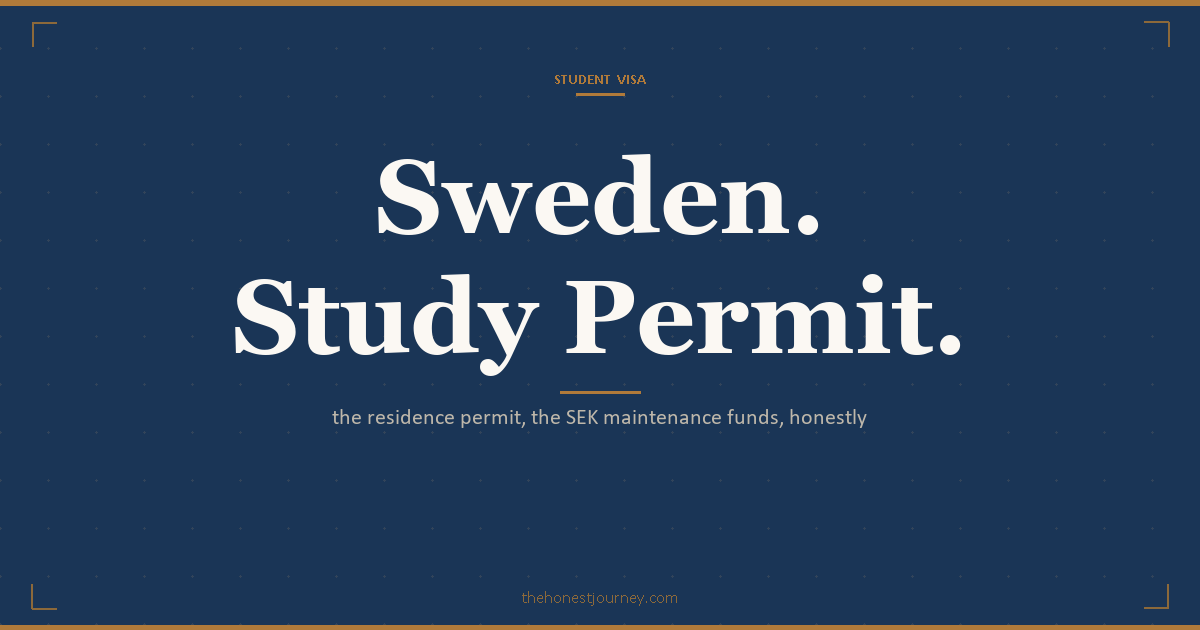
Short answer. For Indian students, Sweden does not issue a classic student visa for courses over 90 days. It issues a residence permit for studies, applied for online at Migrationsverket. As of the 2026 intake the fee is SEK 1,500, and you must show maintenance funds of about SEK 10,656 per month for the length of studies, typically ten months.
Confirm both figures on the official portal, they move each year.
A girl I mentored kept calling it her “Sweden student visa appointment” right up until the week she applied, quietly panicking about which VFS slot to book for the stamp. There was no stamp to chase. Her whole application lived online at Migrationsverket, and the thing she needed to nail was not an interview but a bank statement covering ten months of maintenance in one clean line. She had the money. She just did not know that was the fight, because everyone around her kept using the word “visa” for something that is not one.
This post stays strictly in the visa lane, or rather the permit lane: what the document actually is, how you apply at Migrationsverket, the fee, the maintenance funds that decide most cases, health insurance, decision times, work rights, and the honest refusal reality. If you want the wider decision on programmes, cities and whether Sweden fits you, that lives in the study in Sweden for Indian students guide. Here we only talk about getting the permit.
First, it is a residence permit, not a visa
This is the single point that confuses most Indian applicants, so let me say it plainly. If your course in Sweden runs longer than three months, you do not apply for a student visa. You apply for a residence permit for studies. A visa in the classic sense is a short-stay entry document. A residence permit is permission to live in Sweden for the duration of your studies, and that is what a full degree or a one-year master’s requires.
People still type “Sweden student visa” into Google, and that is fine, it is the natural search phrase. Just know that when you reach the official process, the correct term is residence permit for studies, and the authority that grants it is Migrationsverket, the Swedish Migration Agency. Everything official, the forms, the fee, the maintenance figure, and the decision, lives on their portal at migrationsverket.se. Treat that as your only source of truth. As of the 2026 intake, every number in this post is a planning figure you should confirm there the week you apply, because Sweden revises the maintenance amount annually.
Applying online at Migrationsverket
The Swedish process is almost entirely digital, and that trips up people who expect a consulate queue. You do not begin at an embassy. You begin on the Migrationsverket e-service, and you can only start once you have an unconditional acceptance from a Swedish university.
The admission itself runs through a separate national system. Indian students apply to Swedish degree programmes through the central admissions portal at universityadmissions.se, and once you are admitted and have paid any tuition or first instalment the university requires, you have the acceptance document the permit application depends on. Only then do you open the Migrationsverket e-service, create an account, fill the application, upload your documents, and pay the fee with a Visa or Mastercard. The embassy comes in later, and only for biometrics.
Faz's ruleStop looking for a visa stamp. Sweden grants a residence permit for studies, applied for online at Migrationsverket, and the embassy only enters the picture later for your photo and fingerprints.
The applicants who struggle are the ones who spend weeks hunting for a VFS visa slot that does not exist for their course length. The application is online. The document is a residence permit. Get that framing right and half the confusion disappears before you start.
The permit fee, in INR
Let me put the money on the table first. This is the government fee you pay Migrationsverket to process the application, not your tuition and not your living costs, which belong on the study-in page, not here. The planning rate through this article is ₹8 per Swedish krona. It moves, so re-check it the week you transfer money.
| Item (residence permit for studies) | SEK | INR (at 8) |
|---|---|---|
| Application fee, adult | 1,500 | ~12,000 |
| Application fee, child under 18 | 750 | ~6,000 |
| Maintenance funds to show, per month | ~10,656 | ~85,248 |
| Maintenance funds shown for 10 months | ~1,06,560 | ~8,52,480 |
The honest read of this table: the fee itself is small. At about ₹12,000 the application charge is one of the cheapest in this whole cluster. The number that actually matters is the maintenance funds row, and notice it is not a fee at all. That money is not paid to anyone. It is your own money that you must prove you have available for the length of your studies. The fee gets your application looked at. The maintenance funds decide whether it succeeds. The body image below breaks the fee apart from the funds so you see what you spend versus what you merely show.
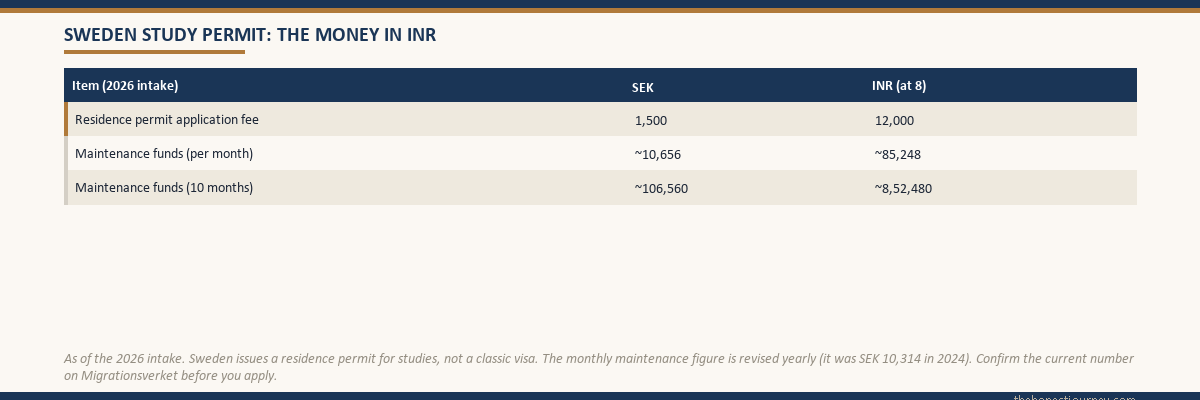
Note what is not on this table. Your tuition, which for non-EU students is real and varies by programme, and your monthly living costs belong on the study in Sweden guide, not here. On this page, money appears only as the funds you must prove to Migrationsverket to be granted the permit.
The maintenance requirement: the part that decides your case
If a Swedish residence permit for studies gets delayed or refused, the maintenance requirement is almost always the reason. So this is the section to get right, and it is where I want you to slow down.
As of the 2026 intake, Migrationsverket requires you to show maintenance funds of about SEK 10,656 per month for the entire period your permit will cover. This figure is tied to Sweden’s annual price base amount, so it rises most years, which is exactly why you must confirm the current number on the official portal rather than trusting a figure a senior quotes you from two intakes ago. In earlier intakes it sat around SEK 10,314, and it has crept up since.
The multiplication is where students get caught. You do not show one month. You show the full length of your studies, and for a standard programme Migrationsverket typically wants around ten months of maintenance demonstrated. At roughly SEK 10,656 per month for ten months, that is about SEK 1,06,560, which at ₹8 per krona is close to ₹8.5 lakh, and that sum has to be sitting available, in your own name or clearly at your disposal, when you apply.
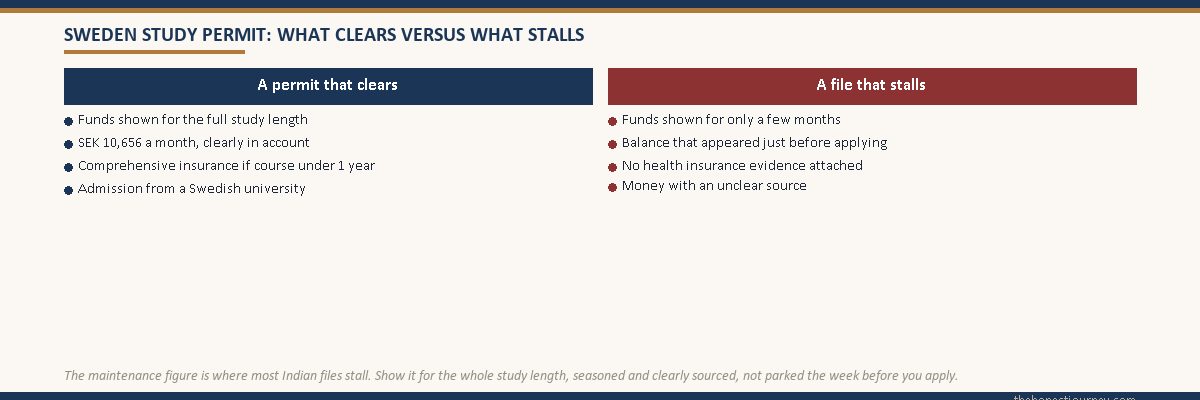
What counts as available maintenance matters as much as the amount. Migrationsverket accepts your own bank assets, a scholarship, student grants or loans from your home country, or a documented sponsor. What it does not want is a balance that appeared last week with no story of where it came from. Seasoned funds, a clear source, and a loan sanction letter if you are financing together read as credible. The broader principles of presenting funds proof cleanly are in the proof of funds for a student visa guide, and if you are wondering how much of this to physically move versus prove, the how much money to carry abroad guide covers that split.
Faz's ruleDo not show one month of funds. Show the full length of your studies, usually about ten months, in one credible line, and confirm the current monthly figure on Migrationsverket before you calculate.
I have seen strong applicants stall because they showed the monthly figure and assumed that was it. Migrationsverket wants the whole study period covered. Multiply the current monthly amount by roughly ten, make the source clean, and season the money. That single step clears more Swedish permits than anything else.
The step process, end to end
Here is how the residence permit for studies actually runs, in the order it happens. Nothing here is a stamp chase. It is admission, then an online application, then biometrics.
Step one: get admitted and accept. You apply to your Swedish programme through universityadmissions.se, receive an unconditional admission, and pay any tuition or first instalment the university asks for. Keep the admission notification and the payment receipt, because the permit application depends on both.
Step two: arrange and season your maintenance funds. Before you touch the application, get your money in order. Show the full study period, roughly ten months at the current monthly figure, in a form Migrationsverket accepts, your own savings, a scholarship, or a sanctioned education loan. This is the stage that quietly takes the longest, because seasoning funds and gathering loan paperwork move on their own schedule, not yours.
Step three: apply online and pay the fee. Open the Migrationsverket e-service, create your account, complete the application, upload your admission notification, your passport pages, proof of maintenance, and health insurance if your course is under a year, then pay the SEK 1,500 fee with a Visa or Mastercard.
Step four: biometrics and the decision. After you submit, Migrationsverket will ask you to visit a Swedish embassy or consulate to give biometrics, your photo and fingerprints, for the residence permit card. Then it is processing time. If approved, your permit card is produced and you collect or receive it before you travel.
Biometrics, health insurance, and the documents that carry weight
Two things catch people who assume a fully online process means no in-person step and no extra cover. First, biometrics. Even though you apply online, you must appear once at a Swedish embassy or consulate to give your photo and fingerprints so your residence permit card can be produced. Build that single visit into your timeline, and note that the embassy is not deciding your case, it is only capturing biometrics.
Second, health insurance. If your programme is shorter than one year, Migrationsverket requires you to hold comprehensive health insurance that covers emergency medical care, hospital treatment, and emergency dental care for your time in Sweden. If your course is a year or longer, you generally become entitled to register in the Swedish population register and access public healthcare instead, so the private cover requirement mostly bites shorter courses. Confirm which applies to your programme length on the official portal.
Beyond those, the documents that decide your case are your admission notification from universityadmissions.se, a passport valid for your stay, clean proof of maintenance for the full study period, and health insurance where required. There is no heavy study-plan interview the way some countries run, but the funds evidence has to be watertight, so follow the official document checklist on Migrationsverket, because it updates between intakes.
Processing and decision times, honestly
Migrationsverket publishes its own processing estimates, and they vary a great deal by season and volume, so I will not quote you a week count that will be wrong by the time you read it. Check the live estimate on the official portal for your case type. The pattern worth knowing is that the pre-autumn crush is real. A large share of admitted students apply in the same short window before the autumn semester, and that is when queues lengthen.
The honest advice is the same I give for every destination. Apply the moment you have your admission and funds in order, not the week before your flight. Applicants who leave it late end up watching a decision they cannot hurry while their semester start approaches. Nothing about the Swedish process rewards waiting.
Work rights while you study
Sweden used to be known for having no fixed cap on student working hours, and for years the guidance was simply that you must make satisfactory progress in your studies. That reputation is a little out of date now. As of the 2026 intake, students at bachelor’s or master’s level may work a maximum of about 15 hours per week during term, with more allowed during the summer months of June to August and for certain internship or student-representation roles. Because this rule was tightened recently, confirm the current hour limit on the official Migrationsverket portal before you rely on it.
The honest framing on work is the one that never changes. Whatever the hour limit, part-time work is a living-cost supplement, not a maintenance fund. You cannot present future earnings to Migrationsverket as how you will support yourself, because the maintenance requirement must be proven upfront. Treat work as breathing room once you arrive. The realistic picture of what student work actually covers abroad is in the part-time work while studying abroad guide.
After studies, and lowering the funds bar
Once you graduate, Sweden allows eligible students to apply for a further residence permit to look for work or start a business, which is a genuine part of why the Swedish route can repay. That is a separate application with its own rules, so I will only flag it here.
Back on the permit itself, the maintenance figure is the real hurdle, so it is worth attacking the number legitimately rather than just scrambling to prove it. A scholarship counts as accepted maintenance and directly reduces the personal funds you must show, which is why the funding search is not separate from the visa question. The realistic options for Indian students are in the scholarships for Indian students guide. Every krona of confirmed scholarship is a krona less you have to season in your own account.
The honest take on the Sweden student permit
The Swedish residence permit for studies is, on paper, one of the gentler processes in this cluster. The fee is low, the application is online, there is no gruelling intent interview, and a well-funded genuine student rarely has a hard time. That is the good news, and it is real.
The catch is the one thing the whole process hangs on. It is not a visa, it is a permit, and it is decided almost entirely on maintenance funds shown for the full length of study. Confirm the current monthly figure on Migrationsverket because it climbs each year, multiply it across roughly ten months, and make the money clean and seasoned. Do that, and Sweden becomes a permit you execute calmly rather than a stamp you chase.
Sweden is one of three Nordic routes Indian students weigh together. The permit steps and self-support funds for the Denmark student visa and the Finland student visa follow the same shape, so read them side by side.
FAQ
Does Sweden give a student visa for Indian students?
For courses longer than three months, no. Sweden issues a residence permit for studies, not a classic visa, through Migrationsverket. People still search “Sweden student visa”, but the official document is a residence permit, and you apply for it online rather than through a consulate visa queue. As of the 2026 intake, confirm the current process on the official Migrationsverket portal, because Sweden revises its student rules between intakes.
What is the Sweden student visa fee for Indian students?
As of the 2026 intake, the application fee for a residence permit for studies is SEK 1,500 for an adult, about ₹12,000 at ₹8 per krona, paid to Migrationsverket by Visa or Mastercard when you submit online. Children under 18 pay SEK 750. The fee is not refunded if your application is refused, so confirm the current amount on the official portal before you pay.
How much money do I need to show for a Sweden student permit?
As of the 2026 intake you must show maintenance funds of about SEK 10,656 per month for the full length of your studies, which for a standard programme usually means around ten months. That is roughly SEK 1,06,560, close to ₹8.5 lakh at ₹8 per krona. The figure rises most years, so verify the current monthly amount on the official Migrationsverket portal before you calculate your total.
How long does a Sweden residence permit for studies take?
Processing times vary a lot by season and application volume, and Migrationsverket publishes live estimates you should check for your case type rather than trusting a forum number. The practical advice is to apply as soon as you have your admission and funds ready, well before the autumn intake, because the pre-semester crush is the main reason admitted students end up waiting on a decision they cannot hurry.
Can I work on a Sweden student residence permit?
Yes, within limits. As of the 2026 intake, bachelor’s and master’s students may generally work up to about 15 hours per week during term, with more allowed over June to August. This is tighter than Sweden’s older no-fixed-cap reputation, so confirm the current limit on the official portal. Whatever the number, work is a living-cost supplement, never the maintenance funds you must prove upfront.
Why do Sweden student permits get delayed or refused?
The maintenance requirement is the usual sticking point. Delays and refusals cluster around applicants who show only one month of funds instead of the full study period, or whose money appeared too recently to look genuine, or whose source is unclear. Migrationsverket accepts savings, scholarships, home-country loans, and documented sponsors. Show the full roughly ten-month amount from a clean, seasoned source and most problems disappear.
Do I need health insurance for a Sweden student permit?
It depends on your course length. If your programme is shorter than one year, Migrationsverket requires comprehensive health insurance covering emergency care, hospital treatment, and emergency dental care. If your course is a year or longer, you generally register in the Swedish population register and access public healthcare instead. Confirm which applies to your programme length on the official portal, because it hinges on the exact duration of your studies.
Is it a residence permit or a visa for studying in Sweden?
For studies over 90 days it is a residence permit, not a visa. A visa is a short-stay entry document, while a residence permit is permission to live in Sweden for the length of your studies, which is what a degree or a one-year master’s needs. You apply online at Migrationsverket, give biometrics at an embassy, and receive a residence permit card. The word “visa” is only search habit here.
Faz · The Honest Journey · 2026