Short answer. For Indian students, Denmark does not issue a classic student visa. You apply for a residence permit for studies through SIRI, the Danish Agency for International Recruitment and Integration. As of the 2026 intake the fee is around DKK 3,060, and you must document roughly DKK 7,426 per month if your programme is not fully covered.
As of the 2026 intake the application fee is around DKK 3,060, and you must document that you can support yourself, roughly DKK 7,426 per month if your programme is not fully covered. Confirm both on the official portal.
A girl I mentored, sharp, already admitted to a master’s in Copenhagen, called me in a small panic because she could not find the “Denmark student visa application” anywhere. She had spent two evenings hunting a form that does not exist under that name. The moment I told her the document was a residence permit for studies, applied for through SIRI, not a visa stamped by an embassy, the whole thing unlocked. Her problem was never the paperwork. It was the wrong search word.
This post stays strictly in the visa lane: the permit type, the SIRI route, the fee, the self-support proof, biometrics, CPR registration, processing reality, work rights, and the honest refusal picture. Denmark does not yet have a full study-in guide on this site, so for the funds side, which is where most Danish permit files wobble, lean on the proof of funds for a student visa guide. Here we only talk about getting the permit.
First, it is a residence permit, not a visa
People type “Denmark student visa” because that is the search phrase everyone uses, and I will use it too so you can find this page. But the document you actually apply for is a residence permit for studies. It is granted by SIRI, the Danish Agency for International Recruitment and Integration, not by a consular officer deciding a visa on a hunch. For a full degree at a state-approved higher education institution in Denmark, this permit is the real thing you are chasing, and understanding that changes how you approach the whole file.
Everything official, the fee, the self-support figure, the document checklist and the processing estimate, lives on the government portal at nyidanmark.dk, run by the Danish immigration authorities. The broader student-life overview sits on studyindenmark.dk. Treat those two as your only source of truth. Danish figures are set at a yearly level, so as of the 2026 intake every number here is a planning figure you should confirm on the official portal the week you apply.
Applying to SIRI: how the route actually works
The Danish permit runs on a case order ID system, which trips up people expecting a simple embassy appointment. Before you can submit anything, you create a case order ID and pay the fee, and only then do you complete the application, usually online. Your Danish institution is your anchor throughout, because SIRI issues the permit on the basis of your admission to a state-approved programme. You are not walking into an embassy to plead your case. You are filing a structured application to an agency that checks specific boxes: valid admission, paid or covered tuition, and documented ability to support yourself.
After you submit online, you record biometrics, a facial photo and fingerprints, at a Danish diplomatic mission or an authorised Visa Application Centre run by VFS, typically within 14 days of submitting. Those biometrics go onto the chip in your residence card. Miss the biometrics window and the application can be rejected outright, so this is not a step to leave floating in your calendar.
The permit fees, in INR
Let me put the money on the table first. This is the government fee you pay to SIRI, not your tuition or your living costs. The planning rate through this article is ₹12 per Danish krone. It moves, so re-check it the week you transfer money.
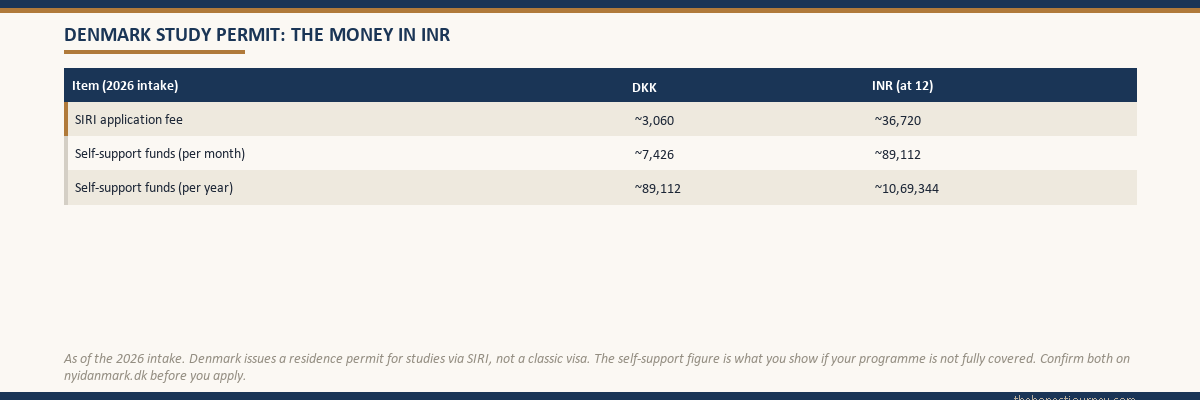
| Fee (residence permit for studies) | DKK | INR (at 12) |
|---|---|---|
| SIRI application fee | ~3,060 | ~36,720 |
| Biometrics at VFS (service fee, typical) | varies by centre | varies |
| Self-support to document, per month | ~7,426 | ~89,112 |
| Self-support for a 12-month reference | ~89,112 | ~10,69,344 |
The honest read of this table: the SIRI application fee, a little over ₹36,000 as of the 2026 intake, is the real government charge, and it is not trivial. The VFS biometrics service fee is a smaller add-on that varies by centre and is paid to the centre, not to SIRI. The big number is the self-support figure, but that is not a fee. It is money you show, not money you hand over, and the body image below breaks it apart so you see what you spend versus what you merely prove.
Note what is not here. Your tuition is paid to the Danish institution, and your city living costs are a separate planning exercise. If you want the wider rupee picture for what to carry and how to structure your money before you fly, that sits in the how much money to carry abroad guide. On this page, money appears only as the self-support you must prove to get the permit.
The self-support proof: the part that decides your case
If a Danish study permit stalls, the reason is most often the self-support documentation, specifically whether SIRI is satisfied you can genuinely support yourself without running into trouble. So this is the section to get right.
As of the 2026 intake, if your programme does not fully cover your maintenance, you must document that you can support yourself with roughly DKK 7,426 per month, which is about ₹89,000 at ₹12 per krone. Shown across a 12-month reference, that is around DKK 89,112, roughly ₹10.7 lakh. Confirm the exact figure on the official portal, because Denmark sets this at a yearly level and it was revised for the current year. The point of the number is simple: Denmark does not want students arriving with no cushion and no plan.
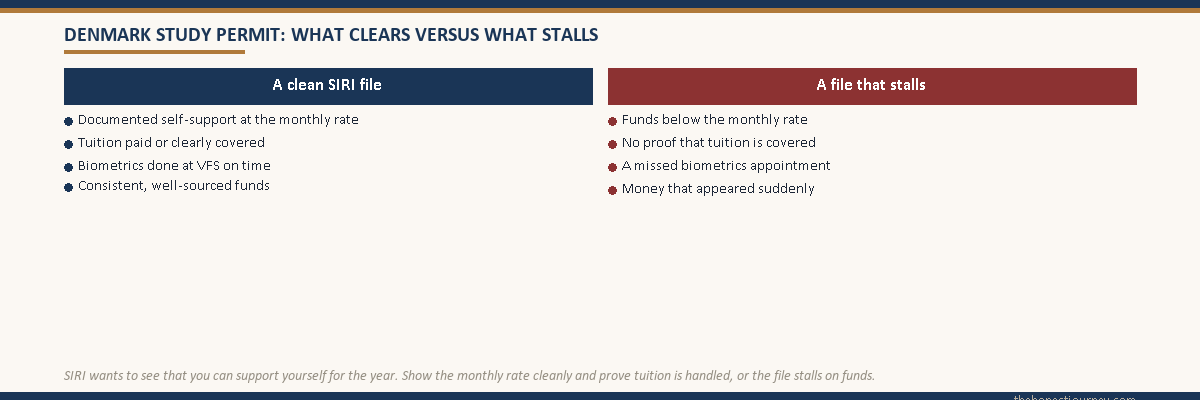
What SIRI actually wants is proof that makes sense, not just a screenshot of a healthy balance. A bank statement in your name, or a clear scholarship or grant letter if your programme covers maintenance, reads as credible. A lump sum that appeared last week, with no story of where it came from, reads as borrowed-for-show and weakens the file. Seasoned funds, a clear source, and supporting letters build trust, while an unexplained deposit does the opposite. Season your money and document its origin before you assemble anything, because SIRI reads the trail, not just the total.
Faz's ruleDenmark issues a residence permit, not a visa, and the self-support proof is what SIRI weighs hardest. Document a clean, well-sourced fund, not a balance that appeared overnight.
The files I see stall are almost never short of money. They are short of a story. A statement that shows steady, explained funds beats a big number that landed last week. Build the paper trail before you build the balance, because SIRI is judging credibility, not just the total.
The step process, end to end
Here is how the residence permit for studies actually runs, in the order it happens, so you can build a timeline that holds.
Step one: secure your admission. You accept a place on a state-approved higher education programme in Denmark and receive your admission letter. SIRI issues the permit on the basis of this admission, so a firm offer is the hard dependency the whole application rests on. Sort any tuition deposit your institution requires at this stage.
Step two: create your case order ID and pay the fee. On the official portal you generate a case order ID and pay the SIRI application fee, currently around DKK 3,060 as of the 2026 intake. Nothing moves until the fee is paid and tied to your case, so treat this as the gate it is.
Step three: complete the application and document your funds. Fill in the online application, attach your admission letter, and attach your self-support evidence, the bank statement or scholarship documentation showing the roughly DKK 7,426 per month figure where required. This is the stage that quietly takes the longest, because gathering clean, well-sourced financial paperwork moves on its own schedule.
Step four: record biometrics and wait for the decision. Within 14 days of submitting, give your facial photo and fingerprints at a Danish mission or an authorised VFS centre. Then it is processing time. If approved, you receive your permit, travel to Denmark, and complete the arrival steps, including registering for a CPR number.
Biometrics at VFS, CPR after arrival, and the documents SIRI expects
Two practical steps catch people who assume the application is purely online. First, biometrics is an in-person visit, a facial photo and fingerprints, usually at a VFS centre, that must happen within about 14 days of submitting online. That data is written to the chip in your residence card, and skipping it can sink the whole application, so book it the moment you submit.
Second, after you arrive in Denmark you register for a CPR number, the Danish personal registration number tied to your address. The CPR is not a border formality you can shrug off. It is what unlocks ordinary life: a bank account, a doctor, and the free Danish lessons the system offers. You register your address in the national register, and the CPR follows. Treat it as the first thing you sort after you land, not something you drift into weeks later.
Beyond those, the documents that carry weight are your admission letter to a state-approved programme, your self-support evidence, your passport, and any scholarship or grant letters that show maintenance is covered. Follow the official document checklist on the portal, because it updates between years and a missing attachment is the easiest way to slow your own file.
Processing reality: what the wait actually looks like
SIRI publishes processing estimates for the residence permit for studies, and they vary by season and volume. The honest takeaway is the same as everywhere: apply early. The crush before an autumn intake is real, and leaving it late is how a strong applicant ends up scrambling, or deferring a semester for no reason other than the calendar. Once you have your admission and your funds are in order, do not sit on the application waiting for a perfect moment. File it, then complete biometrics inside the window.
Now the part most guides skip. Danish permit refusals or delays for genuine students usually come down to the self-support documentation or a gap in the file, not to some hidden bias against Indian applicants. A funds figure that falls short, money with no clear source, or a missing attachment are the common culprits. None of that is a character judgment. It is a credibility and completeness judgment you address with clean documents and an honest, well-sourced fund, not a slicker consultant.
Work rights while you study
Your residence permit for studies lets you work, within limits, and Denmark is reasonably generous here. As of the 2026 intake, students on state-approved higher education programmes may work up to 90 hours per month during the normal study period from September to May, which works out to roughly 20 hours per week, and full-time through June, July and August. Read your own permit conditions, because they govern, and confirm the current limits on the official portal, since the rules can shift between years.
The honest framing on work is the same as everywhere. It is a living-cost supplement, not a tuition fund and not a substitute for the self-support you must prove. Treat it as breathing room once you land, never as the plan that closes a funding gap, and never as something you present to SIRI as how you will pay. If you want a realistic view of what term-time work adds and what it does not, the part-time work while studying abroad guide lays out the honest math.
After studies, and easing the funds bar
Denmark offers a route to stay and look for work after you finish, and the specifics belong to a decision conversation rather than this permit page, so I will only flag it here. Just know the runway after graduation is a real part of why the Danish ticket can repay. What matters for the permit itself is that a completed degree from a state-approved institution keeps that door open.
On the funds bar, the honest move is to shrink it legitimately before you ever assemble the file. A scholarship or grant that covers maintenance changes what you must document, and it is the single cleanest way to strengthen a Danish application. It is worth checking what is available before you assume you must show the full self-support figure from your own pocket. The scholarships for Indian students guide is where to start that search, and if the Danish sums feel steep, the cheapest countries to study abroad guide gives you honest comparisons before you commit.
Faz's ruleShrink the funds bar legitimately before you fight it. A scholarship or grant that covers maintenance is the cleanest way to strengthen a Danish permit file, not a bigger personal balance.
The strongest Danish files I see are not the ones with the fattest bank statements. They are the ones where a grant or scholarship covers maintenance, so the self-support burden drops and the story is clean. Chase the funding first. It does double duty, easing your budget and your permit at the same time.
The honest take on the Denmark student permit
The Danish residence permit for studies is a structured, checkbox-driven process, and that is good news for a genuine, well-prepared student. It rewards a clean file and punishes a sloppy one. There is no charming an officer and no fast lane to buy. There is admission to a state-approved programme, a paid fee, documented self-support, biometrics on time, and a decision that follows the rules.
So the move is simple. Get your admission locked, create the case order ID and pay the fee, document self-support with clean, well-sourced money or a maintenance-covering scholarship, complete biometrics inside the window, and register for your CPR the moment you land. Confirm every figure on the official portal, because Denmark sets them at a yearly level and they shift. Do that, and the permit becomes a process you execute rather than a lottery you enter.
If Denmark is your first choice, Finland is the closest alternative on cost and process. The permit route and funds proof are covered in the Finland student visa in full.
FAQ
How much is the Denmark student visa fee for Indian students?
Denmark issues a residence permit for studies, not a classic visa, and as of the 2026 intake the SIRI application fee is around DKK 3,060, about ₹36,720 at ₹12 per krone. You create a case order ID and pay this before you submit the application. A separate biometrics service fee at a VFS centre may apply. Confirm the current fee on the official nyidanmark.dk portal before you pay, as it is set at a yearly level.
How much money do I need to show for a Denmark student permit?
As of the 2026 intake, if your programme does not fully cover your maintenance, you must document that you can support yourself with roughly DKK 7,426 per month, about ₹89,000 at ₹12 per krone. Across a 12-month reference that is around DKK 89,112, roughly ₹10.7 lakh. This figure is revised yearly, so verify it on the official portal. A scholarship covering maintenance can reduce what you must show from your own funds.
Do I need a CPR number as a student in Denmark?
Yes. The CPR is the Danish personal registration number, tied to your address, and you register for it after you arrive. It is not optional. The CPR unlocks ordinary life in Denmark: a bank account, access to a doctor, and the free Danish lessons the system offers. Register your address in the national register soon after landing, and the CPR follows. Treat it as the first thing you sort on arrival, not weeks later.
How long does a Denmark student residence permit take to process?
SIRI publishes processing estimates for the residence permit for studies, and they vary by season and application volume. There is no single fixed number, so check the current estimate on the official portal rather than trusting a forum figure. The practical advice is to apply early, well before an autumn intake, because the pre-semester crush is the main reason strong applicants end up scrambling or deferring a semester for no good reason.
How many hours can I work on a Denmark student permit?
As of the 2026 intake, students on state-approved higher education programmes may work up to 90 hours per month during the normal study period from September to May, which is roughly 20 hours per week, and full-time through June, July and August. Read your own permit conditions, because they govern, and confirm the current limits on the official portal. Treat work as a living-cost supplement, never as a tuition fund or as how you tell SIRI you will pay.
Is a Denmark student permit a visa or a residence permit?
It is a residence permit for studies, granted by SIRI, the Danish Agency for International Recruitment and Integration, not a classic student visa. People search “Denmark student visa” out of habit, and that is fine, but the document you apply for is the permit. A long-stay entry document may accompany it, yet the permit is the real thing. Knowing the correct term saves you hunting for a visa form that does not exist under that name.
Why do Denmark student permit applications get delayed or refused?
The common causes are the self-support documentation and gaps in the file, not bias against Indian applicants. A funds figure that falls short, money with no clear source, a missing attachment, or skipped biometrics inside the 14-day window are the usual culprits. None of these is a character judgment. They are credibility and completeness issues you fix with clean, well-sourced funds and a complete checklist, so follow the official document list on the portal exactly.
Do I need to give biometrics for a Denmark student permit?
Yes. After you submit the application online you must give a facial photo and fingerprints, usually at an authorised VFS centre, typically within 14 days of submitting. That biometric data is stored on the chip in your residence card. Skipping or missing the biometrics window can lead to the application being rejected, so book the appointment the moment you submit and confirm the current requirement on the official portal.
Faz · The Honest Journey · 2026