Short answer. For Indian students, the Finland “student visa” is really a residence permit for studies, issued by Migri, the Finnish Immigration Service. You apply on the Enter Finland portal and get identified at a VFS visit.
As of the 2026 intake the online fee is EUR 600 and you must show EUR 800 per month, which is EUR 9,600 for a year. Confirm both on the official Migri portal.
A girl from my extended family got into a master’s programme in Tampere and came to me in a mild panic, because a forum thread had told her the Finland permit fee was EUR 450 and her friend’s older post said EUR 490 for paper. She had budgeted for that and felt cheated when the portal quoted a higher number. Nothing was wrong with her. Finland simply raised its processing fees from the start of 2026, and she was reading last year’s figure. In immigration, a fee you copied from a year-old post is a fee you can trust only until the government revises it, which they do.
This post stays strictly in the visa lane: the permit type, the Enter Finland route, the step-by-step, the fee in rupees, the funds proof, identification and insurance, processing, work rights, and the honest bit that trips people. Finland has no study-in overview on this site yet, so for the wider funds thinking under every application I will point you to the proof of funds for a student visa guide. Here we only talk about getting the permit.
First, it is a residence permit, not a visa
People type “Finland student visa” into Google out of habit, and that is fine, it is what everyone searches. But the document you actually apply for is a residence permit for studies. Finland does not issue a classic study visa for a full degree. If your course lasts longer than 90 days, which every degree does, you need the residence permit, and Migri is the authority that grants it.
A short exchange or summer course under 90 days can run on a Schengen visa, but that is not what most Indian students are here for. For a bachelor’s or master’s you apply to Migri for the residence permit, and the entry itself is handled once the permit is granted. So drop the mental picture of a visa sticker as the goal. The goal is the residence permit, and everything official about it lives on the Migri portal at migri.fi. Treat that as your single source of truth, alongside the study-side portal at studyinfinland.fi for the admissions overview.
The Enter Finland portal and the VFS identification
The application does not happen at an embassy counter. It starts online, on a Migri service called Enter Finland. You create an account, fill in the application, upload your documents, and pay the fee there. Applying online through Enter Finland is also cheaper than a paper application, which matters, because the gap between the two is real money.
After you submit online, there is one in-person step you cannot skip. You must visit a VFS Global centre in India to prove your identity and give your biometrics, fingerprints and a photo, and to show your original documents. Book that appointment soon after you submit, because the clock on your decision does not really start moving until you have been identified. People treat Enter Finland as the whole process and forget the VFS visit, then wonder why nothing is happening. The online submission and the identification visit are two halves of one application.
Faz's ruleEnter Finland is only half the application. Your case does not truly move until you have been identified at VFS in person, so book that visit the same week you submit online.
I have seen students submit on Enter Finland, feel done, and sit for weeks waiting on a decision that could not start because they never went for identification. The online form and the VFS visit are one process in two parts. Do the second part fast.
The permit fee, in INR
Let me put the money on the table first. This is the government processing fee you pay to Migri, not your tuition or living costs. Finland revised these fees from 1 January 2026, so if you are reading an older figure like EUR 450, it is out of date. The planning rate through this article is ₹90 per euro. It moves, so re-check it the week you pay.
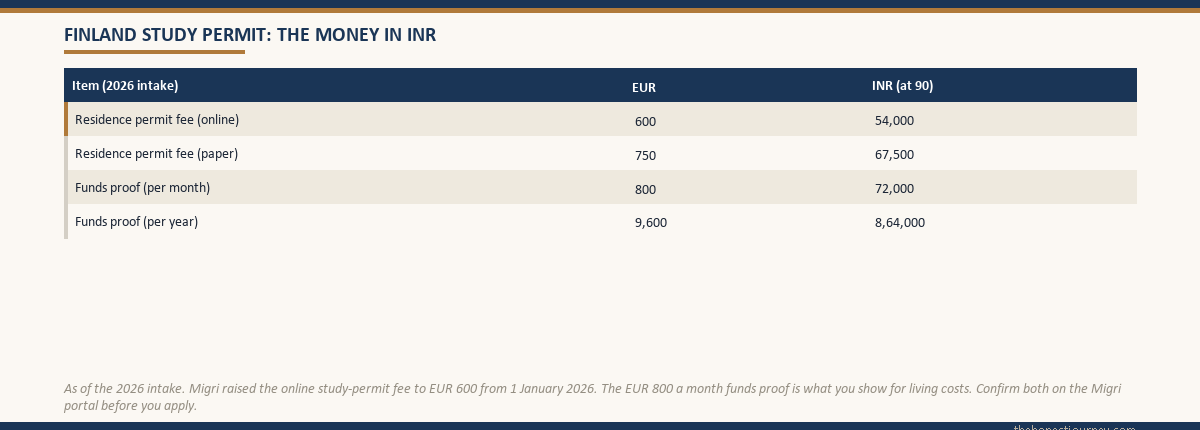
| Item | EUR | INR (at 90) |
|---|---|---|
| Residence permit for studies, online (Enter Finland) | 600 | ~54,000 |
| Residence permit for studies, paper application | 750 | ~67,500 |
| VFS service fee (varies, typical) | ~30 to 40 | ~2,700 to 3,600 |
| Funds you must show (not a fee, your own money) | 9,600 | ~8,64,000 |
The honest read of this table: the processing fee itself is one number, EUR 600 online as of the 2026 intake, and applying online saves you a clear EUR 150 over paper. On top of the Migri fee, VFS charges a small service fee for the identification visit, paid to them, not to Migri. The large figure at the bottom is not a fee at all. It is the EUR 9,600 you must prove you have, your own money, which you keep and spend on yourself in Finland. The body image below splits the fee from the funds so the difference is obvious.
Note what is not on this table. Your tuition is paid to the university, and your monthly rent and groceries are living costs, not visa costs. On this page, money appears only as the funds you must prove to Migri to get the permit. If you want to think through how much cash to actually move and hold, that sits in the how much money to carry abroad guide.
Proof of funds: EUR 800 a month is the real test
If a Finland study permit stalls or gets refused for an Indian applicant, the funds requirement is usually where it happens. Migri wants to see that you can genuinely support yourself, and the rule is specific. You must have at least EUR 800 available every month for accommodation, food, and everything else.
For studies of a year or longer, that adds up to EUR 9,600, and Migri expects to see roughly that amount in your bank account when you submit the application. At ₹90 per euro, EUR 9,600 is about ₹8.64 lakh sitting in the account, as of the 2026 intake. If your programme is shorter than a year, you show EUR 800 for each month of study instead. There is a narrower case too: if your institution provides free accommodation and free meals, the monthly figure drops to about EUR 270, but for most degree students that does not apply, so plan for the full EUR 800 a month. Confirm the exact figures on the official Migri portal, because this is the number Finland adjusts and the one people get wrong.
What trips Indian applicants is not usually the size of the amount. It is timing and clarity. Money that lands in the account the week before you apply, with no visible source, reads as arranged-for-show. Funds that have been sitting there, with a clear origin, or backed by a loan sanction letter, read as genuine. Scholarships that reduce how much you need to show are covered in the scholarships for Indian students guide.
Faz's ruleShow EUR 9,600 that has been in the account, not EUR 9,600 that arrived last week. Migri reads timing as a signal of whether the money is genuinely yours.
The EUR 800 a month rule looks simple, and that is exactly why people underestimate it. A balance that appears just before you apply, with no story, weakens a strong file. Season the funds, keep the source clear, and let a loan letter carry part of the weight if you are financing.
The four-step process, end to end
Here is how the residence permit for studies actually runs, in the order it happens. The step flow below maps the same four stages at a glance.
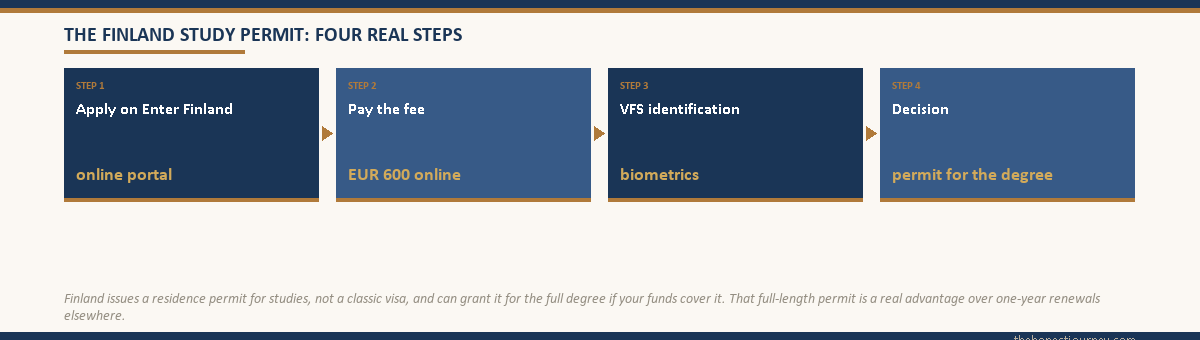
Step one: apply on the Enter Finland portal. You accept your admission offer, create an Enter Finland account, and complete the residence permit application. You attach your acceptance letter, proof of the EUR 9,600 funds, your health insurance, and your passport details. Fill this carefully, because a thin or inconsistent application is what slows a decision later.
Step two: pay the fee. You pay the processing fee inside Enter Finland, EUR 600 for the online application as of the 2026 intake. Applying online rather than on paper is what keeps it at EUR 600 instead of EUR 750, so there is no reason to go the paper route from India.
Step three: VFS identification and biometrics. You book and attend an appointment at a VFS Global centre in India to prove your identity, give fingerprints and a photo, and present your original documents. This is the in-person half of the application, and your decision timeline effectively starts once it is done.
Step four: the Migri decision. Migri reviews your file and decides. If approved, you receive a residence permit for studies, and for a full degree Finland can grant it to cover the whole programme in one go, which I will come back to, because it is a genuine advantage.
Identification, health insurance, and the documents Migri expects
Two requirements catch students who think the whole thing is online. The first is the VFS identification visit, which is not optional and cannot be done remotely. The second is health insurance. Finland requires you to have valid insurance cover, and the level of cover expected depends on the length and type of your studies, so read Migri’s current requirement rather than assuming your basic travel policy is enough. An underinsured application is a common, avoidable stumble.
Beyond those, the documents that carry weight are your certificate of acceptance from a Finnish institution, proof of the EUR 9,600 funds in a form Migri accepts, your health insurance certificate, a valid passport, and any tuition payment evidence. Follow the official document checklist on the Migri portal, because it is updated between intakes and the exact list matters more than any summary here.
Processing reality, and the full-degree advantage
Processing time for a studies permit varies with the season and how complete your file is, and Migri publishes live estimates you should check rather than trusting a forum number. A clean, well-documented application submitted early, and identified at VFS promptly, is the fastest version of this. The crush before an autumn intake is real, so apply as soon as you have your acceptance.
Here is the part that makes Finland genuinely attractive, and I want to be fair about it. For a full degree, Migri can grant the residence permit to cover the entire length of your studies, rather than making you renew every year the way some countries do. If your funds and your programme line up, you get a permit that carries you through the whole course. That is a real advantage, both for peace of mind and for cost, because you are not paying a renewal fee and reassembling funds proof every twelve months.
The honest counterweight is the funds proof. That EUR 800 a month, EUR 9,600 for the year, is where straightforward-looking applications come apart, either because the money is short or because it arrived too recently to look settled.
Work rights while you study
Finland is generous here, and this changed in students’ favour. Since a 2022 law, a student residence permit lets you work up to an average of 30 hours per week, which is meaningfully more room than the 20-hour cap common across much of Europe. During periods when you are not in teaching, the limits are more relaxed still. Confirm the current rule on the Migri portal, because work-hour rules are exactly the kind of figure governments revise.
The honest framing on work is the same everywhere, though. Those 30 hours are a living-cost supplement and useful local experience, not a tuition fund and not something you present to Migri as how you will pay. You still have to prove the EUR 800 a month independently of any job you hope to find. Treat work as breathing room after you land, never as the plan that closes a funding gap. How to think about part-time work realistically is in the part-time work while studying abroad guide.
After your studies
Finland lets graduates stay on to look for work or start a business after a degree, through a separate residence permit you apply for near the end of your studies. I will only flag it here, because it belongs to the after-graduation conversation, not this application page. But the runway exists, and it is part of why a Finnish degree can repay the effort of the funds proof.
The honest take on the Finland student visa
The Finland residence permit for studies is one of the more student-friendly routes in Europe, and I say that without trying to sell it. The application is online through Enter Finland, the fee is a single clear number, the work allowance is generous at 30 hours a week, and Finland can grant the permit for your whole degree in one go rather than dragging you through annual renewals. Those are real, honest advantages.
The catch is narrow. It is the EUR 800 a month, EUR 9,600 for the year, and the way that money has to look genuine and settled, not arranged at the last minute. Get the funds right, apply online, book your VFS identification quickly, carry proper health insurance, and confirm every figure on the live Migri portal the week you apply, because Finland did raise the fee for 2026 and could adjust again. Do that, and this is a process you execute cleanly, not a gamble. If cost is what is steering you toward Finland, weigh it against the alternatives in the cheapest country to study abroad guide before you commit.
Finland and Denmark are the two Nordic routes most Indian students compare. The SIRI application and self-support funds for the Denmark student visa sit alongside Finland’s.
FAQ
How much is the Finland student visa fee for Indian students?
As of the 2026 intake, the residence permit for studies costs EUR 600 for an online application on Enter Finland, about ₹54,000 at ₹90 per euro. A paper application costs EUR 750, so applying online saves you EUR 150. Finland raised these fees from 1 January 2026, so an older figure like EUR 450 is out of date. Confirm the current fee on the official Migri portal before you pay.
How much proof of funds do I need for a Finland student visa?
As of the 2026 intake you must show at least EUR 800 available every month, which is EUR 9,600 for a year of study, about ₹8.64 lakh at ₹90 per euro. Migri expects roughly that amount in your bank account when you apply. If your institution provides free accommodation and meals, the figure can drop to around EUR 270 a month. Verify the exact numbers on the official Migri portal.
What is the Enter Finland portal?
Enter Finland is Migri’s online service where you actually submit your residence permit for studies. You create an account, complete the application, upload your acceptance letter and funds proof, and pay the fee there. Applying through Enter Finland is cheaper than a paper application. After submitting online, you still visit a VFS centre in India in person to prove your identity and give biometrics, so treat both steps as one process.
How long does a Finland student residence permit take to process?
Processing time varies by season and how complete your file is, and Migri publishes live estimates you should check for your situation rather than trusting a forum number. Your decision timeline effectively starts once you have been identified at VFS, so book that appointment promptly after submitting on Enter Finland. The practical advice is to apply as soon as you have your acceptance, because the crush before an autumn intake is real.
How many hours can I work on a Finland student permit?
Since a 2022 law, a student residence permit in Finland lets you work up to an average of 30 hours per week, which is more generous than the 20-hour cap common across much of Europe. During periods with no teaching, the limits are more relaxed. Confirm the current rule on the Migri portal, as work-hour figures get revised. Treat work as a living-cost supplement, never as your tuition fund or as how you prove funds.
Does the Finland permit cover my whole degree?
Often, yes, and this is a real advantage. For a full degree, Migri can grant the residence permit for studies to cover the entire length of your programme in one go, provided your funds cover it, rather than forcing an annual renewal the way some countries do. That saves you repeated fees and repeated funds proof. Confirm the length Migri grants for your specific course on the official portal, as it depends on your programme.
Do I need health insurance for a Finland student visa?
Yes. Finland requires valid health insurance cover for your residence permit for studies, and the level of cover expected depends on the length and type of your studies. A basic travel policy may not meet the requirement, so read Migri’s current insurance rule carefully before you apply. An underinsured application is a common, avoidable reason for a file to stumble, so treat the insurance certificate as a core document, not an afterthought.
Is it a visa or a residence permit for studying in Finland?
For a full degree it is a residence permit for studies, not a classic visa, granted by Migri. People search “Finland student visa” out of habit, which is fine, but the document you apply for is the residence permit, because any course over 90 days requires it. A short course under 90 days can run on a Schengen visa instead. For a bachelor’s or master’s, plan for the Migri residence permit through Enter Finland.
Faz · The Honest Journey · 2026