Short answer. Almost every Indian student applying abroad picks the Fall intake without ever deciding to. It is the default everyone talks about, the one the agents push, the one your seniors took. So you take it too, and you never ask whether it was the right window for you.
That is the honest problem with intakes. It is not a hard topic. It is a decision most people skip, and skipping it quietly costs some of them a scholarship, an internship cycle, or a whole year of runway.
This page explains what the intakes actually are, why Fall is more crowded than it looks, when Spring is the smarter call, and how the intake you choose ripples into your funding, your job timing and your visa. No jargon, no “apply now”, just the trade-offs nobody spells out.
What an intake actually is
An intake is simply the point in the year a university opens its doors to new students. Most countries run two main ones, and a smaller third.
Fall intake. Starts around August or September. This is the big one, the primary intake almost everywhere, with the most courses open and the most seats.
Spring intake. Starts around January or February. Smaller, fewer courses, but a real second chance if Fall did not work out or you were not ready.
Summer intake. Starts around April or May. The smallest, offered by fewer universities and for a limited set of programmes. Treat it as a niche option, not a plan.
The words themselves cause confusion, because they come from the US academic calendar. Two of the biggest destinations for Indian students, Australia and Germany, do not use “Fall” and “Spring” at all. Searching the wrong word there is how people miss deadlines, which is covered further down.
Faz's ruleFall is the default, not the correct answer. Choosing an intake on autopilot because everyone else did is the most common and most avoidable mistake in the whole application timeline.
The intake is one of the few big decisions you make before you have spent a rupee. Get it right and everything downstream gets easier. Get it wrong and you are fighting the calendar for two years.
Fall versus Spring, honestly
The usual framing is that Fall is the “main” intake and Spring is the “backup”. That is lazy. The real picture is a set of trade-offs, and which side wins depends on you.
Where Fall genuinely wins
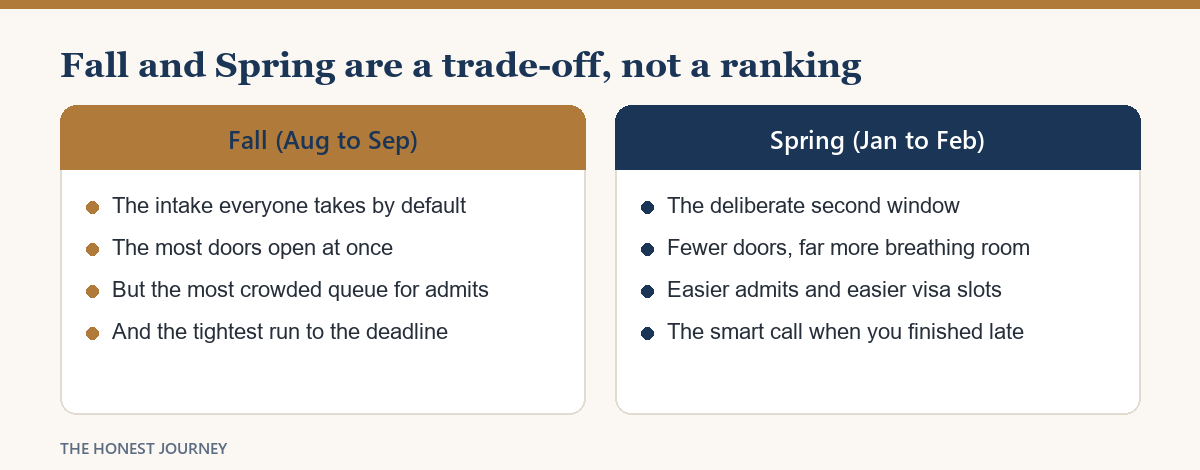
Fall has the most programmes open, so if your exact course runs in only one intake, it is usually this one. It has the most scholarship money, because most funding cycles are built around a September start. It lines you up for summer internships the following year, which matters enormously in the US and for any career-focused degree. And you arrive with the largest cohort, which makes settling in easier.
Where Spring is the smarter choice
Spring is not the consolation prize it is made out to be. It gives you more time to prepare, so your application is stronger rather than rushed. Because fewer people apply, some courses are genuinely less competitive to get into. Visa appointments are easier to book, since you are not in the pre-Fall crush when embassies are jammed. And if you finished your degree or your test late, Spring saves you from losing eight months waiting for the next Fall.
The honest catch with Spring is real and worth saying plainly: fewer courses open, less scholarship money on the table, and a smaller intake cohort. It is the right call for specific situations, not a universally equal option.
| Factor | Fall (Aug to Sep) | Spring (Jan to Feb) |
|---|---|---|
| Courses open | Almost all | A reduced selection |
| Scholarship money | Most funding cycles | Noticeably less |
| Admission competition | Highest, everyone applies | Lower for many courses |
| Visa appointment crush | Worst, pre-Fall jam | Easier to book |
| Summer internship timing | Lines up cleanly | Can be half a cycle off |
| Best for | On-time, funding-focused applicants | Late finishers, stronger-later applicants |
The intake decides more than your start date
This is the part that gets skipped. Your intake is not just when classes begin. It sets the clock on three things that cost real money.
Scholarships. The large majority of university scholarships and assistantships are attached to the Fall cycle. Apply for Spring and a chunk of the funding you were counting on may simply not be open. If your plan depends on a scholarship, that alone can settle the question. Our guide to fully funded scholarships covers which are worth chasing.
Internships and your post-study work clock. Summer internships, the ones that turn into job offers, recruit for a start the following summer. A Fall entry lands you in that cycle naturally. A Spring entry can leave you half a cycle out of step, which matters most in career-driven degrees. The same timing logic feeds into whether the whole degree pays off, which we work through in is studying in the USA worth it.
Visa appointment availability. The pre-Fall window is when embassy slots are hardest to get. Every Indian student applying for a September start is booking at the same time. A Spring applicant sidesteps that crush entirely. If you have watched appointment slots vanish, you know why this matters, and our page on student visa rejection reasons covers what a rushed, last-minute application risks.
The intakes are named differently by country
Here is where the vocabulary bites. “Fall” and “Spring” are American terms. The countries below run the same idea on a different calendar and different names, and searching the wrong word is a genuine way people miss a deadline.
| Country | Primary intake | Second intake | What to search |
|---|---|---|---|
| USA | Fall (Aug to Sep) | Spring (Jan) | Fall and Spring intake |
| UK | September | January | September and January intake |
| Canada | Fall (Sep) | Winter (Jan) | Fall and Winter intake |
| Australia | Semester 1 (Feb) | Semester 2 (Jul) | February and July intake, not Fall |
| Germany | Winter semester (Oct) | Summer semester (Apr) | Winter and Summer semester, not Fall |
Each country has its own deadlines, its own second-intake quirks and its own funding pattern. We have a dedicated, honest breakdown for each:
- Intakes to study in the USA
- Intakes to study in the UK
- Intakes to study in Canada
- Intakes to study in Australia
- Intakes to study in Germany
How much runway you actually need
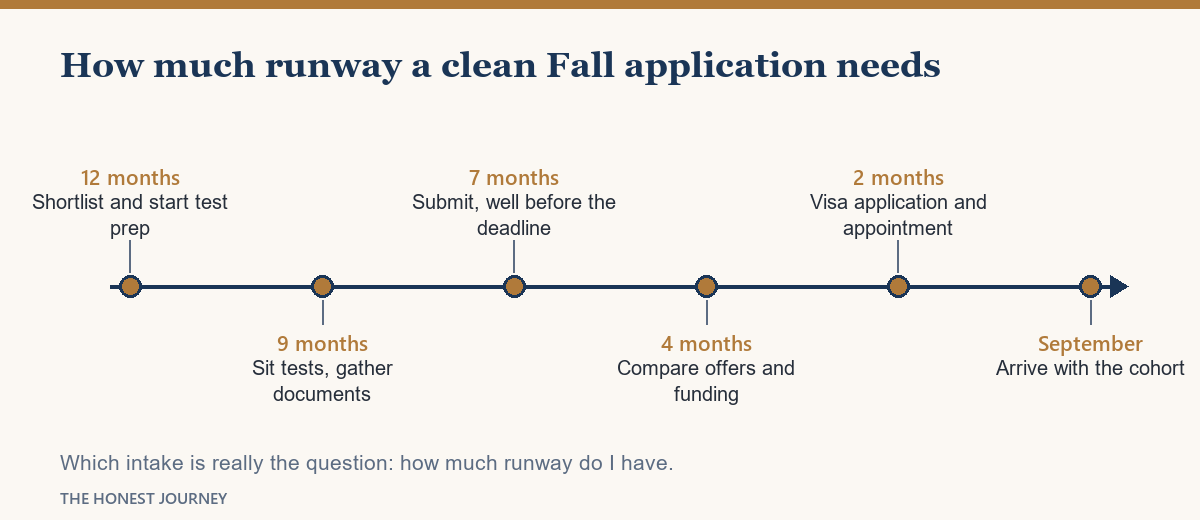
The single most useful way to think about intakes is backwards. Pick your arrival month, then count back. A clean application needs roughly 12 months.
12 months out: shortlist countries and universities, and start your English or standardised test prep. 9 to 10 months out: sit the tests, line up your documents, and start the statement of purpose and recommendation letters. 7 to 8 months out: submit applications, well before the deadline. 4 to 5 months out: accept an offer, sort finances and scholarships. 2 to 3 months out: visa application and appointment. This is why “which intake” is really the question “how much runway do I have”. If you are reading this six months before a Fall you have not prepared for, Spring is not a downgrade, it is you giving yourself a proper runway instead of a rushed one.
Faz's ruleA well-prepared Spring application beats a panicked Fall one every time. The calendar is not a status symbol. The strength of your application is.
People rush into Fall with a weak profile because it feels like the serious choice, then wonder why the admits and scholarships did not come. Runway wins. Pick the intake that gives you enough of it.
Frequently asked questions
What is the difference between Fall and Spring intake?
Fall intake starts around August or September and is the primary intake, with the most courses and the most scholarship money open. Spring intake starts around January or February, is smaller, and works as a strong second window for applicants who finished late or want more preparation time.
Is Spring intake worse than Fall?
No, it is different. Spring has fewer courses and less scholarship funding, but lower admission competition for many programmes and far easier visa appointments. It is the right choice for specific situations, not a lower-quality option.
Which intake is best for Indian students?
Fall suits students who are ready on time and depend on scholarships or summer-internship timing. Spring suits students who finished their degree or tests late, or whose application is meaningfully stronger with a few more months. The best intake is the one you can prepare properly for.
Do Australia and Germany have Fall intake?
Not by that name. Australia runs Semester 1 starting in February and Semester 2 in July. Germany runs a Winter semester starting in October and a Summer semester in April. Searching “Fall intake” for these countries returns the wrong dates, so use the local terms.
How early should I start for a particular intake?
Roughly twelve months before your intended start month. That gives you time for tests, documents, applications ahead of deadlines, scholarships, and the visa without a last-minute scramble.
Can I switch from Fall to Spring if I am not ready?
Usually yes, and it is often the wiser move. Many universities let you defer to the next intake, and applying to Spring with a complete, strong application beats forcing a rushed Fall one. Confirm the specific university’s deferral policy.
The honest closing
Intakes look like a small logistical detail, which is exactly why they get decided by default. But the intake you enter sets the clock on your funding, your internships, your post-study work timeline and your visa. Those are not small.
Fall is the busiest intake for good reasons, and for many students it is the right one. But it is also the most crowded, the most rushed and the most competitive, and picking it on autopilot with a half-ready application is not a strategy. Spring exists for a reason, and for a late finisher or a stronger-later applicant it is the better call, not the fallback.
Decide it deliberately. Count your runway backwards from the month you want to arrive, be honest about whether your application will actually be ready, and pick the intake that lets you show up with your strongest case rather than your fastest one.