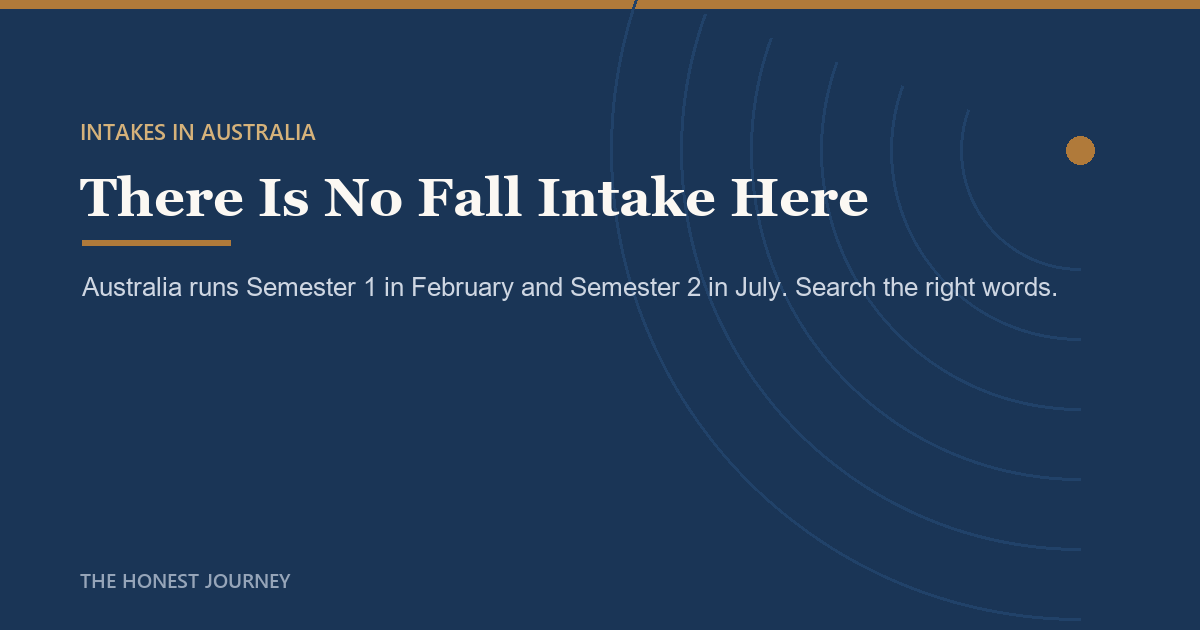
Short answer. The most common mistake with Australian intakes happens before you even apply: you search for “Fall intake” and get answers that do not fit. Australia does not use Fall and Spring. It runs on Semester 1 and Semester 2, February and July, and the seasons are flipped because it is in the southern hemisphere.
This page fixes the vocabulary first, then covers what each Australian intake actually offers, and how the intake you pick interacts with the post-study work visa that draws so many Indian students to Australia in the first place.
The same decision, by country
The intakes work on a different calendar in every country, and the honest catch is different in each. If another country is on your list, start there, or see the study abroad intakes hub.
- The full Fall vs Spring decision
- intakes in the USA
- intakes in Canada
- intakes in the UK
- intakes in Germany
Get the words right first
Because Australia is south of the equator, its calendar and its seasons do not match the American terms most Indian students have absorbed. Searching “fall intake in Australia” returns either nothing useful or dates for the wrong hemisphere.
Here is the translation. Australia runs two main intakes, and it calls them semesters.
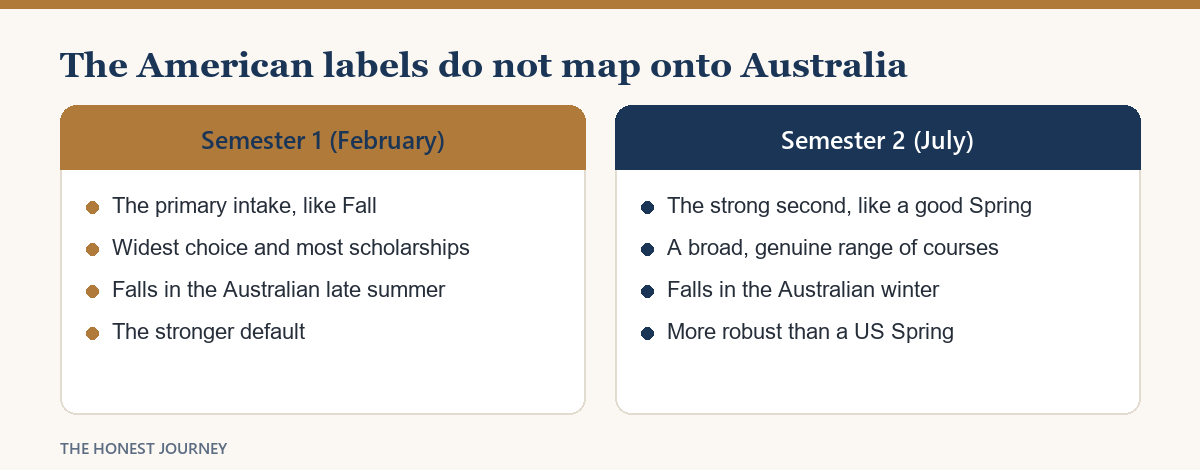
Semester 1 (February to March). This is the primary intake, the equivalent of Fall elsewhere. Widest course choice, most scholarships, largest cohort. It falls in the Australian late summer.
Semester 2 (July to August). The strong second intake, roughly the equivalent of a good Spring. Many programmes open, and it is a genuine option rather than a fallback. It falls in the Australian winter.
Some universities also run a smaller Semester 3 or trimester around November, mostly at institutions on a trimester system. Niche.
Faz's ruleAustralia has no Fall or Spring. It is Semester 1 in February and Semester 2 in July, and searching the American terms is how people read the wrong deadlines for the wrong hemisphere.
This sounds trivial until you miss an application window because you were reading dates for a calendar Australia does not use. Get the vocabulary right and half the confusion disappears.
Semester 1 versus Semester 2, honestly
February is the main event. It carries the widest range of programmes, the bulk of scholarship funding, and the largest intake of new students, so if your course and your timeline allow it, this is the stronger default.
July is a real second intake, more robust than a US Spring. Many universities open a broad slate of courses, and for a student who finished a degree or a test too late for February, it is a sensible, respectable choice rather than a compromise. The usual trade-offs apply: somewhat fewer courses and less scholarship money than February, and a smaller cohort.
| Intake | Starts | Equivalent to | Honest note |
|---|---|---|---|
| Semester 1 | February to March | Fall (primary) | Widest choice and most scholarships |
| Semester 2 | July to August | Spring (strong second) | Broad and genuine, slightly less funding |
| Semester 3 / trimester | November | Summer (niche) | Only some universities, limited courses |
How the intake interacts with the post-study work visa
Australia’s biggest draw for Indian students is the Temporary Graduate visa, the post-study work stream that lets you stay and work after graduating. Your intake feeds into when that clock starts, so it is worth a moment of thought.
Because a February start and a July start finish at different points in the year, they place your graduation, and the point you can lodge the post-study work visa, in different parts of the Australian job cycle. Neither is wrong, but if your plan leans heavily on maximising the stay-back and job-search window, align your finish with when graduate hiring in your field is most active rather than defaulting blindly. Confirm the current rules too, since the post-study work settings and any regional-study extensions have shifted in recent years.
Faz's ruleIn Australia the intake quietly sets when your post-study work clock starts. If the stay-back is the reason you chose Australia, do not pick the intake on autopilot.
People come to Australia largely for the work rights afterward, then choose the intake without connecting it to the graduation and job-search timing. Those two decisions belong together.
The Australian timeline, counted backwards
Work back from your intended semester start.
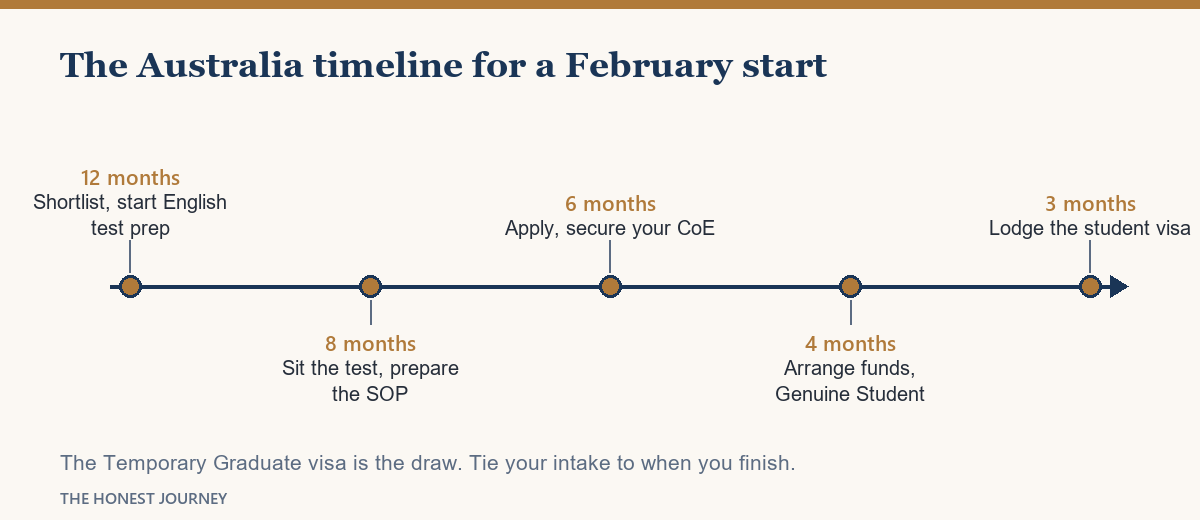
About 10 to 12 months out: shortlist universities and start your English test prep. 8 months out: sit the test and prepare your statement of purpose and recommendation letters. 5 to 6 months out: apply and secure your Confirmation of Enrolment. 3 to 4 months out: arrange finances, meet the Genuine Student requirement, and lodge the student visa. Our page on student visa rejection reasons covers the Genuine Student pitfalls that trip up Australian applications specifically.
The traps to avoid
Searching the wrong terms. “Fall” and “Spring” do not map cleanly onto the Australian calendar. Use Semester 1 and Semester 2, and check dates against the southern-hemisphere year.
Ignoring the post-study work timing. If the Temporary Graduate visa is your reason for choosing Australia, connect your intake to when you finish and when your field hires.
Underestimating the Genuine Student requirement. Australia scrutinises intent closely. A rushed application into any intake, with a thin statement, is a common refusal cause. For the bigger picture of whether Australia pays back, read the best country to study abroad.
Frequently asked questions
Does Australia have a Fall or Spring intake?
No. Australia uses Semester 1, starting in February, and Semester 2, starting in July. Because it is in the southern hemisphere, the seasons are reversed, so the American Fall and Spring labels do not apply. Search using the semester terms instead.
Which intake is the main one in Australia?
Semester 1 in February. It has the widest choice of programmes, the most scholarships and the largest cohort, making it the equivalent of the Fall intake elsewhere.
Is the July intake good in Australia?
Yes. Semester 2 in July is a strong, well-supported second intake with a broad range of courses, more robust than a typical US Spring. It has slightly fewer courses and less funding than February, but it is a genuine option, not a fallback.
How does the intake affect the post-study work visa in Australia?
Your intake decides when you graduate, which sets when you can lodge the Temporary Graduate visa and enter the job market. If the stay-back is central to your plan, align your finish with active graduate hiring in your field rather than choosing an intake at random.
When should I apply for the February intake in Australia?
Around ten to twelve months ahead. Prepare tests early, apply five to six months out to secure your Confirmation of Enrolment, then lodge the student visa three to four months out with a strong Genuine Student statement.
The honest closing
Australia is straightforward once you drop the American vocabulary. Semester 1 in February is the strong default, Semester 2 in July is a genuine second option, and the trimester intake is niche. That part is simple.
The part worth real thought is that in Australia the intake and the post-study work visa are linked. Most Indian students come for the work rights afterward, so choosing the intake without connecting it to graduation timing and hiring cycles wastes the very advantage that drew you here. Get the words right, respect the Genuine Student requirement, and pick the semester that lines your finish up with the future you actually want.