Short answer. The US is the destination most Indian students default to, and Fall is the intake most of them default to inside it. Both defaults are usually right. But “usually” is not “always”, and the students who lose a scholarship or a whole year are the ones who never checked whether the default fit them.
This page lays out the US intakes honestly: what Fall, Spring and Summer actually mean for an Indian applicant, which one your course and your funding really point to, and the timing traps that catch people every year.
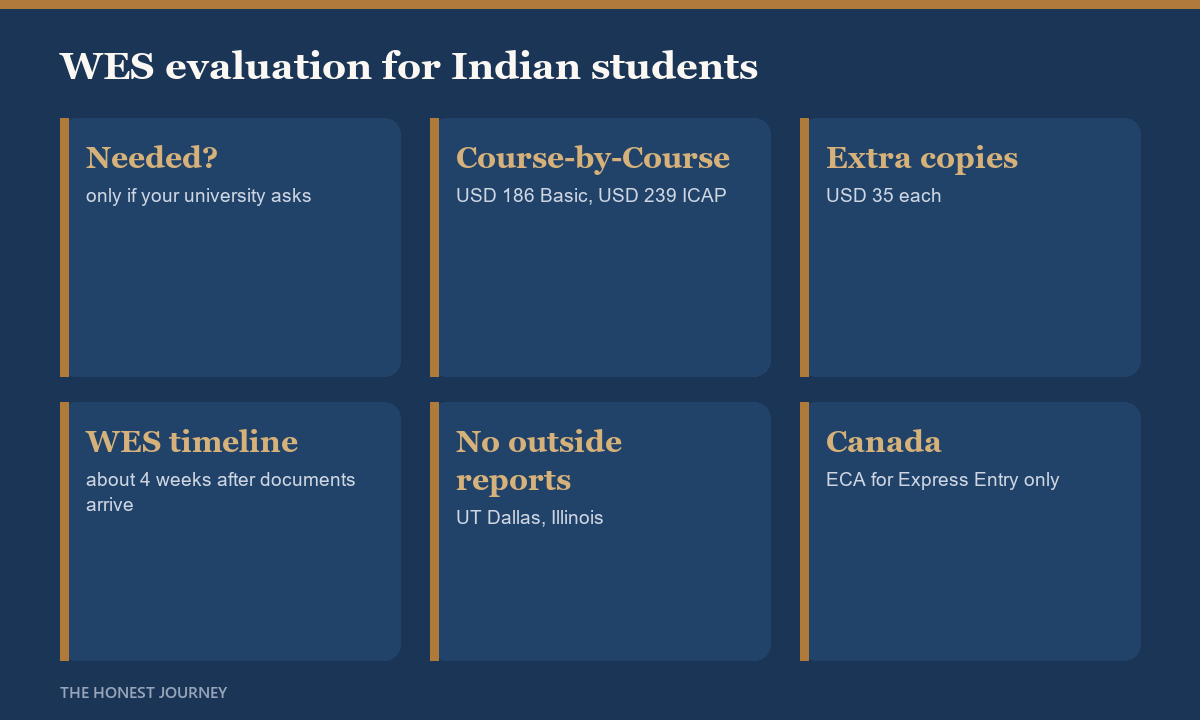
Need a transcript evaluation for your applications? See WES fees and timelines for Indian transcripts.
Planning a Fall application? Start with how to shortlist universities for an MS in the USA.
Once your I-20 arrives, prepare with the F-1 visa interview questions for 2026.
The same decision, by country
The intakes work on a different calendar in every country, and the honest catch is different in each. If another country is on your list, start there, or see the study abroad intakes hub.
- The full Fall vs Spring decision
- intakes in Canada
- intakes in the UK
- intakes in Australia
- intakes in Germany
The three US intakes
American universities run on a Fall, Spring and Summer calendar. For Indian students, only the first two matter for most degrees.
Fall intake (August to September). The primary intake, and by a wide margin. This is where the most programmes open, the most funding sits, and the largest cohort arrives. If you have no specific reason to do otherwise, this is the one.
Spring intake (January). The genuine second window. Fewer programmes and less funding, but a real option, especially for students who finished a degree or a test too late for Fall.
Summer intake (May). Small and limited. A handful of programmes, rarely funded, and not something to build a plan around. For most applicants it is not a real choice.
Faz's ruleIn the US, Fall is not just popular, it is where the assistantships live. If your plan runs on funding, the intake is half the battle before you have written a single essay.
Most teaching and research assistantships are budgeted for the Fall cohort. Applying for Spring can quietly cut you off from the money that makes a US degree affordable in the first place.
Why Fall dominates in the US specifically
Fall is the default everywhere, but in the US the reasons are sharper than usual, and they are financial.
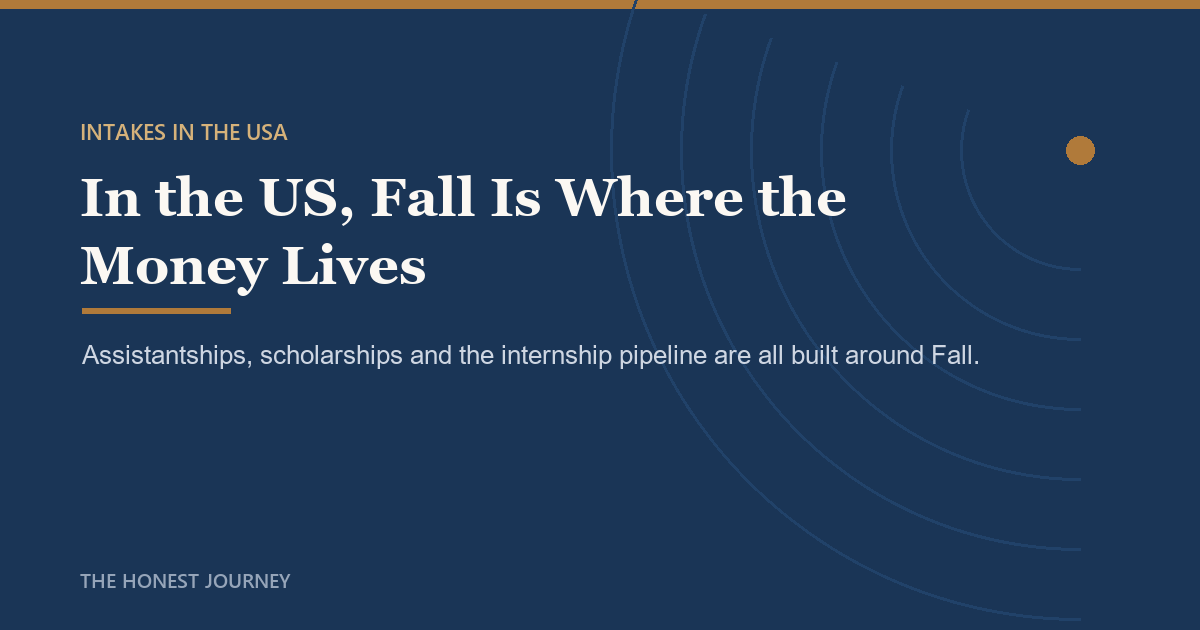
Assistantships follow Fall. Teaching and research assistantships, the funding that turns a terrifying US sticker price into something payable, are overwhelmingly attached to the Fall cycle. Departments plan their budgets and their hiring around the September cohort. Spring assistantships exist but are far fewer. For a self-funding student this is the single biggest reason Fall wins.
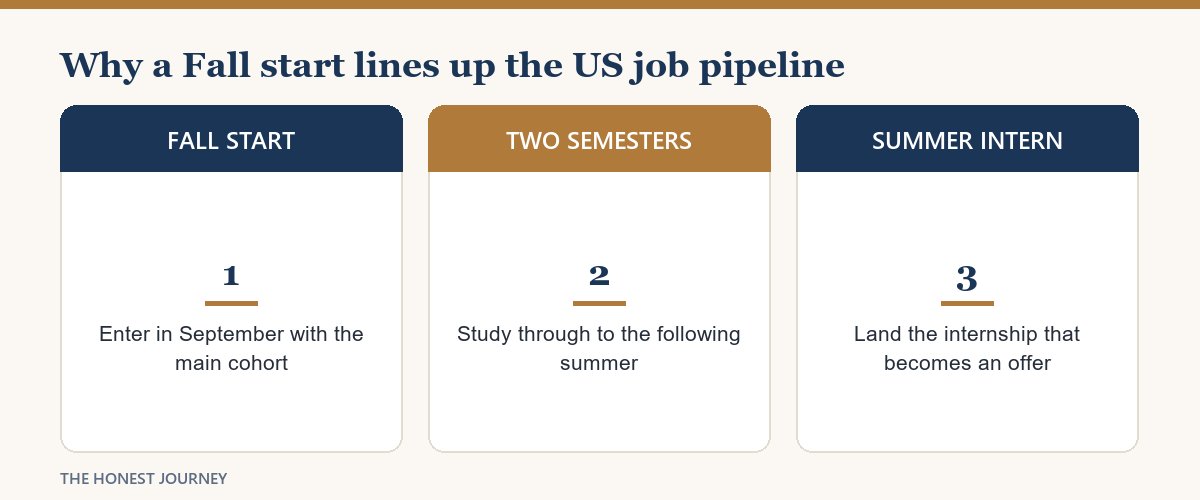
Summer internships line up. The US internship machine recruits in autumn and winter for the following summer. Enter in Fall and you complete two full semesters before that first summer, which is exactly what makes you eligible and competitive. This is the pipeline that leads to a full-time offer, and it is built around a Fall start.
The cohort is largest. More students, more courses, more clubs starting fresh, more everything. Settling into a new country is easier when you arrive with the crowd rather than mid-year.
When Spring is the right call for the US
Spring is not the loser’s bracket. For the right student it is clearly better than forcing a bad Fall.
It is the right call if you finished your degree late and cannot assemble a strong Fall application in time. It is right if your GRE, GMAT or English score came in late and a few more months would raise it. It is right if the specific programme you want happens to admit for Spring with less competition. And it is right if you simply need more runway to fund the move properly rather than scrambling.
The trade-offs are real and you should go in with eyes open: a narrower list of programmes, materially less funding, and a smaller arriving cohort. If none of those are dealbreakers for your situation, a strong Spring application beats a rushed Fall one every time.
Faz's ruleDeferring to a stronger intake is a decision, not a defeat. A weak Fall admit with no funding is the expensive outcome, not a Spring start.
The students who regret their intake are almost never the ones who waited for Spring. They are the ones who forced Fall with a half-ready file and took whatever admit came back.
| Your situation | Lean Fall | Lean Spring |
|---|---|---|
| You need an assistantship or scholarship | Yes, strongly | Only if you can self-fund |
| Your test scores are ready and strong now | Yes | – |
| You finished your degree or tests late | – | Yes |
| A few more months clearly lift your profile | – | Yes |
| Summer internship timing is critical to you | Yes | Riskier |
The US timeline, counted backwards
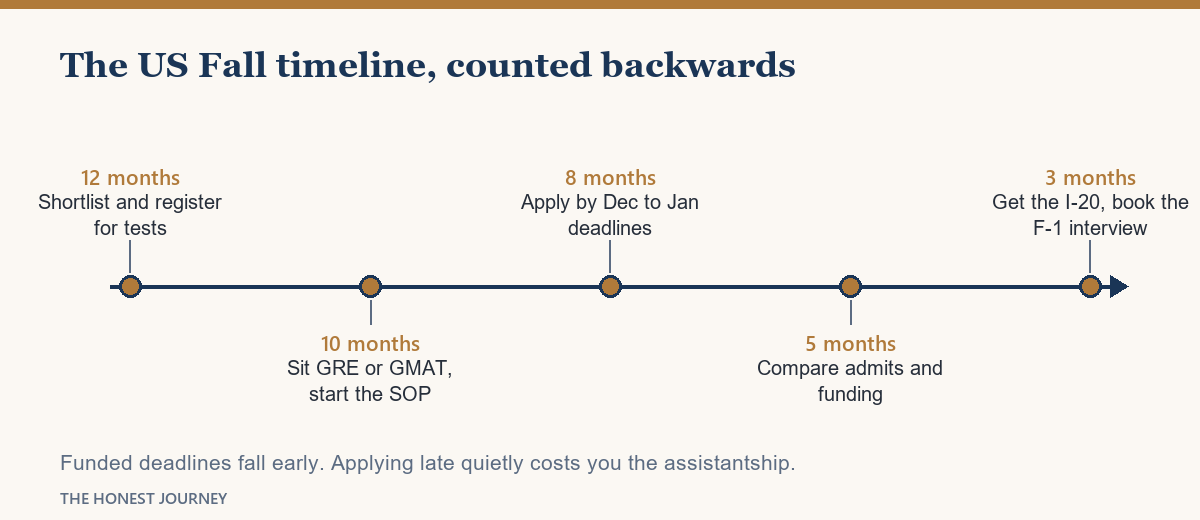
Work back from your start month. For a Fall (September) entry, the clean version looks like this.
About 12 months out (previous September to October): shortlist universities and register for the GRE, GMAT or the English test. 10 months out (November): sit your tests, and begin the statement of purpose and your recommendation letters. 8 to 9 months out (December to January): submit applications, since many funded programmes have December and January deadlines and applying early helps for assistantships. 5 to 6 months out (March to April): compare admits and funding offers and decide. 3 to 4 months out (May onward): pay the deposit, get the I-20, and book the F-1 visa interview.
For a Spring (January) entry, shift the whole sequence back by roughly eight months, with test-taking around April to May and applications by August to September.
The traps that catch Indian applicants
A few specific mistakes show up every cycle.
Assuming Spring funding matches Fall. It rarely does. If a scholarship or assistantship is central to your plan, treat Fall as close to mandatory and confirm the department’s Spring funding before you count on it.
Leaving the F-1 interview too late. The pre-Fall window is the busiest for US visa appointments, and slots in India fill fast. A late admit plus a jammed appointment calendar is how people end up deferring. Book the moment you have your I-20. Our page on student visa rejection reasons covers what a rushed interview risks.
Chasing Fall with a weak profile. Forcing a Fall application because it is the “proper” intake, when your scores or documents are not ready, produces weak admits and no funding. A deliberate Spring, or a deferral to the next Fall, usually serves you better.
Not checking whether your course even runs in Spring. Some programmes admit only in Fall. Confirm your specific programme’s intakes before assuming you have a choice.
The bigger financial picture, whether a US degree pays back at all, is worth reading alongside this: see is studying in the USA worth it for Indian students and the honest walk-through on studying in the USA.
Frequently asked questions
How many intakes are there in the USA?
Three: Fall (August to September), Spring (January) and Summer (May). Fall is the primary intake with the most courses and funding. Spring is a solid second option. Summer is small and offered by few programmes.
Which intake is best for the USA?
Fall for most Indian students, because assistantships, scholarships and the summer-internship cycle are all built around it. Spring is the better choice if you finished late, need more preparation time, or your profile is clearly stronger with a few extra months and you can self-fund.
Is there enough funding in the Spring intake in the USA?
Usually less than in Fall. Most teaching and research assistantships are budgeted for the Fall cohort. Spring funding exists but is more limited, so if funding is essential, lean Fall and confirm the department’s Spring options directly.
When should I start applying for the Fall intake in the USA?
About twelve months ahead. Register for tests around a year out, sit them by November, and submit applications by the December to January deadlines, earlier if you want to be competitive for assistantships.
Can I get an F-1 visa in time for a January Spring intake?
Yes, and Spring often has an easier appointment calendar than the pre-Fall crush. Book your interview as soon as you receive your I-20, and you generally have a smoother run at slots than Fall applicants.
The honest closing
For a US-bound Indian student, Fall is usually the right intake, and the reasons are concrete: it is where the assistantships, the scholarships and the internship pipeline live. That is not herd behaviour, it is following the money and the timing.
But “usually” leaves real room. If you finished late, if your scores need another few months, or if a rushed Fall would mean a weak application and no funding, Spring is not a step down. It is you choosing runway over a status symbol.
Decide it on your own facts, not the default. Check that your programme and your funding are actually available in the intake you pick, book the visa the moment you can, and enter with your strongest application rather than your fastest one.