Short answer. F-1 officers ask about four things: why this course and university, who pays, what you will do after, and why you will return. Since September 2025 nearly everyone interviews in person, in India. Your social media must be public and listed on the DS-160. A calm, consistent account of your own plan beats any memorised answer.
Most F-1 question lists online are written as if the interview has not changed since 2019. It has. Since mid 2025, interview waivers have been all but abolished, you have to apply in your own country, and your online presence is now part of the file. The questions themselves are still the same handful, but the officer now arrives at the window knowing more about you than your DS-160 says.
Budgeting for a second interview? The F-1 visa fee calculator shows what a refusal costs and when SEVIS does not need paying again.
The officer reads your DS-160 first. See how to fill it consistently.
Graduated a while ago? Read how visa officers look at a study gap before your interview.
This page does two things. It groups the questions by what the officer is actually testing, so you can prepare for any wording of them rather than learning a script. And it lists the 2025 and 2026 changes that decide what happens before and after those two or three minutes at the window.
What changed in 2025, and why old question lists mislead
The questions have barely moved. The process around them has moved a lot, and most of it lands on Indian applicants in particular, because India sends more students to the US than almost any other country and its appointment queues are among the longest.
| Change | When | What it means for you |
|---|---|---|
| Social media vetting for F, M and J applicants | 18 June 2025 | Set every profile to public. Officers review your online presence as part of the decision. |
| Social media identifiers on the DS-160 | In force | List every platform and username you used in the past five years. Leaving one out can be treated as misrepresentation. |
| Interview waivers withdrawn for students | 2 September 2025 | First time applicants, renewals and F-2 dependants all interview in person. The dropbox route for students is effectively gone. |
| Apply in your country of nationality or residence | September 2025 | Booking a faster slot in Dubai, Bangkok or Frankfurt is no longer a workaround for Indian residents. |
| Visa integrity fee of $250 | Law in force from 1 October 2025 | Charged only when the visa is issued, on top of the MRV and SEVIS fees. Rollout has been uneven by consulate, so check what your post charges. |
| Duration of status rule | Blocked by a court on 14 September 2026 | Fixed four year admissions were due to start on 15 September 2026. A nationwide preliminary injunction keeps duration of status in place for now, and an appeal is expected. |
The practical result is that your interview is harder to reschedule, harder to move to another city abroad, and harder to fix with a quick second attempt. Treat the first interview as the one that counts.
How the interview actually works
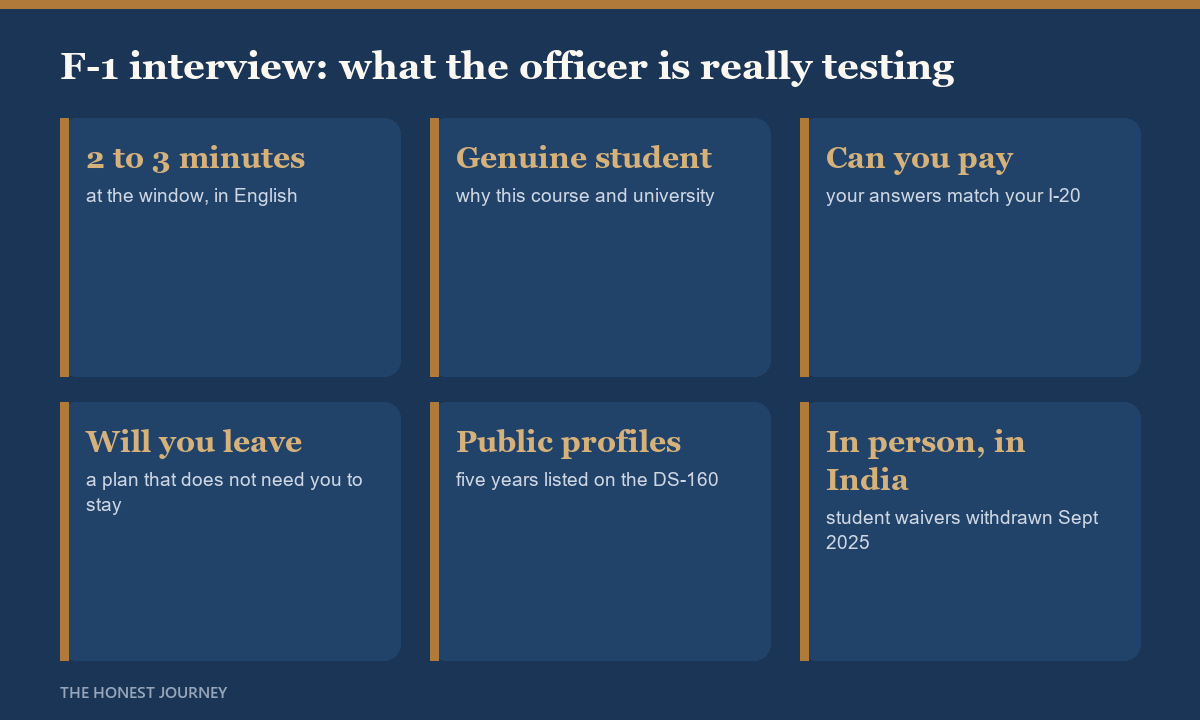
The interview is usually two to three minutes, in English, at a window. The officer has your DS-160, your SEVIS record and whatever is publicly visible about you. They do not have time to read your file, and most of the time they will not ask for most of it.
Every F-1 applicant starts from the presumption in Section 214(b) of the US Immigration and Nationality Act: you are treated as an intending immigrant until you show otherwise. In practice the officer is checking three things.
- You are a genuine student. The course fits your background and you can explain why you chose it.
- You can pay without working illegally. The money on your I-20 exists, and you can say where it comes from.
- You intend to leave after your studies. Your plan after graduation is coherent and does not depend on staying.
Every question below is a way of testing one of those three. If you know which one a question is testing, you can answer any version of it without having memorised the wording. We explain the refusal ground itself in more detail on our US student visa guide for Indian students.
The questions, grouped by what they test
These are the questions Indian applicants report most often. The wording varies from officer to officer. The intent behind each group does not.
Your course and university: are you a genuine student?
- Why this university?
- Why this course?
- Which other universities did you apply to, and which admitted you?
- Why did you choose this one over the others?
- Who is your professor or adviser, and what is their research?
- Why not study this in India?
What they are checking: that you made the choice yourself, for reasons you understand. A good answer names one or two specific things about the programme, such as a lab, a specialisation, a faculty member or a curriculum feature, and connects them to what you studied or worked on before. Rankings alone sound like an agent chose for you.
The trap: “Why did you pick this over a better ranked admit?” If you chose on cost or scholarship, say so. It is a perfectly good reason and it is honest. Inventing an academic reason on the spot is how answers fall apart.
Your academics and scores: can you do this course?
- What was your undergraduate degree and your grade?
- What were your GRE, GMAT, IELTS, TOEFL or Duolingo scores?
- Do you have backlogs? Why?
- What is your final year project about?
- Why is there a gap in your education?
What they are checking: fit between your record and the programme. Weak scores do not sink a file by themselves, because the university has already admitted you. What hurts is being evasive about them. A backlog or a gap has an explanation, and a short factual one is enough. If you were working during the gap, say what you did.
Money: can you pay for this?
- Who is sponsoring your education?
- What do your parents do, and what do they earn?
- How much is the first year going to cost?
- Have you taken an education loan? From which bank, and for how much?
- How will you repay the loan?
- Do you have a scholarship or assistantship?
What they are checking: that the funds on your I-20 are real, available and consistent with your family’s income. Know your numbers without looking at a paper: the total cost on the I-20, how much comes from each source, and your sponsor’s annual income. An answer that matches your DS-160 and I-20 exactly is worth more than a thick folder.
If you are funded by a loan, know your lender, your sanctioned amount and roughly what your EMI will be once repayment starts. Officers ask about repayment because it tests your plan after graduation too. Our pages on proof of funds for a student visa and using a sanction letter as proof of funds cover the paperwork side.
After graduation: will you leave?
- What will you do after you graduate?
- Do you plan to work in the US?
- What is the average salary for your course in India?
- Will you come back to India? Why?
- Which companies would you work for back home?
What they are checking: non-immigrant intent. This is the group where Indian applicants most often talk themselves into a refusal, usually by being either too eager to stay or too rehearsed about returning.
OPT is a legal part of the F-1, and the officer knows it. Saying you hope to get practical experience on OPT and then return is not a problem. Saying you want to settle in the US is. The honest middle answer, a specific kind of role in India that your degree prepares you for, plus family or career reasons to return, is the one that holds up under a follow-up question. If you want the real picture of the work window after graduation, see our guide to OPT and post-study work in the US.
Your background and online presence: is anything inconsistent?
- Have you been to the US or any other country before?
- Do you have relatives in the US? What do they do?
- Have you ever been refused a visa?
- Questions about something visible on your public profiles
What they are checking: that what you say matches what they can see. Relatives in the US are not disqualifying, but hiding them is. A previous refusal must be declared on the DS-160, and it will be on the officer’s screen whether you mention it or not.
Special cases: masters, undergraduate, PhD, and a second attempt
Master’s applicants get the most questions on course choice and job plans, because that is where the immigration risk is highest in the officer’s eyes. Expect a follow-up on why a US master’s makes sense at this point in your career, especially if you have work experience. Our page on studying abroad as an engineering graduate covers that decision in numbers.
Undergraduate applicants are asked more about parents: who they are, what they do, and why the family is sending a seventeen or eighteen year old abroad. Your parents’ ability to fund four years, not one, matters here.
PhD applicants are usually funded, so the money questions are shorter. The research questions are longer, and some fields trigger administrative processing, covered below.
After a 214(b) refusal, the second officer will see the first refusal. Nothing has to be new on paper, but something has to be different in substance: a clearer explanation, a corrected inconsistency, or new funding evidence. Reapplying with the same answers a week later rarely works. Our page on student visa rejection reasons sets out what usually went wrong and the reapply playbook.
Faz's ruleThe officer is not grading your English or your confidence. They are checking whether your answers agree with your DS-160, your I-20 and your public profile.
The applicants I have seen refused were rarely weak on paper. They were inconsistent. A sponsor income that did not match the DS-160, an adviser name they could not recall, a plan to return that sounded rehearsed. Before the interview, read your own DS-160 once more, slowly, as if you were the officer.
Your social media before the interview
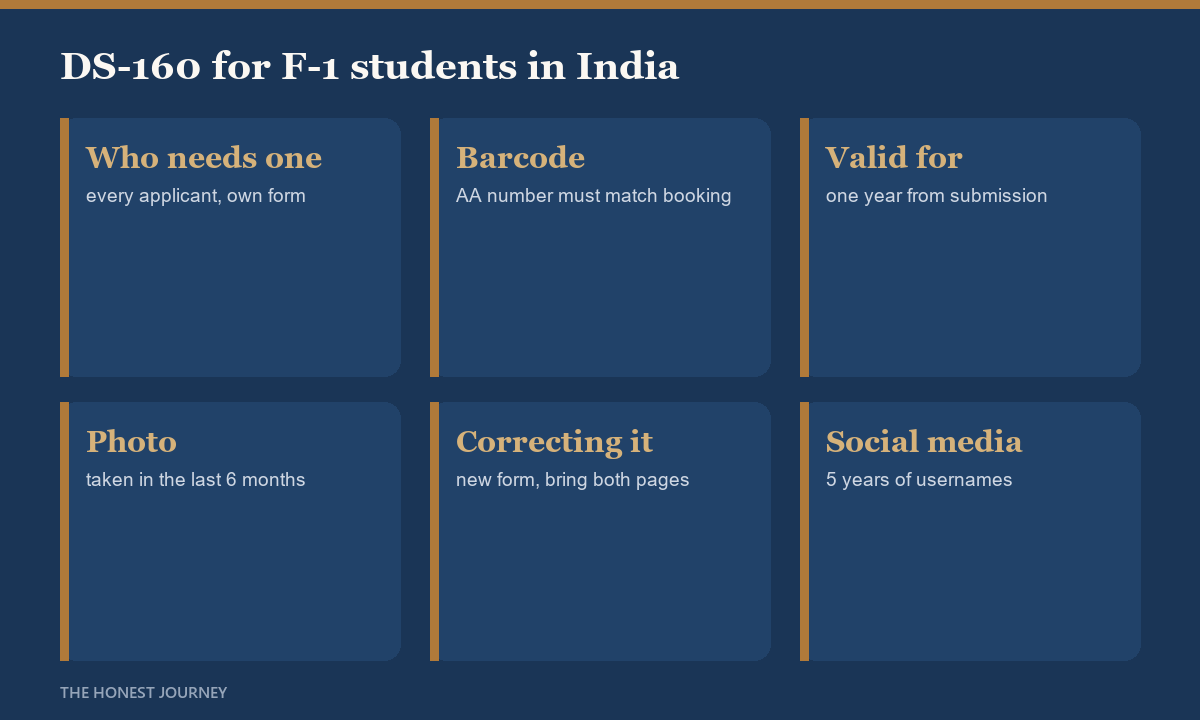
Since 18 June 2025, F, M and J applicants are told to set their social media profiles to public, and officers review applicants’ online presence as part of the decision. The DS-160 asks for the platforms and usernames you have used in the past five years.
Three practical points follow from the university guidance on this:
- List everything, including dormant accounts. Leaving an account off the DS-160 can be treated as misrepresentation, which is a far bigger problem than anything the account contains.
- Do not mass delete content just before the interview. University offices specifically warn against abrupt large deletions right before applying.
- Check that your profiles match your story. If your LinkedIn says you work somewhere your DS-160 does not mention, fix the DS-160 or be ready to explain.
What to carry to the interview
The officer will ask for very little, but you should have it all in a folder you can open without searching.
- Passport, valid for at least six months beyond your intended stay
- Form I-20, signed by you and your school official
- DS-160 confirmation page and appointment confirmation
- SEVIS I-901 fee receipt ($350)
- MRV fee receipt ($185)
- Admission letter and any scholarship or assistantship letter
- Financial documents: bank statements, loan sanction letter, sponsor income proof such as ITRs
- Academic documents: transcripts, degree certificate, test score reports
The rupee amounts for the MRV fee are fixed by the consular exchange rate shown on the payment portal, which changes from time to time, so check it on the day you pay. Our packing list for the USA covers what to carry once the visa is in your passport.
If you get a 221(g) instead of a decision
A 221(g) slip means your case has been placed in administrative processing. It is technically a refusal, but it is not a 214(b) refusal and it is not final. Either the officer needs a document from you, or the case needs further review.
University guidance is that most administrative processing is resolved within about 60 days of the interview, and that you should generally wait 180 days before chasing the consulate. In higher education it is most often triggered by research fields with possible military applications. If your slip asks for a document, send exactly what it asks for, and nothing else.
Timing: when to book and when you can travel
An F-1 visa can be issued up to 365 days before your programme start date, but you cannot enter the US more than 30 days before that date. With interview waivers gone and slots in India scarce at peak season, the useful rule is to book as soon as you have your I-20 and have paid the SEVIS fee, not when you feel ready.
For the Fall intake, that usually means booking in spring. Our guide to US intakes for Indian students sets out the full calendar, and the pre-departure checklist covers everything after the visa.
The honest closing take
The F-1 interview is short, and that is exactly why it feels arbitrary. It is less arbitrary than it looks. The officer is testing three things, and nearly every refusal traces back to one of them being unclear or inconsistent, not to a wrong answer to a trick question.
Question banks with a hundred model answers make this worse, not better. Officers hear the same memorised lines all day, and a memorised line is the easiest thing in the world to break with a follow-up. The better preparation is duller: know your course, know your numbers, know your plan, and make sure your DS-160, your I-20 and your public profiles all say the same thing. Then practise saying it out loud to someone who interrupts you.
And plan for the process, not just the conversation. In 2026 you interview in person, in India, with your social media on the table. Book early, and treat the first interview as the one you get.
FAQ
What are the most common F-1 visa interview questions?
Why this university, why this course, who is funding you, what your sponsor earns, what you will do after graduating, and whether you will return to India. Almost every question tests one of three things: that you are a genuine student, that you can pay, and that you intend to leave after your studies.
How long is the F-1 visa interview?
Usually two to three minutes at the window, in English. The officer decides mostly from your answers and your DS-160, and rarely asks for more than one or two documents.
Is the F-1 interview waiver still available in 2026?
For students, effectively no. From 2 September 2025 the State Department withdrew waivers for most applicants, including F-1 renewals and F-2 dependants. You should expect to interview in person.
Can Indian students take the F-1 interview in another country?
Not as a routine workaround any more. Since September 2025, applicants are expected to apply at a US embassy or consulate in their country of nationality or residence, which for most Indian students means India.
Do I have to make my social media public for an F-1 visa?
Yes. Since 18 June 2025, F, M and J applicants are told to set all social media profiles to public, and the DS-160 asks for platforms and usernames used in the past five years. Omitting an account can be treated as misrepresentation.
What should I say if the officer asks whether I will work in the US?
Tell the truth. OPT is a legal part of the F-1, so saying you hope to gain practical experience on OPT before returning is fine. What undermines your case is a plan that only makes sense if you stay permanently.
What happens after a 214(b) refusal?
You can reapply, and the next officer will see the refusal. Reapply only once something is genuinely different, such as a clearer explanation, a corrected inconsistency or stronger funding evidence. Repeating the same interview rarely changes the result.
How much are the F-1 visa fees?
The MRV application fee is $185 and the SEVIS I-901 fee is $350, both paid before the interview. A $250 visa integrity fee is also set by law, charged only when a visa is issued, with collection rolling out unevenly across consulates.
Where these figures come from
- University of Illinois Chicago, on the 18 June 2025 social media vetting announcement for F, M and J applicants
- Stanford Bechtel International Center, on the five year social media disclosure and the warning against omitting accounts or mass deleting content
- Northeastern University, on in-person interviews for F and J applicants and renewals from 2 September 2025
- Georgetown University immigration updates, on the country of nationality or residence rule and the court order of 14 September 2026 on duration of status
- Fragomen, on the preliminary injunction in Presidents’ Alliance v. DHS (D. Mass.)
- Boston University ISSO, on the $250 visa integrity fee
- ICE, for the $350 SEVIS I-901 fee
- UCSF ISSO, on 221(g) administrative processing
- US Department of State, student visa page
Checked against the sources above in September 2026. US visa rules changed repeatedly through 2025 and 2026, so confirm the current position with your university’s international office and the US embassy in India before your interview.