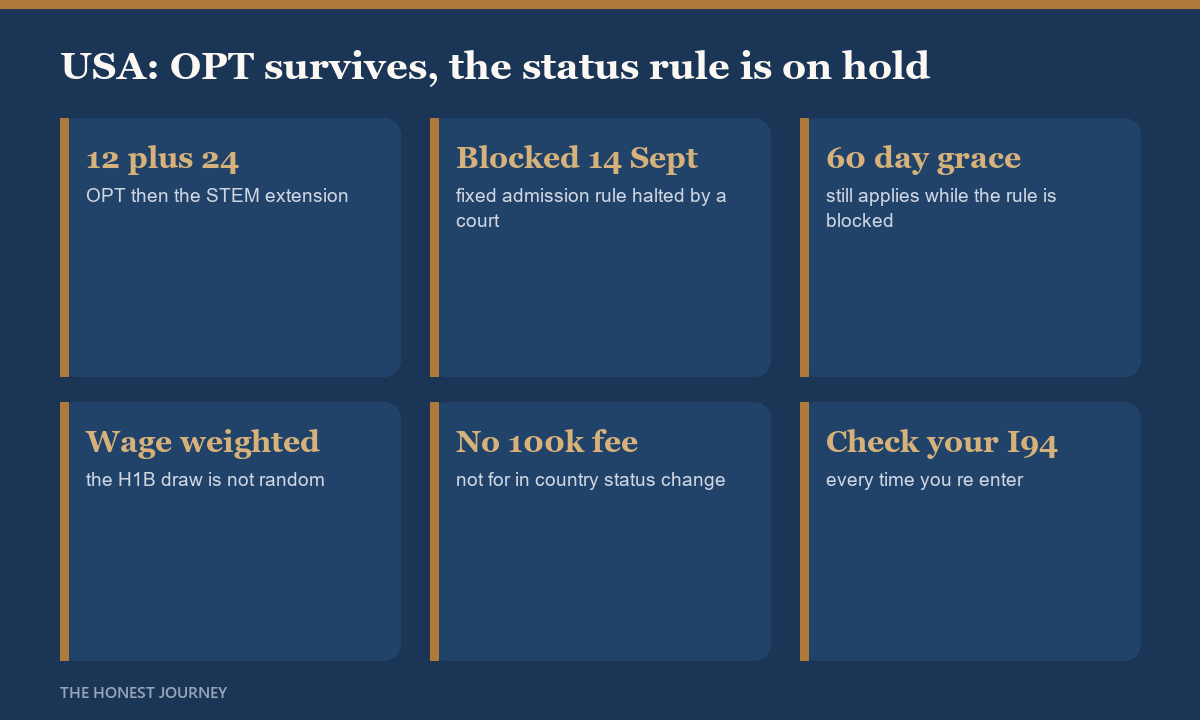
Short answer. OPT still gives 12 months, or 36 with the STEM extension. A DHS rule replacing duration of status with fixed admission periods from 15 September 2026 was blocked nationwide by a federal court on 14 September. For now your status continues as before, with the 60 day grace period. An appeal is expected.
The USA gives you 12 months of OPT after graduating, plus a 24 month STEM extension if your degree is on the STEM list, so up to three years of work rights in total. Both survive intact in 2026. What nearly changed is the ground underneath them. DHS finalised a rule to replace duration of status with fixed admission periods and cut the grace period from 60 days to 30, due from 15 September 2026, but a federal court blocked it nationwide the day before. It is on hold rather than withdrawn, so it is still worth understanding. Separately, the H-1B cap lottery is no longer random: selection is now weighted by the wage level of the offer, which structurally disadvantages exactly the entry level salaries most fresh graduates are offered. The good news nobody seems to have told students is that the 100,000 dollar H-1B fee does not apply to you if you are inside the US on OPT changing status.
The American plan has always had one obvious bottleneck and Indian students know it by name: the H-1B lottery. For years the honest advice was simple enough. You get one to three years of OPT, you get two or three shots at a random lottery, and the odds are what they are. That framing is now wrong in two ways, and both of them matter more than the usual advice admits.
First, a rule that would split your permission to work from your permission to remain is frozen by a court, not withdrawn, and could return on appeal. Second, the lottery stopped being a lottery in the sense you understood it. This page covers what OPT and STEM OPT still give you, what the blocked duration of status rule would mean if it returns, how the wage weighted selection changes your odds specifically, and what all of it does to the honest maths on a US master’s. If the US is still a decision rather than a plan, read this next to our honest ROI breakdown for the USA and the F-1 student visa guide.
What OPT and STEM OPT still give you
Start with the part that has not changed, because a lot of panicked commentary this year implied OPT was being taken away. It was not.
- Post completion OPT: 12 months. Available after your degree, in a job directly related to your field of study. You apply through USCIS and receive an Employment Authorization Document.
- STEM OPT extension: a further 24 months. A one time extension for graduates of eligible science, technology, engineering and mathematics fields, taking your total to 36 months. Your employer must be enrolled in E-Verify and there are formal training plan and reporting obligations.
- Cap gap. If your employer files a timely H-1B cap petition while you are on valid OPT, your work authorisation is automatically extended to bridge the gap until the H-1B start date.
Three years is genuinely generous by international standards. It is longer than the UK now offers, longer than Germany, longer than Ireland. That length is the single strongest argument for the US, and it is why the STEM question matters so much more than students realise at application time. Whether your specific programme is on the STEM designated list is often the difference between one year and three, and it is worth checking the CIP code of the exact programme before you accept an offer rather than assuming that anything technical sounding counts.
The rule on hold: fixed admission periods, blocked on 14 September 2026
This is the part to understand properly. It was due to rewire how being an international student in the US works, it has been stopped for now, and it could still come back.
Historically, F-1 students were admitted for “duration of status”, written as D/S on your I-94. It meant that as long as you remained a full time student in good standing, you were lawfully present. There was no expiry date to manage. Your status simply continued.
A final rule published by DHS on 17 July 2026 would end that. Under it, F-1 students would be admitted for a fixed period tied to the programme end date on their record, capped at four years. If you needed longer, you would either apply to USCIS for an extension of stay on Form I-539, with a fee and biometrics, or leave and receive a new admission period when you re-enter. Alongside it, the grace period after your programme or authorised work ends would be cut from 60 days to 30.
If the rule is reinstated and you are already in the US. Students present in F-1 status when the rule takes effect could stay without filing an extension up to the programme end date on their record, and no later than 14 November 2030. The rule would mainly bite on new admissions and on re-entry after travel, so keep checking what your I-94 says every time you come back.
What it would mean for OPT. Post completion OPT and STEM OPT that run past your admission end date would need either an extension of stay or a fresh admission on re-entry. One useful exception: if your employer has filed a timely H-1B cap petition and you qualify for cap gap, you would not need to file an extension. How the transition applies to your own OPT dates is worth confirming in writing with your international student office.
The court has blocked it, for now. Universities and student groups sued on 18 August 2026. On 14 September 2026, the day before it was due to start, a federal district court in Massachusetts granted a nationwide preliminary injunction in the case brought by the Presidents’ Alliance on Higher Education and Immigration, NAFSA and others. DHS is barred from implementing the rule while the case continues, and the government is expected to appeal. Until a court says otherwise, F-1 students continue to be admitted for duration of status, and the grace period stays at 60 days. An appeal could change that quickly, so check with your university’s international student office before any trip abroad.
The consequence worth internalising, if the rule returns, is this. Your authorisation to work and your authorisation to remain would become two different approvals that can fall out of sync. Approval of an employment document does not by itself settle whether you are allowed to be in the country for the whole period that document covers. Students on a three year STEM OPT run are the most exposed here, because that is a long stretch to cover with a fixed admission period, and an extension application that sits in a queue is a very different experience from a status that simply continued on its own.
None of this would make the US unworkable. It does mean the era of not thinking about your I-94 is probably ending, injunction or not. Check your admission end date every single time you re-enter the country, diarise it, and treat any extension filing as something you do early rather than close to the line. A 30 day grace period, if it arrives, leaves much less room to fix a problem you notice late.
The H-1B lottery is no longer a lottery
The cap itself is unchanged: 65,000 regular selections plus 20,000 reserved for holders of a US master’s degree or higher. Registration for the FY 2027 season ran in March 2026 at 215 dollars per registration, filed by your employer.
What changed is how selections are made. DHS finalised a wage weighted selection process, effective from late February 2026, replacing the purely random draw. Registrations are now weighted according to the wage level of the offer measured against the official occupational wage statistics for that role and location. Higher wage offers get proportionally better odds.
Read that honestly, because the implication for you is specific and unflattering. A fresh master’s graduate is, almost by definition, offered an entry level wage. Under a random lottery, a graduate on a level one wage had exactly the same chance as a senior engineer on a level four wage. Under weighting, they do not. The change does not ban anyone, but it systematically shifts the odds away from the group that most Indian students belong to in the year they most need it.
What follows from that is not despair, it is strategy. The wage level attached to your offer is now a variable that affects your immigration outcome, not just your bank balance. Negotiating a higher band, taking the offer in a higher cost metro where the prevailing wage is higher, or spending a year on OPT building experience before your first cap attempt so you enter at a stronger wage level, are all now immigration decisions as well as career ones. Students who understand this in year one will do meaningfully better than students who learn it in year three.
The 100,000 dollar fee that probably does not apply to you
This one caused genuine panic among Indian students and most of the panic was misplaced, so it is worth stating clearly.
A 100,000 dollar fee on H-1B petitions was introduced, struck down by a federal court on 8 June 2026, and then put back into effect by a temporary stay while the government appeals. But the fee applies principally to petitions filed for workers who are outside the United States. It does not apply where the petition requests a change of status for someone already inside the US who is granted that change.
In plain terms: if you are in the US on F-1 with OPT and your employer files to change your status to H-1B, that fee is not your problem. The students it genuinely affects are those being hired from abroad. If an employer or an agent has told you that hiring you will cost them 100,000 dollars while you are on OPT, they have either misunderstood the rule or are using it as an excuse. That distinction is worth knowing before an interview, not after.
The three year timeline, mapped
If you get the full STEM runway, you have 36 months and three cap seasons. The students who convert treat that as a schedule rather than a hope. Here is what that schedule looks like.
Final year of study, before OPT. Verify your programme’s STEM designation by CIP code with your international office, in writing. Apply for OPT in the window your school specifies, since filing late costs you months off the front of an already finite runway. Start applying for jobs before you graduate, and filter for employers who have sponsored H-1B petitions before, which is public information you can check.
OPT year one. Your priority is a role that is both genuinely related to your field, which OPT requires, and at an employer willing to file an H-1B. Raise the sponsorship question early rather than at offer stage, because discovering in month ten that your employer does not sponsor is the single most common way this goes wrong. If your first cap season falls here, you enter it at the lowest wage level you will ever have, so treat it as the weakest of your three attempts rather than the decisive one.
STEM extension, years two and three. File the extension well before your initial OPT expires, and confirm your employer is enrolled in E-Verify, because the extension is not available otherwise. This is where the wage weighting starts working for you rather than against you: two years of US experience should move you up a wage level, and each step improves your selection odds. Use the pay review conversation deliberately, because your salary is now an immigration input.
Throughout. Track your I-94 admission end date after every re-entry, keep your SEVIS record current with every address and employer change, and never let a reporting obligation lapse. If the fixed admission rule returns, these stop being clerical details.
What to do if the H-1B does not land
Plan for this branch, because it is common and being unprepared for it turns a manageable outcome into a crisis. There are more routes than most students realise.
- Cap exempt employers. Universities, affiliated non-profit research organisations and some government research bodies are exempt from the numerical cap entirely, so they can file for you at any time of year with no lottery. Pay is usually lower than industry, but it is a legitimate route that a surprising number of students never consider.
- O-1. For those with genuinely strong publication, award or recognition records, particularly research heavy graduates. Demanding, but not restricted to the famous.
- Employer transfer abroad. Working for a multinational’s overseas office and returning later on an L-1 intracompany transfer is a well trodden path.
- Canada as a bridge. Many US trained graduates move north, use the PGWP or a work permit route to permanent residence, and re-enter the US years later from a stronger position.
One thing to avoid firmly: enrolling in a questionable programme purely to obtain day one curricular practical training in order to extend your stay. These arrangements have been the subject of enforcement action, and the consequences for your immigration record are severe and lasting. If the runway ends, use one of the legitimate routes above or go home with your experience intact. A clean record is worth far more than an extra year obtained badly.
That warning got sharper in August 2026. On 24 August, SEVP Broadcast Message 2608-02 told schools that CPT is allowed only where practical training is required of every student in the programme, and that CPT through an optional elective course does not qualify. It is guidance to schools rather than a new regulation, but universities have already paused or tightened approvals, and schools that get it wrong risk losing their certification. Do not build a plan on CPT unless your programme requires it of everyone.
What this does to the honest maths
A US master’s remains the highest ceiling option available to an Indian student, and also the highest variance one. The salaries are genuinely the best in the world for technical fields, the three year STEM runway is the longest meaningful post study window on offer, and the graduates for whom it works do better than they would have anywhere else. That case is real and I am not going to talk you out of it.
But the honest version has to include the shape of the risk. You are spending the largest sum of any destination, frequently 40 to 70 lakh with a loan against it, for a work window that is long but finite, ending in a selection process that has just been reweighted against entry level wages, in a status environment that now requires active management rather than passive continuation. The good outcome is very good. The bad outcome is a large loan and a return to India with two or three years of US experience, which is genuinely valuable but is not the outcome the loan was sized for.
So the questions that actually decide it are narrow and answerable. Is your specific programme STEM designated, checked by CIP code and not by assumption? Is your field one where an entry level offer still lands at a respectable wage level, or one where it does not? Can your family service the loan on the scenario where you return after OPT rather than only on the scenario where H-1B lands? If those three answers are good, the US remains a strong bet. If the third answer is uncomfortable, that discomfort is the finding, and it is much cheaper to have it now. Our guide on returning to India after studying abroad works through that scenario without pretending it is a failure, because usually it is not.
The honest take
OPT and STEM OPT are intact and still the most generous post study runway of any major destination. That is the headline and it is a good one. What has genuinely changed is that the US now demands administrative attention from you in a way it did not before: a status rule that is frozen by a court rather than settled, and a lottery that rewards wage level rather than treating everyone equally.
The students who will struggle are not the ones with weaker degrees. They are the ones who assume the rules are what their seniors described in 2023, do not check their I-94 after a trip home, and discover at month 34 of a 36 month runway that something needed filing at month 20. Track your dates, verify your programme’s STEM status before you accept, treat your wage level as an immigration variable, and size the loan against the honest downside. Do that and the American bet is still one of the best available. Skip it and the cost of finding out is very high.
Rules verified 17 September 2026 against DHS and USCIS guidance, the 14 September court order and current reporting. US immigration policy is moving unusually fast this year and several of these items have been litigated, so confirm the current position with your university’s international student office and on uscis.gov before acting.
Frequently asked questions
Is OPT being cancelled?
No. Both post completion OPT of 12 months and the 24 month STEM extension remain available in 2026. The rule that was due to take effect, and is now blocked by a court, concerns how long you are admitted to the US, not whether OPT exists.
Did my F-1 status change on 15 September 2026?
No. A federal court blocked the rule nationwide on 14 September, so you remain in duration of status. If the rule is later reinstated, students already in F-1 status could remain without filing an extension up to their programme end date, and no later than 14 November 2030.
Is duration of status ending?
Not for now. DHS finalised a rule to replace it with fixed admission periods of up to four years from 15 September 2026, but a court blocked it the day before. The government is expected to appeal, so the rule could return, in which case you would need to apply to USCIS to extend beyond your admission date.
Has the grace period changed?
Not at the moment. The rule would cut it from 60 days to 30, but with the rule blocked the 60 day grace period still applies. Check again before your programme or OPT ends, because an appeal could change this.
How many chances at the H-1B do I get?
It depends on your OPT length. With 12 months of OPT you realistically get one cap season. With the 24 month STEM extension you typically get three. This is the main reason the STEM designation of your programme matters so much.
Does the wage weighted lottery mean I cannot get an H-1B as a fresh graduate?
No, but your odds are lower than a higher paid applicant’s rather than equal to them as before. It makes your offered wage level a factor worth optimising, and it strengthens the case for building experience on OPT before relying on a cap attempt.
Will my employer have to pay 100,000 dollars to sponsor me?
Not if you are inside the US on F-1 and the petition requests a change of status that is granted. The fee applies mainly to petitions for workers outside the country.
What is cap gap?
If your employer files a timely H-1B cap petition while your OPT is valid, your work authorisation is automatically extended to bridge the period until the H-1B takes effect, so you do not fall out of work authorisation in between.