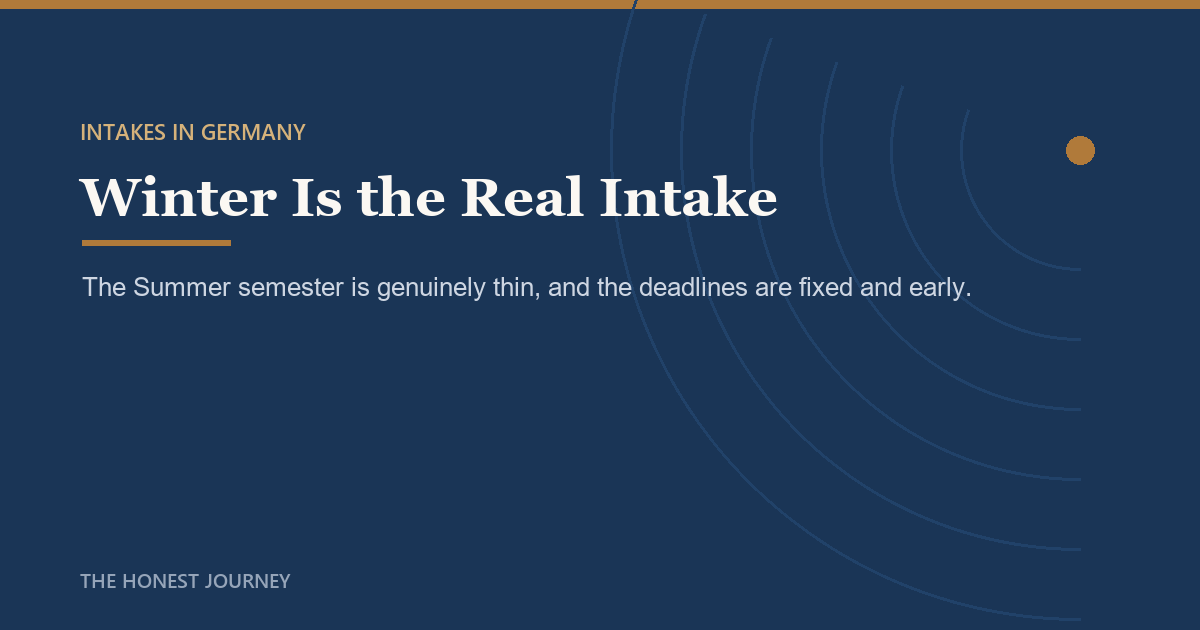
Short answer. Germany is the destination where the intake matters most and gets understood least. It does not run Fall and Spring. It runs a Winter semester and a Summer semester, the Winter one is far larger, and its public-university deadlines are strict, early and unforgiving in a way the English-speaking countries are not.
This page covers the two German intakes honestly: why Winter is the real one for most international students, why the Summer intake is thinner than it looks, and how Germany’s fixed deadlines and slow processing make runway matter more here than anywhere else.
Planning a Winter intake at TUM or RWTH? Check whether your programme requires the GRE early.
The same decision, by country
The intakes work on a different calendar in every country, and the honest catch is different in each. If another country is on your list, start there, or see the study abroad intakes hub.
- The full Fall vs Spring decision
- intakes in the USA
- intakes in Canada
- intakes in the UK
- intakes in Australia
The two German intakes
Winter semester (starts October). This is the primary intake, and for international students it is not close. The overwhelming majority of programmes, especially the English-taught master’s that Indian students target, open for Winter. Application deadlines at public universities typically fall around the 15th of July.
Summer semester (starts April). The second intake, and genuinely limited. Many programmes simply do not admit new international students in Summer, and the choice narrows sharply. Deadlines usually fall around the 15th of January. Treat Summer as a real option only after checking that your specific programme offers it.
Faz's ruleIn Germany the Winter semester is the real intake and Summer is genuinely thin. Do not assume a two-intake choice exists until you have checked your exact programme admits for Summer.
Elsewhere the second intake is smaller but real. In Germany many programmes only take international students for Winter, so Summer is often not a choice at all for your course.
Why Winter dominates for international students
The imbalance in Germany is sharper than the usual primary-and-secondary pattern. Most master’s programmes, and nearly all the well-known English-taught ones, run their main admission cycle for the October start. Summer admission, where it exists at all, is often reserved for continuing students or a narrow set of courses.
The practical result: if you are set on a specific English-taught programme, there is a strong chance it only admits for Winter, and planning around a Summer start can quietly remove your top choices from the table. Always verify programme by programme rather than assuming Germany offers the same two-door flexibility as Canada or the UK.
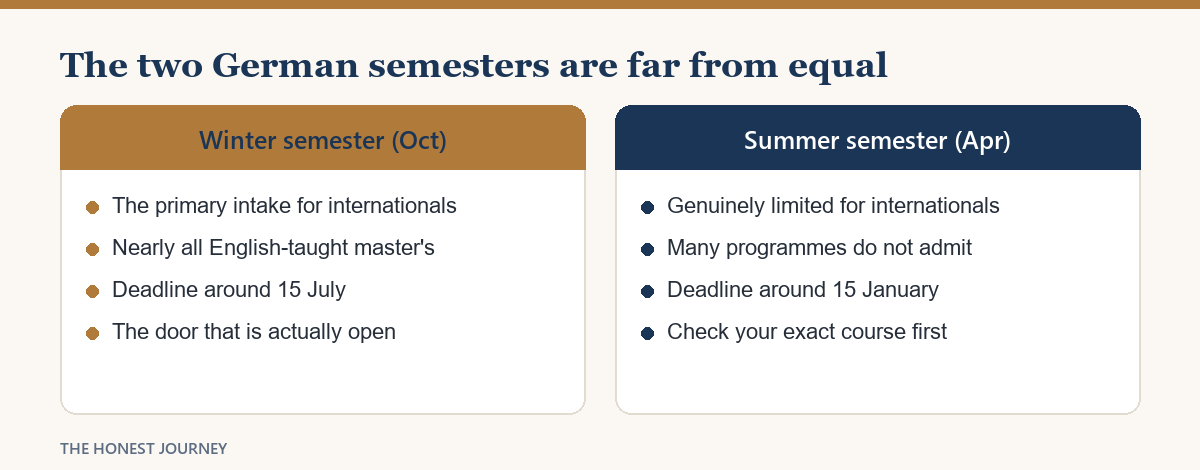
| Intake | Starts | Typical deadline | Honest note |
|---|---|---|---|
| Winter semester | October | Around 15 July | Primary intake, most programmes, the default for internationals |
| Summer semester | April | Around 15 January | Limited, many programmes do not admit internationals |
The deadlines and processing are the real challenge
Germany’s intake system is unforgiving in a specific way: the deadlines are fixed and early, and the processing behind them is slow. Two things drive this.
First, public-university deadlines are firm. The 15 July cutoff for a Winter start is not a rolling suggestion, and missing it usually means waiting a full year, since your programme may not offer Summer at all. Second, many applications route through uni-assist, a centralised processing service that checks and forwards international applications, and it takes weeks. Add the time to get documents certified and translated, and the real deadline for starting your application is months before the stated one.
There is also the language question that sits underneath all of this. A large share of “study in Germany without a test” programmes are taught in German, needing TestDaF or DSH rather than IELTS, which is a harder qualification, not an easier one. Confirm the language of instruction before you plan a timeline. We cover that trap in detail on studying in Germany for Indian students.
Faz's ruleThe 15 July deadline is fixed and uni-assist is slow. Your real start date for a German application is months before the deadline, not the week of it.
Germany punishes lateness harder than most countries, because a missed Winter deadline plus a programme that skips Summer means losing a whole year. Build the runway in from the start.
The German timeline, counted backwards
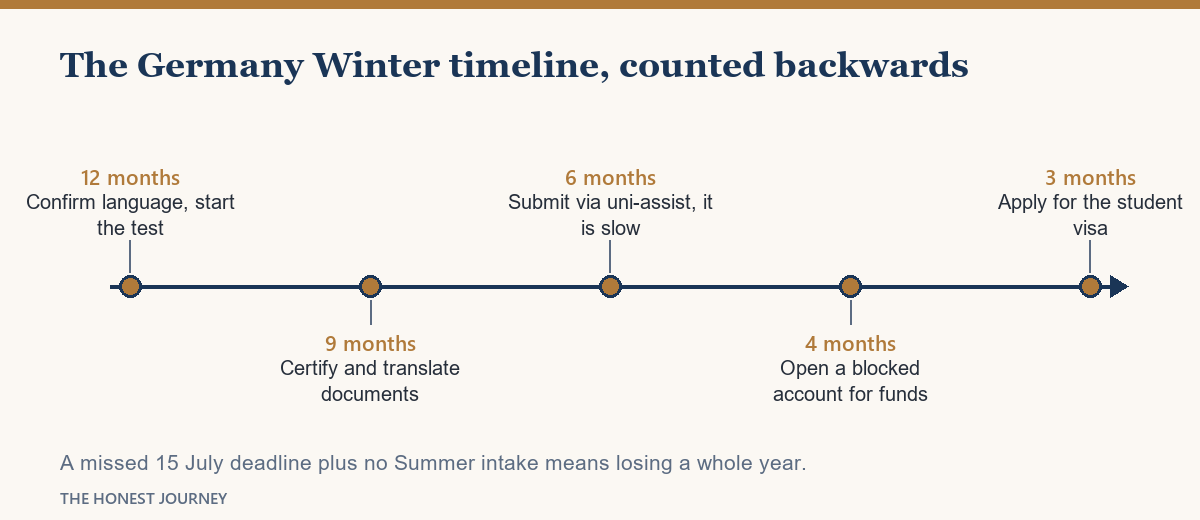
For a Winter (October) start with a mid-July deadline, work back generously.
About 12 months out: shortlist programmes, confirm the language of instruction, and start the required test, whether that is IELTS for English-taught programmes or TestDaF for German-taught ones. 9 to 10 months out: get documents certified and translated, and prepare your statement of purpose and recommendation letters. 6 to 7 months out: submit through uni-assist or the university portal well before 15 July, allowing for slow processing. 3 to 4 months out: open a blocked account to prove funds and apply for the student visa. Our page on student visa rejection reasons covers the blocked-account and funds pitfalls.
The traps to avoid
Assuming Summer is a real fallback. For many programmes it is not. Check your specific course before relying on a Summer start.
Underestimating uni-assist and certification time. These add weeks. Treat the stated deadline as a hard finish line you must reach early.
Missing the language trap. A German-taught programme needs TestDaF, not IELTS. Confirm the language before you build a timeline around the wrong test.
Leaving the blocked account late. Proving funds through a blocked account takes time and is a common last-minute bottleneck before the visa.
Frequently asked questions
How many intakes does Germany have?
Two: the Winter semester, starting in October, and the Summer semester, starting in April. Winter is the primary intake and admits the large majority of international students. Summer is limited, and many programmes do not open it to international applicants.
Is the Summer intake in Germany a good option?
Only if your specific programme offers it. Many German master’s programmes, especially English-taught ones, admit international students for Winter only. Always verify course by course rather than assuming a Summer start is available.
What are the German university application deadlines?
Public universities typically use around 15 July for the Winter semester and around 15 January for the Summer semester. These are firm, and because processing through uni-assist is slow, you should apply well ahead of them.
Does studying in Germany without IELTS mean an easier intake?
Not necessarily. Many “no IELTS” programmes are taught in German and require TestDaF or DSH, which is harder than IELTS. Confirm the language of instruction before planning your intake and test timeline.
When should I start applying for the Winter semester in Germany?
About twelve months ahead. Confirm language and tests a year out, certify and translate documents nine to ten months out, and submit through uni-assist six to seven months out to clear the mid-July deadline with room for slow processing.
The honest closing
Germany offers extraordinary value, near-zero public tuition and strong programmes, but it asks for something in return that catches unprepared applicants: precision. The Winter semester is the real intake for internationals, the Summer semester is thinner than it looks, and the deadlines are fixed while the processing is slow.
Do not treat Germany like the English-speaking countries with their rolling deadlines and flexible second intakes. Confirm your programme’s language and its actual intakes, certify your documents early, submit through uni-assist well before 15 July, and get your blocked account moving in time. Germany rewards the organised and quietly costs the late a full year. Plan the runway and the value is real.