Short answer. The UK runs one of the cleanest two-intake systems anywhere. September is the big one, January is a genuine, well-supported second, and for a one-year UK master’s the choice between them is more consequential than students expect, because it decides when you graduate into the job market and the Graduate Route.
This page covers the UK intakes honestly: what September and January really offer, the smaller options around them, and the one timing quirk that catches Indian students who pick January without thinking about what comes after the degree.
The same decision, by country
The intakes work on a different calendar in every country, and the honest catch is different in each. If another country is on your list, start there, or see the study abroad intakes hub.
- The full Fall vs Spring decision
- intakes in the USA
- intakes in Canada
- intakes in Australia
- intakes in Germany
The UK intakes
September intake. The primary intake by a wide margin. Nearly every programme opens, funding is at its fullest, and the arriving cohort is largest. If nothing pushes you otherwise, this is the one.
January intake. A strong, normal second intake in the UK, far more established than a US Spring. Many universities open a solid range of master’s programmes in January, and it is a common, respectable choice, not a fallback.
A smaller May or spring intake. Some universities run a limited third intake around April or May for a narrow set of courses. Treat it as niche.
Faz's ruleThe UK January intake is normal and well-supported, so use it without shame. Just decide it knowing it moves your graduation, and your Graduate Route clock, into a different part of the year.
January is a real intake in the UK, not a downgrade. The honest catch is not quality, it is timing, specifically how a January finish lines up with graduate recruitment.
Why the UK intake choice is really about what comes after
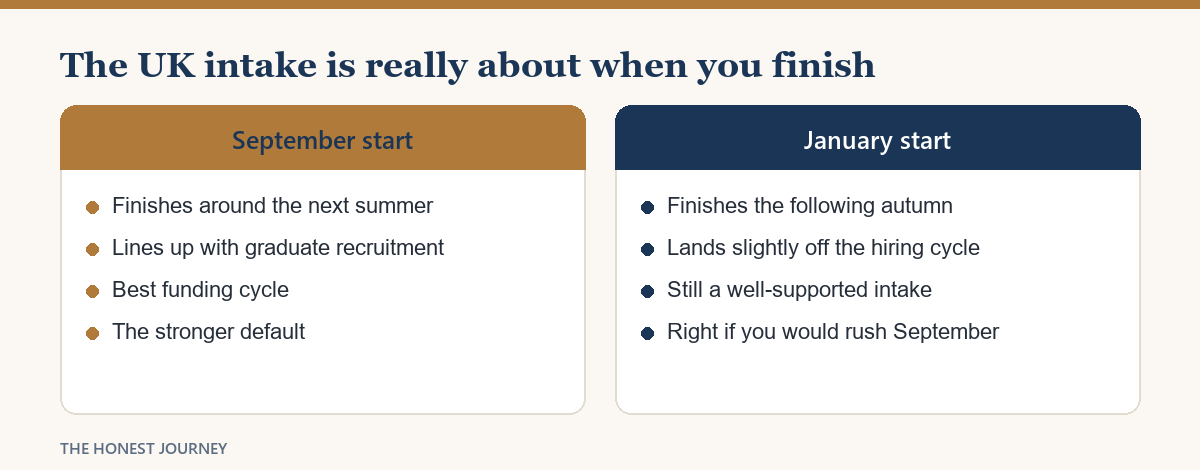
A UK master’s is usually just twelve months. That compresses everything, and it means your intake does not only decide when you start, it decides when you finish and enter the job market on the Graduate Route.
A September start means you finish the taught part around the following summer or autumn, which lines up reasonably with UK graduate recruitment cycles. A January start means you finish around the following autumn or winter, which can land you slightly out of step with the main graduate-scheme intake, whose applications typically open in autumn for the next year. It is not a dealbreaker, but if your plan leans on landing a graduate role during the Graduate Route, September has a timing edge.
The Graduate Route itself, the post-study work visa that lets you stay and work, has been under review and tightened in recent years, so the value of that stay-back window is exactly why its timing deserves thought. Our honest breakdown of studying in the UK covers where that route stands: studying in the UK for Indian students.
| Intake | Starts | Course choice | Honest note |
|---|---|---|---|
| September | Sep to Oct | Almost all programmes | Primary intake, best funding, best job-cycle alignment |
| January | Jan to Feb | Broad, a genuine option | Well-supported, but a one-year finish lands slightly off-cycle |
| May | Apr to May | Narrow | Niche, only some universities and courses |
Where January is clearly the right call
January earns its place for plenty of students. It is right if you finished your degree or your English test too late for a strong September application. It is right if a few more months would lift your profile or your funds. And it is right if the specific course you want has a good January cohort with less of a rush. A well-prepared January application beats a scrambled September one, and in the UK January is respectable enough that you lose nothing on the admissions side.
Faz's ruleIf your English or your funds are not ready for September, take January and arrive strong. A rushed September start is twelve expensive months built on a weak beginning.
The UK degree is short and costly. Starting it underprepared to hit a September deadline is a poor trade against a clean January start where you are actually ready.
The UK timeline, counted backwards
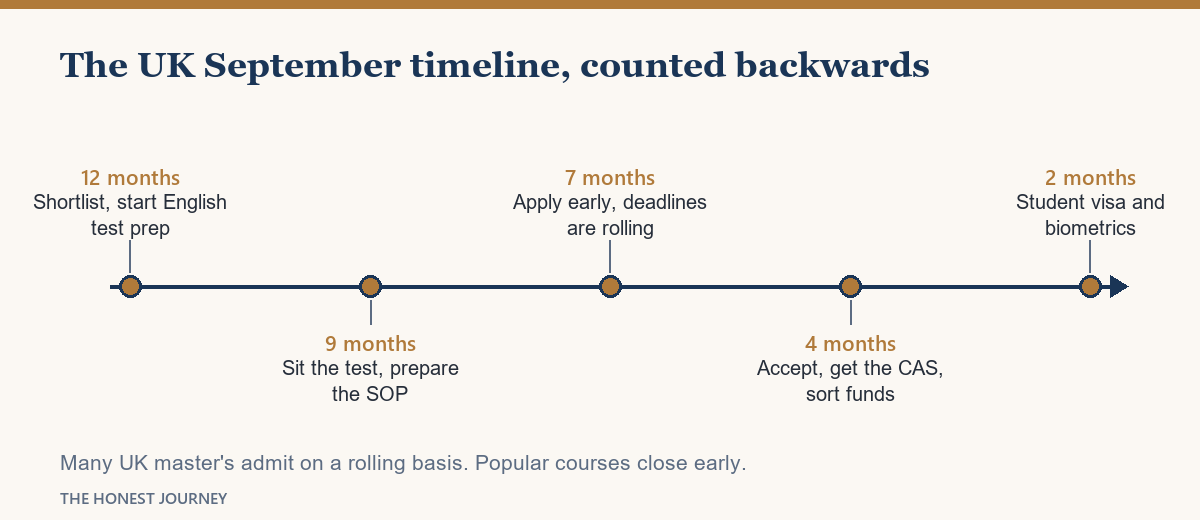
For a September start, work back roughly twelve months.
About 12 months out: shortlist universities and start your English test prep, since UK master’s admissions move quickly and many operate rolling deadlines. 9 to 10 months out: sit the test and prepare your statement of purpose and recommendation letters. 7 to 8 months out: apply early, because rolling admissions and scholarship deadlines both reward it. 4 to 5 months out: accept your offer, get your CAS, and arrange finances. 2 to 3 months out: apply for the student visa and book biometrics. For a January start, shift the whole sequence back by around four months. Our page on student visa rejection reasons covers the common UK pitfalls.
The traps to avoid
Ignoring rolling deadlines. Many UK master’s admit on a rolling basis and popular courses fill before the stated deadline. “The deadline is months away” is how good courses close early.
Picking January without thinking about the job cycle. It is a fine intake, but if landing a graduate role on the Graduate Route is central, understand that a January finish lands slightly off the main recruitment window.
Assuming full scholarship parity in January. The biggest funding cycles favour September. Confirm before you count on January funding.
Frequently asked questions
How many intakes does the UK have?
Mainly two: September, the primary intake with almost all courses and the best funding, and January, a well-supported second intake. Some universities also run a small May intake for a narrow set of programmes.
Is the January intake good in the UK?
Yes. Unlike a thin US Spring, the UK January intake is established and offers a broad range of master’s programmes. The main consideration is timing: a one-year master’s starting in January finishes slightly off the main graduate-recruitment cycle.
Which UK intake is best for jobs and the Graduate Route?
September has a slight edge, because a one-year master’s finishing in summer or early autumn lines up better with UK graduate recruitment, which opens applications in autumn for the following year. January still works, it just lands a little off-cycle.
When should I apply for the September intake in the UK?
Around twelve months ahead, and earlier is better because many UK master’s use rolling admissions. Apply seven to eight months out to protect both your seat and your scholarship chances.
Is there scholarship money in the January intake?
Less than in September. The largest funding cycles are built around the September cohort, so if a scholarship is central to your plan, confirm January availability directly with the university before relying on it.
The honest closing
The UK gives you two genuinely usable intakes, which is a luxury. September is the stronger default for funding and job-cycle alignment, but January is respectable and often the wiser choice for a student who would otherwise rush September underprepared.
The one thing not to do is pick January on autopilot without noticing that a twelve-month master’s beginning in January finishes at an awkward point for graduate recruitment. Decide it with that in mind, apply early to beat rolling deadlines, and enter the year ready rather than rushed. In a degree this short and this expensive, starting strong is most of the battle.