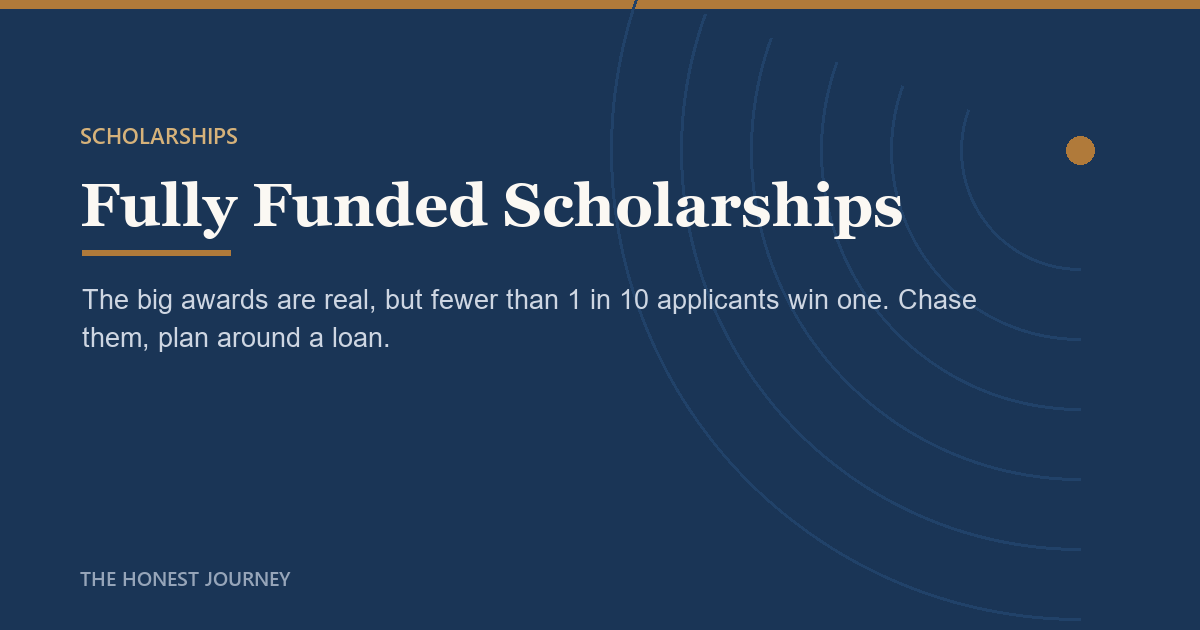
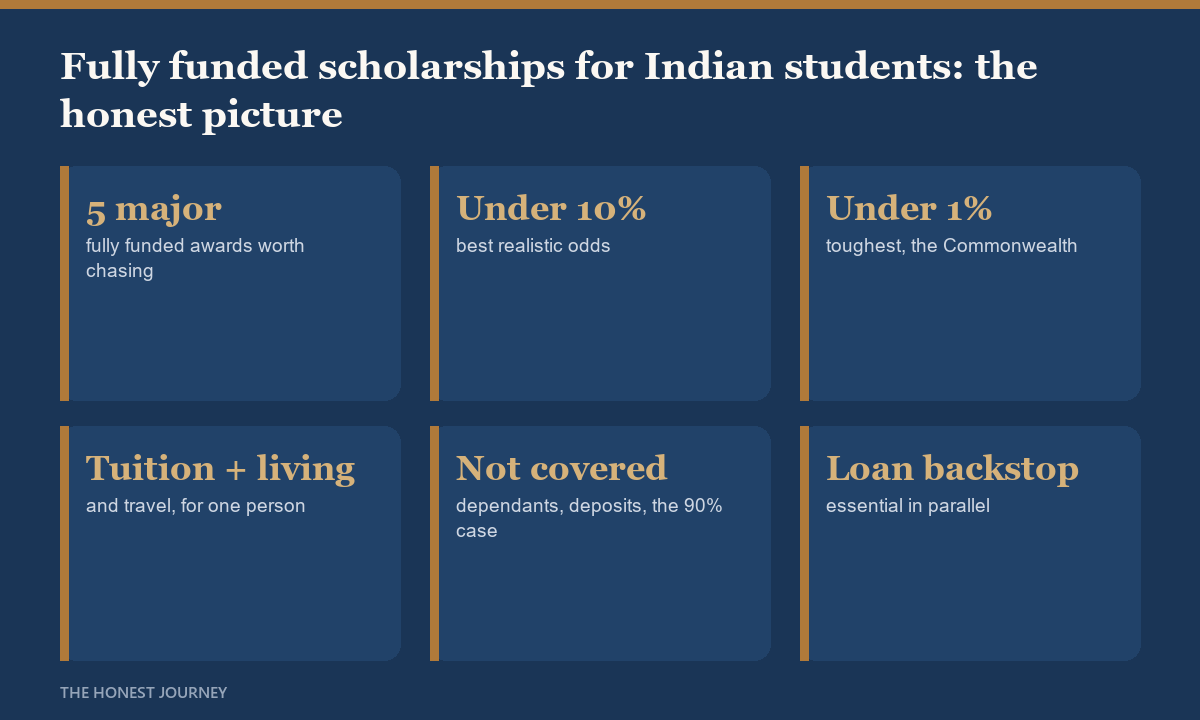
Short answer. Fully funded scholarships for Indian students do exist, and Chevening, Fulbright-Nehru, DAAD, Commonwealth and Erasmus Mundus genuinely cover tuition, living and travel. But fewer than 1 in 10 applicants to a major government scholarship wins one, and the most prestigious sit under 1 percent. Chase one as a bonus, never as your funding plan.
Fully funded scholarships for Indian students do exist, and the big ones (Chevening, Fulbright-Nehru, DAAD, Commonwealth and Erasmus Mundus) genuinely cover tuition, living and travel, but the honest truth is that fewer than 1 in 10 applicants to a major government scholarship actually wins one, and the most prestigious sit under 1 percent, so a fully funded award is a bonus to chase, never the plan you fund your degree on. This page does what the aggregator lists will not: it ranks the real fully funded options by the odds you actually face, tells you which one fits which student, and shows why almost everyone still needs a loan running in parallel. If you take one thing from it, take this: apply for these with everything you have, and plan your funding as if you will not get them.
Also worth knowing: Stipendium Hungaricum in Hungary and Italy’s DSU regional scholarship, which waive tuition but pay smaller stipends.
Two more fully funded government awards with Indian quotas: MEXT in Japan and GKS in Korea.
Every application season I watch the same pattern. A strong student reads a listicle titled “25 fully funded scholarships,” feels reassured, delays the loan paperwork, and then panics in April when nothing has come through. The list was not wrong that the scholarships exist. It was dishonest about the odds. Fully funded awards are real and worth chasing. They are also long shots, and treating them as a plan is how good students miss their intake.
This guide ranks the major fully funded awards by realistic odds, matches each to the right kind of applicant, and explains the backstop that makes the whole thing safe. For the complete picture of every option, keep the broader scholarships for Indian students to study abroad list open alongside this one.
The major fully funded scholarships, ranked by real odds
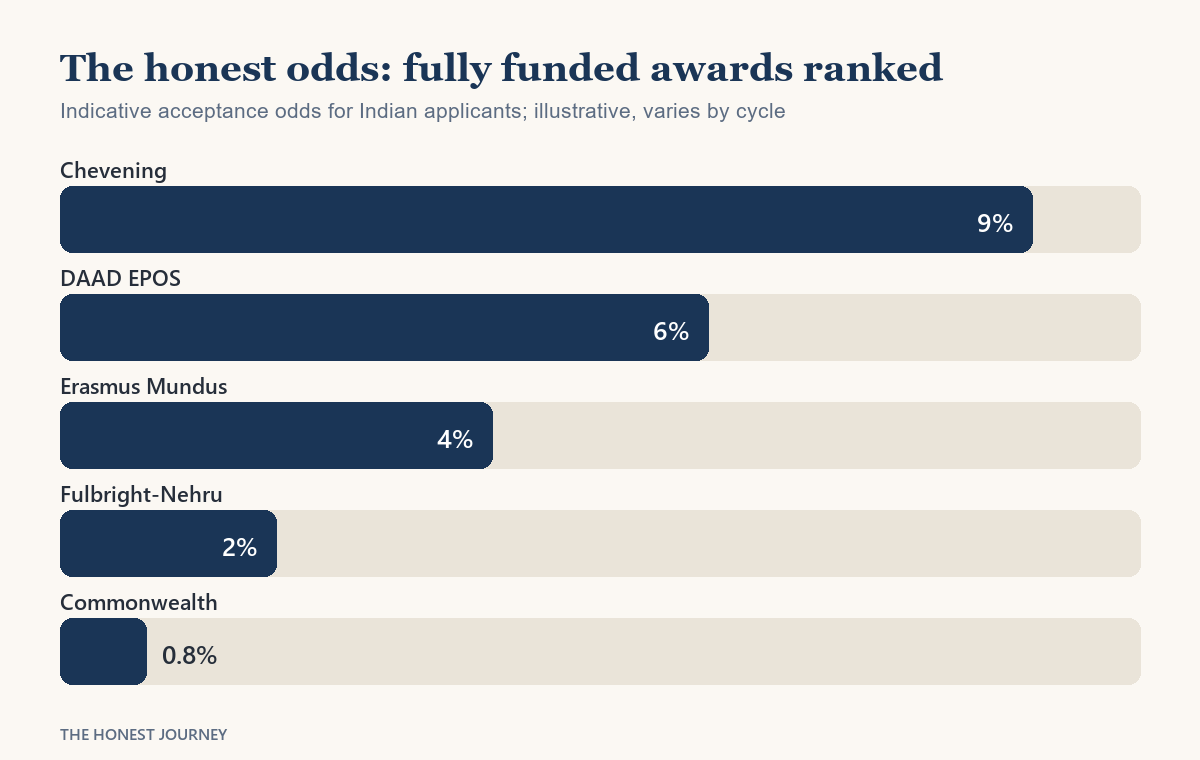
Here are the big fully funded awards Indian students actually win, ordered from least brutal odds to most. “Least brutal” still means single digits.
| Scholarship | Where | Real odds for Indians | Best fit |
|---|---|---|---|
| Chevening | UK, one-year Master’s | Under 10 percent | Early-career professional, 2 years work experience, clear leadership story |
| DAAD EPOS | Germany, Master’s or PhD | Course-dependent, narrow eligibility | Development-focused professional on an EPOS-listed course |
| Erasmus Mundus | EU, multi-country Master’s | Tight and shrinking for Indians | Student wanting a multi-country EU Master’s, applied per programme |
| Fulbright-Nehru | USA, two-year Master’s | Very low, strong field | Mid-career professional, 3 years work experience, return-to-India purpose |
| Commonwealth | UK, Master’s or PhD | Under 1 percent | Development-focused candidate, especially for a funded PhD |
Each of these has its own guide with the full coverage, eligibility and timeline: Chevening, DAAD, Erasmus Mundus, Fulbright-Nehru, and Commonwealth. Read the one that matches your country and profile before you apply, because the eligibility bars differ sharply.
Faz's ruleThe listicles count how many scholarships exist. The number that matters is how many people like you actually win one. That number is small.
“25 fully funded scholarships” sounds like abundance. But if each funds a handful of people from a huge pool, the honest headline is “25 lotteries.” Count winners, not awards, and you will plan your money very differently.
What “fully funded” really includes, and what it leaves out
Fully funded is a real category, but it has consistent blind spots. Knowing them stops you from being surprised after you win.
| Usually covered | Usually not covered |
|---|---|
| Tuition fees for the degree | Dependants: partner or child visa, travel, living |
| A monthly living stipend for one person | The gap in very high-cost cities like London |
| Return economy airfare | Deposits and flights you pay before results arrive |
| Health insurance | Courses longer than the funded period, in one-year awards |
| Visa fee, in most cases | The 90 percent-plus case where you are not selected at all |
The single biggest hidden gap is time. Most scholarship results land between April and June, but university deposits, and sometimes flights, come due earlier. Even eventual winners often need bridging funds. And for the large majority who are not selected, the whole bill lands with no notice in peak season. Both problems have the same solution.
Why almost everyone still needs a loan
The uncomfortable arithmetic is simple. If the best fully funded awards sit at under 10 percent and the top ones under 1 percent, then for any individual applicant the most likely outcome, by far, is no scholarship. A plan that only works if you beat those odds is not a plan.
The fix is not to skip the scholarships. It is to apply for them while keeping a sanctioned education loan and a confirmed admission moving in parallel. If an award comes through, you draw down less or cancel the loan entirely. If it does not, you have lost nothing and kept your intake. A sanctioned loan also serves as clean proof of funds for the student visa, which a pending scholarship result cannot provide.
Faz's ruleA sanctioned loan you never draw down costs you almost nothing. A missed intake because you bet on a scholarship costs you a year. Keep both lanes open.
This is the whole strategy in one line. The asymmetry is enormous and it runs entirely in favour of applying for scholarships and arranging a loan at the same time. Anyone who tells you to wait for the scholarship before sorting your loan is giving you dangerous advice.
How to actually improve your odds
The odds are long, but they are not random. A few things reliably separate winners from the pack.
- Match, do not spray. Apply to the two or three awards you genuinely fit, not every scholarship you can find. A tailored application to the right award beats ten generic ones.
- Respect the eligibility walls. Chevening wants two years of work, Fulbright three, DAAD EPOS a listed course. Applying without meeting these is wasted effort.
- Write specific essays. Dated, named, concrete stories of leadership and impact beat “hardworking and passionate” every time.
- Have a clear return-and-contribute plan. Most of these awards fund people who will take the degree home and use it. Say exactly how you will.
- Keep the loan moving anyway. A backstop lets you apply boldly, because a rejection is not a catastrophe.
If a fully funded award is out of reach for your profile or timeline, that is not the end of the road. It just means your funding leans on a loan, which for most Indian students it does anyway. Start with the education loan India complete guide and the wider studying abroad from India cost and funding guide to build the plan that does not depend on winning a lottery.
The honest closing take
Fully funded scholarships for Indian students are real, valuable and worth serious effort. Chevening, Fulbright-Nehru, DAAD, Commonwealth and Erasmus Mundus can transform the finances of the students who win them. If you fit one, apply with everything you have, and use the individual guides to get the eligibility and essays right.
But hold the odds honestly in your head. The best of these still rejects more than nine in ten applicants, and the most prestigious rejects more than ninety-nine in a hundred. The students who come out ahead are the ones who chase these awards hard while funding their degree as if the awards will never arrive. Apply boldly, keep your loan sanctioned, run the honest study-abroad math, and let any scholarship you win be the bonus that shrinks your borrowing rather than the bet that decides your future.
FAQ
Are there really fully funded scholarships for Indian students?
Yes. Chevening, Fulbright-Nehru, DAAD EPOS, Commonwealth and Erasmus Mundus are all genuinely fully funded, covering tuition, a living stipend, travel and usually insurance and visa costs for the students who win them. They are real and worth applying for. The honest caveat is the odds: fewer than 1 in 10 applicants to a major government scholarship actually receives one, and the most prestigious sit under 1 percent, so they should be treated as a bonus rather than a guaranteed funding source.
Which fully funded scholarship is easiest for Indian students to get?
Among the major awards, Chevening tends to have the least brutal odds, at under 10 percent for Indian applicants, provided you meet its two-year work experience requirement. DAAD EPOS can be a strong option for development-focused professionals on a listed course. Commonwealth and Fulbright-Nehru are the hardest, with Commonwealth effectively under 1 percent. None are easy in absolute terms, so the right approach is to apply to the ones you genuinely fit rather than chasing the one that sounds easiest.
Can a fully funded scholarship cover my entire study abroad cost?
For a single student, often yes. The major awards typically cover tuition, a monthly living stipend, return airfare and insurance, which can make a degree close to cost-neutral for one person. The common gaps are dependants, whose visa and living costs are not covered, high-cost cities where the stipend is tight, and money you must pay before results arrive, such as university deposits. And of course the coverage only matters if you are among the small minority selected.
Should I wait for scholarship results before applying for an education loan?
No. Because most fully funded awards reject the large majority of applicants and results often arrive close to the intake, waiting for a scholarship before arranging a loan is risky. The safer approach is to apply for scholarships while keeping a sanctioned education loan and a confirmed admission moving in parallel. If you win an award, you borrow less or cancel the loan. If you do not, you have kept your intake and your visa proof of funds intact.
How can I improve my chances of a fully funded scholarship?
Apply only to the awards you genuinely fit rather than spraying applications, respect each award’s eligibility walls such as Chevening’s two years of work experience or Fulbright’s three, and write specific, dated essays about real leadership and impact instead of generic claims. A clear plan to return and contribute to India matters for most of these awards. And keep a loan sanctioned in parallel, because a backstop lets you apply boldly without a rejection costing you the year.
What if I do not qualify for any fully funded scholarship?
That is the situation most Indian students are actually in, and it is manageable. If a fully funded award is out of reach for your profile or timeline, your funding simply leans on an education loan, which is the default route for the majority anyway. Start with the education loan India complete guide and the studying abroad cost and funding guide to build a plan that does not depend on winning a competitive award, and treat any smaller or partial scholarship you do get as a welcome reduction on the total.
Faz · The Honest Journey · 2026