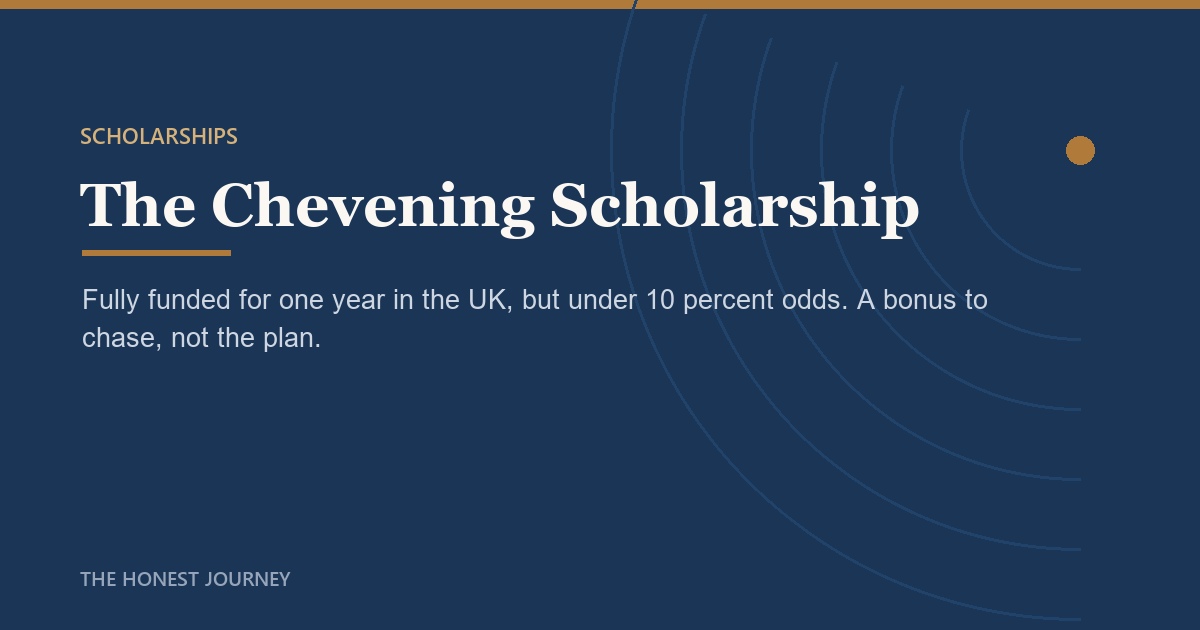
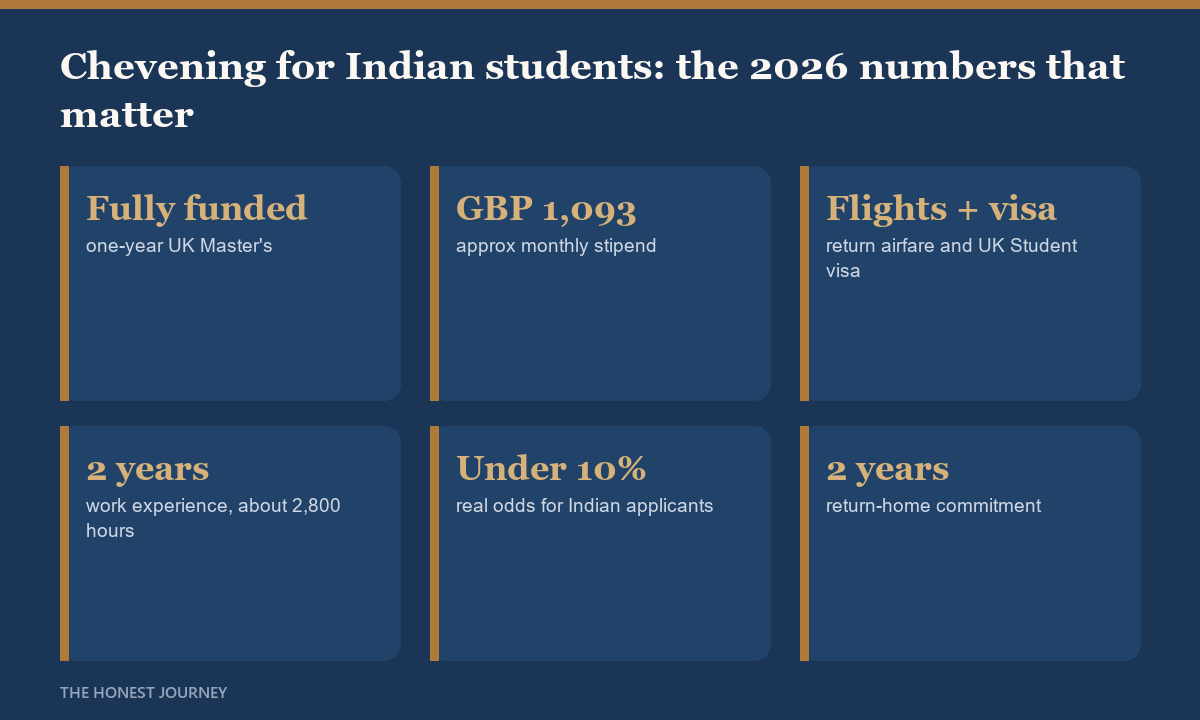
Short answer. The Chevening Scholarship is a fully funded one-year UK Master’s award that covers tuition, a monthly living stipend, return flights and your UK visa, but for Indian applicants the real odds sit under 10 percent, so it is a bonus to chase, never the plan you fund your degree on.
India is one of the largest Chevening cohorts in the world, which sounds encouraging until you see the other half of that number: roughly a thousand or more Indians apply each cycle for something like 60 to 110 places. It rewards work experience and a clear leadership story far more than raw marks, and it only funds a single-year taught Master’s, not a two-year course or a PhD.
Aiming at Oxford specifically? See the Rhodes Scholarship for Indian students, which gives India five places a year.
A reader messaged me last November, two days before the deadline, asking if he should quit his half-finished loan paperwork because “Chevening will cover everything anyway.” He had a strong profile. He also had a 9 percent chance. I told him what I will tell you here: apply, put real effort into the essays, but keep the loan sanction moving in parallel. He got shortlisted, then missed out at the interview stage, and started his Master’s in September on the loan he had wisely kept alive. That is the honest way to treat a scholarship this competitive.
This guide walks through what Chevening actually pays for, the eligibility bar that trips most Indian applicants, the real acceptance odds, the timeline and essays, and what you still need to fund yourself. If you are mapping the wider picture first, start with the full list of scholarships for Indian students to study abroad and the guide to studying in the UK for Indian students.
What Chevening actually covers
Chevening is funded by the UK Foreign, Commonwealth and Development Office and partner organisations. When people call it “fully funded” they are mostly right, but the edges matter. It covers the standard cost of a taught Master’s and a modest London-adjusted living allowance. It does not cover a lavish lifestyle, dependant costs, or anything beyond twelve months.
| What Chevening pays | Detail | What it does not cover |
|---|---|---|
| Tuition fees | Full tuition for one eligible one-year Master’s, paid directly to the university | Any course longer than 12 months |
| Monthly living stipend | A fixed monthly amount set by Chevening, higher for London universities | The gap if you study in central London on a tight budget |
| Return flights | Economy return airfare, India to the UK and back | Flights for family or mid-year trips home |
| UK visa | The Student visa application fee is reimbursed | The NHS Immigration Health Surcharge in some years, so confirm this each cycle |
| Arrival and other grants | An arrival allowance plus grants for the compulsory Chevening events | Dependant visas, dependant travel, or living costs for a partner |
The stipend is calibrated to a single student living carefully. Scholars in London routinely report that the allowance covers rent and food if you share accommodation and cook, but leaves little slack. Bringing a spouse or child on a dependant visa is where many Chevening budgets break, because the award funds one person only. Understand the wider UK number in the cost of studying in the UK for Indian students guide before you assume the stipend stretches further than it does.
Faz's rule“Fully funded” means fully funded for one person, for one year, at a modest standard of living. It is not a blank cheque, and it is not enough for a family.
The most common Chevening regret I hear is from married applicants who assumed the stipend would support a partner too. It will not. If you are bringing a dependant, budget their visa, flight and living costs entirely on your own, on top of the scholarship.
Who is actually eligible, and the bar that trips people
The published eligibility criteria are simple to list and harder to clear than most applicants expect. You must be an Indian citizen, hold an undergraduate degree strong enough to get into a UK Master’s (broadly a UK upper second, a 2:1), and crucially, have at least two years of work experience.
| Requirement | The honest reading |
|---|---|
| Indian citizenship | Straightforward. You also commit to returning to India for at least two years after the course. |
| Bachelor’s degree | Must qualify you for postgraduate UK study. A 2:1 equivalent is the usual bar, so a strong second class or first. |
| Two years of work experience | Measured as 2,800 hours. This is the criterion that quietly disqualifies most fresh graduates. Internships, part-time and voluntary roles can count if documented. |
| Three UK course offers | You must apply to three different eligible one-year Master’s courses and hold at least one unconditional offer by a mid-year deadline. |
| Return home commitment | You agree to leave the UK for a minimum of two years after your studies. Chevening is a leadership and return programme, not an immigration route. |
The 2,800 hour work requirement is the single biggest reason strong students are ruled out. Chevening is not designed for someone going straight from a bachelor’s to a Master’s. It is designed for early-career professionals with a demonstrable trajectory. If you are a fresh graduate, this is not your scholarship yet, and that is worth knowing before you spend a month on the essays. The official Chevening scholarships page lists the current-cycle detail.
The honest odds: how competitive Chevening really is
This is the section other guides skip. Chevening publishes that India is among its largest cohorts globally, and consultants quote that proudly. What they leave out is the denominator. In a typical year roughly a thousand or more Indians apply, and the India allocation is on the order of 60 to 110 scholarships. That puts the real acceptance rate for Indian applicants somewhere under 10 percent, and in the toughest years closer to 6 or 7 percent.
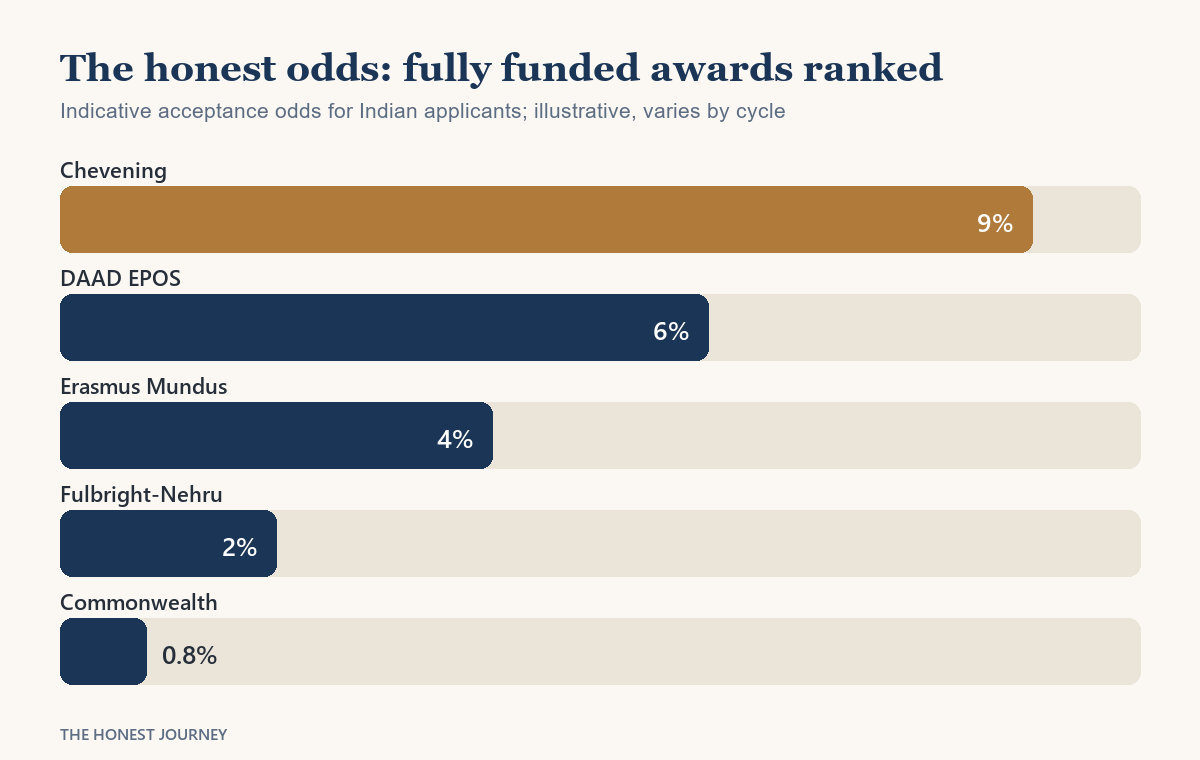
Those are not bad odds for a fully funded award, and they are far better than the sub 1 percent reality of a Commonwealth Scholarship. But they are still long odds. Selection weighs four things heavily: a clear leadership record, a specific and credible career plan, a networking and influencing story, and why these exact three courses. Marks alone do not win Chevening. A 9-pointer with no work story loses to a 7-pointer who led a real team and can articulate impact.
Treat Chevening as one lane in a funding plan that has other lanes running at the same time. The students who handle it well apply for Chevening, keep a loan sanction moving, and check every other scholarship they qualify for in parallel. The ones who struggle are those who bet everything on a single sub-10 percent outcome.
The application timeline and the four essays
Chevening runs on a fixed annual cycle, and the dates barely move year to year. Applications for the intake open in the second week of August, and the window closes in the first week of November. Everything after that is staged over the following eight months.
| Stage | Rough timing | What happens |
|---|---|---|
| Applications open | Early to mid August | The online portal opens. You can draft essays before this. |
| Deadline | Early November | Hard cut-off, usually a fixed UTC time. No extensions. |
| Shortlisting | December to February | Applications are read and scored. Shortlisted candidates are invited to interview. |
| References and offer proof | By around mid February | You submit two references and proof of your three course applications. |
| Interviews | February to April | Held at the UK High Commission or deputy high commissions in India. |
| Conditional results | By early June | You must hold at least one unconditional UK offer by the mid-July deadline. |
| Course starts | September | The one-year Master’s begins. |
The heart of the application is four essays: leadership, networking and influencing, your study plan (why these three courses), and your career plan. Each has a tight word limit. The single most common mistake is writing four variations of “I am hardworking and passionate.” The essays that score reference specific situations, specific people you influenced, and a specific job you intend to do in India afterwards. Always confirm the exact current-cycle dates and word limits on the official Chevening site, because they do shift by a few days each year.
Faz's ruleWrite the four essays around specific, dated, named events from your own life. Selectors can smell a generic essay in the first two sentences.
“I led a team” is worthless. “In March 2024 I took over a stalled four-person project, rebuilt the timeline, and shipped it six weeks late instead of six months late” is a leadership essay. The detail is the credibility. Vague ambition reads as no ambition.
Where Chevening falls short, and what you still fund yourself
Even a full Chevening award leaves gaps, and a rejected application leaves the whole bill. Both cases need a funding backstop. Here is what the scholarship does not solve.
- The one-year cap. Chevening funds a single-year taught Master’s only. A two-year course, an integrated Master’s or a research degree is out of scope.
- Dependants. A partner or child is entirely your cost: their visa, their flight, their living expenses.
- The timing gap. Results arrive in June, but you often pay a university deposit and sometimes book flights earlier. You need bridging funds even if you eventually win.
- The 90 percent case. Most applicants are not selected. If Chevening is your only plan, a rejection in April leaves you scrambling for a loan in peak season.
This is why the honest structure is scholarship plus loan, not scholarship or loan. Keep a sanctioned education loan for the UK ready in parallel. If Chevening comes through, you draw down less or cancel it. If it does not, you have not lost the intake. A sanctioned loan also doubles as clean proof of funds for your student visa, which the scholarship confirmation alone sometimes complicates.
Faz's ruleChase Chevening with everything, and fund your degree as if you will not get it. Those two things are not in conflict. They are the plan.
A sanctioned loan you never draw down costs you almost nothing. A missed intake because you bet on a 9 percent outcome costs you a full year and often a second application season. The asymmetry is obvious once you see it.
The honest closing take
Chevening is a genuinely excellent award. It is fully funded in the ways that matter, it carries real prestige, and the alumni network is valuable for a career built in India. For an early-career professional with two years of solid work behind them and a clear reason to be in the UK for exactly one year, it is worth every hour the application takes.
What it is not is a funding strategy. The odds are under 10 percent, the work-experience bar rules out fresh graduates, and it funds one person for one year only. The students who benefit most are the ones who apply seriously while treating it as upside, not as the floor of their plan. Run the honest study-abroad math, keep your loan moving, and let Chevening be the bonus that lowers your borrowing rather than the bet that decides whether you go at all.
FAQ
Is the Chevening Scholarship really fully funded?
Yes, for one person for one year. Chevening covers full tuition for an eligible one-year UK Master’s, a monthly living stipend, economy return flights between India and the UK, the Student visa application fee, and an arrival allowance. It does not cover any course longer than twelve months, and it does not fund dependants, so a spouse or child’s visa, travel and living costs are entirely your own. Scholars in high-cost cities like London report the stipend is enough only with shared accommodation and careful budgeting.
What are the real chances of getting Chevening for an Indian student?
Under 10 percent in a typical year. India is one of the largest Chevening cohorts globally, but roughly a thousand or more Indians apply for something like 60 to 110 places, which puts the acceptance rate in the 6 to 10 percent range. Those are strong odds for a fully funded award and far better than a Commonwealth Scholarship, but they are still long. Selection rewards a documented leadership record and a specific career plan far more than high marks alone.
Do I need work experience for Chevening?
Yes, and this is the criterion that disqualifies most fresh graduates. You need at least two years of work experience, measured as 2,800 hours. Internships, part-time roles and voluntary work can count if you can document the hours. Chevening is built for early-career professionals with a clear trajectory, not for students going straight from a bachelor’s degree into a Master’s. If you have just graduated, this is not your scholarship yet.
When do Chevening applications open and close for the 2027 intake?
The cycle is fixed year to year. Applications typically open in the second week of August and close in the first week of November, with interviews in India between February and April and conditional results by early June. You must hold at least one unconditional UK Master’s offer by a mid-July deadline. Confirm the exact dates for your intake on the official Chevening website, because they move by a few days each year.
Can I apply for Chevening and take an education loan at the same time?
Yes, and you should. Because the odds are under 10 percent, the honest approach is to apply for Chevening while keeping a sanctioned UK education loan ready in parallel. If you win, you draw down less or cancel the loan. If you do not, you have not lost the intake to a scholarship gamble. A sanctioned loan also serves as clean proof of funds for the UK Student visa, which is useful even in the year you are waiting on scholarship results.
Does Chevening cover a two-year Master’s or a PhD?
No. Chevening funds a single-year taught Master’s only. A two-year course, an integrated Master’s, or a research degree such as a PhD is outside its scope. If your target course runs longer than twelve months, Chevening cannot fund it, and you will need a different scholarship or a loan. This one-year cap is one of the most common reasons applicants are surprised late in the process, so check your course length before you apply.
What should the Chevening essays focus on?
Specifics. The four essays cover leadership, networking and influencing, your study plan, and your career plan, each with a tight word limit. The essays that score reference dated, named, concrete situations rather than generic claims of being hardworking or passionate. Describe a specific project you led, specific people you influenced, and the specific job you intend to do in India after the course. Selectors read thousands of applications and can identify a generic essay within the first two sentences.
Faz · The Honest Journey · 2026