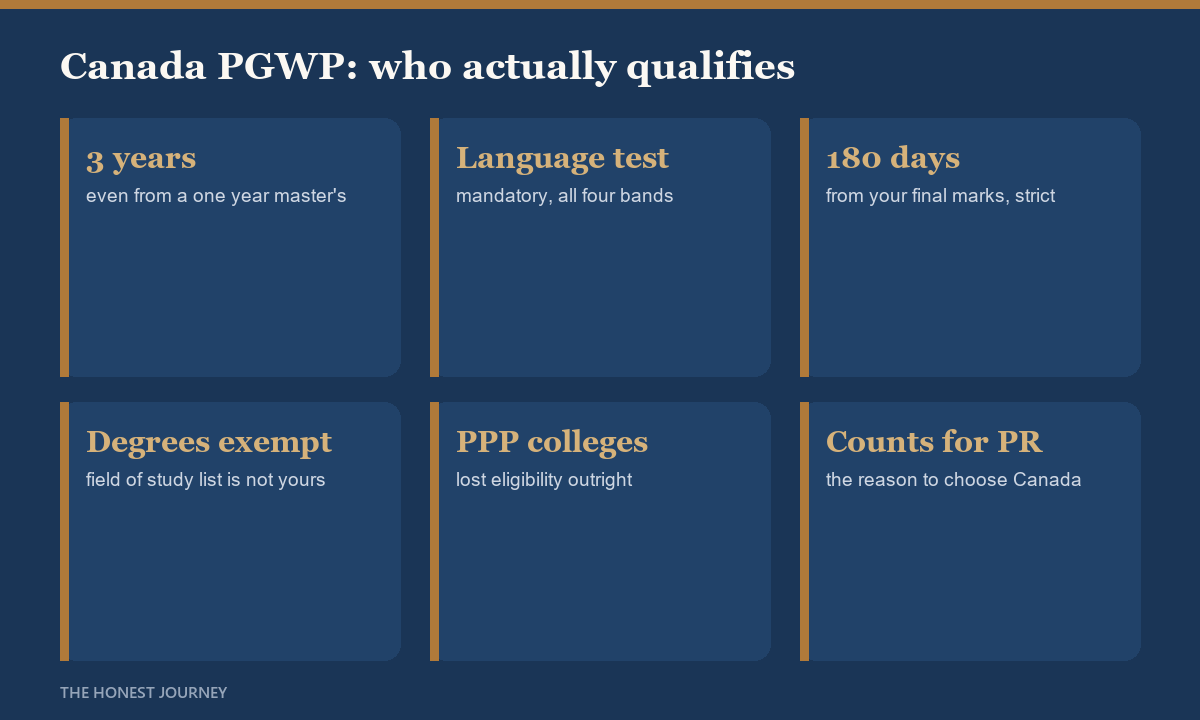
Short answer. Degree graduates get a PGWP of up to three years, and master’s graduates get the full three even from a short programme. The field of study list does not apply to degrees. What actually causes refusals is an expired or weak language test, CLB 7 in all four bands for degree holders, and missing the 180 day deadline.
The Post-Graduation Work Permit gives you up to three years of open work rights in Canada, and master’s and PhD graduates now get the full three years even if the programme itself ran only eight months. The rules that actually disqualify people are not the ones students worry about. Degree graduates are completely exempt from the field of study list, which is frozen for all of 2026 anyway, so the field of study panic mostly does not apply to you. What does catch people is the language test, mandatory since November 2024 at CLB 7 for degree graduates and CLB 5 for diploma graduates, needed in all four bands and valid within two years, and the hard 180 day deadline after your final marks. Students who started a public private partnership college programme on or after 15 May 2024 are not eligible at all.
Planning Express Entry after your PGWP? Read when a WES ECA is worth buying before ordering an ECA.
Canada is the destination where the gap between what students worry about and what actually sinks their application is widest. Every few months another wave of “PGWP rules changed” coverage lands, everyone forwards it, and the specific detail that would have mattered to a particular student gets lost in the noise. Meanwhile the two things that most commonly cost people their work permit are boring, administrative, and entirely avoidable.
This page is the sorting exercise. What the PGWP gives you, how long you actually get, who is genuinely exempt from what, the two traps that account for most refusals, and the honest read on whether Canada still works as a plan. If you are still choosing, put this next to our honest ROI breakdown for Canada and the Canada student visa guide.
What the PGWP gives you
The PGWP is an open work permit, and that word carries most of its value. You are not tied to a named employer, you do not need a job offer to apply, you can work full time for anyone, change jobs freely, or be self employed. Among major destinations this is unusually permissive. The UK Graduate Route is comparable, but the US requires your OPT job to relate to your field and STEM OPT requires an E-Verify employer, while Canada simply lets you work.
It also matters because Canadian permanent residence is genuinely reachable from it. Skilled work experience gained in Canada feeds Express Entry, and the Canadian Experience Class exists precisely for people in your position. Unlike the UK Graduate Route, which does not count towards settlement at all, PGWP time is the raw material for a PR application. That single structural fact is the strongest argument for Canada over the UK, and it survives all of this year’s rule changes intact.
How long you get
PGWP length tracks the length of your programme, with an important exception that now works in favour of postgraduate students.
- Master’s and doctoral graduates: three years, even where the programme itself was shorter, subject to a minimum programme length of eight months. This is a meaningful improvement for the many one year Canadian master’s programmes, which previously produced correspondingly short permits.
- Programmes of two years or longer: generally three years.
- Programmes between eight months and two years: generally a permit matching the programme length.
- Two consecutive programmes can be combined, so a one year diploma followed by a one year post graduate certificate is assessed on the combined duration.
The eight month floor is absolute. A programme shorter than that produces no PGWP at all, which is worth checking before enrolling in any short certificate marketed as a pathway.
Trap one: the language test
This is the single most common avoidable failure, and it exists because of an assumption that feels reasonable and is wrong.
Since November 2024, a language test result is mandatory with every PGWP application. The thresholds are:
- University degree graduates: CLB 7, roughly IELTS 6.0 in each band.
- College diploma and certificate graduates: CLB 5, roughly IELTS 5.0 in each band.
Two details do the damage. First, the minimum must be met in all four abilities separately: reading, writing, listening and speaking. An overall band of 7.0 with a 5.5 in writing does not qualify. Second, the result must be valid, meaning under two years old at the time you apply for the PGWP.
Now consider the ordinary timeline. You sat IELTS in early 2024 to get your study permit. You started a two year programme in September 2024. You finish in late 2026 and go to apply. That test is now more than two years old and is dead for this purpose. You need to book, sit and receive a new test result inside a 180 day window while also finishing your programme and looking for work.
The fix is simple and almost nobody does it: check the expiry date of your existing test the moment you begin your final year, and if it will lapse before you apply, book the retest early while you have time rather than in the panic after results. This one paragraph is probably the most useful thing on this page.
Trap two: the 180 day deadline and where you studied
You have 180 days from receiving your final marks to apply for the PGWP, and this deadline is enforced strictly. It runs from the confirmation of your results, not from convocation. Miss it and there is no discretionary route back in. Combined with the language test problem above, a student who is casual about both can lose eligibility entirely through nothing but timing.
The second structural issue is where you studied. Graduates of public private partnership programmes, the arrangement where a private college delivers a public institution’s curriculum under licence, lost PGWP eligibility if they began the programme on or after 15 May 2024. Students who started before that date can still qualify if they meet every other requirement. A great many Indian students were recruited into exactly these programmes by agents who presented them as equivalent to the public college. They are not, and for a post May 2024 start there is no appeal on this point, though an employer backed work permit remains possible. If you are still choosing a Canadian institution, verify its status directly with the institution and against the official designated learning institution list rather than relying on an agent’s description. IRCC also clarified in June 2026 that graduates of non-credit programmes, flight school aside, are not eligible.
The field of study question, and why it probably is not your problem
This is the topic that generates the most anxious forwarding and the least relevant worry for most readers of this site.
IRCC maintains a list of eligible fields of study for the PGWP. In early 2025 it removed 178 fields and added 119, then reinstated the removed 178 in July 2025. On 15 January 2026 IRCC confirmed the list would not be updated at all during 2026, which means a full year of stability.
Here is the part that gets buried. The field of study requirement applies to non-degree graduates. If you complete a bachelor’s, master’s or doctoral degree, you are exempt from the field of study list entirely. Your subject does not affect your PGWP eligibility.
So if you are doing a master’s in Canada, which describes most of the Indian students reading this, the field of study churn that dominated the headlines does not apply to you. It is a real and serious issue for students in college diploma and certificate programmes, who should check their programme against the current list before enrolling and again before applying. For degree students it is noise, and treating it as a reason to avoid Canada would be a mistake built on a misreading.
Can you work while the PGWP is being processed?
Yes, in most cases, and this provision saves a great deal of anxiety once you understand it.
If you apply for the PGWP before your study permit expires, you are generally permitted to begin working full time while the application is processed, rather than waiting for the permit to arrive. This is the reason the ordering matters so much: apply while your study permit is still valid and you keep working continuously, apply after it has expired and you face a gap and a restoration process instead.
Processing times vary and have been long at points over the last two years, so treat the ability to work during processing as the normal case you should protect rather than a bonus. The practical rule is simple: file before your study permit expires, keep the confirmation, and do not travel outside Canada during processing without checking your re-entry position first, since leaving can complicate an application in progress.
How PGWP time actually turns into permanent residence
This is the part worth understanding properly, because it is the whole reason to choose Canada and most students hold only a vague sense of it.
Canada selects economic immigrants through Express Entry, a pool where candidates are scored against each other on a points system called the Comprehensive Ranking System. Periodically the government invites the highest scoring candidates to apply for permanent residence. Your job while on the PGWP is to accumulate the things that raise your score.
The programme most relevant to you is the Canadian Experience Class, which requires at least one year of skilled work experience in Canada within the preceding three years. Skilled here means work in TEER category 0, 1, 2 or 3 under the national occupation classification, which broadly covers management, professional and technical or skilled trades roles. It does not cover most entry level retail, food service or general labour positions, which is the detail that catches people who take any job to pay rent and assume the months are counting. They may not be.
So the practical sequence is: land skilled work early in your PGWP, hold it for at least twelve months, and enter the pool with Canadian experience plus your language scores plus your education. Canadian work experience and strong language results are among the heaviest scoring factors, which is why a graduate with two years of skilled Canadian work is in a genuinely strong position rather than a hopeful one.
Two accelerators are worth knowing. Provincial nominee programmes let individual provinces nominate candidates whose skills they need, and a nomination adds a very large block of points that in practice all but guarantees an invitation. Provinces outside Toronto and Vancouver are often far more accessible, which is a strong argument for studying somewhere less obvious. Second, category based draws periodically target specific occupations or French language ability, so a candidate with French can be selected at a materially lower score than an English only candidate.
The honest caveat: cut off scores move, targets get revised, and nobody can promise you a number. But the mechanism is public, the inputs are things you can influence, and the arithmetic is real. That is a fundamentally different proposition from the UK, where the Graduate Route contributes nothing to settlement no matter how well you use it.
The practical checklist for your final year
Most PGWP problems are calendar problems. Work through this list in your final year rather than after results:
- Check your language test expiry date now. If it will be more than two years old when you apply, book the retest immediately. This is the most common avoidable failure.
- Confirm your institution’s status on the designated learning institution list, and confirm it is not a public private partnership arrangement.
- Confirm your programme length clears eight months, and understand what permit length that produces.
- Diarise your 180 day window from the date final marks are issued, not convocation. Set a reminder at day 30.
- Keep your study permit valid or maintain status while the PGWP is processed, so you can work in the interim under the relevant provisions.
- Target TEER 0 to 3 work from the start if permanent residence is your goal, because lower category work does not count towards the Canadian Experience Class.
- Gather your documents early: final transcript, completion letter, passport, and the language result.
None of this is difficult. All of it is time sensitive, and the deadlines do not bend.
Is Canada still worth it?
Canada has taken a reputational battering among Indian students over the last two years, some of it earned and some of it not, and the honest answer requires separating the two.
What genuinely got worse: study permit volumes were capped, the cost of living proof requirement rose sharply, the PPP loophole closed, the language test became mandatory, and the graduate job market in several provinces is soft. Students who went in 2022 and 2023 on the assumption that a two year diploma led smoothly to PR have had a hard time, and their experience is what most of the negative sentiment is built on. That sentiment is not fabricated.
What is still genuinely good, and specifically for the degree route: three years of open work rights from a one year master’s is an excellent ratio, better than the UK now offers and without the US requirement to relate your job to your field. PGWP time counts towards permanent residence through the Canadian Experience Class, which is a real, published, arithmetic pathway rather than a hope. The total cost is well below the US and typically below the UK. And degree graduates sit outside the field of study restrictions that caused most of the disruption.
The honest summary is that Canada got considerably worse for the college diploma route and remains solid for the degree route. Most of the horror stories come from the first group. If you are looking at a master’s at a public university, the plan still works, and the PR pathway is the reason it works. Compare it directly in our Germany versus Canada and UK versus Canada breakdowns before you commit.
The honest take
The PGWP remains one of the best post study work permits available to an Indian student, mostly because it is open, reasonably long, and actually leads somewhere. The changes of the last two years were aimed squarely at the private college pathway, and they hit it hard. If you are on the degree route at a public institution, most of what you have been reading about does not apply to you.
What will decide your outcome is unglamorous. Check today whether your language test will still be valid when you apply, and rebook now if it will not. Diarise the 180 day window from your final marks. Verify your institution is not a public private partnership before you enrol. Those three checks take an afternoon and they prevent the large majority of PGWP refusals. The immigration policy debate is loud and mostly outside your control. These three things are entirely inside it.
Rules verified September 2026 against IRCC guidance and current reporting. Canadian immigration rules have changed repeatedly over the last two years, so confirm the current position on the IRCC website and with your institution’s international office before you act.
Frequently asked questions
Do I need a language test for the PGWP?
Yes, since November 2024 it is mandatory. Degree graduates need CLB 7, roughly IELTS 6.0, and diploma graduates need CLB 5, roughly IELTS 5.0. The minimum must be met in each of the four bands separately, and the result must be less than two years old when you apply.
Does the field of study list affect my master’s?
No. Bachelor’s, master’s and doctoral graduates are exempt from the field of study requirement entirely. It applies to non-degree graduates such as college diploma and certificate holders.
How long a PGWP will a one year master’s get me?
Three years. Master’s and doctoral graduates now receive the full three years even where the programme is shorter, provided it ran at least eight months.
How long do I have to apply after finishing?
180 days from receiving your final marks. The deadline runs from confirmation of results rather than from convocation, and it is enforced strictly.
Can I apply for the PGWP more than once?
No. The PGWP is a one time permit in your lifetime, which is why it matters to use it at the right moment and not on a short programme that generates a brief permit.
Does PGWP time count towards permanent residence?
Yes. Skilled work experience gained in Canada on a PGWP counts towards Express Entry and the Canadian Experience Class. This is the main structural advantage Canada holds over the UK Graduate Route, which does not count towards settlement.
I studied at a public private partnership college. Am I eligible?
It depends on when you started. If you began the programme on or after 15 May 2024, no, and there is no appeal on this point, although an employer backed work permit is still possible. If you began before 15 May 2024, you can still qualify provided you meet every other requirement.