Short answer. The honest answer on whether studying in Canada is worth it for Indian students: Canada’s return is not the highest, but it is the most controllable.
It costs ₹30 to 45 lakh all-in, pays a graduate ₹37 to 46 lakh, and clears a ₹30 lakh loan in four to six years if you stay, which most graduates realistically can, because the path to staying runs on points and English, not a visa lottery. That predictability is the whole pitch. But Canada has tightened hard since 2024, study-permit caps, a higher proof-of-funds bar, narrowed post-study work eligibility and rising permanent-residence cut-offs, so the pathway is real but no longer easy. Canada is worth it if you value a plannable, English-language route to staying over the highest possible salary, and if you choose a program that still qualifies for the work permit. It is weaker if you chase raw earnings or pick a program without checking the new rules.
Canada’s payback case rests on the work permit after graduation. See who actually qualifies for the PGWP.
A student I know did the sensible version. Two-year Master’s in Ontario, ₹38 lakh, funded partly by a GIC-linked loan. She was not chasing the biggest salary; she was chasing the surest way to stay, and she got it: a three-year post-graduation work permit, Canadian work experience, and an Express Entry profile she could improve point by point. Four years in, the loan is nearly gone and permanent residence is in sight, not through luck but through a checklist she could actually work. Her Canadian salary is lower than a US friend’s, but her odds of staying were never a coin toss.
This post is the return question, not the cost question; the price detail lives on the cost of studying in Canada post. I will walk the all-in cost in rupees, what you actually earn, how fast the loan clears, and the specific risk, the 2024 tightening, that has reshaped the Canadian bet. For the math I use ₹61 per Canadian dollar throughout; treat it as the planning frame.
If you are still choosing the country, the wider view is in is studying abroad worth it and the USA vs Canada comparison.
The ROI question in one paragraph
Canada is the moderate-return, high-certainty option, and certainty is the product. It does not pay like the USA and it is not as cheap as Germany, but it offers something neither reliably does: a route to actually staying that runs on points, English and Canadian work experience rather than a lottery or a language wall. For an Indian student, the value of that predictability is easy to underrate. A slightly lower salary that you will almost certainly get to keep earning, in a country you can realistically settle in, often beats a higher salary gated behind a one-in-four visa draw. The catch is that Canada has made the path harder since 2024, so the certainty is not automatic; it now depends on choosing a qualifying program and building a competitive profile. Plan it well and Canada is the surest bet on this list.
Total all-in cost in INR
Canada sits in the middle on cost. A Master’s runs roughly CAD 20,000 to 35,000 per year in tuition, about ₹12.2 to 21.35 lakh a year, with living outside Toronto and Vancouver around CAD 15,000 to 18,000 a year, or ₹9.15 to 10.98 lakh. All-in, a two-year Canadian Master’s commonly lands between ₹30 and 45 lakh, and the student visa now needs CAD 20,635 in proof of funds beyond tuition, up sharply from the old CAD 10,000 figure.
Most students fund this with a loan of ₹25 to 35 lakh, often partly through the GIC route that doubles as proof of funds. It is a real loan but smaller than a US or Australian one, and because the PGWP-to-PR path is plannable, the loan pencils out more reliably: you can reasonably expect to service it from Canadian earnings rather than hoping a visa comes through. That link between a moderate loan and a controllable stay is the core of Canada’s ROI case.
| Cost item | Two-year Canadian Master’s |
|---|---|
| Tuition (full program) | ~₹24 to 42 lakh |
| Living (full program) | ~₹18 to 22 lakh |
| Rough all-in study cost | ~₹30 to 45 lakh |
| Typical loan shape | ₹25 to 35 lakh, often GIC-linked |
| Proof of funds at visa | CAD 20,635 (~₹12.59L), plus tuition |
The breakdown and loan detail sit on the cost of studying in Canada post and the education loan for Canada post, and the GIC mechanics are in the GIC for Canada post. The ROI point: a mid-size loan against a stay you can plan for is a steadier bet than a big loan against a lottery.
Faz's ruleCanada does not sell the highest salary. It sells the highest certainty of getting to keep earning one. For a big loan, a stay you can plan on points beats a bigger salary you might win in a lottery.
The Canadian return is moderate but its defining feature is that you can actually plan on it. The USA pays more, but staying runs through a visa draw; Canada pays less, but the route to staying is a points checklist in English. When you are servicing a real loan, that predictability is worth a great deal, because the worst outcome, being forced to leave, is far less likely here.
What you actually earn
Canadian graduate pay is solid and honest, neither spectacular nor disappointing. A Master’s graduate commonly starts around CAD 60,000 to 80,000, roughly ₹37 to 49 lakh gross at ₹61, with tech and specialised fields in the higher bracket. It is clearly below US levels and broadly comparable to Germany and Australia on gross.
Canadian tax is moderate, so take-home on a CAD 70,000 salary is around CAD 52,000 to 55,000, about ₹32 to 34 lakh a year in hand, before rent. The Toronto and Vancouver rent problem is real and eats into that, which is exactly why studying and working outside those two cities improves the maths noticeably. For loan repayment, a disciplined graduate outside the priciest cities can put ₹9 to 13 lakh a year toward the balance.
The genuine advantage is not the salary size but its durability. Because staying is plannable, the salary is one you can reasonably expect to keep earning for years, building both repayment capacity and the Canadian experience that feeds permanent residence. A durable moderate salary you will keep often beats a high salary you might lose to a visa outcome, and that is Canada’s quiet edge on the return.
The payback period, said plainly
Two scenarios frame the return, but Canada’s good column is more reachable than the USA’s.
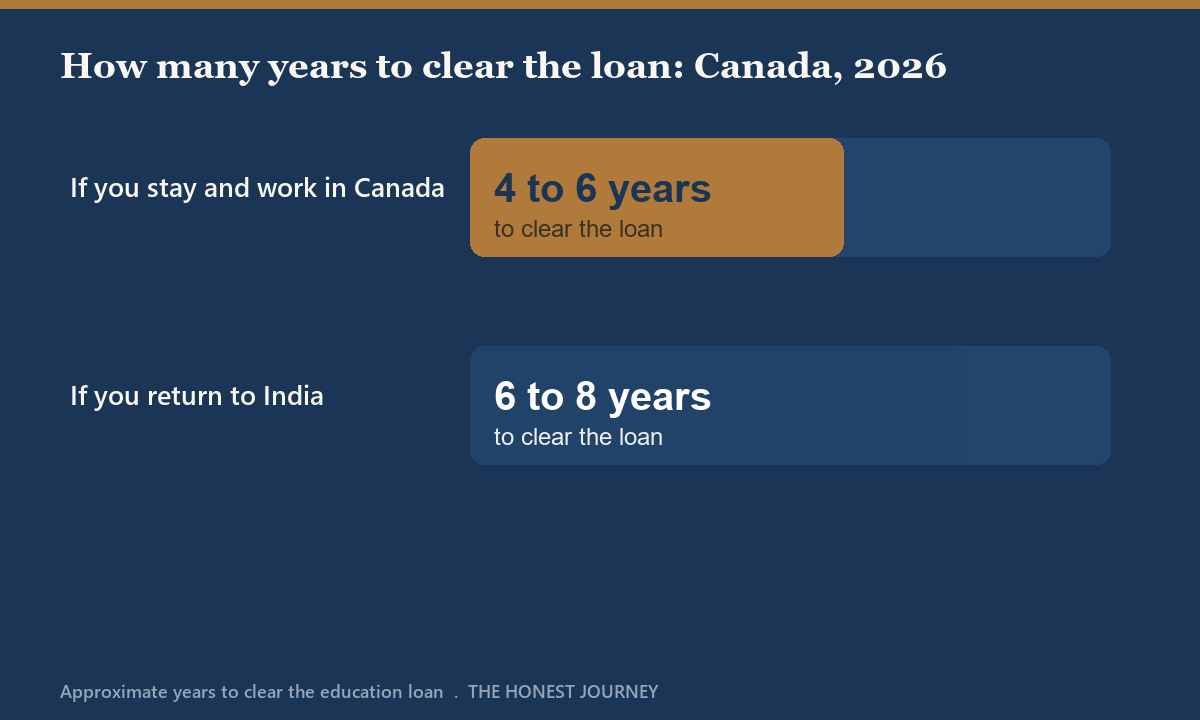
Scenario one, you stay and work in Canada. A graduate on CAD 70,000, directing ₹10 to 13 lakh a year at a balance near ₹33 lakh, clears the loan in roughly four to six years, then continues on a stable salary toward permanent residence. The important part is that this column is realistically achievable for most graduates, because the PGWP gives up to three years and Express Entry rewards exactly the profile you are building. You are not betting on a lottery to reach it.
Scenario two, you return to India. A Canadian Master’s plus some Canadian experience commands a decent Indian salary, often ₹12 to 22 lakh a year, and the same ₹33 lakh balance takes six to eight years to clear. It is a longer slog, but the loan was moderate, so it is more survivable than a failed US bet. And because staying is more controllable in Canada, fewer students are forced into this column against their will.
| Payback factor | Stay in Canada | Return to India |
|---|---|---|
| Typical salary | CAD 60k to 80k (~₹37 to 49L) | ~₹12 to 22 lakh |
| Annual take-home in hand | ~₹30 to 34 lakh | ~₹10 to 18 lakh |
| Realistic yearly loan repayment | ~₹10 to 13 lakh | ~₹5 to 8 lakh |
| Years to clear ~₹33 lakh | ~4 to 6 years | ~6 to 8 years |
| What decides it | Choosing a PGWP-eligible program | Program or profile fell short of PR |
The thing that moves you between columns in Canada is mostly within your control: program choice, work experience and profile-building. That is the opposite of the US lottery, and it is why Canada is the safest stay-and-repay bet here.
Faz's ruleIn Canada the fork between staying and returning is decided by your own choices, program, experience and profile, not by a random draw. That control is the reason Canada is the safest stay-and-repay bet on this list, provided you respect the new rules.
Where the US column split is partly luck, Canada’s is mostly planning. Choose a post-study-work-eligible program, build the Canadian experience Express Entry rewards, and the good column is genuinely reachable. The risk is not randomness; it is picking a program or profile that falls short of the tightened rules. Do the homework and Canada rewards it.
The risk that breaks the ROI
Canada’s main risk is not a lottery or a language; it is that the country has tightened significantly since 2024, and a student who plans against the old, easier Canada gets caught out.
The changes are real and stacked. Study-permit numbers have been capped, proof of funds has more than doubled to CAD 20,635, post-graduation work permit eligibility has been narrowed for certain programs and institutions, and Express Entry cut-off scores have risen as immigration targets were cut. None of this closes the pathway, but all of it raises the bar. The single most important consequence is that not every program still leads to a PGWP, and choosing one that does not can quietly break the entire staying plan the ROI depends on.
The honest planning rule is to verify, before you accept an offer, that your specific program and institution qualify for the post-graduation work permit under the current rules, and to build toward a competitive Express Entry profile from the start rather than assuming a pass. Do that and Canada’s controllable-stay advantage holds. Skip it and you inherit the cost of Canada without the certainty that justifies it. The current rules sit with canada.ca.
A worked payback example
Take one student, a two-year Canadian Master’s graduate, ₹32 lakh loan at 10.5 percent.
| Step | Figure |
|---|---|
| Loan borrowed | ₹32 lakh at 10.5 percent |
| Balance after 2-year moratorium | ~₹37 to 39 lakh |
| Canadian starting salary | CAD 70,000 = ~₹42.7 lakh gross |
| Take-home after Canadian tax | ~CAD 53,000 = ~₹32.3 lakh |
| Yearly amount toward loan | ~₹11 lakh |
| Payback if staying (PGWP job) | ~4.5 to 6 years |
| Payback if returned to India | ~6 to 8 years |
The staying column is a steady, achievable return: a moderate loan cleared in about five years on a durable salary, with permanent residence building alongside. The returning column is longer but survivable on a mid-size loan. Same student, and the fork is program choice and profile, both of which you control, not a draw you do not. That controllability is precisely what makes Canada worth its middle-of-the-pack salary.
When Canada is worth it, when it is not
It comes down to whether you value certainty over ceiling.
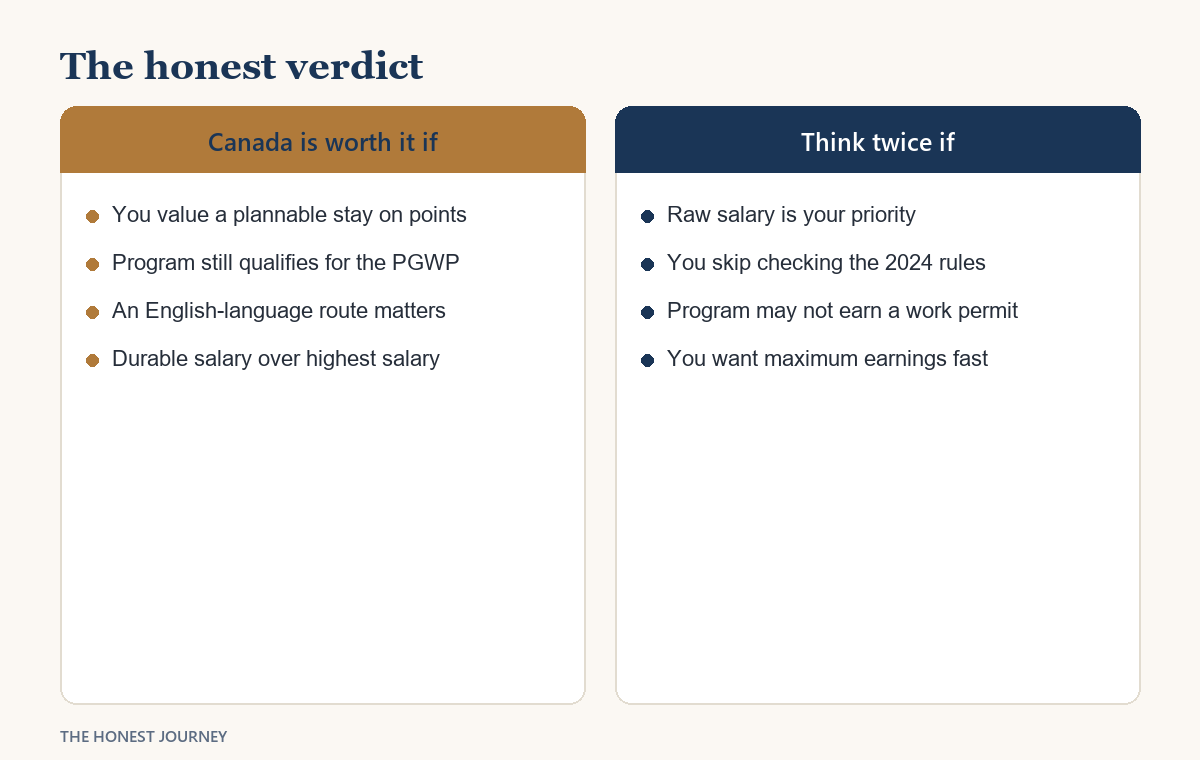
Canada is worth it if you want an English-language route to staying that you can plan on points rather than luck, you choose a program and institution that still qualify for the post-graduation work permit, and you value a durable, moderate salary and a realistic path to permanent residence over the highest possible earnings. For that profile Canada is the surest bet on this list, a moderate loan against a stay you can actually engineer.
Think twice if your priority is raw salary, where the USA pays far more, or if you pick a program without checking the tightened post-study-work rules, which can silently break the staying plan the whole return relies on. If maximum earnings matter most and you can stomach the visa lottery, the USA vs Canada comparison weighs that trade directly.
One note for everyone: a Canadian Master’s plus experience is a strong asset back in India too, and with a moderate loan a planned return is a reasonable outcome, not a disaster. But Canada’s real distinction is that, done right, you rarely have to return against your will.
The honest take
The Ontario graduate did not get rich fast, and she never expected to. What she got was the thing Canada actually sells: a stay she could plan on, a loan she could service from a durable salary, and permanent residence approaching on a checklist rather than a coin flip. She would tell you the salary was never the point. The certainty was.
So reduce it to the honest test. Do you value a controllable, English-language route to staying over the highest salary, and will you choose a program that still qualifies under the tightened 2024 rules and build a competitive profile from day one? If yes, Canada is the safest, most plannable return in international education. If you want maximum earnings or you skip the homework on the new rules, price that carefully and read the study in Canada page before you commit a rupee. Decide against the new Canada, not the old, easier one.
Funding the move with a loan? Start with the complete education loan guide, then apply through the PM Vidyalakshmi portal, the government route most Indian students use.
Canada takes a wider spread of profiles. See what it looks like for non-STEM graduates.
FAQ
Is a Canadian Master’s degree worth it for Indian students in 2026?
For students who value a plannable route to staying, yes, though it is harder than it was. Canada costs ₹30 to 45 lakh all-in and pays ₹37 to 49 lakh, clearing a ₹30 lakh loan in four to six years if you stay, which most graduates realistically can because the path runs on points and English, not a lottery. The catch is the 2024 tightening: caps, higher proof of funds, narrower work-permit eligibility and higher PR cut-offs. Choose a qualifying program and it remains the surest bet here.
How long does it take to repay a Canadian education loan?
If you stay and work in Canada, roughly four to six years on a normal graduate salary. If you return to India, the same loan takes about six to eight years on an Indian salary. Canadian loans are usually smaller than US or Australian ones, and because staying is plannable rather than lottery-based, more graduates actually reach the faster staying column, which is what makes the Canadian payback reliable even though the salary is moderate.
What salary can an Indian student expect after studying in Canada?
A Master’s graduate commonly starts around CAD 60,000 to 80,000, about ₹37 to 49 lakh gross at ₹61, with tech and specialised fields higher. Take-home after Canadian tax is roughly ₹32 to 34 lakh on a CAD 70,000 salary, before rent. Toronto and Vancouver rents cut into that sharply, so studying and working in other cities improves the maths. The salary is below US levels but durable, because you can realistically keep earning it while pursuing permanent residence.
Has Canada become harder for Indian students?
Yes, notably since 2024. Canada has capped study permits, raised proof of funds to CAD 20,635, narrowed post-graduation work permit eligibility for some programs, and lifted Express Entry cut-off scores as immigration targets fell. The permanent-residence pathway still exists and remains English-based and points-driven, but the bar is higher. The most important effect is that not every program leads to a work permit anymore, so verifying your specific program qualifies is now essential.
What is the biggest risk of studying in Canada now?
Choosing a program that no longer qualifies for the post-graduation work permit under the tightened rules, which silently breaks the staying plan the whole return depends on. Unlike the US lottery, Canada’s risk is largely within your control: it comes down to program and institution choice and building a competitive Express Entry profile. Verify eligibility before accepting an offer, and plan the PR profile from the start, and the risk is manageable.
Can Indian students settle permanently in Canada after studying?
Yes, and more predictably than in most destinations, because permanent residence runs through Express Entry, which rewards your Canadian credential, work experience and English scores without needing employer sponsorship. The post-graduation work permit gives up to three years to build that experience. Cut-off scores have risen since 2024, so it is more competitive than before, but it remains a points system you can plan toward step by step, which is Canada’s core advantage over lottery-based routes.
Should I take a large loan to study in Canada?
A moderate loan is well-suited to Canada because the stay is plannable, so you can reasonably expect to service it from Canadian earnings rather than hoping a visa comes through. A ₹25 to 35 lakh loan pencils out cleanly against a durable graduate salary. Keep it proportionate, prefer secured or GIC-linked options where the rate is lower, and study outside the most expensive cities to protect your repayment capacity. Canada rewards a moderate, well-planned loan more than a stretched one.
Is Canada or the USA a better return for Indian students?
The USA has the higher salary and Canada the higher certainty. A US STEM graduate who stays earns and repays faster, but staying runs through the H-1B lottery and a long green-card queue for Indians. Canada pays less but offers a controllable, English-based, points route to staying that most graduates can realistically reach. For maximum upside choose the USA; for a plannable stay and a steadier return, Canada often wins on a risk-adjusted basis. The full split is in the USA vs Canada comparison.
Faz · The Honest Journey · 2026