Short answer. The all in cost of studying in Canada for Indian students in 2026 runs roughly ₹30 lakh to ₹55 lakh for a one to two year PG diploma or Master’s, depending on province and program.
Tuition alone sits between CAD 17,000 and CAD 35,000 per year (₹10.5L to ₹21.5L), the mandatory GIC is CAD 20,635 (about ₹12.7L), and living costs in Toronto or Vancouver add CAD 15,000 to CAD 20,000 a year on top. The new PAL or TAL letter from the province is now a hard requirement, not optional.
Got your admit? Next, plan the move with our pre-departure checklist and what to carry to Canada.
A friend’s younger brother messaged me last month asking what Canada really costs end to end. He had one number from his consultant, another from a Reddit thread, and a third from his cousin who studied in Brampton in 2019. None of the three were close to the 2026 reality, mostly because the GIC amount jumped, the PAL letter became mandatory, and the PGWP rules shifted under his feet.
This is the honest breakdown for 2026, with real numbers, the rule changes, and the parts the consultants skip.
Once you have the number for Canada, the rest of the picture is close by: the USA vs Canada comparison, the UK vs Canada comparison, the study in Canada guide, and the GIC for Canada post.
The all in cost at a glance
This summary pulls the headline figures straight from the breakdown below, all of them indicative ranges at the May 2026 rate of CAD 1 = ₹61.5. Treat them as planning numbers, not quotes. The real total moves with your province, program and city.
| Cost head | Indicative range (INR) | Notes |
|---|---|---|
| Tuition (per year) | ₹7.4L to ₹21.5L | CAD 12,000 to 35,000, varies by province and program |
| GIC (per year) | ₹12.7L | CAD 20,635, refunded back to you monthly during studies |
| Living top up (per year) | ₹3L to ₹6L | Gap above the GIC in higher cost cities like Toronto or Vancouver |
| One time application and fees | ₹50,000 to ₹60,000 | Study permit, biometrics, VFS, medical, IELTS, translation |
| All in (typical Master’s, 2 years) | Roughly ₹45L net | ₹70L gross before GIC drawdown; PG diploma 1 year lands ₹28L to ₹35L net |
Tuition by province: where the real spread sits
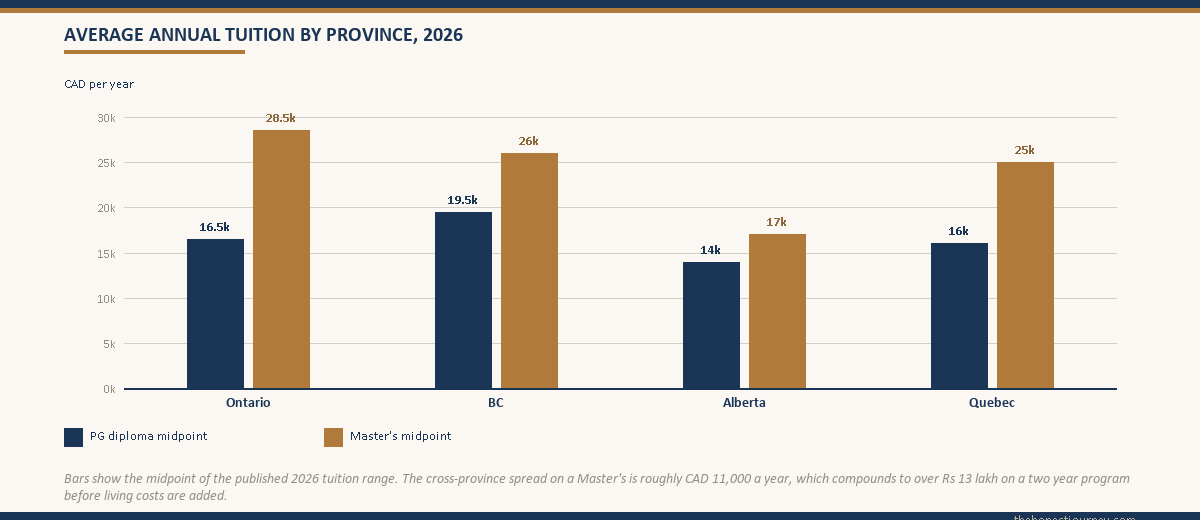
Canadian tuition for international students is set province by province and program by program, not nationally. The cost of studying in canada for indian students starts with picking the right province for your budget, because the gap between Ontario and Alberta on the same kind of program is real.
For a one year postgraduate diploma at an Ontario public college (Seneca, Centennial, Conestoga), tuition runs CAD 15,000 to CAD 18,000. The same program at a BC public institution sits at CAD 17,000 to CAD 22,000. Alberta is meaningfully cheaper for university programs, often CAD 12,000 to CAD 20,000 for a Master’s. Quebec’s tuition is the lowest sticker price for many programs but the CAQ adds a separate process, which I cover further down.
| Program type | Province | Tuition per year (CAD) | Approx INR |
|---|---|---|---|
| PG diploma, public college | Ontario | 15,000 to 18,000 | ₹9.2L to ₹11L |
| PG diploma, public college | BC | 17,000 to 22,000 | ₹10.5L to ₹13.5L |
| Master’s, public university | Ontario | 22,000 to 35,000 | ₹13.5L to ₹21.5L |
| Master’s, public university | BC | 20,000 to 32,000 | ₹12.3L to ₹19.7L |
| Master’s, public university | Alberta | 12,000 to 22,000 | ₹7.4L to ₹13.5L |
| Master’s, Quebec (anglophone) | Quebec | 20,000 to 30,000 | ₹12.3L to ₹18.4L |
Conversions use CAD 1 = ₹61.5, which is roughly the May 2026 inter-bank mid rate. Your bank’s card rate will be 50 to 150 paise above this on disbursement day. Private “career college” tuition is usually lower than public college tuition but those institutions are often outside the PGWP eligible list now, which makes the lower sticker price a false economy.
The GIC: a hard CAD 20,635, and what the SDS change means
The Guaranteed Investment Certificate is the proof of funds the Canadian study permit needs for living expenses. As of the 2026 update, the GIC requirement is CAD 20,635 per year, up from the long standing CAD 10,000 figure many older blog posts still quote. This is set by Immigration, Refugees and Citizenship Canada and is non negotiable for any student using the SDS or non SDS route.
You buy the GIC from one of the approved Canadian banks listed on the IRCC SDS page (Scotiabank, ICICI Bank Canada, CIBC, RBC, HSBC Canada, SBI Canada, BMO, TD, Desjardins and a few others). The bank issues a Letter of Attestation. On arrival, you complete activation and they release roughly CAD 2,000 upfront, then about CAD 1,550 monthly over twelve months.
The CAD 20,635 has to come from your own funds or a sanctioned education loan disbursement direct to the Canadian bank. Routing it through your INR savings first triggers LRS reporting and 0.5 percent TCS on education remittance above ₹7L, so direct disbursement under the loan is cleaner. For more see the proof of funds for student visa post.
Faz's rulePick the GIC issuing bank by which one has fewer activation headaches in your destination city, not by which Indian agent gets you the fastest sign up.
Scotiabank, ICICI Canada and SBI Canada all work fine on paper. The friction shows up on arrival when you need to walk into a branch to complete activation. If your university is in Halifax, picking a bank with two branches in Atlantic Canada is going to cost you a weekend trip and a Greyhound ticket compared to picking one with a branch on campus.
The PAL letter: the rule most 2024 era posts miss
The Provincial Attestation Letter (called a TAL in Quebec) became mandatory in January 2024 and remains so in 2026. Every undergraduate and most graduate study permit applications now need a PAL from the province where the institution is located. The PAL confirms the student is counted within the province’s annual study permit cap.
The institution applies for the PAL on your behalf after you accept the offer and pay the tuition deposit. Processing takes one to six weeks depending on the province. Ontario and BC have been the slower ones because their caps fill faster. Without a PAL in the file, IRCC will return the study permit application as incomplete, not even reject it on merit.
Master’s and PhD students are exempt from the cap in many provinces but the PAL or equivalent is still being requested by IRCC in 2026 for consistency. Check the current exemption list on the IRCC site before assuming a Master’s bypasses it. Quebec students need a CAQ from the provincial government plus a TAL, and the CAQ alone takes four to six weeks. The official EduCanada portal lists designated learning institutions by province.
Tuition upfront: the SDS requirement nobody warned the family about
Under the Student Direct Stream, which is how most Indian students apply for the Canadian study permit, you have to pay the first year tuition in full before applying. Not a deposit, not 50 percent. The full year. The proof is the receipt from the institution and it goes into the SDS application file alongside the GIC confirmation.
For a CAD 22,000 PG diploma that is ₹13.5L. For a CAD 30,000 Master’s it is ₹18.4L. Add the GIC of ₹12.7L and you are committing roughly ₹26L to ₹31L of liquid capital before the study permit is even decided. If the permit is refused, the GIC is fully refundable and the tuition is refundable per the institution’s published refund policy (typically minus a deposit of CAD 250 to CAD 1,000).
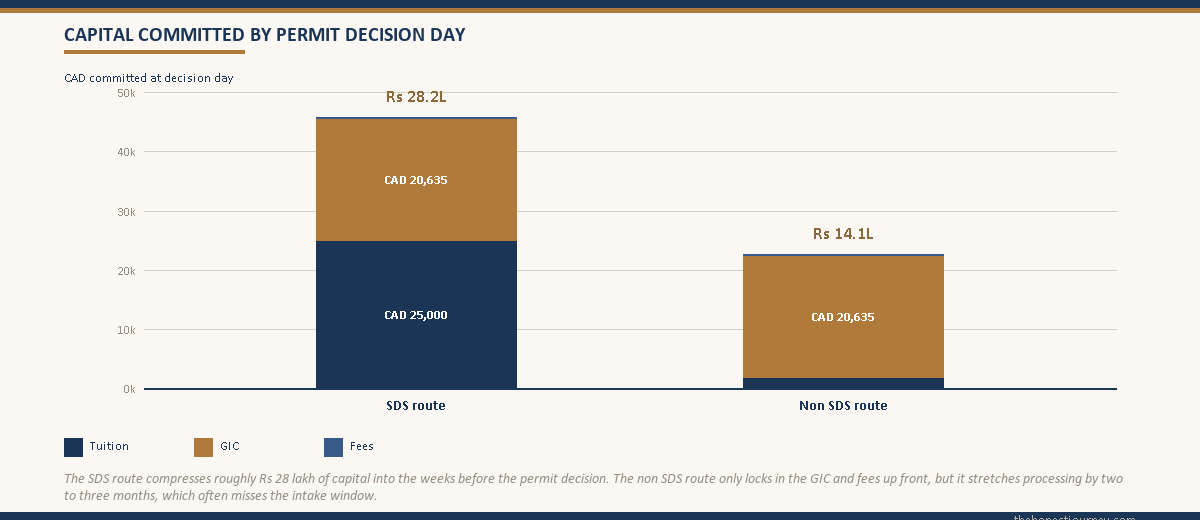
The non SDS route does not require full year tuition upfront, but processing times stretch to 12 to 16 weeks instead of 4 to 8 weeks for SDS. Most students with an education loan sanction route through SDS because the loan covers the upfront and the speed gain matters for the intake window. For sequencing loan tranches against these dates see the how to fund study abroad post.
Biometrics, study permit fee, and the small line items that add up
The application fees themselves are modest but they all hit before you board the flight.
| Fee | Amount (CAD) | Approx INR |
|---|---|---|
| Study permit application fee | 150 | ₹9,225 |
| Biometrics fee | 85 | ₹5,225 |
| VFS Canada service charge (India) | ₹2,200 to ₹2,800 | As listed |
| Medical exam (panel physician) | ₹5,500 to ₹7,500 | As listed |
| IELTS or equivalent | ₹17,000 | As listed |
| Translation and notarisation | ₹3,000 to ₹8,000 | As listed |
| Courier and incidentals | ₹2,000 to ₹4,000 | As listed |
Total application phase costs land around ₹50,000 to ₹60,000 outside tuition and GIC. Student account opening in Canada is usually free for internationals, and the Social Insurance Number is free.
Living costs in Canada: by city, honestly
The IRCC living estimate of CAD 20,635 (the GIC figure) is supposed to cover one year. In Toronto, Vancouver and Mississauga, it does not. Realistic monthly costs in those three cities run CAD 1,800 to CAD 2,400, so most students top up with personal funds or part time work earnings.
Smaller cities are meaningfully cheaper. Halifax, Winnipeg and Saskatoon run CAD 1,200 to CAD 1,600 a month, which the GIC actually covers. Montreal sits in the middle at CAD 1,400 to CAD 1,900. Rent is the largest variable: a shared room in Brampton or Scarborough runs CAD 600 to CAD 850, a Toronto studio starts at CAD 1,800.
Faz's ruleBudget for living costs based on the city, not on the IRCC minimum figure, because the IRCC number is a floor not a forecast.
The CAD 20,635 is what the government uses to grant you the study permit. It is not what one year in Toronto actually costs. If your loan is sized off that figure alone and your program is in the GTA, you are short by CAD 5,000 to CAD 8,000 a year before you find a part time job. Build the loan around the real city cost or plan a clear funding source for the gap.
Quebec is a different country for paperwork
If your program is in Quebec, the process forks. You need a CAQ (Certificat d’acceptation du Quebec) before applying for the federal study permit. The CAQ costs CAD 134 and takes four to six weeks. Quebec also issues its own TAL, which the institution requests after you accept the offer.
Tuition at McGill and Concordia for international students sits between CAD 20,000 and CAD 30,000 for most Master’s, roughly comparable to Ontario. The lower in province rate does not apply to Indians. Montreal living is gentler than Toronto (a shared apartment in Cote des Neiges runs CAD 700 to CAD 900). French language requirements apply to some programs and the new Quebec language law tightens this every year.
PGWP changes: the rule that broke a lot of plans in 2024 and 2025
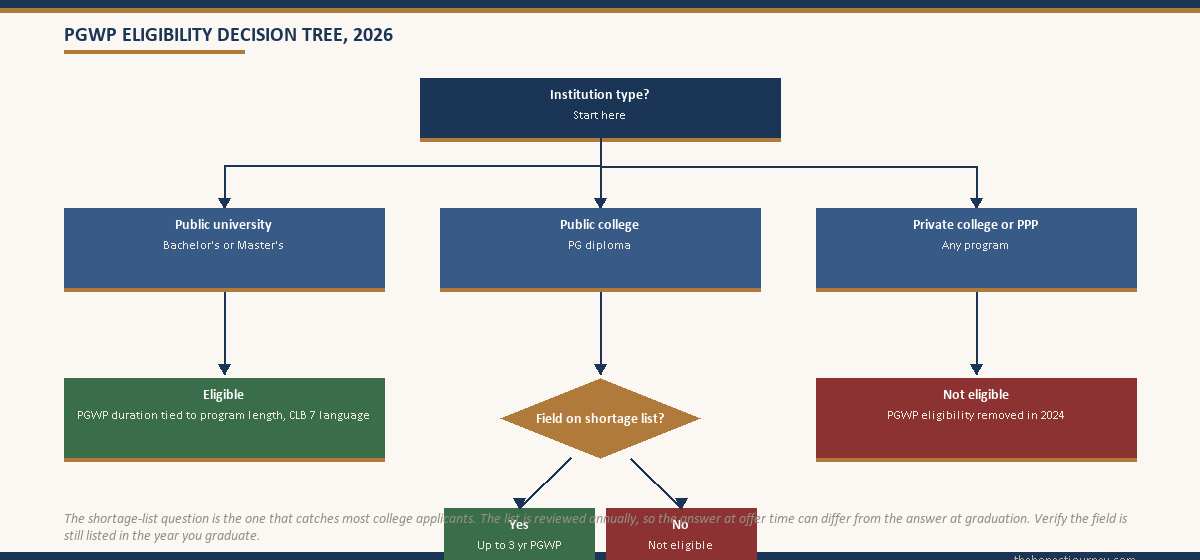
The Post Graduation Work Permit is the part of the Canada equation that justified the cost for many students, and the rules tightened materially through 2024 and 2025. The 2026 position:
Public college PG diploma graduates in a long term labour shortage field (healthcare, trades, STEM, education, transport) can still get a PGWP of up to three years. PG diploma graduates outside those fields are no longer eligible. University Bachelor’s and Master’s graduates remain eligible regardless of field, with duration tied to program length. Private career college and public private partnership programs lost PGWP eligibility entirely. A new language requirement applies from 2024: CLB 7 for university, CLB 5 for college graduates.
Check the current eligibility list on the IRCC page because the eligible field list is updated annually. For the broader funding context see the studying abroad from India cost and funding guide.
Faz's ruleIf your PGWP plan depends on a specific eligibility category, verify the field is still listed in the year you will graduate, not just the year you apply.
The 2024 changes caught a lot of students who started a PG diploma in 2023 expecting a three year PGWP that no longer existed by graduation. The eligibility list is reviewed every year. If you are signing a ₹35L loan on the assumption of a three year work permit and a Toronto salary, build the worst case scenario into the repayment math, not just the best case.
The full INR total: a worked example
Here is the all in number for a typical case. A two year Master’s at a public Ontario university, tuition CAD 28,000 per year, living in Toronto with the IRCC GIC plus a CAD 5,000 personal top up per year, completed and PGWP applied for.
| Line | Amount |
|---|---|
| Tuition, 2 years | ₹34.4L |
| GIC, 2 years | ₹25.4L (refunded back to you monthly during studies) |
| Personal top up living, 2 years | ₹6.2L |
| Application phase costs | ₹0.6L |
| Flights, 2 round trips | ₹1.6L |
| Initial settlement, deposits, winter gear | ₹1.5L |
| PGWP application and language test | ₹0.5L |
| Total outlay | Roughly ₹70L gross, ₹45L net after GIC drawdown |
For a one year PG diploma at a public Ontario college (CAD 17,000 tuition), the equivalent net lands at ₹28L to ₹32L. For a Master’s at a smaller Atlantic Canada or Prairie university (CAD 16,000 tuition), ₹30L to ₹35L net over two years. Provincial choice shifts the total by ₹10L to ₹15L on otherwise comparable programs. For forex card sequencing across these payouts see the best forex card for students post.
Scholarships: real, but thinner than the brochures suggest
Let me be honest about scholarships before you bank on one. For Indian students heading to Canada, awards exist at three levels, but the headline ones are extremely selective and almost none of them cover the full ₹30L to ₹55L all in cost. Treat any scholarship as a discount on the number above, not as the thing that makes the loan unnecessary.
Federal and flagship awards. The Vanier Canada Graduate Scholarship is the one everyone names. It is worth CAD 50,000 a year for three years, but it is for doctoral students only, it runs through the university nomination route rather than direct application, and the success rate is in the low single digits. If you are doing a PG diploma or a one year Master’s, Vanier is not on the table. The Banting and other tri-council awards sit in the same doctoral, ultra-selective bracket.
Provincial awards. Some provinces run merit programs for international students, often tied to a specific institution or research field. These tend to be partial, in the CAD 2,000 to CAD 10,000 range, and they rarely repeat every year. Useful to offset one tuition installment, not to fund a degree.
University entrance and program awards. This is where most Indian students actually see money. Many Canadian universities offer entrance scholarships that are applied automatically based on your admission GPA, usually CAD 1,000 to CAD 5,000 in the first year, occasionally higher at research universities. There are also program specific bursaries and graduate teaching or research assistantships, and the assistantships are often worth more than the named scholarships because they pay a stipend across the year. Check the financial aid page of your specific institution rather than relying on aggregator lists.
Faz’s ruleSize your loan as if you will win nothing, then treat any scholarship as a prepayment.
The selective awards have low single digit success rates and the automatic entrance ones rarely top CAD 5,000. If you build your funding plan around a scholarship you have not been offered yet, a rejection in March leaves you scrambling weeks before the intake. Win one and it shortens your repayment. Plan around one and it can sink the whole year.
The honest closing take
Canada is no longer the budget option it was in 2018. The 2024 to 2026 rule changes have made the upfront commitment higher and the back end work permit thinner. The GIC doubled. The PAL became mandatory. The PGWP eligibility list narrowed. Tuition kept rising.
What still works is a public university Master’s in a province with reasonable rent (Alberta, the Prairies, Atlantic Canada) where total net cost lands at ₹30L to ₹40L and PGWP remains available regardless of field. What stopped working is the private career college pathway and the assumption that any PG diploma converts to a three year work permit.
Before signing the loan, verify three things on official IRCC pages for the year you will start: the current GIC amount, the PAL status for your institution and program, and PGWP eligibility for the program at the institution. If any of those changed since you started researching, the math changes with it.
Once the budget for Canada is clear, the visa is the next hurdle. The fees, funds proof and processing are in the Canada student visa guide.
Cost is only half the question. See is studying in Canada worth it for the salary, payback period and return on this spend.
FAQ
What is the cost of studying in Canada for Indian students in 2026?
An all in budget for a one year PG diploma at a public Ontario or BC college lands at ₹28L to ₹35L net, covering tuition, application costs, flights, settlement and the gap between IRCC living estimates and real city costs. A two year Master’s at a public university runs ₹40L to ₹55L net depending on province. The GIC of CAD 20,635 is included in the gross outlay but is returned to you monthly during studies, so it is a cash flow item not a true cost.
What is GIC and how much is needed in 2026?
The Guaranteed Investment Certificate is a proof of funds product issued by approved Canadian banks like Scotiabank, ICICI Canada, SBI Canada and CIBC. As of 2026 the required amount is CAD 20,635 per year, up from the long quoted CAD 10,000 figure many older blog posts carry. You buy it from India before applying, and after arrival in Canada the bank releases roughly CAD 2,000 upfront and CAD 1,550 monthly over twelve months.
Is the PAL letter mandatory for a Canada study permit?
Yes, for most study permit applications since January 2024. The Provincial Attestation Letter is issued by the province where your institution is located and confirms you are counted within that province’s annual study permit cap. The institution applies on your behalf after you accept the offer. Without it in the file, IRCC will return the application as incomplete. Quebec uses a separate equivalent called a TAL that runs alongside the CAQ process.
Do I need to pay the full first year tuition before applying?
Under the Student Direct Stream, yes. The full first year tuition has to be paid and the receipt included in the file, not a deposit. Under the non SDS route, full prepayment is not required but processing stretches to 12 to 16 weeks instead of 4 to 8. If the study permit is refused, tuition is refundable per the institution’s published policy, usually minus a deposit of CAD 250 to CAD 1,000.
Can I work in Canada as an international student?
Yes, study permit holders can work up to 24 hours per week off campus during academic sessions and full time during scheduled breaks, as of the late 2024 update. On campus work is unrestricted. Entry level part time wages run CAD 16 to CAD 20 per hour, roughly CAD 1,500 to CAD 2,000 a month, which meaningfully closes the gap between the IRCC living estimate and real city costs.
What is PGWP and who qualifies in 2026?
The Post Graduation Work Permit is an open work permit issued after program completion, valid up to three years. University Bachelor’s and Master’s graduates qualify regardless of field. Public college PG diploma graduates qualify only if the field is on the long term labour shortage list (healthcare, trades, STEM, education, transport). Private career college and public private partnership graduates no longer qualify. A language test at CLB 7 (university) or CLB 5 (college) is required at PGWP application.
How is Quebec different for Indian students?
Quebec runs its own immigration process alongside the federal one. You need a CAQ from the Quebec government before applying for the study permit, which costs CAD 134 and takes four to six weeks. Quebec also issues its own TAL through the institution. Tuition at McGill or Concordia for internationals is similar to Ontario, so the bargain Quebec used to offer is for Canadian and French citizens, not Indians. Montreal living is lower than Toronto and some programs require French.
Can an Indian education loan fund the GIC and tuition?
Yes. Public sector banks like SBI Global Ed-Vantage, Bank of Baroda, Canara Bank and private lenders like HDFC Credila routinely fund both the GIC purchase and tuition prepayment. The sanction letter has to mention overseas remittance for GIC and tuition. The bank wires CAD directly from the loan account to the Canadian bank issuing the GIC and to the institution, which keeps the remittance inside the education loan TCS framework rather than the higher LRS rates on personal remittance. For a lender by lender breakdown, see how to pick an education loan for studying in Canada.
Faz · The Honest Journey · 2026