Short answer. Canada’s packing challenge is the winter, which in most student cities is genuinely harsh, minus twenty and colder. The advice is counterintuitive: do not pack for a Canadian winter from India. Indian winter wear will not cope, and proper Canadian gear is better and often cheaper bought there. Carry documents and your study permit letter.
Canada’s packing challenge is the winter, which in most student cities is genuinely harsh, minus twenty and colder, in a way no Indian sweater prepares you for. The honest advice is counterintuitive: do not try to pack for a Canadian winter from India, because Indian winter wear will not cope and proper Canadian gear is better and often cheaper bought there. Carry your documents including the study permit letter and GIC proof, prescription medicines with a doctor’s letter, a North-American plug adapter, a forex card with some cash, and clothes for the season you land in. Leave the bulk food and utensils behind, because Canadian cities have large Indian communities, Indian grocers everywhere, and Amazon and Walmart for the rest. Land warm enough to get from the airport to a store, then buy the real winter there.
Canada has one of the largest Indian student populations anywhere, and that shapes what is worth carrying: almost nothing Indian is hard to find. Every student city has Indian grocery stores, temples, and communities, and the big-box stores and Amazon cover everything else. The one thing the community cannot solve for you is arriving underdressed for a real winter, which is the single most common and most miserable Canada packing mistake. Get the winter strategy right and the rest of the list is short.
This is the honest Canada packing guide: what earns its weight, what to leave, the customs and voltage realities, and the winter plan that actually works. For the money side read how much money to carry abroad and the GIC for the Canada student visa guide, and if Canada is still being costed, the cost of studying in Canada is the honest baseline.
Pack for the season you land in, buy winter there
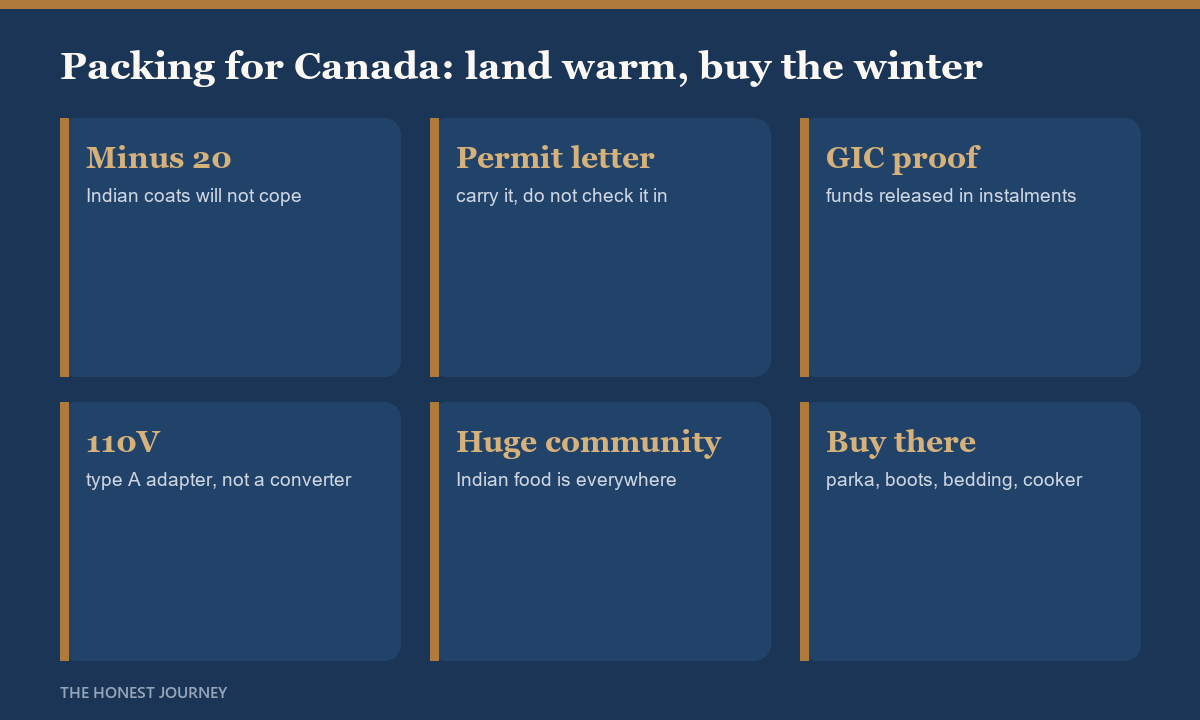
Canadian winters in cities like Toronto, Montreal, Winnipeg and Edmonton reach temperatures Indian clothing simply cannot handle. A Delhi winter jacket is a light autumn layer in Canada. The proven approach is to carry clothes for the season you arrive in, plus one warm layer for the airport, and buy the serious winter kit, an insulated parka rated for the cold, snow boots, thermals, gloves and a proper hat, in Canada. It is designed for the actual temperatures and frequently cheaper in end-of-season and student sales than shipping heavy coats in your luggage.
If you land in fall or winter, bring enough to stay warm from the airport to a store in your first days, then invest in real gear locally. Trying to pre-buy a Canadian winter from India usually means paying luggage weight for clothing that does not do the job.
Documents to hand-carry
These go in your cabin bag, never checked, with photocopies and scans:
- Passport with the visa and your study permit introduction letter (the Port of Entry letter), which you present at immigration to get the actual study permit.
- Letter of Acceptance from your Designated Learning Institution.
- Proof of funds: GIC certificate, education loan sanction letter, and bank statements. The GIC guide explains how it works and what your loan does and does not cover.
- Academic records: transcripts, degree and mark sheets, originals plus attested copies.
- Medical and immunization records, and any custodianship or additional documents if relevant.
- Passport photographs and printed emergency contacts.
The study permit itself is issued at the airport on arrival, so the introduction letter must be in your hand, not your suitcase.
Medicines: original packaging and a prescription
Carry prescription medicines in original packaging with the prescription and a doctor’s letter, enough for two to three months while you set up local healthcare, which varies by province. A basic over-the-counter kit is fine in personal quantities. Do not carry large unlabelled quantities or anyone else’s medication.
Plugs, voltage and electronics
Canada uses 110 to 120V with type A and B plugs, the same as the US and different from India’s 230V. Most laptops, phones and chargers are dual-voltage (check for 100 to 240V) and need only a plug adapter, but single-voltage Indian appliances will fail or need a bulky converter, so leave hair dryers and irons and buy cheap local ones. Carry an unlocked phone for a Canadian SIM, covered in the SIM abroad guide, and note Canadian mobile plans are relatively expensive, so compare student options.
Clothes beyond winter
Aside from the winter strategy above, pack everyday wear, comfortable shoes, and one set of Indian formals or ethnic wear for events and the many Indian community celebrations you will find on Canadian campuses. Layering is the key skill for Canadian weather, which swings widely, so pack layers rather than a few heavy single pieces.
Food and kitchen: the community has it covered
With such a large Indian population, Canada is one of the easiest places to find Indian food, spices, atta and ready mixes, in dedicated grocers and even mainstream supermarkets. Amazon Canada and Walmart handle utensils and a pressure cooker cheaply. Do not carry kitchen hardware or bulk food, bring a small starter kit of core spices and any specific homemade item you cannot replace, and stop there. Pack pickles and liquids sealed inside checked luggage.
Canada customs and food rules
The Canada Border Services Agency requires you to declare all food, plants and animal products, and enforces the rules. For a student:
- Declare everything. Tick the food box on your declaration; not declaring can mean fines and confiscation.
- Prohibited or restricted: meat and many animal products, fresh fruits and vegetables, seeds, and some dairy. Do not carry these.
- Generally allowed if declared: commercially packaged, sealed dry goods like spices, packaged snacks and tea in personal quantities.
Carry only sealed, labelled, vegetarian dry goods, declare all of it, and avoid fresh, meat-based or homemade items.
Money for the journey and first days
Your GIC provides your initial living-cost funds in Canada and is released to you in instalments after you activate the account locally. For the journey and first days, carry a forex card plus around 100 to 200 Canadian dollars in cash. Opening or activating your Canadian bank account is a first-week task, covered in opening a bank account abroad. For the wider picture see how much money to carry abroad.
Buy it there in week one
Leave these for Canada: the real winter coat and boots, bedding and towels, a pressure cooker and kitchen basics, toiletries in bulk, and a study lamp. Walmart, Canadian Tire, dollar stores and Amazon Canada cover it cheaply. Carry two days of toiletries and buy the rest on arrival.
The honest closing take
Canada is generous to the light packer in everything except the one thing that matters most: the winter. Do not fight it from India with sweaters that will not cope, land warm enough to reach a store and buy gear built for minus twenty. Keep your study permit letter and GIC proof in your cabin bag, lean on Canada’s huge Indian community for everything food-related, and buy the bulky essentials there. Pack for arrival day and the airport walk, and let Canada dress you for its real winter.
FAQ
Should I buy winter clothes in India or Canada?
Buy the serious winter gear in Canada. Indian winter wear cannot handle Canadian cold, which reaches minus twenty and below in many student cities. Carry one warm layer for the airport and first days, then buy an insulated parka, snow boots and thermals locally, where they are built for the cold and often cheaper on sale.
What documents must I hand-carry to Canada?
Carry your passport with visa, the study permit introduction letter (Port of Entry letter), Letter of Acceptance, proof of funds including the GIC certificate, and academic records in your cabin bag. The study permit itself is issued at the airport, so the introduction letter must be in hand, not checked.
Do I need a plug adapter or voltage converter for Canada?
Canada uses 110 to 120V with type A and B plugs. Most laptops and chargers are dual-voltage and need only a plug adapter, but single-voltage Indian appliances like hair dryers will not work safely, so buy those in Canada instead.
Can I carry Indian food to Canada?
Sealed, commercially packaged dry goods like spices, packaged snacks and tea are generally allowed in personal quantities if declared. Meat, many animal products, fresh produce, seeds and some dairy are prohibited or restricted. Declare all food to the Canada Border Services Agency to avoid fines.
How does the GIC money work when I arrive?
Your GIC provides initial living-cost funds and is released to you in instalments after you activate the account in Canada, typically an initial lump sum then monthly payouts. Carry a forex card and some cash for the journey and first days, and activate your Canadian bank access in your first week.