Short answer. For Indian students, the Canada study permit (it is a permit, not a visa) costs CAD 150 to apply plus CAD 85 for biometrics, and as of the 2026 intake you must show proof of funds of CAD 20,635 for living costs plus your first-year tuition.
A Provincial Attestation Letter is now mandatory, the SDS fast track is gone, and refusals usually come down to weak funds or unclear intent.
To work out your Canada proof of funds in rupees, use the student visa proof of funds calculator.
For what happens after you graduate, see who actually qualifies for the PGWP.
Got your admit? Next, plan the move with our pre-departure checklist and what to carry to Canada.
A boy I mentored from my hometown applied last year, fully confident, because his cousin had sailed through the SDS stream two years earlier in under three weeks. He had built his whole timeline around that memory. Then he learned, halfway through, that SDS had closed and he was on the regular stream like everyone else, and that he needed a Provincial Attestation Letter he had never heard of. The plan was not wrong. It was just a year out of date, and in Canadian immigration a year is a long time now.
This post stays strictly in the visa lane: the permit type, the real step-by-step, fees, funds proof, biometrics and medical, processing time, and the honest refusal reality. If you want admissions and the wider decision on whether Canada is right for you, that lives in the study in Canada for Indian students guide. The full rupee budget for tuition and city living sits in the cost of studying in Canada post. Here we only talk about getting the permit.
First, it is a study permit, not a visa
People say “Canada student visa” out of habit, but the document you actually apply for is a study permit. Alongside it, most Indian applicants are also issued a temporary resident visa (the entry sticker in your passport) or an eTA, but that comes bundled with the permit decision. You do not run two separate processes. You apply for the study permit, and if approved, the entry document is granted with it.
The whole system is run by Immigration, Refugees and Citizenship Canada, or IRCC. Everything official, the forms, fees, funds figure and processing estimates, lives on the government portal at canada.ca and ircc.canada.ca. Treat those two as your only source of truth. The rules change between intakes, so as of the 2026 intake every number in this post is a planning figure you should confirm on the official IRCC portal the week you apply.
What changed in 2024 to 2025, and why it matters
Canada tightened the student route hard over 2024 and 2025, and if your information is older than that, it is wrong in three specific ways.
First, the Provincial Attestation Letter, or PAL, is now required for most study permit applications. It is a letter from the province confirming you are counted within its allocation of study permits, and your designated learning institution helps you obtain it after you accept your offer. No PAL, no complete application, and IRCC will return it. This is the single most common new gap for applicants working from old guides.
Second, the Student Direct Stream, the SDS, closed in November 2024. For years it was the fast lane that processed strong Indian applications in weeks, in exchange for an upfront GIC and an English test. It is gone. Every Indian applicant now goes through the regular study permit stream, so plan for regular-stream timelines, not the SDS speed your seniors remember.
Third, the proof-of-funds figure was raised. The living-cost amount you must show, on top of tuition and travel, was lifted to CAD 20,635 for a single applicant. This is roughly double the old CAD 10,000 figure that sat unchanged for two decades. If your family’s plan is built on the old number, it is short by about ₹6.5 lakh before you start.
Faz's ruleThe SDS is dead and PAL is mandatory. If your plan came from a senior who applied before late 2024, throw it out and rebuild from the current IRCC page.
The two most painful refusals I see are people who never got a PAL and people who budgeted for the old funds figure. Both were applying with last year’s rulebook. The Canadian student route now changes between intakes, so the only safe move is to read the live IRCC page yourself the month you apply.
The study permit fees, in INR
Let me put the money on the table first. These are the government fees you pay to IRCC, not your tuition or living costs, which live in the cost post. The planning rate through this article is ₹61 per Canadian dollar. It moves, so re-check it the week you transfer money.
| Fee (study permit) | CAD | INR (at 61) |
|---|---|---|
| Study permit application fee | 150 | ~9,150 |
| Biometrics fee | 85 | ~5,185 |
| Medical exam (panel physician, typical) | ~150 to 250 | ~9,150 to 15,250 |
| GIC, living-funds proof (recoverable) | ~20,635 | ~12,58,735 |
| Government fees only (excl. GIC) | ~385 to 485 | ~23,485 to 29,585 |
The honest read of this table: the application fee and biometrics are small, a little over ₹14,000 combined. The medical is paid to an approved panel physician, not IRCC, and varies by clinic. The big number is the GIC, but that is not a fee. It is your own money, parked in a Canadian account as proof of funds, that you draw back in instalments after you land. The body image below breaks the outlay apart so you see what you actually spend versus what you merely show.
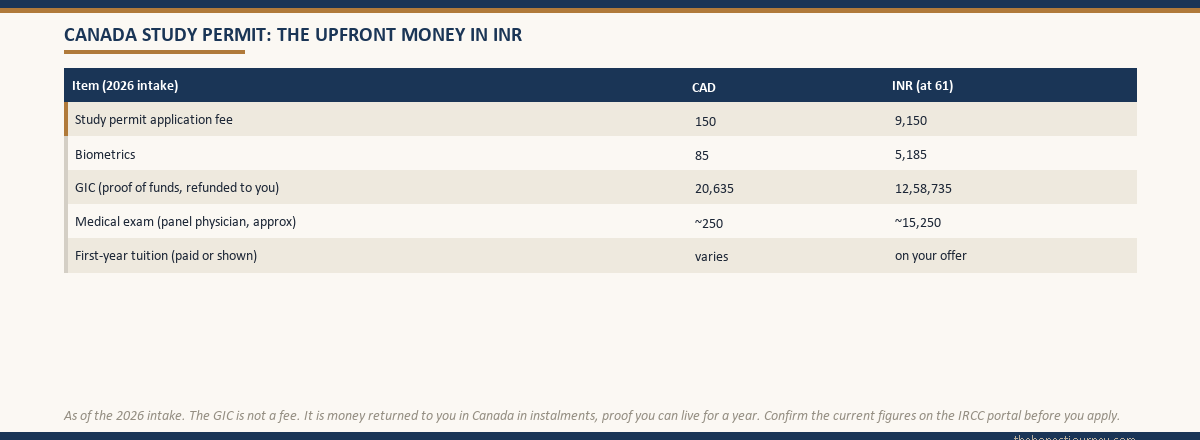
Note what is in the table and what is not. Your tuition is paid to the university, and the full rupee picture for tuition and city living is in the cost of studying in Canada post, not here. On this page, money appears only as the funds you must prove to get the permit.
Proof of funds: the part that decides your case
If a Canadian study permit gets refused, the reason is most often money, specifically whether the officer believes you can genuinely pay for your studies without working illegally. So this is the section to get right.
As of the 2026 intake you must show, on top of first-year tuition and travel costs, living funds of CAD 20,635 for a single applicant. At ₹61 per dollar that is about ₹12.6 lakh. Add a first-year tuition that often runs CAD 20,000 to CAD 35,000 and the total proof is substantial. Confirm the exact living figure on the official IRCC portal, because this is the number that was raised recently and could move again.
The cleanest way most Indian applicants satisfy the living-funds part is the Guaranteed Investment Certificate, the GIC. You transfer roughly CAD 20,635 to a participating Canadian bank before you apply, the bank issues a certificate, and after you arrive the money is released back in instalments. It is your money the whole time. Under SDS the GIC was mandatory. On the regular stream you can prove funds other ways, but the GIC remains the cleanest proof. The mechanics of arranging it from India, and how it interacts with a loan, are in the GIC and Canada education loan post.
What officers actually want is not just a big balance, but money that makes sense. A lump sum that appeared last week, with no story of where it came from, reads as borrowed-for-show and weakens you. Seasoned funds, a clear source, and a loan sanction letter if you are financing together build credibility. The broader principles of presenting funds proof are in the proof of funds for a student visa guide, and the Canada loan route is in the education loan for Canada post.
Faz's ruleOfficers judge whether your money is credible, not just whether it is enough. A fat balance that landed last week looks worse than a steady, well-sourced fund with a loan sanction behind it.
I have watched applications with plenty of money get refused because the funds appeared overnight and had no story. Seasoned savings, a clear source, and a loan letter that ties to your tuition tell a coherent tale. Build that story before you build the balance.
The four-step process, end to end
Here is how the regular-stream study permit actually runs, in the order it happens. The step flow below maps the same four stages at a glance.
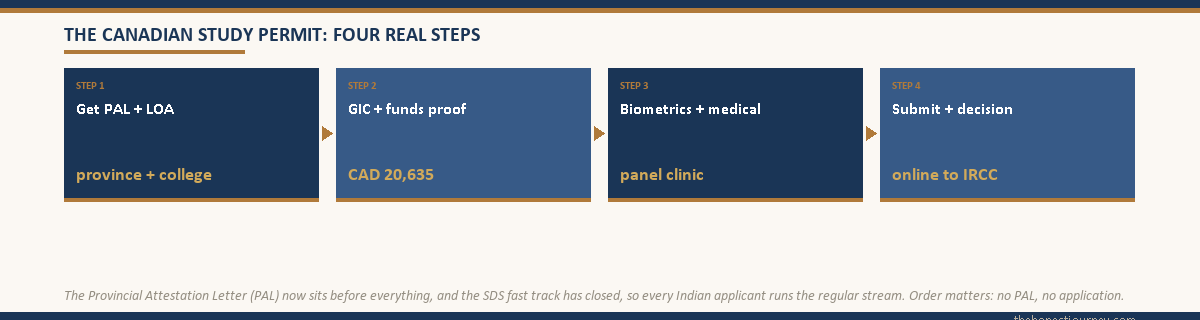
Step one: get your acceptance and your PAL. You accept an offer from a designated learning institution, pay any tuition deposit they require, and receive your Letter of Acceptance. Your institution then helps you secure the Provincial Attestation Letter from the province. You cannot complete a study permit application without both, so treat the PAL as a hard dependency, not an afterthought.
Step two: arrange your GIC and proof of funds. Open the GIC with a participating Canadian bank and transfer the living-funds amount, currently around CAD 20,635, then gather your tuition payment evidence, loan sanction letter if applicable, and any other funds documents. This is the stage that quietly takes the longest, because international transfers and bank paperwork move on their own schedule.
Step three: biometrics and medical. Pay the biometrics fee and book an appointment at a Visa Application Centre for fingerprints and a photo, then complete an immigration medical exam with an IRCC-approved panel physician. Doing the medical upfront generally speeds things along compared with waiting to be asked.
Step four: submit and wait for the decision. Create your account on the IRCC portal, complete the application, upload your documents, pay the CAD 150 fee, and submit. Then it is processing time. If approved, you receive a letter of introduction and your entry document, and finalise the actual permit when you land.
Biometrics, medical, and the documents officers expect
Two physical steps catch people who think the application is purely online. Biometrics is an in-person visit to a Visa Application Centre for fingerprints and a photo, valid ten years, with the CAD 85 fee. The medical must be done by a panel physician on IRCC’s approved list, not your family doctor, paid directly to that clinic. Build both into your timeline early. Beyond those, the documents that carry weight are your Letter of Acceptance, PAL, proof of funds, passport, and a clear study plan explaining why this course, why Canada, and what you intend after. That last one is where intent is judged, so follow the official document checklist on the IRCC portal, because it updates between intakes.
Processing time and the honest refusal reality
With SDS gone, you are on regular-stream timelines. These vary by season and volume, and IRCC publishes live estimates you should check for India rather than trusting a forum number. The takeaway is to apply early. The crush before a September intake is real, and leaving it late is how strong applicants end up deferring a semester for no reason other than the calendar.
Now the part most guides skip. Canadian study permit refusals for Indian applicants are common, and the reasons cluster around funds and intent. Funds refusals happen when the money is short, unseasoned, or its source is unclear. Intent refusals, phrased around whether the officer is satisfied you will leave at the end of your stay, happen when your study plan does not hang together, the course looks like a weak fit, or your profile reads as immigration-first rather than study-first. Neither is a character judgment. They are credibility judgments you address with documents and a coherent story, not a better consultant.
If you are refused, you get a letter with reasons. Read it literally. Most successful re-applications fix the specific gap named, a stronger funds story or a clearer study plan, rather than re-submitting the same file and hoping. Honesty matters more here than people expect, because a misrepresentation finding carries a multi-year ban that no amount of money fixes.
Work rights and what comes after
Your study permit lets you work, within limits, and this recently changed in students’ favour. Off-campus work during academic sessions is now permitted up to 24 hours per week, up from the old 20-hour cap, and full-time during scheduled breaks, provided you meet the conditions printed on your permit. Read your own permit conditions, because they govern, and confirm the current hour limit on the IRCC portal, as this figure was revised recently.
The honest framing on work is the same as everywhere. It is a living-cost supplement and an experience builder, not a tuition fund. Treat it as breathing room, never as the plan that closes a funding gap, and certainly never as something you present to IRCC as how you will pay.
After you graduate, the bigger prize is the Post-Graduation Work Permit, the PGWP, which can let eligible graduates work in Canada for a period tied to their programme length. The PGWP has its own evolving rules and belongs to the decision conversation, not this permit page, so I will only flag it and point you to the study in Canada guide. Just know the work runway after graduation is a real part of why the Canadian ticket can repay.
Arrival: finalising the permit when you land
One last thing people miss. The document you receive after approval is a letter of introduction, not the permit itself. The actual study permit is issued by a border officer when you arrive in Canada. At the port of entry you present your passport, letter of introduction, Letter of Acceptance, PAL, and proof of funds, and the officer issues the physical permit. Keep all of those in your hand luggage.
The honest take on the Canada study permit
The Canada study permit is more demanding than it was two years ago, and pretending otherwise helps nobody. The PAL is a new gate, the SDS speed lane is gone, and the funds bar is meaningfully higher. None of that makes it hard for a genuine, well-funded student with a coherent plan. It makes it hard for a thin file built on an outdated playbook.
So the move is simple. Build your funds early and make them credible, secure the PAL as a hard dependency, do biometrics and medical without leaving them late, and write a study plan that explains your choices. Confirm every fee and figure on the live IRCC portal, because they shift between intakes. Do that, and the permit becomes a process you execute rather than a lottery you enter.
Bringing a partner to Canada now depends on your programme length. The spousal open work permit rules changed twice in 2026. See the spousal work permit page.
FAQ
How much is the Canada study permit fee for Indian students?
As of the 2026 intake, the study permit application fee is CAD 150, about ₹9,150 at ₹61 per dollar, paid to IRCC when you submit. On top of that you pay CAD 85 for biometrics, roughly ₹5,185, and the medical exam fee directly to an approved panel physician. Confirm the current fee on the official IRCC portal before you pay, as these are revised between intakes.
How much proof of funds do I need for a Canada study permit?
As of the 2026 intake you must show living funds of CAD 20,635 for a single applicant, about ₹12.6 lakh at ₹61 per dollar, on top of your first-year tuition and your travel costs. This figure was raised recently from the long-standing CAD 10,000, so verify the current number on the official IRCC portal. Most Indian applicants prove the living portion through a GIC, which is your own money released back to you after arrival.
How long does a Canada study permit take to process?
Since the SDS fast track closed in November 2024, all Indian applicants are on the regular study permit stream, so plan for regular-stream timelines rather than the few-week SDS speed seniors may remember. Processing time varies by season and application volume, and IRCC publishes live estimates for India that you should check directly. The practical advice is to apply early, well before a September intake, because the pre-semester crush is the main reason strong applicants end up deferring.
How many hours can I work on a Canada study permit?
Off-campus work during academic sessions is now permitted up to 24 hours per week, raised from the old 20-hour cap, and you can work full-time during scheduled breaks, provided you meet the conditions printed on your permit. Confirm the current limit on the official IRCC portal, as this was revised recently. Treat work as a living-cost supplement and experience, never as a tuition fund or as something you present to IRCC as how you will pay.
Why are Canada study permits refused for Indian students?
Refusals cluster around two issues: funds and intent. Funds refusals happen when the money is short, appeared too recently to look genuine, or has an unclear source. Intent refusals turn on whether the officer is satisfied you will leave at the end of your stay, which weakens when your study plan does not hang together or the course looks like a poor fit. Both are credibility judgments you address with seasoned funds, a clear source, and a coherent study plan.
What is the PAL for a Canada study permit?
The Provincial Attestation Letter, or PAL, is now required for most study permit applications. It is a letter from the province or territory confirming you fall within its allocation of study permits, and your designated learning institution helps you obtain it after you accept your offer. Without a PAL your application is incomplete and IRCC will return it. This is the most common new gap for applicants working from guides written before late 2024, so treat it as a hard requirement.
Is the SDS stream still available for Canada study permits?
No. The Student Direct Stream closed in November 2024, so it is no longer an option for Indian applicants. For years SDS was the fast lane, processing strong applications in weeks in exchange for an upfront GIC and an English test. Every Indian applicant now uses the regular study permit stream, so plan for regular-stream documents and timelines rather than the few-week turnaround your seniors may remember.
Do I need biometrics and a medical exam for a Canada study permit?
Yes, both. Biometrics means an in-person visit to a Visa Application Centre to give fingerprints and a photo, with a CAD 85 fee, valid for ten years. The medical exam must be completed by an IRCC-approved panel physician, not your own doctor, and you pay that clinic directly. Neither is optional for a study permit of this length, so build both into your timeline early and confirm the current requirements on the official IRCC portal.
Faz · The Honest Journey · 2026