Short answer. Canada used to be the simple answer. If you were married and wanted to study abroad with your partner earning alongside you, Canada was where that worked, almost regardless of what you studied. Diploma, bachelor’s, master’s, it did not much matter. Your spouse got an open work permit and the household had two incomes.
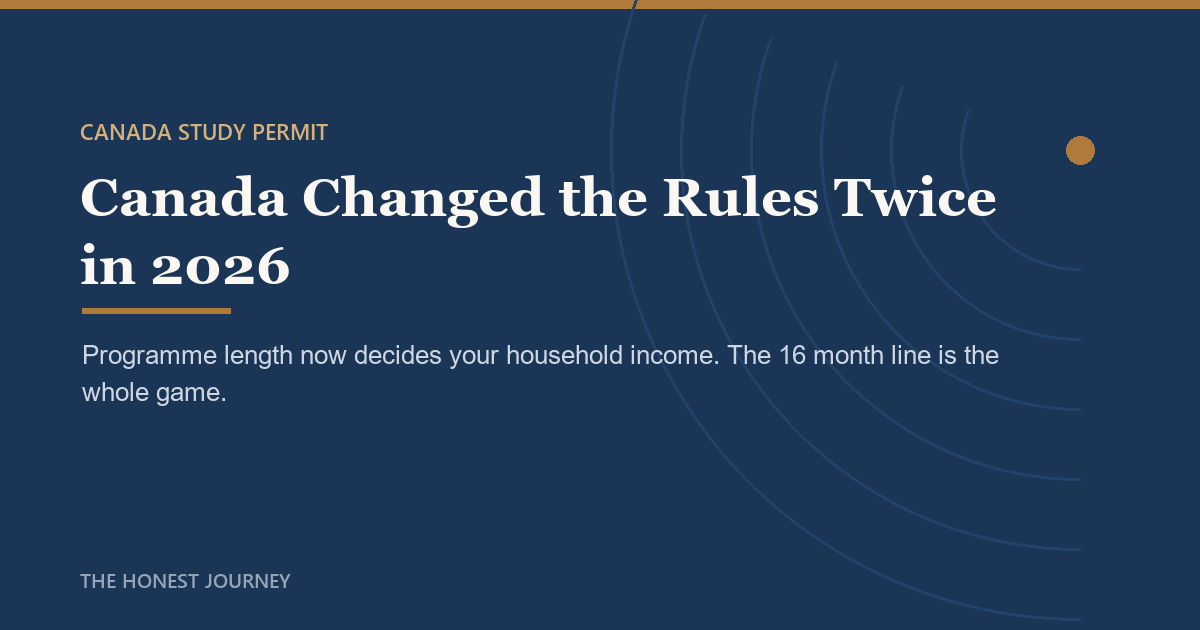
That Canada is gone. It changed twice in the first quarter of 2026, and the changes were not cosmetic. Programme length is now a financial decision. A twelve month master’s and a sixteen month master’s are no longer two versions of the same choice, they are the difference between a one income household and a two income one.
Here is what the rules say now, what the second change did to renewals, and how to choose a programme so the household plan actually survives.
The rule as it stands
Two separate changes, three months apart, both in 2026.
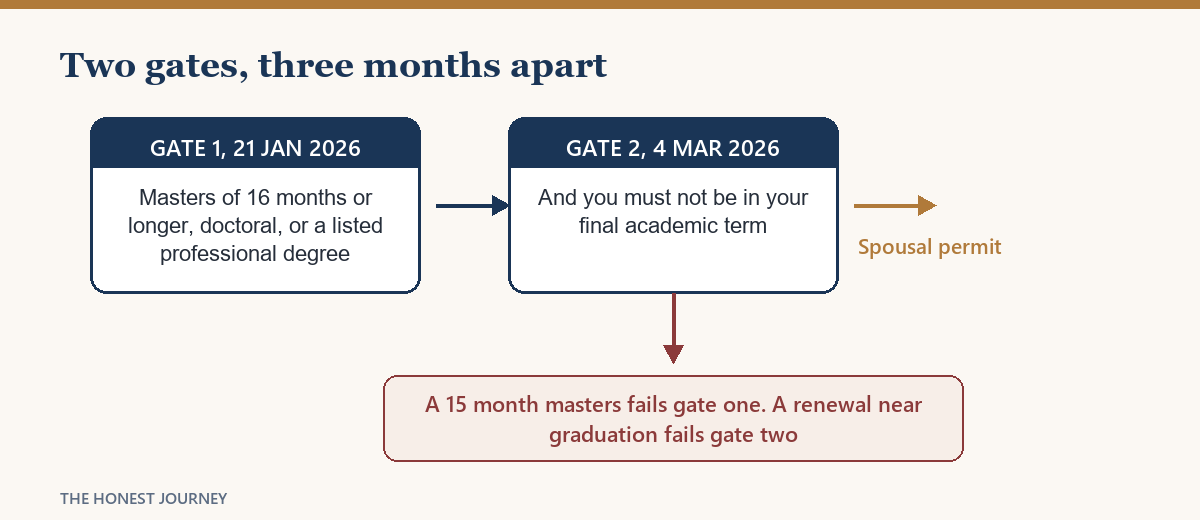
Since 21 January 2026, a spousal open work permit is available only if you are enrolled in one of these:
- A master’s programme lasting at least 16 months
- A doctoral programme
- One of the professional degree programmes on the IRCC eligible list
College diplomas, general bachelor’s degrees and undergraduate programmes no longer qualify at all. That is a very large share of Indian enrolment in Canada, and it is the group that has historically relied most on a second income.
Effective 4 March 2026, spouses of students in their final academic term are refused, including on renewal applications.
The sixteen month line is the whole game
A master’s of fifteen months does not qualify. A master’s of sixteen months does. The academic difference between them is often close to nothing, and the financial difference for a married applicant is an entire second salary for the duration of the programme.
Nobody chooses a programme this way, which is exactly why it is worth saying. If you are married and Canada bound, programme length belongs on your shortlist criteria alongside ranking and fees, and arguably above both.
Check the stated length carefully. Universities describe programmes loosely in marketing material, and “sixteen months” in a brochure is not the same as sixteen months on your letter of acceptance. The letter is what IRCC assesses.
Faz's ruleIn Canada your programme length now sets your household income. Choose the course before you check the length and you may have chosen a single income.
A fifteen month and a sixteen month masters look identical on a university website. One of them lets your spouse work for the whole time you study. Read the letter of acceptance, not the brochure.
The final term problem
The March change is the more awkward of the two, because it creates a trap on renewal rather than on first application.
If your spouse holds a valid open work permit and applies to renew it while you are in your final academic term, that renewal is refused. The permit does not roll over. A household that has been running on two incomes for a year can lose the second one in the last few months of the programme, which is precisely when tuition is paid off and everyone is most stretched.
IRCC has not defined “final term” as a specific number of days. That ambiguity is a genuine problem, not a technicality. If your partner’s permit expires anywhere near your graduation date, get proper advice before applying rather than after a refusal, because a refusal creates a record that complicates everything that follows.
What qualifies, in practice
| Your programme | Spousal open work permit? |
|---|---|
| College diploma or advanced diploma | No |
| General bachelor’s degree | No |
| Master’s under 16 months | No |
| Master’s of 16 months or longer | Yes |
| Doctoral programme | Yes |
| Listed professional degree programme | Yes |
| Any of the above, but in your final term | No, refused since 4 March 2026 |
Children are a separate matter and are treated more generously. Dependent children can accompany you and attend school, and this did not change in either 2026 update. The restrictions target spousal work rights specifically.
What the second income is actually worth
This is why the sixteen month line matters so much in rupee terms.
An open work permit is unrestricted. Your spouse can work full time, for any employer, in any role. At entry level wages of CAD 17 to 22 an hour, full time, that is roughly CAD 2,900 to 3,700 a month before tax, or around CAD 35,000 to 44,000 a year.
Over a sixteen month programme that is roughly CAD 47,000 to 59,000 gross, which is around ₹29 to 36 lakh. Against a master’s that might cost CAD 30,000 to 45,000 in tuition, the spouse’s earnings can cover the entire tuition bill and more.
| Line | 15 month master’s | 16 month master’s |
|---|---|---|
| Tuition | CAD 30,000 to 45,000 | CAD 30,000 to 45,000 |
| Living costs, two people | CAD 33,000 | CAD 35,000 |
| Spouse earnings | Zero, not eligible | CAD 47,000 to 59,000 |
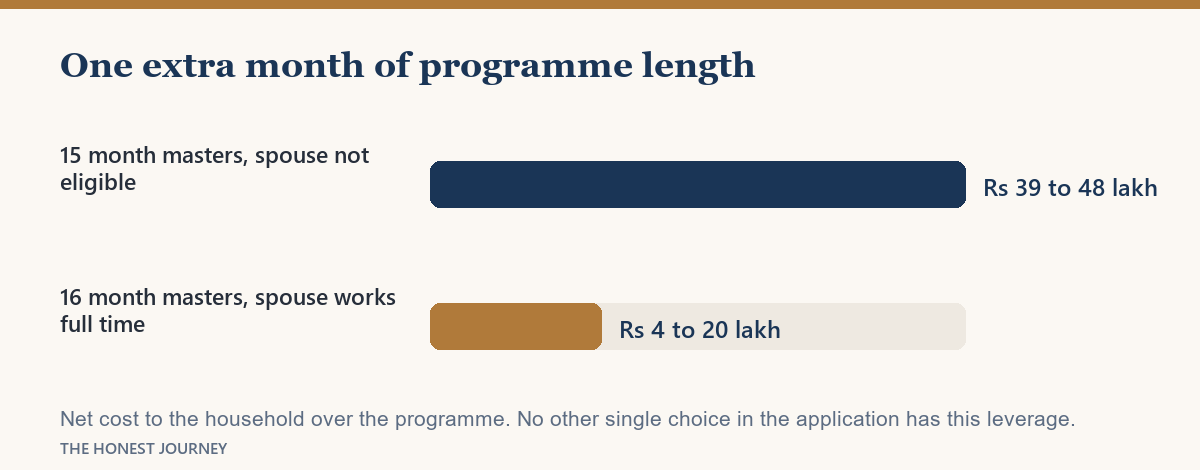
| Net cost to the household | CAD 63,000 to 78,000 | CAD 6,000 to 33,000 |
| Roughly in INR | ₹39 to 48 lakh | ₹4 to 20 lakh |
Figures use mid 2026 rates and vary by province. Treat them as sizing, not quotes.
One extra month of programme length, and the household’s net cost falls by roughly ₹30 lakh. There is no other single decision in the Canadian application process with that kind of leverage, which is why it deserves to sit at the top of the shortlist rather than as a detail checked after the deposit.
Three household outcomes
Numeric archetypes, not people.
The one that works. A sixteen month master’s, spouse arrives on an open work permit within three months, finds full time work at CAD 20 an hour. The household runs on roughly CAD 3,300 a month of spouse income against CAD 2,900 a month of combined living costs. The loan is ₹25 lakh, taken mostly for tuition, and repayment starts from savings before the student even graduates. This household leaves Canada, or stays, with a manageable debt and two people with Canadian work history. It is the best outcome available to a married applicant anywhere on the shortlist, including Germany.
The one that strains. The same programme, but the spouse takes seven months to find steady work because of credential recognition or a weak local job market. Half the expected income never arrives. The loan was sized at ₹30 lakh assuming the second salary, and now covers less than planned. The household finishes intact but with roughly ₹12 lakh more debt than modelled. The lesson repeated here is the one that applies everywhere: size the loan as if the spouse earns nothing, and treat their income as the buffer.
The one that breaks. A fifteen month master’s chosen for its ranking, spouse ineligible, household on one income in a high cost city like Toronto or Vancouver. A ₹48 lakh loan against a degree that leads to a CAD 55,000 starting salary. The EMI of roughly ₹64,000 lands against a take home that is already covering rent for two. This is the avoidable one, and what makes it avoidable is a single question asked before applications rather than after.
What to do about it
Filter your shortlist by programme length first. Before ranking, before fees, before city. If you are married and want two incomes, the sixteen month threshold is a hard filter, not a preference. Many Canadian universities offer both a twelve and a sixteen month version of the same master’s, and the longer one is often the co-op or thesis variant, which is better for employment outcomes anyway.
Time the permit application away from your final term. Apply early, and renew early. If your partner’s permit runs out close to your graduation date, that renewal is at risk under the 4 March 2026 rule. Plan the dates deliberately rather than discovering the problem when the refusal arrives.
Check the professional programme list. If your field has a listed professional degree, that route qualifies regardless of the sixteen month calculation. It is worth checking the current IRCC list rather than assuming, because the list is specific and it changes.
Compare against Germany honestly. Germany gives spouses full work rights with no programme length condition and near zero tuition. If the sixteen month filter is pushing you toward a programme you do not actually want, that comparison deserves a look. See the country comparison and the Germany family reunion page.
Children, which did not change
Worth stating plainly because the 2026 headlines caused unnecessary alarm. The restrictions target spousal work permits. They did not change the position for children.
Dependent children can accompany you, and they can attend school. Primary and secondary education is publicly funded in Canada and children of study permit holders can generally attend without paying international fees, though the detail varies by province and by school board. That is a meaningful benefit for families with school age children and it survived both 2026 changes intact.
Childcare for younger children is the offsetting cost, and it is significant. Licensed daycare runs CAD 700 to 1,400 a month depending on province, though the national programme has been reducing fees in several provinces. If your household plan depends on your spouse working full time, price childcare before you assume the second income is net.
What happens after you graduate
This is the part that makes the Canadian route recoverable even if the study stage is restricted.
When you move onto a post graduation work permit, your situation changes. You are then a worker rather than a student, and spousal work permit eligibility is assessed against your employment rather than your programme. For students who did not qualify during study, this is where the second income becomes available.
The practical consequence is that a fifteen month master’s is not a permanent single income sentence. It is a fifteen month one, followed by a period where your spouse can generally work once you are on a PGWP and employed in an eligible occupation. Requirements attach to your job and change periodically, so verify them at the time rather than relying on this page.
That reframes the decision usefully. If the sixteen month programme is genuinely worse academically, the honest comparison is not one income forever against two. It is one income for fifteen months against two, and for many households the better degree wins that trade.
Provincial variation matters
Canada is not one cost market and treating it as one is a common planning error.
A two person household in Toronto or Vancouver needs roughly CAD 3,800 to 4,500 a month. The same household in Winnipeg, Halifax or Saskatoon runs CAD 2,600 to 3,200. Over a sixteen month programme that difference is CAD 19,000 to 21,000, which is around 12 lakh rupees, for an identical degree at a comparable institution.
Since your spouse’s earnings at entry level wages are broadly similar across provinces, the cheaper city converts almost the entire gap into surplus. For a married applicant the city choice carries more financial weight than it does for a single student, because you are multiplying the accommodation premium by two people rather than one.
Faz's ruleFor a married applicant the choice of city moves more money than the choice of university. You are paying the accommodation premium twice.
Toronto against Winnipeg is roughly 12 lakh over a sixteen month programme, for the same degree and the same spousal earnings. Single students can absorb the big city premium. Households usually should not.
The same question, answered by country
The rules differ enormously, and four of the eight changed in the last two years. If a different destination is on your list, start there instead, or see the full country comparison.
- New Zealand, the most generous of the eight
- Germany, with full spousal work rights
- Australia, where partners work capped hours
- the USA, where an F-2 spouse cannot work
- the UK, where taught masters cannot bring family
- Ireland, where only PhD students qualify
- the Netherlands, closed by an income floor
Frequently asked questions
Can my spouse get an open work permit if I study in Canada in 2026?
Only if you are enrolled in a master’s programme of at least 16 months, a doctoral programme, or a listed professional degree programme, under rules effective 21 January 2026. College diplomas, general bachelor’s degrees and undergraduate programmes no longer qualify.
Why does 16 months matter?
It is the threshold IRCC set for master’s programmes. A master’s of 15 months does not make your spouse eligible, a master’s of 16 months does. Check the length stated on your letter of acceptance, not the university’s marketing material.
Can my spouse renew their work permit while I am finishing my course?
Not in your final academic term. Since 4 March 2026, spouses of students in their final term are refused, including on renewal applications. IRCC has not defined “final term” numerically, so get advice if the timing is close.
Can my children come with me to Canada?
Yes. Dependent children can accompany you and attend school. The 2026 changes restrict spousal work permits specifically and did not change the position for children.
How much can a spouse earn on an open work permit?
An open work permit is unrestricted, so full time work is permitted. At entry level wages of CAD 17 to 22 an hour that is roughly CAD 35,000 to 44,000 a year, which over a 16 month programme is around ₹29 to 36 lakh.
Does a college diploma qualify for a spousal open work permit?
No. Since 21 January 2026, college diplomas and advanced diplomas do not qualify, regardless of length. This is the biggest change for Indian applicants, since diploma programmes were a common and affordable route.
The honest closing
Canada is still one of the better destinations for a married applicant. It is just no longer the automatic one, and the thing that decides it is not a rule you can influence, it is a number on your letter of acceptance.
The uncomfortable part is that this rewards people who knew to check. Two applicants with identical profiles, identical budgets and identical ambitions can end up ₹30 lakh apart because one of them looked at programme length before applying and the other did not.
If you are married and looking at Canada, that check costs you an afternoon. Do it before the applications, not after the offers. And once you are there, our Canada student visa guide and Canada education loan guide cover the rest of the paperwork.