Short answer. If you are married and looking at a one year master’s in the UK, this page exists to save you about four months. The answer is no. Not “it depends on your finances”, not “it is harder now”. No.
Since 1 January 2024, students on taught master’s programmes cannot bring a spouse or children to the UK on the student route. That is the whole of the new rules on the UK student dependent visa. They are not widely explained to Indian applicants, partly because the people explaining them are usually paid when you enrol, and partly because they are genuinely recent enough that a lot of advice online still predates them.
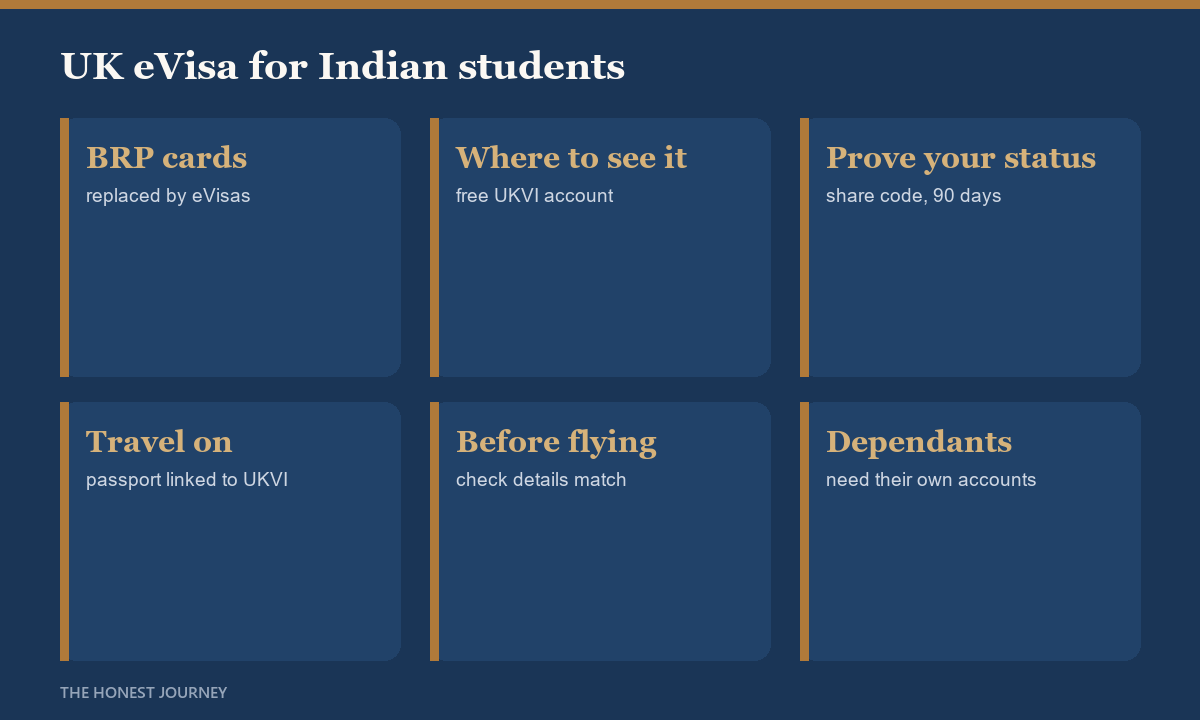
Each dependant needs their own UKVI account. See how UK eVisas work.
What follows is who still qualifies, what the transitional cases look like, what it costs for the minority who are eligible, and what married applicants realistically do instead. Some of those alternatives are better than they sound.
The new rules, stated plainly
For courses starting on or after 1 January 2024, you can bring dependants on a UK Student visa only if you meet one of these:
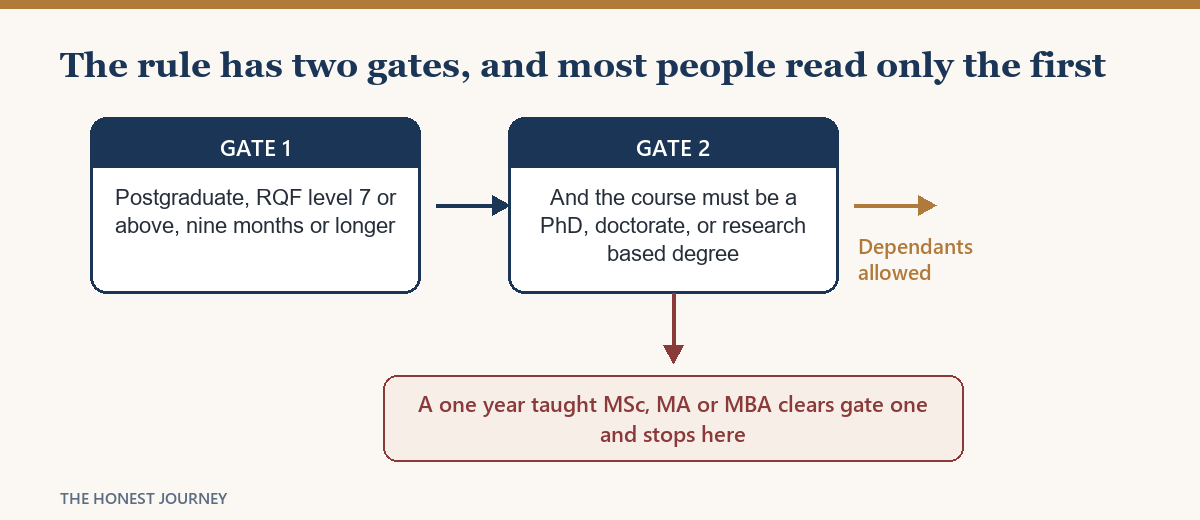
- You are a full time postgraduate student at RQF level 7 or above, on a course lasting nine months or more, and that course is a PhD, another doctorate at RQF level 8, or a research based higher degree.
- You are a government sponsored student on a course lasting longer than six months.
A dependant means your husband, wife or civil partner, your unmarried partner, or your child under 18.
Read the first condition carefully, because it has two gates and most people only notice one. Being a postgraduate is not enough. Being on a nine month course is not enough. The course itself must be research based. A one year MSc, MA or MBA is a taught postgraduate course, it sits at RQF level 7, and it does not qualify.
Faz's rulePostgraduate does not mean eligible. Research based means eligible.
This is the single most misread sentence in UK student immigration. People see “postgraduate, RQF level 7, nine months” and assume their MSc qualifies. It does not. The gate is research versus taught, and almost every Indian student in the UK is on the taught side of it.
Who this actually excludes
The overwhelming majority of Indian students in the UK. The one year taught master’s is the entire proposition of UK study for Indian applicants. It is why the UK competes with a two year US master’s at all: you finish faster, you pay for one year of living costs instead of two, and you get back to earning sooner.
That same one year taught format is precisely the category the 2024 rule targets. So the thing that makes the UK attractive to Indian students is the thing that disqualifies them from bringing family.
| Your course | Dependants allowed? |
|---|---|
| One year taught MSc, MA or MBA | No |
| Undergraduate degree | No |
| Foundation or pre master’s | No |
| English language course | No |
| PhD or doctorate (RQF level 8) | Yes |
| Research based higher degree, 9+ months | Yes |
| Government sponsored, 6+ months | Yes |
The transitional cases
There is a narrow group for whom the old rules still matter, and it is worth checking whether you are in it before assuming you are not.
If you were already in the UK before 1 January 2024 on a valid visa, and your dependants were granted their visas under the previous rules, you may be able to extend their permission alongside yours. What you cannot do is add new dependants who were not already granted permission, unless your current course independently qualifies under the 2024 rules.
The practical read: transitional protection covers families who were already here together. It does not create a route for someone who came alone in 2023 and now wants to bring a spouse in 2026.
What it costs for those who do qualify
If you are on a PhD or a research degree, the financial requirement is real and worth planning for early. On top of your own maintenance funds, each dependant must show:
- £845 per month if your course is in London, for up to nine months. That is £7,605, roughly ₹8.0 lakh.
- £680 per month if your course is outside London, for up to nine months. That is £6,120, roughly ₹6.4 lakh.
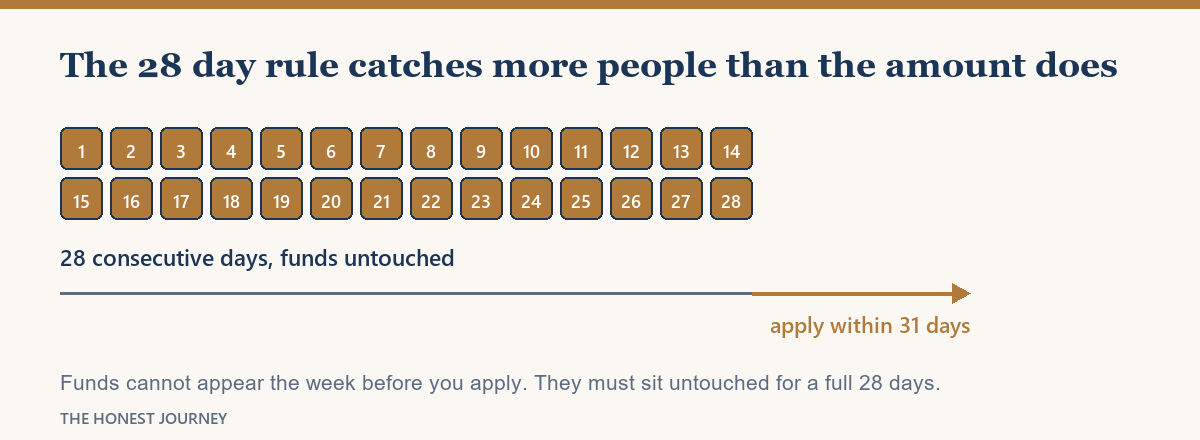
Those funds must be held for at least 28 consecutive days, and the end of that 28 day window must fall within 31 days of the application date. This trips people up more than the amount does. The money cannot appear in the account the week before you apply. It has to sit there, untouched, for a full 28 days, and the statement has to be recent enough.
There is an exemption: a dependant who has already been in the UK on a valid visa for at least 12 months does not need to prove funds again.
Multiply by family size honestly. A spouse and one child in London is £15,210 on top of your own maintenance, which is around ₹16 lakh you must show before anyone flies. If you are financing through a loan, that has to be visible in the sanction, and our proof of funds guide covers how banks and UKVI treat loan sanction letters differently.
What the rule did to the UK’s position
Worth understanding the why, because it tells you whether this is likely to reverse.
The dependant restriction was a net migration measure. Student dependants had become a large and fast growing share of the numbers, and Indian and Nigerian students specifically had high dependant ratios. The rule was designed to reduce that, and it did so sharply and immediately.
That matters for planning because it means the restriction is doing exactly what it was intended to do. This is not an administrative quirk waiting to be corrected. Anyone planning a 2027 or 2028 intake should assume the rule holds rather than betting on a reversal.
It also sits alongside the narrowing of the Graduate Route, which we cover in the UK student visa guide. Together they change the UK’s offer to a married Indian applicant materially: come alone, study for a year, and work on a shorter post study window than the one you may have read about.
Three ways married applicants handle it
These are numeric archetypes rather than people, and they are the three patterns that actually recur.
Go alone for the year, reunite on the Graduate Route. The most common workable answer, and the one most people arrive at eventually. You do the twelve month master’s alone. Living costs for one in a non London city run around £1,100 to £1,400 a month. Once you move onto the Graduate Route, dependant rules are more generous than on the student visa, so your spouse joins you when you are earning rather than when you are burning loan money. The cost is a year apart. The saving is roughly £13,000 to £17,000 of second person living costs during the exact period when you have no income, which is ₹14 to 18 lakh of loan you do not take.
Redirect to Germany or Australia. If your partner working is central to the plan, the UK simply is not the country. Germany gives spouses full work rights on family reunion and charges near zero tuition at public universities. Australia allows dependants with a 48 hours per fortnight work cap. A household comparing a ₹35 lakh UK master’s on one income against a ₹8 lakh German master’s on two incomes is not making a close decision. See the full country comparison.
Switch to a research degree. A PhD or research master’s unlocks dependants, and UK PhDs are often funded, which changes the money entirely. But this only works if you actually want to do research. Committing to three or four years of doctoral work to solve a visa problem is a bad trade, and supervisors can tell. If you were already considering a PhD, the dependant rule is a genuine point in its favour. If you were not, it is not a workaround.
The money, alone versus together
This is the calculation that should drive the decision, and almost nobody runs it before choosing. Take a typical one year taught master’s outside London, and compare the three live options on total cash needed before you earn anything.
| Line | UK, alone | UK, with family (research route) | Germany, together |
|---|---|---|---|
| Tuition | £18,000 to £26,000 | Often funded on a PhD | Near zero at public universities |
| Your living costs, 12 months | £13,200 to £16,800 | £13,200 to £16,800 | EUR 11,904 |
| Dependant funds to show | Not applicable | £6,120 per dependant | Roughly 75% of EUR 992 per month each |
| Partner can work? | Not present | Yes | Yes, full rights |
| Total cash needed upfront | ₹33 to 45 lakh | ₹22 to 30 lakh if funded | ₹14 to 20 lakh |
Conversions use mid 2026 rates. Treat them as sizing, not quotes.
The row that decides most households is the last one. A UK taught master’s taken alone is a ₹33 to 45 lakh commitment funded entirely by loan or savings, against a German master’s for two people at ₹14 to 20 lakh where one of them can work full time from arrival. That is not a marginal difference. It is two and a half times the capital at risk, for a degree that finishes at roughly the same time.
None of which means the UK is the wrong answer. If your field is one where a UK master’s opens doors that a German one does not, or your English is far stronger than your German ever will be, the premium can be worth paying. It just has to be a decision you made, rather than a number you never calculated.
What it does to the loan
Run the EMI, because this is where the family question turns into a twenty year consequence.
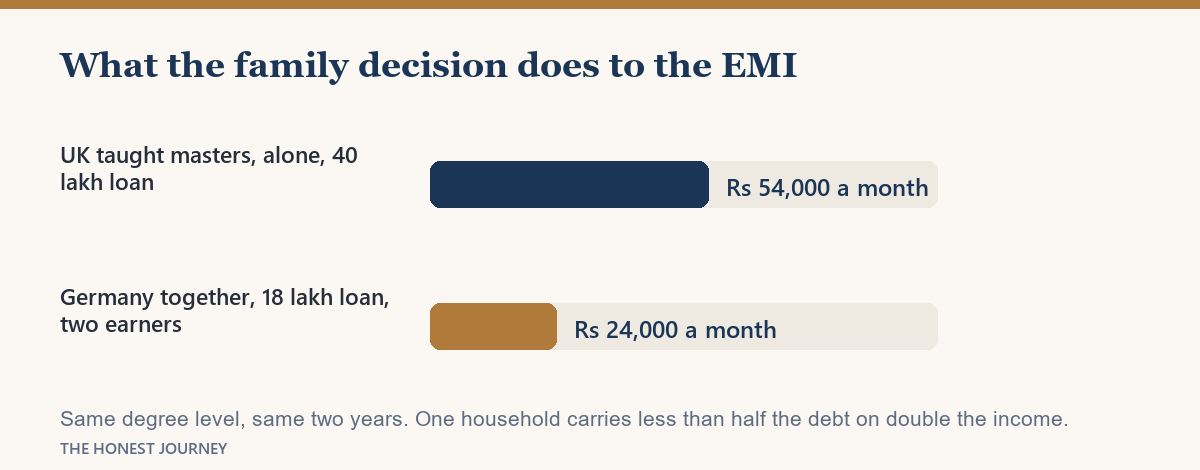
A ₹40 lakh education loan at around 10.5% over 10 years carries an EMI near ₹54,000. On a UK graduate salary of £30,000 to £35,000, that is manageable but tight once London or Manchester rent is paid. On a return to India at ₹14 to 18 lakh, it is punishing.
Now consider the household that went to Germany instead. A ₹18 lakh loan at the same rate over 10 years is an EMI near ₹24,000, and there are two earners against it from month eight. The same family, the same degree level, the same two years of their lives, and one household is servicing less than half the debt with double the income.
This is the whole reason the dependant rule belongs in a money conversation rather than a visa conversation. It does not just decide whether your spouse can come. It decides the size of the loan and the number of incomes available to repay it, which between them decide almost everything about how the next decade feels. Our UK education loan guide covers the sanction side in more detail.
What not to do
Two things worth saying plainly, because both circulate in Indian applicant groups.
Do not apply for a visitor visa for your spouse intending for them to stay. A visitor visa is for visits. Using it as a substitute for a dependant visa risks refusal at the border, a refusal record that follows both of you, and it prejudices future applications including the Graduate Route reunion that would otherwise have worked.
Do not take advice from anyone who tells you a taught master’s qualifies. It does not, the rule is published on gov.uk, and an agent who is vague about this is either not current or not honest. Check the official guidance yourself before you pay anyone a deposit.
Faz's ruleIf an agent is confident your taught masters can bring dependants, that is not an opinion difference. That is a factual error, and you should treat everything else they told you with the same suspicion.
The rule is one page on gov.uk and it has been in force since January 2024. Getting it wrong in 2026 tells you how current the rest of their advice is.
The same question, answered by country
The rules differ enormously, and four of the eight changed in the last two years. If a different destination is on your list, start there instead, or see the full country comparison.
- New Zealand, the most generous of the eight
- Germany, with full spousal work rights
- Australia, where partners work capped hours
- Canada, where the 16 month rule decides it
- the USA, where an F-2 spouse cannot work
- Ireland, where only PhD students qualify
- the Netherlands, closed by an income floor
Frequently asked questions
Can I bring my wife on a UK student visa for a one year master’s?
No. For courses starting on or after 1 January 2024, only PhD, doctorate and research based higher degree students, or government sponsored students on courses longer than six months, can bring dependants. A taught one year master’s does not qualify.
How much money does a UK dependant need to show?
£845 per month for London courses and £680 per month outside London, for up to nine months. That is £7,605 or £6,120 per dependant. The funds must be held for 28 consecutive days ending within 31 days of the application.
Can my spouse join me later on the Graduate Route?
Dependant rules on post study routes are generally more generous than on the student route, which is why studying alone and reuniting afterwards is the most common workable plan. Check the current requirements at the time you switch, since these rules change.
Does an MBA count as a research degree in the UK?
No. An MBA is a taught postgraduate programme. It sits at RQF level 7 but it is not a research based higher degree, so it does not qualify for dependants.
My dependants were already in the UK before 2024. Can they stay?
Possibly. If you were in the UK before 1 January 2024 on a valid visa and your dependants held visas under the previous rules, you may be able to extend their permission alongside yours. You cannot add new dependants who did not already hold permission.
What are the new rules for a UK student dependent visa in 2026?
The new rules have been in force since 1 January 2024 and have not loosened since. Dependants are limited to students on a PhD, another doctorate at RQF level 8, or a research based higher degree of nine months or more, plus government sponsored students on courses longer than six months. Eligible dependants must show £845 per month in London or £680 outside, for up to nine months, held for 28 consecutive days.
Is the UK dependant ban likely to be reversed?
Plan on the assumption that it is not. It was introduced as a net migration measure, it achieved what it was designed to achieve, and there is no indication of reversal. Do not build a two year plan on a rule change that may never come.
The honest closing
The hard part of this page is that there is no clever answer at the end. The rule is clear, it is published, and it excludes most of the people reading this.
What you can control is the order in which you decide. If bringing your family matters more than the UK specifically, then Germany and Australia deserve a serious look before you commit, and the comparison is not close on money. If the UK matters more, then the year apart followed by a Graduate Route reunion is a real plan that a lot of families run successfully, and it is far cheaper than the alternative of funding two people through a year of no income.
What is genuinely worth avoiding is finding this out in month four, after the deposit, after the loan conversation, and after your spouse has resigned from a job on the assumption that they were coming with you.