Short answer. Germany is the most generous of the major European destinations on this question, and only New Zealand beats it outright. Your spouse can join you through family reunion, and once their residence permit is granted, they have the right to work. Not a capped number of hours. Not conditional on what you study. Full work rights.
Set against tuition that is close to zero at public universities, this produces a combination no other country on the standard Indian shortlist can match: a degree that costs almost nothing, and a household where the second adult can earn a full German salary while you study.
The trade is paperwork. Germany asks for more upfront than anywhere else, and it asks in a specific order that is easy to get wrong. This page is the honest version of both halves.
Why Germany is different
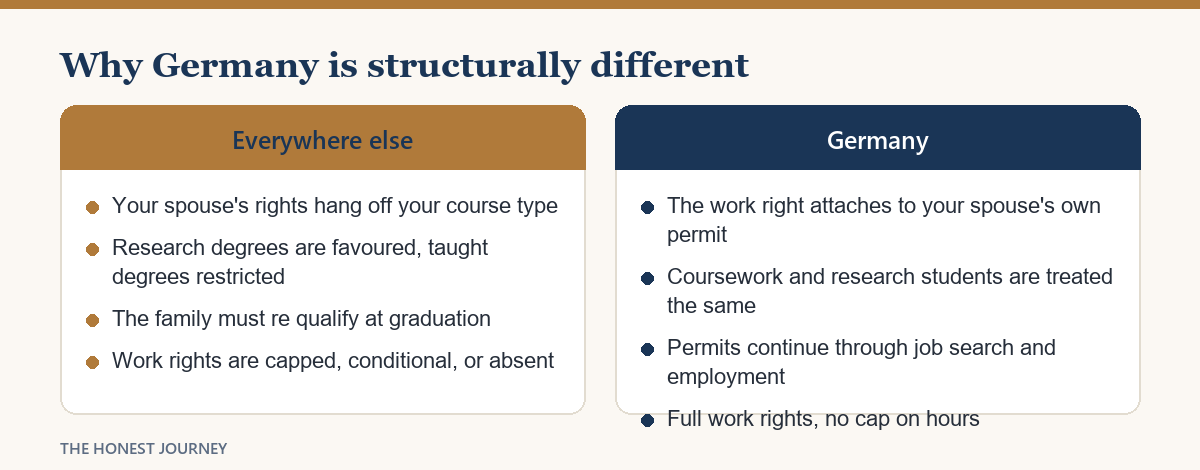
Every other country ties your spouse’s rights to what you study. The UK allows dependants only for research degrees. Ireland only for PhDs. Canada only for master’s of sixteen months or more. Australia caps hours unless you are a research student. The USA bars work entirely.
Germany does none of this. Family reunion is a separate residence route, and the work right attaches to the permit rather than to your course type. A coursework master’s student’s spouse has the same rights as a doctoral student’s spouse.
That single structural difference is worth more, in rupee terms, than any scholarship on this website.
What you have to prove
Four things, and all four are assessed.
1. Money in a blocked account
The blocked account, or Sperrkonto, is the standard proof of funds for German student visas. As of 2026 the required amount is EUR 11,904 per year, released to you at EUR 992 per month.
For dependants, most consulates require an additional amount per person. The common requirement is roughly 75% of the base monthly rate per dependant per month, so budget around EUR 744 a month extra for a spouse, which is about EUR 8,900 a year.
Consular practice varies. Check the specific requirement at the mission handling your application rather than assuming the general figure, because this is one of the areas where individual consulates differ meaningfully.
2. Adequate housing
Germany assesses whether your accommodation is genuinely large enough for the family. The working standard is roughly 12 square metres per person over the age of six.
This is a real constraint, not a formality, and it is the one that most often delays applications. A student room in a shared flat will not satisfy it. You need a lease for a suitable apartment, which in cities like Munich, Frankfurt or Berlin is difficult and expensive to secure before you arrive. Start this early. It is frequently the longest pole in the tent.
3. Health insurance
Every dependant needs coverage. German health insurance is comprehensive and not optional, and family coverage under statutory insurance is often more affordable than people expect once your spouse is working and contributing.
4. A1 German for the spouse
The spouse usually needs to demonstrate basic German at A1 level before arrival. There are exceptions, and they are worth checking against your circumstances, but plan on it applying.
A1 is genuinely basic, reachable in two to three months of part time study, and it is far less onerous than it sounds. It is also, practically speaking, useful: a spouse arriving with zero German will struggle in the job market regardless of their legal right to work.
Faz's ruleThe German paperwork is front loaded on purpose. Everything hard happens before you arrive, and everything after that is easier than any other country on the list.
Housing and A1 German are the two that delay people. Both are solvable with three to four months of lead time, and both are far cheaper than the alternative of a country where your spouse cannot work at all.
The money, which is the whole point
Take a two year master’s at a public university, two people.
| Line | You alone | You plus a spouse |
|---|---|---|
| Tuition, 2 years | Near zero plus semester fees | Near zero plus semester fees |
| Blocked account, 2 years | EUR 23,808 | EUR 41,664 |
| Actual living costs, 2 years | EUR 24,000 | EUR 36,000 |
| Spouse earnings, 2 years | Not applicable | EUR 45,000 to 62,000 |
| Net cost to the household | EUR 24,000 to 26,000 | Net positive, or close to it |
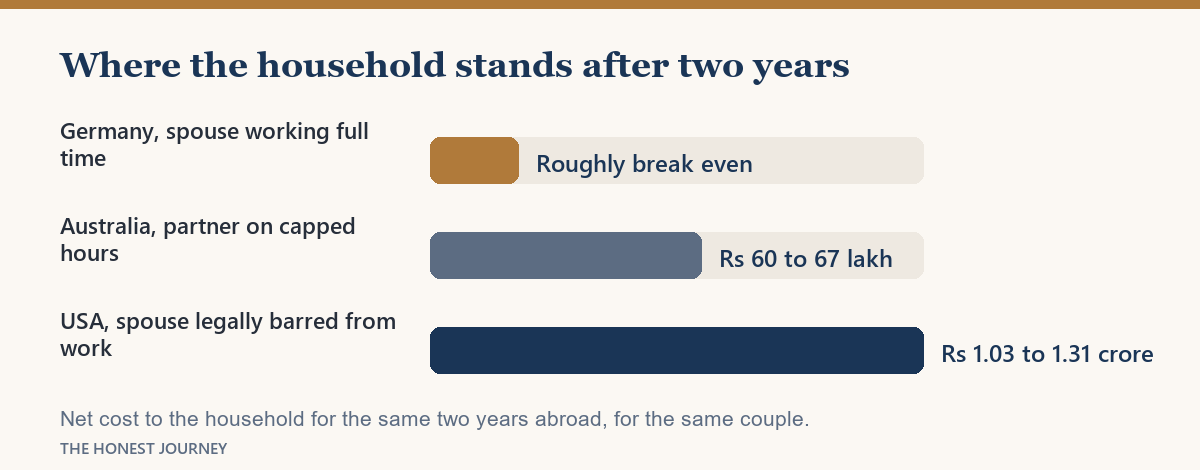
| Roughly in INR | ₹22 to 24 lakh | Roughly break even |
Figures use mid 2026 rates and vary by city. Treat them as sizing, not quotes.
Read the last row carefully, because it is the reason this page exists. A German master’s with a working spouse can be close to cost neutral over two years. A spouse earning EUR 2,200 to 2,800 a month in an entry level role, against combined living costs of about EUR 1,500 a month, covers the household and contributes toward the blocked account requirement being replenished.
Compare that against the same couple in the USA, where the identical decision costs ₹1.03 to 1.31 crore with no offsetting income, or the UK, where it is not permitted at all for a taught master’s.
The blocked account is a cash flow problem, not a cost
Worth separating clearly, because people conflate them.
EUR 41,664 for two people over two years is roughly ₹38 lakh that must sit in a blocked account. That is not money spent. It is money released back to you at EUR 992 a month per person, and you live on it.
But you have to have it, upfront, before the visa. For most Indian families that means a loan, even though the underlying cost of studying in Germany is low. This is the specific reason education loans for Germany exist despite near zero tuition, and it catches families who assumed a cheap destination meant no borrowing. Our Germany education loan guide and the page on the blocked account specifically cover how banks treat this.
Three household outcomes
Numeric archetypes, not people.
The one that works. Master’s at a public university, spouse arrives on family reunion three months in with A1 German, finds work at EUR 2,400 a month within five months. Combined living costs about EUR 1,500. The household is net positive from month eight. The ₹20 lakh loan taken for the blocked account is being repaid from surplus before the student graduates. Both leave with German work experience and the student has an EU degree with essentially no debt. This is the best financial outcome available to a married Indian applicant anywhere.
The one that strains. Same setup, but the spouse’s German stays at A1 and the job search takes eleven months, landing a lower paid role at EUR 1,800. The household runs on the blocked account longer than planned and the loan does not start repaying until after graduation. Still a good outcome by any comparative standard, just slower. Language is the variable that decides which of these two you get, far more than qualifications do.
The one that breaks. Rarely a money failure in Germany. It is a paperwork failure. The couple cannot secure a lease meeting the 12 square metre standard in Munich, family reunion is delayed by eight months, and the spouse spends most of the first year in India while the student carries a two person blocked account requirement alone. The fix is entirely preventative: start the housing search before the visa application, and consider a smaller city where the housing market is not the binding constraint.
Practical sequencing
Order matters here more than in any other country on the list.
- You get your student visa and arrive first. Family reunion is applied for on the basis of your residence permit, so you need that established.
- Register your address and get your residence permit. Nothing moves before this.
- Secure qualifying housing. The 12 square metre standard applies to the accommodation you will actually share. Start looking immediately, and expect this to take longer than you plan for.
- Spouse completes A1 German. This can run in parallel from India, so start it early rather than sequentially.
- Lodge the family reunion application. With housing, insurance, funds and A1 evidenced.
Realistic total timeline from your arrival to your spouse joining you is four to nine months, driven mostly by housing and the appointment backlog at the relevant authority. Plan for the longer end.
Children, and why Germany suits families
Germany is among the strongest destinations for families with children, and the reasons compound.
School is free, including for children of residence permit holders, and the standard is high. There are no international student fees at public schools, unlike Australia. Childcare, or Kita, is heavily subsidised and free in several states, though places are limited and waiting lists are real, so register as soon as you have an address.
Families in Germany may also be eligible for Kindergeld, the child benefit, depending on residence status and circumstances. It is not automatic for every student family and the rules around residence permit type matter, so check your specific situation rather than assuming. Where it applies it is a monthly payment per child and it is not trivial.
Set against Australia, where two school age children can cost AUD 20,000 a year in government school fees, or the USA, where the schooling is free but your spouse cannot work at all, the German package for a family with children is not close to the alternatives.
What happens after you graduate
The family position does not deteriorate when you finish, which is unusual.
Germany offers an eighteen month residence permit for graduates to seek work, and there is now also the Opportunity Card route for qualified job seekers. During that period your family’s residence permits continue, and your spouse keeps their work rights. There is no cliff at graduation of the kind that catches Canadian families in their final term.
Once you move into employment, the path continues through the EU Blue Card for qualifying salaries, which carries strong family provisions and a relatively fast route to permanent residence. A household that arrives together on family reunion can move through study, job search, employment and settlement without the spouse ever losing the right to work.
That continuity is the underrated part of the German offer. Most countries on this list give you a study stage answer and a different post study answer, and families have to re qualify at each transition. Germany largely does not.
Faz's ruleGermany is the only destination here where your family does not have to re qualify at every stage. Study, job search, employment and settlement run on one continuous permission.
Elsewhere the family plan has to survive a transition at graduation, and in Canada it can fail in the final term. In Germany the spouse keeps working across all of it. That continuity is worth more than a ranking difference.
The same question, answered by country
The rules differ enormously, and four of the eight changed in the last two years. If a different destination is on your list, start there instead, or see the full country comparison.
- New Zealand, the most generous of the eight
- Australia, where partners work capped hours
- Canada, where the 16 month rule decides it
- the USA, where an F-2 spouse cannot work
- the UK, where taught masters cannot bring family
- Ireland, where only PhD students qualify
- the Netherlands, closed by an income floor
Frequently asked questions
Can my spouse work in Germany while I study?
Yes, with full work rights once the residence permit is granted. There is no cap on hours and it does not depend on whether your course is taught or research based. Germany is the most generous of the major destinations on this point.
How much extra money do I need in the blocked account for a spouse?
Most consulates require roughly 75% of the base monthly rate per dependant, so around EUR 744 a month on top of your own EUR 992. Check the specific requirement at the mission handling your application, as consular practice varies.
Does my spouse need to speak German?
Usually A1 level before arrival, with some exceptions worth checking against your circumstances. A1 is basic and reachable in two to three months of part time study. It also materially improves their job prospects once there.
What is the housing requirement for family reunion?
Roughly 12 square metres per person over the age of six. A student room in a shared flat will not qualify. This is the requirement that most often delays applications, so start the search early.
Can my spouse come with me from the start?
Generally no. Family reunion is applied for on the basis of your residence permit, so you normally arrive, register, and secure your permit first. Expect four to nine months from your arrival to their joining you.
Is Germany cheaper than the UK if I bring my spouse?
Substantially. A UK taught master’s does not permit dependants at all since 1 January 2024. A German master’s with a working spouse can be close to cost neutral over two years, against ₹33 to 45 lakh for a UK master’s taken alone.
The honest closing
If bringing your partner and having them work is central to your plan, Germany is the answer, and the rest of this cluster is mostly explaining why the alternatives are worse.
What Germany asks is patience and preparation rather than money. The blocked account is a cash flow hurdle rather than a cost, the housing requirement is real and slow, and the A1 German is a genuine but modest task. None of that is trivial, and all of it is solvable with four to six months of lead time.
What you get for it is the only version of this decision where the household can finish two years abroad without meaningful debt, with two people holding European work experience, and with a degree that cost almost nothing. Set against a US master’s that costs ₹1.3 crore for the same couple, the paperwork starts to look like a bargain.
For the wider picture, see the country comparison, the Germany student visa guide, and cost of studying in Germany.