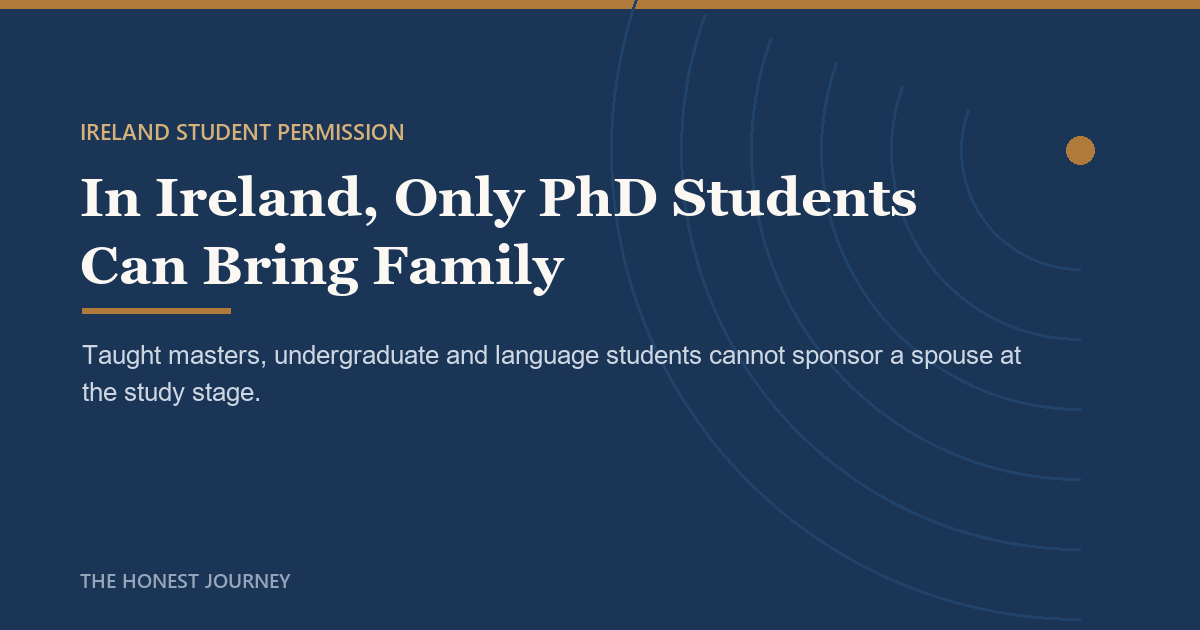
Short answer. Ireland is the shortest answer in this cluster, so here it is up front. If you are doing a taught master’s, an undergraduate degree, or an English language course in Ireland, you cannot bring your spouse or children with you at the study stage. Only PhD students can.
That is unusually restrictive, more so than most people expect, and it is not well advertised. Ireland markets itself hard to Indian students on the strength of an English speaking EU country with a strong tech sector and a two year post study visa. The family position rarely comes up in that pitch.
This page covers who actually qualifies, what happens to families who arrive anyway, and what the realistic alternatives are. It is shorter than the others in this cluster because there is genuinely less to say, and padding it would not serve you.
The rule
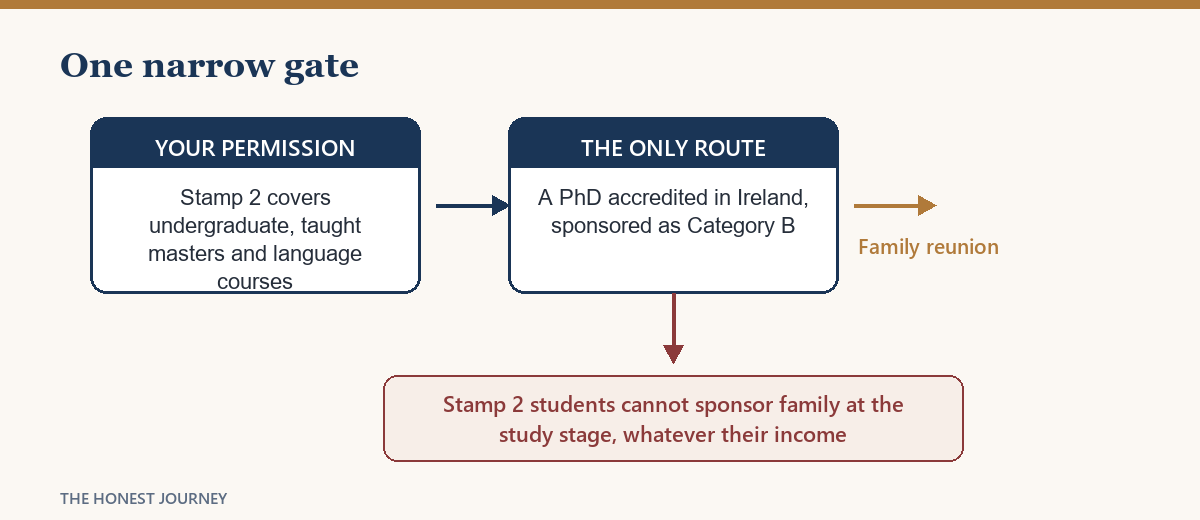
Only PhD students whose doctorate is accredited in Ireland can sponsor immediate family members while studying.
Under the policy updated in November 2025, those PhD holders are treated as Category B sponsors, which is generous once you are in it:
- No waiting period before applying
- No minimum income threshold for nuclear family members
- Nuclear family means spouse or civil partner, and dependent children under 18
Everyone else is on Stamp 2, the standard student permission, and Stamp 2 holders are not eligible to sponsor family reunification at the study stage. That covers undergraduate degrees, taught master’s programmes, and English language courses, which together are the overwhelming majority of Indian students in Ireland.
The Stamp 3 confusion
There is a persistent misunderstanding worth clearing up, because it circulates widely in applicant groups.
Stamp 3 is the dependant permission in Ireland, and it does not carry an automatic right to work. A Stamp 3 holder needs a separate employment permit to take a job.
In 2025 Ireland did make a genuinely positive change here: eligible spouses and partners of General Employment Permit and Intra-Corporate Transferee permit holders, granted family reunification, are now registered on Stamp 1G rather than Stamp 3, which lets them work without needing a separate employment permit.
That change is real and it is good. It also does not apply to you. It covers spouses of employment permit holders, not spouses of students. People read the headline, assume it improved the student position, and plan accordingly. It did not.
Faz's ruleThe 2025 Stamp 1G change was for employment permit holders, not students. If someone tells you it helps your Irish student application, they have misread it.
This is the most commonly misapplied piece of Irish immigration news in Indian applicant circles right now. Good change, wrong population. Students on Stamp 2 are exactly where they were.
What this means in practice
| Your course | Can you bring family? |
|---|---|
| English language course | No |
| Undergraduate degree | No |
| Taught master’s | No |
| PhD accredited in Ireland | Yes, as a Category B sponsor |
Ireland and the UK have arrived at effectively the same position by different routes. Both now reserve family rights for research students. Given how often the two are compared as the English speaking options for Indian applicants, it is worth knowing they are equally closed on this specific question.
The mistake families make
The pattern is predictable and expensive. A married applicant accepts a taught master’s place in Dublin, assumes their spouse will follow on a visitor visa and switch to something workable once there, and discovers on arrival that there is no switch available.
Two things go wrong with that plan.
First, a visitor visa is for visiting. Using it as a route to settle risks refusal at the border, and a refusal record complicates every future application including the post study one that would otherwise have worked cleanly.
Second, Dublin is expensive. Rent for a one bedroom runs EUR 1,800 to 2,400 a month, and the housing shortage is severe enough that finding anything at all takes time. A household funding two adults in Dublin on a single student budget, with a taught master’s costing EUR 15,000 to 25,000 in tuition, is looking at a very large loan for a one year degree. Our cost of studying in Ireland page has the full breakdown.
Two household outcomes
Numeric archetypes, not people. There are only two worth describing here, because the third does not exist as a legal option.
The one that works. A funded PhD. Irish doctoral positions frequently carry a stipend, and as a Category B sponsor you can bring your spouse and children with no income threshold and no waiting period. A stipend of EUR 19,000 to 25,000 a year, plus a spouse who can pursue their own permission, plus fees usually covered, makes this a genuinely strong family option. If you were already considering research, Ireland is a better family destination than its reputation suggests.
The one that strains. A one year taught master’s taken alone. Tuition EUR 15,000 to 25,000, living costs in Dublin around EUR 16,000 for the year, so roughly ₹30 to 38 lakh for twelve months. That is a lot for one year, but it is the correct plan given the rules, and the two year post study permission that follows is where the household reunites. The alternative of trying to bring family during the master’s is not a plan, it is a refusal waiting to happen.
What to do instead
Go alone, reunite on the post study permission. The standard answer and the right one for most people. Ireland’s two year post study window is one of the better ones in Europe, and dependant options on post study and employment permissions are considerably more open than on Stamp 2. Do the year alone, then bring your family once you are working. Check the requirements at the time you switch, since these rules move.
Consider the PhD seriously, if research suits you. Unusually, this is real advice in Ireland rather than a technicality, because Irish PhDs are often funded. A funded doctorate with family reunification rights and a stipend is a materially different proposition from a self funded taught master’s with neither. That said, do not choose four years of research to solve a twelve month visa problem. It only works if you want the research.
Look at Germany. If your partner working during your studies is the priority, Germany gives full spousal work rights with no course type condition and near zero tuition. Against a EUR 20,000 Dublin master’s where family cannot come at all, it is not a close comparison. See the Germany family reunion page.
Compare against Australia. If English language study matters and family matters, Australia allows dependants with capped work rights, which is more than Ireland offers. The country comparison sets them side by side.
The funded PhD, looked at properly
Since the PhD is the only route that works, it is worth treating it as a real option rather than a footnote.
Irish doctoral positions are frequently funded, with stipends commonly in the range of EUR 19,000 to 25,000 a year, and fees usually covered as part of the package. Research funding bodies and individual universities both award these, and Indian applicants are well represented in Irish research, particularly in computing, pharmaceuticals and food science.
For a married applicant the arithmetic is very different from a taught master’s. A funded PhD means no tuition to borrow for, a stipend that covers modest living costs, family reunification rights as a Category B sponsor with no income threshold, and four years of Irish residence that count toward longer term options. Against a self funded EUR 20,000 taught master’s where your family cannot come at all, it is not a marginal comparison.
The honest caveat stands. A PhD is four years of research and it suits people who want to do research. If you do not, this is a bad way into Ireland and both you and your supervisor will know it by the end of year one.
Reuniting after the master’s
If you take the standard route of studying alone, it is worth knowing what you are studying alone toward.
Ireland’s Third Level Graduate Programme gives eligible master’s graduates up to two years of permission to work, on Stamp 1G. That is a genuine advantage over several European alternatives, and it is the stage at which the household position improves. Once you are working and holding an employment permit, family reunification options open up considerably, and the 2025 change moving eligible spouses of General Employment Permit holders onto Stamp 1G with work rights becomes directly relevant to you.
So the sequence that works is: one year alone on Stamp 2, then Stamp 1G and employment, then family reunification with a spouse who can work. It is slower than most people want. It is also the only version that does not involve a refusal.
Verify the requirements at the point you switch rather than relying on this page, since both the graduate programme and the reunification policy have changed inside the last two years.
Faz's ruleIn Ireland the family plan does not fail, it just starts later. One year alone, then employment, then reunification with full work rights.
The mistake is trying to compress that sequence. Every shortcut people attempt, visitor visas mostly, ends in a refusal record that makes the legitimate route harder than it needed to be.
The same question, answered by country
The rules differ enormously, and four of the eight changed in the last two years. If a different destination is on your list, start there instead, or see the full country comparison.
- New Zealand, the most generous of the eight
- Germany, with full spousal work rights
- Australia, where partners work capped hours
- Canada, where the 16 month rule decides it
- the USA, where an F-2 spouse cannot work
- the UK, where taught masters cannot bring family
- the Netherlands, closed by an income floor
Frequently asked questions
Can I bring my spouse to Ireland on a student visa?
Only if you are a PhD student whose doctorate is accredited in Ireland. Students on Stamp 2, which covers undergraduate degrees, taught master’s programmes and English language courses, cannot sponsor family at the study stage.
Does Stamp 3 allow my spouse to work?
No. Stamp 3 does not carry an automatic right to work, and a separate employment permit is required. The 2025 change moving eligible spouses onto Stamp 1G applies to employment permit holders, not to students.
Can my spouse come on a visitor visa and switch?
No. A visitor visa is for visits, and using it as a route to settle risks refusal at the border plus a refusal record that complicates future applications. There is no in country switch available from visitor to student dependant.
Can PhD students really bring family with no income requirement?
Yes. Under the November 2025 policy update, PhD student permission holders are Category B sponsors, eligible for immediate family reunification with spouse or civil partner and dependent children under 18, with no waiting period and no minimum income threshold for nuclear family members.
Can I bring my family after I finish my master’s?
Options on post study and employment permissions are considerably more open than on Stamp 2, which is why studying alone and reuniting afterwards is the standard plan. Check the specific requirements at the time you switch.
Is Ireland stricter than the UK on dependants?
They are effectively equivalent. Both now reserve family rights for research students. The UK restricted dependants to research degrees from 1 January 2024, and Ireland limits sponsorship to PhD students.
The honest closing
There is no clever workaround here and this page is not going to invent one. If you are doing a taught master’s in Ireland, your family cannot come with you, and the sooner that is a known fact rather than an assumption, the better every downstream decision gets.
What that knowledge buys you is a real choice. You can do the year alone and reunite on the post study permission, which is a well worn path and financially sensible. You can look at a funded Irish PhD, which is a genuinely good family option that most applicants never consider. Or you can look at Germany or Australia, where the answer is yes.
What you should not do is go anyway and hope. Dublin rents do not forgive optimism, and neither does a refused visitor visa. For the rest of the Irish picture, see the Ireland student visa guide and the Ireland education loan guide.