Short answer. For an Indian student, Ireland uses the long-stay (D) study visa, applied for online through AVATS. The application fee is EUR 60 for single entry or EUR 100 for multiple entry.
You must show roughly EUR 10,000 in living funds for the first year on top of paying your tuition, and after you land you register for the Irish Residence Permit, which costs EUR 300. At ₹90 per euro, those core fees are around ₹5,400 and ₹27,000.
A cousin of a friend applied for his Ireland visa last summer and rang me in a panic two days before his flight. His AVATS form was submitted, his offer letter was perfect, but he had read somewhere that the EUR 10,000 was the whole cost of the visa and had been quietly terrified about where the rest would come from. It took ten minutes to untangle for him: the EUR 10,000 is money you show in your own account, not a fee you pay to anyone. Nobody had drawn the line between the small fees you actually hand over and the large balance you only have to prove. That confusion is the most common one I see with Ireland, so this post draws every line clearly.
This post stays strictly in the visa lane. It is the D-visa route, the AVATS process, the actual fees, the funds-proof rule, insurance, work rights and the registration you do on arrival. It does not cover tuition tables or city budgets. If you want the admissions and decision side of Ireland, that lives in the study in Ireland for Indian students guide, and the full rupee budget sits in the cost of studying in Ireland for Indian students post. Here we only talk about getting the stamp.
What the Ireland student visa actually is
The thing you apply for is the long-stay (D) visa for study. The D simply means it is a long-stay category, the route for anyone coming to Ireland for more than ninety days, as opposed to the short-stay C visa for visits. As an Indian national you need this visa before you travel, because India is on the list of countries whose citizens require a visa to enter Ireland. You cannot turn up and sort it out on arrival.
One point worth fixing in your head early. The D visa is permission to travel to Ireland and present yourself at the border. It is not your residence permission. Your actual right to live and study in Ireland comes from the Irish Residence Permit, the IRP, which you register for after you arrive. The visa gets you to the door. The IRP lets you stay inside. People treat these as one thing and then get surprised by a second fee and a second appointment after they land. They are two separate steps.
The official source for all of this is Irish immigration. As of the 2026 intake the figures below are accurate, but visa fees and funds-proof amounts change every intake, so confirm the current numbers on irishimmigration.ie before you apply. Your day-to-day rights once you are a resident are explained on citizensinformation.ie.
The fees, in INR
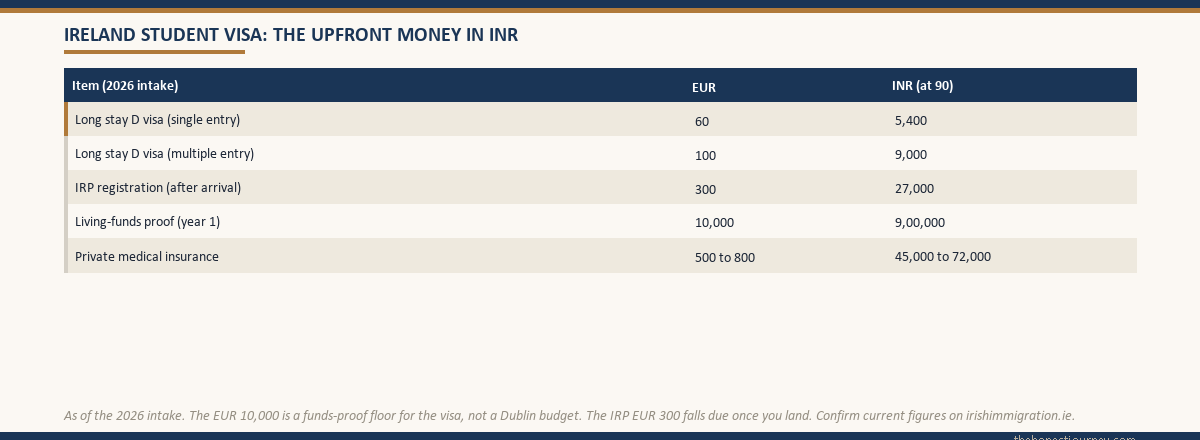
Let me put the real money on the table first, because the fees are genuinely small and people inflate them in their heads. The planning rate through this post is ₹90 per euro. It moves, so re-check it the week you pay.
| Item | EUR | INR (at 90) |
|---|---|---|
| D visa application, single entry | 60 | 5,400 |
| D visa application, multiple entry | 100 | 9,000 |
| IRP registration (after arrival) | 300 | 27,000 |
| Private medical insurance (year) | ~500 to 800 | ~45,000 to 72,000 |
| Core visa-side outlay (multiple entry) | ~900 to 1,200 | ~81,000 to 1,08,000 |
So the fee you pay to apply is tiny, ₹5,400 to ₹9,000. The IRP at EUR 300 is the bigger single line, and the insurance is the other real cost. Notice what is not on this table: the EUR 10,000. That is not a fee. It never leaves your account as a payment. It is a balance you prove you hold, and we deal with it in its own section because confusing it with a fee is the single most common Ireland mistake.
Faz's ruleThe EUR 10,000 is money you show, not money you spend. The actual fees you hand over are small. Keep these two ideas in separate boxes in your head and the whole process stops being scary.
Almost everyone who panics about Ireland has merged the funds proof and the fee into one frightening number. They are not the same. You pay EUR 60 or EUR 100 to apply and EUR 300 to register. The EUR 10,000 sits in your account as evidence and stays yours. Once you see the two as separate, the visa is a paperwork exercise, not a financial cliff.
The funds proof: EUR 10,000, explained honestly
This is the heart of the Ireland application, so let me be precise. Irish immigration wants to see that you can support yourself for the first year without becoming a burden on the state. As of the 2026 intake that benchmark is approximately EUR 10,000 in available living funds for the first year, and this is on top of having paid your tuition. Confirm the exact figure on irishimmigration.ie, because it is reviewed and it does move.
Two parts, then. First, your tuition must be paid, or substantially paid, before you apply. The official offer fee on your university’s letter is the number that matters here. Second, separately from that, you show roughly EUR 10,000 sitting available for your living costs. The EUR 10,000 does not include tuition. It is the living-cost layer on top.
At ₹90 per euro the EUR 10,000 is about ₹9 lakh in funds proof. This needs to be genuine, accessible money, typically in your account or a sponsor’s account with a clear paper trail, not a number conjured up the week before. The deeper mechanics of what counts, how recently it must have been there and how sponsorship is documented are covered in the proof of funds for student visa guide, which applies across countries. If you are funding this with a loan, the sanction letter feeds directly into this proof, and how Irish loans are structured sits in the education loan for Ireland post.
Be honest with yourself about the gap between the proof and the reality. The EUR 10,000 is a floor immigration wants to see. Actually living in Dublin costs more than that across a year. The funds proof is a compliance threshold, not a budget. Plan your real money on your actual city, which is the cost page’s job, and treat the EUR 10,000 as a separate box you tick for the visa.
Faz's ruleTuition paid plus EUR 10,000 shown. Those are two separate requirements, not one. Get the tuition receipt and the funds statement as two clean documents and the funds section of your application is done.
People try to roll tuition and living funds into one figure and confuse the officer and themselves. Keep them apart. Your tuition is paid and receipted on one document. Your roughly EUR 10,000 in living funds is evidenced on another. Two documents, two purposes. That clarity is what a clean Ireland file looks like.
The AVATS process, step by step
Ireland runs its visa applications through an online system called AVATS, the Automated Visa Application and Tracking System. You complete the application on the immigration portal, and AVATS then generates a summary you print, sign and submit with your supporting documents and biometrics as instructed for your region. The whole thing starts online, which trips up people expecting an embassy-counter process from the first step.
Here is the honest shape of the journey, start to finish.
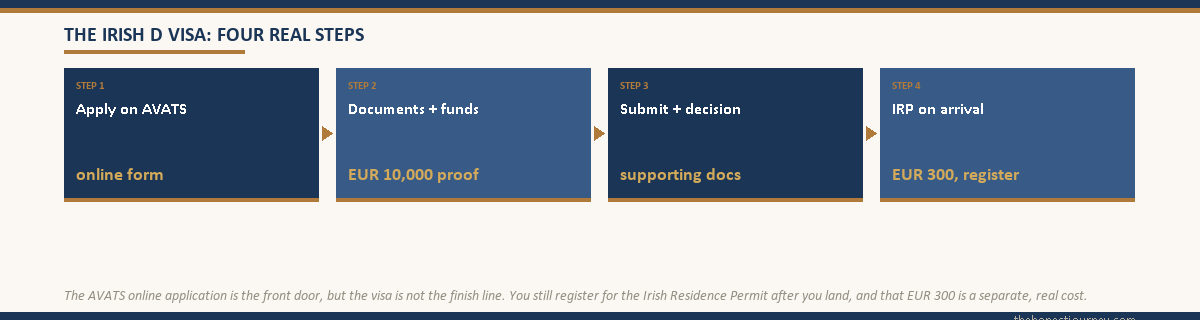
- Get your offer and pay tuition. You need an unconditional offer from an Irish institution on the official programmes list, and your tuition paid or arranged, before the application makes sense. The paid receipt is a core document.
- Apply online through AVATS. Complete the visa application on the immigration portal. AVATS produces a summary sheet at the end. Print it and sign it.
- Assemble your documents. The signed AVATS summary, passport, offer and tuition receipt, the roughly EUR 10,000 funds evidence, your private medical insurance, academic records and a clear statement of intent.
- Submit and give biometrics. Submit your documents and pay the EUR 60 or EUR 100 fee as instructed for your region, and provide biometrics where required.
- Decision, then travel. Wait for the decision, then travel to Ireland on the D visa.
- Register for the IRP on arrival. Within the first ninety days, register for your Irish Residence Permit and pay the EUR 300. This is what makes your stay lawful beyond the initial entry.
The single and multiple entry choice at step four is worth a thought. Single entry means the visa is used once to enter Ireland. Multiple entry, at EUR 100, lets you leave and re-enter, which matters if you plan to travel home or around Europe during the year. For most students doing a full year, multiple entry is the sensible EUR 40 to spend.
Medical insurance, biometrics and the documents that get missed
Private medical insurance is mandatory, not optional. As a non-EEA student you must hold private medical insurance covering you in Ireland, and evidence of it is part of the application and the IRP registration. Budget roughly EUR 500 to EUR 800 for the year, about ₹45,000 to ₹72,000. Many students buy a policy bundled through the university or an approved provider, which makes the paperwork cleaner at registration.
Beyond insurance, the documents that quietly sink applications are the soft ones. A weak or generic statement of intent, funds that appeared too recently to look genuine, gaps in your academic story, or a tuition receipt that does not match the offer. Irish refusals are far more often about a documentation or credibility gap than about the officer doubting you as a person. The fix is a clean, consistent, well-evidenced file where every document agrees with every other one.
Processing time and the refusal reality
Processing time for an Ireland D study visa varies by season and by where you apply, and it tends to stretch in the peak pre-autumn window when everyone is applying at once. Treat it as a process that wants to be started early, well before your course start date, rather than something you can rush in the final weeks. The portal publishes current processing guidance, so check it for your region and apply with comfortable margin. Confirm timelines on irishimmigration.ie rather than trusting a number from a forum.
On refusals, the honest picture is reassuring if your file is genuine. The common reasons are financial, where the roughly EUR 10,000 is not clearly evidenced or the money looks recently parked, and intent, where the statement does not convincingly explain why this course in Ireland makes sense for you. There is also straightforward incompleteness, where a required document is missing. A genuine student with a real offer, paid tuition, clean funds and a coherent statement is in a strong position. If you are refused, the decision letter states the reasons, and you can usually appeal in writing within the stated window, addressing each reason directly.
Working on the visa, and what comes after
Once you are registered, a student on valid permission can work up to 20 hours a week during term time and up to 40 hours a week during the holiday periods. This is genuine money at Irish wage levels, but treat it as a living-cost supplement, never as a tuition fund or as the thing that closes your funding gap. You should arrive with tuition and core living costs already funded, and let work be breathing room on top. The honest mechanics of student work abroad, including how much it actually offsets, are in the part-time work while studying abroad post.
The real prize on the Irish side is what comes after the course. A graduate of an eligible programme can stay on the Third Level Graduate Programme for up to two years to look for work, which is a longer post-study runway than several other one-year-Master’s destinations offer. That window is genuinely part of why Ireland appeals, but it belongs to the decision conversation, not this visa page. The mechanics of switching from a student stamp onto that graduate permission, and what it means for your longer plan, sit in the study-in guide.
The honest take on the Ireland student visa
Ireland’s visa process is, in plain terms, one of the more humane ones for an Indian student. The application fee is tiny, the route is online from the start through AVATS, and the funds requirement, while real, is a clear single number rather than a moving maze. The two things that catch people are mental, not bureaucratic: confusing the EUR 10,000 funds proof with a fee, and forgetting that the visa and the IRP are two separate steps with two separate costs.
Get those two ideas straight and the rest is discipline. Pay tuition, evidence roughly EUR 10,000 cleanly, buy your insurance, write an honest statement, apply early through AVATS, and register for your IRP within ninety days of landing. Do that and Ireland is one of the smoother stamps to earn, with a two-year graduate runway waiting on the far side. Confirm every figure on irishimmigration.ie for your intake, because the numbers shift, but the shape of the process is steady and fair.
Worth knowing early if you are married: only PhD students can sponsor family in Ireland. The Ireland dependants page covers the alternatives.
If Ireland’s cost gives you pause, Malaysia is one of the most affordable English-taught routes anywhere. The Student Pass steps sit in the Malaysia student visa too.
FAQ
How much is the Ireland student visa fee for Indian students?
The long-stay (D) study visa application fee is EUR 60 for single entry or EUR 100 for multiple entry, about ₹5,400 to ₹9,000 at ₹90 per euro. That is the only fee you pay to apply. Separately, after you arrive you pay EUR 300 to register your Irish Residence Permit. As of the 2026 intake these are the figures, but confirm the current numbers on irishimmigration.ie before you apply, since they are reviewed each intake.
How much money do I need to show for an Irish student visa?
Irish immigration expects evidence of roughly EUR 10,000 in available living funds for the first year, on top of having paid your tuition. At ₹90 per euro that is about ₹9 lakh in funds proof. This is money you show, not a fee you pay, and it must be genuine and accessible with a clear paper trail. Treat it as a floor for the visa rather than a real Dublin budget, and confirm the exact figure for your intake on irishimmigration.ie.
What is the IRP and why does it cost EUR 300?
The Irish Residence Permit is your actual residence permission, separate from the visa. The D visa gets you to Ireland, but the IRP is what makes living and studying there lawful beyond entry. You register for it after you arrive, within the first ninety days, and it carries a fee of EUR 300, about ₹27,000 at ₹90 per euro. Budget it as a real arrival cost, because many students forget it and treat the visa as the final step.
What is AVATS and how does the application work?
AVATS is Ireland’s online visa application and tracking system. You complete your D study visa application on the immigration portal, and AVATS generates a summary sheet you print, sign and submit with your supporting documents, fee and biometrics as instructed for your region. The process starts online rather than at an embassy counter, which surprises people. After submission you track the application through the same system until a decision is issued.
How long does an Ireland student visa take to process?
Processing time varies by region and by season, and it tends to stretch in the busy pre-autumn window when most students apply. There is no single fixed number, so treat it as a process to start early with comfortable margin before your course start date, not something to rush in the final weeks. Check the current processing guidance for your region on irishimmigration.ie rather than relying on a figure from a forum, since published timelines are updated regularly.
Do I need medical insurance for the Ireland student visa?
Yes. As a non-EEA student you must hold private medical insurance covering you in Ireland, and evidence of it is required for both the visa application and the IRP registration. Budget roughly EUR 500 to EUR 800 for the year, about ₹45,000 to ₹72,000 at ₹90 per euro. Many students buy a policy bundled through their university or an approved provider, which simplifies the documentation when you register your residence permit after arrival.
Can I work on an Ireland student visa?
Once registered, a student on valid permission can work up to 20 hours a week during term and up to 40 hours a week during holiday periods. At Irish wage levels this is genuine money, but it is a living-cost supplement, not a tuition fund. Never present part-time work to a bank or to yourself as the thing that closes your funding gap. Arrive with tuition and core living costs funded, and treat any earnings as breathing room on top.
What is the Third Level Graduate Programme?
It is Ireland’s post-study work scheme. A graduate of an eligible programme can stay in Ireland for up to two years after the course to look for work, a longer runway than several other one-year-Master’s destinations offer. It is a major reason Ireland appeals, but it belongs to the after-study decision rather than the visa application itself. Confirm current eligibility and duration on irishimmigration.ie, since the scheme’s terms can change between intakes.
Faz · The Honest Journey · 2026