Short answer. Ireland gives Indian students 1-year master’s degrees, a 2-year post-study Stay Back visa, and full EU work access after graduation. I find tuition runs roughly EUR 15K to 28K a year at Trinity, UCD, and University of Galway, and total annual costs land near ₹28L to 35L.
The shorter degree makes Ireland competitive on ROI versus Canada, the UK, or Australia.
Ireland doesn’t come up in most Indian conversations about studying abroad. When families sit down to plan, the shortlist is usually Canada, the UK, Australia, or the US. Ireland gets mentioned occasionally, then dropped.
That’s partly why it’s worth looking at seriously.
The students who end up in Ireland have usually done the research. They’ve run the numbers, looked at the post-study work options, and made a deliberate choice. The students who rush to Canada or the UK often haven’t looked at what Ireland actually offers, or compared total costs over the full program duration.
This post is an honest look at Ireland as a study destination for Indian students: what it offers, where the trade-offs are, and which student profiles it actually makes sense for. It’s not a pitch. Ireland isn’t the right choice for everyone. But for the right student, it’s a serious option that gets overlooked.
If you’re comparing destinations and haven’t made a decision yet, also read the full country comparison for Indian students.
For the full guide, read Studying Abroad From India: Cost and Funding Guide.
The money side of Ireland is split across companion pages: the education loan for Ireland post.
Why Ireland Even Exists as a Study Destination
Ireland has a specific combination of features that makes it relevant for Indian students, and it’s worth understanding each one before getting into costs and logistics.
English-speaking EU member state. This matters more than it sounds. Ireland is the only country in the EU where English is a primary official language (Malta is the other, but far smaller). For Indian students who want to be in Europe without learning German, French, or Dutch, Ireland is the natural entry point.
European headquarters for major US tech companies. Google, Meta, Apple, LinkedIn, Salesforce, Pfizer, and several dozen others have their European operations based in Ireland, primarily Dublin. This isn’t a marketing claim, it’s a structural feature of the Irish economy that creates real graduate jobs in tech, pharma, and finance. These are not satellite offices. They are full-scale operational hubs employing tens of thousands of people.
1-year master’s programs. Most Irish master’s programs are one year, full-time. This is meaningfully different from the 2-year model that Canada and the US typically require. The cost comparison between Ireland and North America is not just tuition: it’s one year of tuition and living versus two. That gap adds up.
The Third Level Graduate Programme. After completing a degree in Ireland, international graduates get a structured stay-back period to find work. After a bachelor’s (Level 8), you get 12 months. After a master’s (Level 9) or higher, you get 24 months, structured as two sequential 12-month blocks. During this period you can work any job while applying for a work permit.
That combination (English instruction, EU location, tech job market, shorter programs, and a defined post-study path) is what makes Ireland worth evaluating.
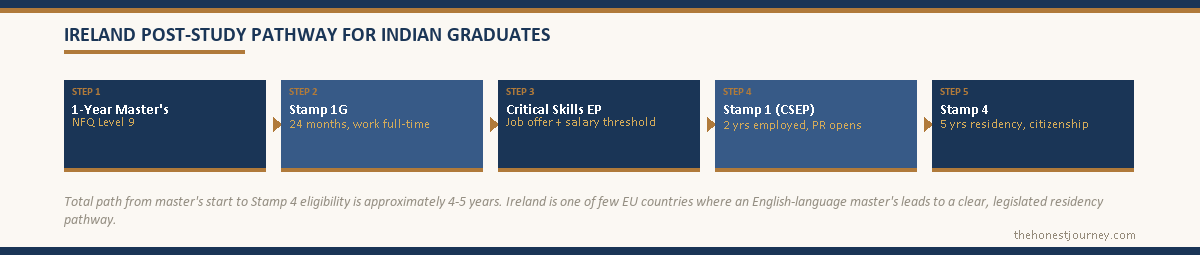
The Post-Study Work Path, Explained Clearly
The post-study pathway in Ireland follows a clear sequence, and it’s worth understanding it before deciding whether the destination fits your plan.
Faz's ruleIreland is one of few EU countries with a clear, legislated post-study residency pathway.
1-year master’s + 2-year Stamp 1G + Critical Skills EP + 5-year residency = a legible path to citizenship eligibility. Most other EU destinations require language proficiency or have ambiguous post-study routes.
The Third Level Graduate Programme
After graduating from an Irish institution, you apply for a Stamp 1G permission, which is the stay-back arrangement under the Third Level Graduate Programme.
- Level 8 (bachelor’s degree): 12 months stay-back
- Level 9 (master’s) or Level 10 (PhD): 24 months, issued as two consecutive 12-month permissions
During this period you are allowed to work any job (up to 40 hours per week) while you look for a sponsored role. There is no restriction on job type during the Stamp 1G period. This matters because it means you can support yourself while applying.
The Critical Skills Employment Permit
This is the main route Indian tech and pharma graduates use to transition into a long-term work permit. The requirements are:
- Annual salary of €34,000 or above
- The role must be in an eligible occupation, most tech, healthcare, financial services, and engineering roles qualify
- Your employer applies jointly with you, you are not filing alone
- No Labour Market Needs Test required, which means your employer does not have to advertise the role to EU candidates before hiring you
The Critical Skills Employment Permit is valid for 2 years initially and is renewable. Spouses and dependants can come with you and are allowed to work without needing their own permit, this is a significant practical advantage over comparable permits in Canada or the UK.
The General Employment Permit
For roles that don’t meet the Critical Skills criteria, there is the General Employment Permit. The minimum salary is €30,000, but this permit requires a Labour Market Needs Test: the employer must advertise the vacancy to EU/EEA candidates first and demonstrate that no suitable candidate was found. This makes it slower and more administratively demanding. Most Indian students aiming for Ireland target the Critical Skills route specifically to avoid this step.
Long-Term Residency and Citizenship
- After 2 years on a work permit, you are eligible to apply for Long-Term Residency (the equivalent of PR in the Irish system)
- After 5 years of legal residence in Ireland, you are eligible to apply for Irish citizenship
- Irish citizenship is EU citizenship, which means freedom of movement and the right to live and work across all EU member states
Five-year citizenship eligibility is faster than comparable paths in Canada (typically 5-6 years from landing), the UK, or Australia. It’s one of the faster EU citizenship routes available to Indian nationals.
Faz's ruleA 1-year Irish master's plus 2 years on the Graduate Scheme puts you in a position to apply for the Critical Skills Employment Permit 3 years after you land. That is a clear path.
The Critical Skills pathway is real and used by thousands of Indian graduates each year. Tech and pharma roles in Ireland routinely qualify. If your occupation is on the eligible list and you earn above the threshold, the permit process is employer-sponsored and relatively predictable.
What It Costs to Study in Ireland
The cost picture in Ireland has two sides: tuition that compares well against North America, and Dublin living costs that can eat into that advantage if you’re not careful about where you study.
Tuition
- Master’s programs: €10,000 to €20,000 per year for most fields (roughly ₹9 lakh to ₹18 lakh)
- Medicine and specialist programs can run higher, and the official Citizens Information guide on third-level fees sets out how charges are structured
- Because these are 1-year programs, you pay this once, not twice
Living Costs
- Dublin: €1,200 to €1,600 per month, depending on your accommodation situation
- Cork, Galway, Limerick: €900 to €1,200 per month, meaningfully cheaper, and these cities have real universities and real job markets
- Grocery and transport costs are high by Indian standards but comparable to London or Sydney
Total All-In Cost for a 1-Year Master’s
Tuition plus a year of living expenses lands most students in the €25,000 to €38,000 range (roughly ₹22 lakh to ₹35 lakh), depending on which city you’re in and your accommodation situation. For a line-by-line breakdown of every rupee, see the full cost of studying in Ireland for Indian students.
The Honest Comparison with Canada
A 2-year master’s in Canada, all-in including tuition and living in a city like Toronto or Vancouver, typically costs ₹45 lakh to ₹65 lakh. Ireland at ₹22-35 lakh for an equivalent degree level is cheaper, sometimes by ₹15 to ₹25 lakh.
But the comparison doesn’t end at cost. Post-graduation salaries in Canada (especially in tech) are higher than in Ireland. The rupee-equivalent income on an Irish tech salary is lower than on a Canadian one. So the decision is really about total life cost and life outcome, not just education cost, the kind of trade-off the honest ROI math on studying abroad works through. We’ll come back to this when we talk about the job market.
Faz's ruleThe 1-year master's is Ireland's real cost advantage. You spend one year of tuition and living instead of two. That saves ₹15-25 lakh compared to Canada.
The comparison is not Ireland tuition vs Canada tuition. It is Ireland total cost (1 year of study) vs Canada total cost (2 years of study). When you run the full number including living costs and opportunity cost of time, Ireland is often meaningfully cheaper for an equivalent outcome.
The Tech Corridor, What the Job Market Actually Looks Like
Ireland’s job market for international graduates is concentrated. If you’re in the right field, it’s genuinely good. If you’re not, it’s thin.
Where the Jobs Are
Dublin, Tech and financial services. Dublin’s tech sector is built around European HQ operations for US multinationals. Google, Meta, Apple, LinkedIn, Salesforce, HubSpot, Stripe, these are not small offices. They employ thousands of people in engineering, product, sales, finance, and operations roles. The IFSC (International Financial Services Centre) in Dublin adds a financial services layer with banks, insurance, and fintech operations.
Entry-level tech roles in Dublin: €35,000 to €50,000 per year. Mid-level roles: €50,000 to €70,000. Senior roles: €70,000 to €100,000 and above. These are real numbers, not projections.
Cork, Pharma and medtech. Cork has a concentrated pharma and medtech corridor. Apple also has a large operations presence there. If you’re studying biomedical engineering, pharmaceutical sciences, or related fields, Cork is worth considering as your base rather than Dublin, both because the relevant employers are there and because the city is cheaper to live in.
Galway, Medtech. Galway has a strong medtech cluster, with companies like Medtronic, Abbott, and Boston Scientific operating significant facilities there. For biomedical or medical device students, it’s a legitimate employment destination.
Who This Works For and Who It Doesn’t
Students in computer science, software engineering, data science, electrical engineering, pharmaceutical sciences, biomedical engineering, finance, and accounting have a real job market in Ireland. The Critical Skills Employment Permit was essentially designed around this cluster of occupations.
Students in arts, media studies, humanities, social sciences, or fields without a direct mapping to Ireland’s tech/pharma/finance economy have a harder time. There is demand in healthcare (nursing and medicine especially) and in education, but the general graduate market for non-STEM fields is thinner than in the UK or Canada.
This is not a reason to avoid Ireland if your field maps well. It is a reason to be honest with yourself about whether your field maps at all.
The Housing Problem, Being Honest About This
Dublin has a serious housing shortage. This is not a temporary situation or a Covid hangover, it is a structural problem that has been getting worse for over a decade and is unlikely to be resolved quickly.
Faz's ruleIreland's housing shortage adds 6-8 weeks of stress to every academic year.
Particularly acute in Dublin and Cork. Smaller cities like Limerick, Galway, and Waterford have better housing supply but smaller post-study job markets. The location decision involves trade-offs in both directions.
Student accommodation at universities is limited and competitive. Many students end up in the private rental market, where rents are among the highest in Europe.
For a single room in a shared apartment in Dublin, budget €1,000 to €1,300 per month as a baseline. A self-contained studio will cost €1,500 to €2,000 or more. These numbers erode the cost advantage over Canada and the UK fairly quickly if your entire program is Dublin-based.
Outside Dublin, the housing picture is better. Cork, Galway, and Limerick have tighter student housing markets than they used to, but they are materially cheaper than Dublin. If a program you’re considering is available at a university in Cork or Galway, the housing cost difference is worth factoring in, it can amount to €3,000 to €6,000 over the course of a year.
Practical advice: when you’re evaluating Irish universities, don’t just compare the program and the university ranking. Compare the city and what it will actually cost to live there. University College Cork is a strong institution offering many of the same master’s programs available in Dublin. The daily cost of living there is genuinely lower.
The Visa Process
The Irish student visa process is relatively straightforward for Indian applicants and less bureaucratically demanding than Canada or Australia.
- Processing time: typically 6 to 8 weeks from application submission (the official Irish Immigration Service study pages publish current timelines)
- Financial evidence requirement: €3,000 per year of study is the baseline threshold. This is lower than Canada (which has moved to CAD 20,635 per year) or Australia
- During studies: 20 hours of work per week during term time, 40 hours per week during official holidays
- English proficiency: IELTS Academic 6.5 overall (6.0 per band minimum) is the standard requirement at most Irish universities, though specific programs may set higher thresholds
The visa documentation is standard: offer letter, financial statements, travel history, academic transcripts. If you are still deciding how to fund the financial evidence, the comparison of an education loan versus self-funding is worth running before you apply. There are no additional points-based hoops or complex expression of interest systems. You apply, you submit documents, you wait.
For most Indian applicants with clean travel history, a legitimate offer letter, and the financial evidence in place, the Irish student visa is not where complications arise.
Who Ireland Works For, and Who Should Look Elsewhere
This is the part of the article that matters most. Ireland is not a universally good choice. It’s a good choice for a specific kind of student.
Ireland Works Well If:
- Your field is tech, pharma, biomedical, finance, or a related discipline that maps to Ireland’s job market
- You want a 1-year master’s to reduce total cost and time-to-employment
- You want to be in the EU, either because EU access matters to you professionally, or because the 5-year citizenship path is part of your longer-term plan
- You want a post-study work permit path that is defined and employer-friendly (Critical Skills Employment Permit)
- You’ve accounted for Dublin’s housing costs, or you’re considering a university outside Dublin
Ireland Is Probably Not the Right Choice If:
- Your target field does not map to Ireland’s economy, media, law (different legal system), arts, social work, humanities
- You are optimising for maximum rupee-equivalent post-study income. Canadian or US salaries in tech are higher than Irish salaries
- You need Canadian PR specifically, Ireland’s residency system works differently and won’t give you that
- You haven’t planned concretely for housing costs in Dublin and are expecting something comparable to a mid-tier Canadian city
For a broader comparison of destinations, including how Ireland stacks up against Canada, the UK, and Germany, read the full destination comparison guide. For a detailed look at the Canadian option, see the honest guide to studying in Canada for Indian students.
Faz's ruleDon't go to Ireland expecting North American salaries. Do go expecting EU tech salaries, a reasonable path to a work permit, and a faster graduation date.
Irish tech salaries are good by Indian standards and liveable in Dublin, but they are not Toronto or San Jose levels. Students who go to Ireland expecting to maximise rupee-equivalent earnings often feel underpaid. Students who go expecting to build European work experience and pursue the Critical Skills path tend to find it works as planned.
The Honest Case for Ireland
Ireland is a legitimate study destination for Indian students in the right fields. It is not the obvious first choice, and for many students it isn’t the right choice at all. But the combination of English instruction, a real tech and pharma job market, a 1-year master’s format, a defined post-study work path, and EU citizenship eligibility at 5 years is a genuine package.
The students who do well in Ireland are the ones who went there deliberately, who understood the job market, budgeted honestly for Dublin housing, targeted the Critical Skills permit from day one, and weren’t expecting North American salaries in year one. That’s a narrow profile, but it’s not a rare one. There are thousands of Indian professionals working in Ireland on exactly that path.
If the profile fits, Ireland deserves a serious look. If it doesn’t, that’s useful information too, and knowing that early saves you from a decision made on incomplete information.
Sorting the visa is the step most people underestimate. The full process, fees and funds proof for Ireland sit in the Ireland student visa guide.
Deciding between destinations? Compare Ireland vs UK for Indian students against the UK.
FAQ
Is Ireland a good country to study in for Indian students?
Ireland is a good option for Indian students whose field maps to Ireland’s job market, primarily tech, pharma, biomedical, and finance. The combination of 1-year master’s programs, an English-speaking EU environment, and the Critical Skills Employment Permit post-graduation makes it a compelling package for the right student. For students in fields outside Ireland’s economic strengths, other destinations may be a better fit.
What is the post-study work period in Ireland after a master’s?
After completing a master’s degree (Level 9) in Ireland, international graduates receive 24 months of stay-back permission under the Third Level Graduate Programme. This is issued as two consecutive 12-month blocks (Stamp 1G). During this period you can work any job, full-time, while applying for a work permit. After a bachelor’s degree (Level 8), the stay-back period is 12 months.
What is the Critical Skills Employment Permit in Ireland?
The Critical Skills Employment Permit is Ireland’s main skilled worker visa for international graduates. It requires a job offer in an eligible occupation (most tech, healthcare, engineering, and financial services roles qualify) with a salary of at least €34,000 per year. Your employer applies jointly with you, and no Labour Market Needs Test is required, meaning your employer does not have to prove that no EU candidate was available first. It’s valid for 2 years initially and is renewable. Dependants can come with you and are permitted to work.
How much does it cost to study in Ireland for Indian students?
Tuition for a master’s program in Ireland typically ranges from €10,000 to €20,000 per year (roughly ₹9 to ₹18 lakh). Living costs in Dublin run €1,200 to €1,600 per month. Outside Dublin (in Cork, Galway, or Limerick) living costs are €900 to €1,200 per month. Total all-in cost for a 1-year master’s is typically €25,000 to €38,000 (approximately ₹22 to ₹35 lakh), which compares favourably to the 2-year Canadian master’s route on a total-cost basis.
Can I get PR in Ireland after studying and working?
Ireland does not use the term “PR” in the same way as Canada or Australia, but the equivalent is Long-Term Residency. After 2 years on a work permit, you are eligible to apply for Long-Term Residency, which gives you the right to live and work in Ireland without needing an employment permit. After 5 years of legal residence in Ireland (which includes your time as a student), you are eligible to apply for Irish citizenship, which also carries EU citizenship and freedom of movement across EU member states.
How does the housing situation in Dublin affect Indian students?
Dublin has a genuine housing shortage and some of the highest private rents in Europe. Student accommodation at universities is limited and competitive. Indian students should budget €1,000 to €1,300 per month for a room in a shared apartment in Dublin, and more for a self-contained space. This cost can significantly reduce the financial advantage Ireland holds over North America. One practical approach: consider universities in Cork, Galway, or Limerick, where the same programs are available and housing costs are €300 to €600 per month lower.