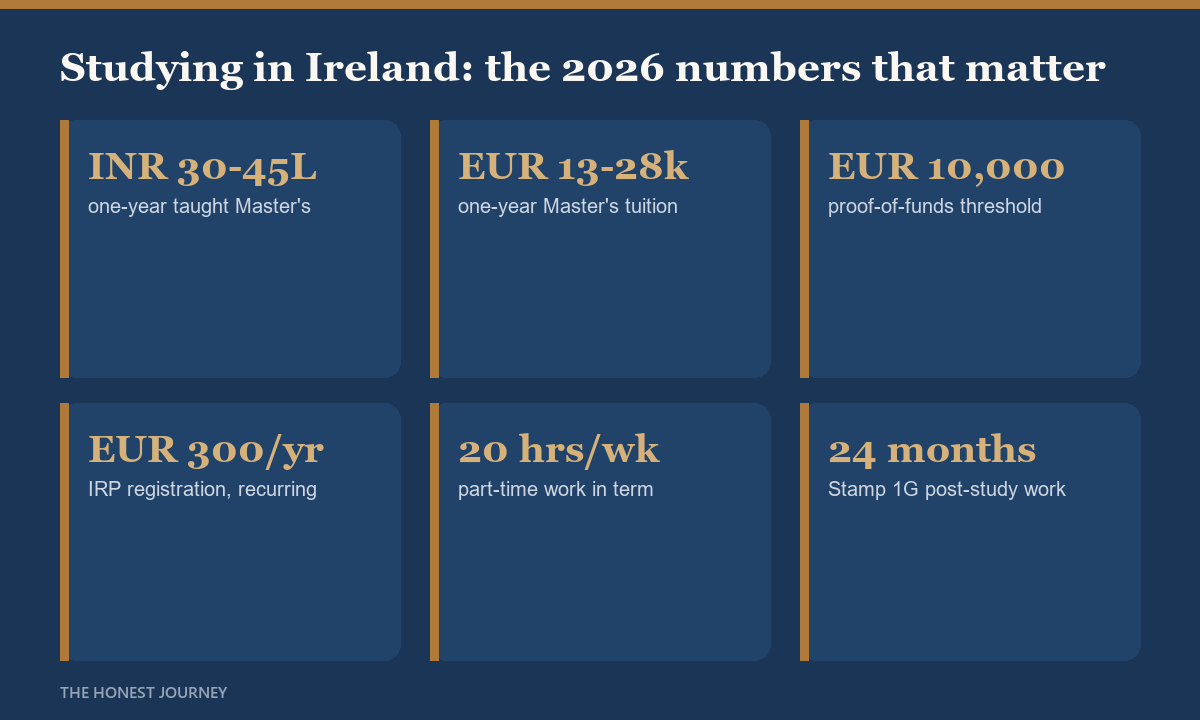
Short answer. The all-in cost of studying in Ireland for Indian students in 2026 runs roughly ₹30 lakh to ₹45 lakh for a one-year taught Master’s, which is where most Indian students land.
Irish Master’s are typically a single year, so the cost is compressed: tuition of €13,000 to €25,000, living of €1,200 to €1,800 a month, and a hard proof-of-funds requirement of €10,000. At ₹92 to the euro, the one-year format is Ireland’s biggest cost advantage.
Ireland has quietly become one of the most popular destinations for Indian students, and the reason is not that it is cheap, because Dublin is expensive, but that the Master’s is usually one year and the post-study work visa is generous. When families ask me why Ireland costs less than the UK for a similar degree, the honest answer is that it often does not cost less per year, it just takes fewer years. The cost of studying in Ireland for Indian students is a story about a compressed timeline more than a low price.
This post walks through Irish tuition by field, the one-year Master’s format, living costs in Dublin versus Cork and Galway, the €10,000 proof-of-funds rule and the IRP registration, part-time work and the Stamp 1G post-study visa, and the honest rupee total in 2026. If you are still mapping the bigger picture, the full guide on studying in Ireland for Indian students covers admissions, the visa and timelines end to end.
If you are choosing Ireland against the other English-speaking destinations, it helps to see them side by side: the best country to study abroad for Indian students.
Tuition: what a one-year Irish Master’s costs
Irish Master’s tuition for international students varies by field, with business, data and technology programs at the higher end and general arts and social sciences lower. The defining feature is that most taught Master’s (Level 9) run a single year, so the tuition figure below is usually the whole program, not a per-year cost repeated twice.
| Program field | Tuition (one-year Master’s) | Rupees (at ₹92 per euro) |
|---|---|---|
| Arts, humanities, social sciences | €13,000 to €17,000 | ₹12 lakh to ₹15.6 lakh |
| Business, management | €16,000 to €24,000 | ₹14.7 lakh to ₹22.1 lakh |
| Computing, data, engineering | €18,000 to €28,000 | ₹16.6 lakh to ₹25.8 lakh |
| Bachelor’s (per year, 3 to 4 years) | €10,000 to €25,000 | ₹9.2 lakh to ₹23 lakh |
The universities behind these numbers include Trinity College Dublin, University College Dublin, University of Galway and University College Cork, all well regarded and all teaching in English, which removes the language barrier that France or Germany carry. Dublin institutions typically charge 15 to 20 percent more than Cork or Galway for a comparable program, so the city choice affects tuition as well as rent.
Faz's ruleIreland's real advantage is the one-year Master's, not the tuition. You pay Dublin's high costs for twelve months, not twenty-four, and you enter the job market a full year sooner than a two-year program elsewhere.
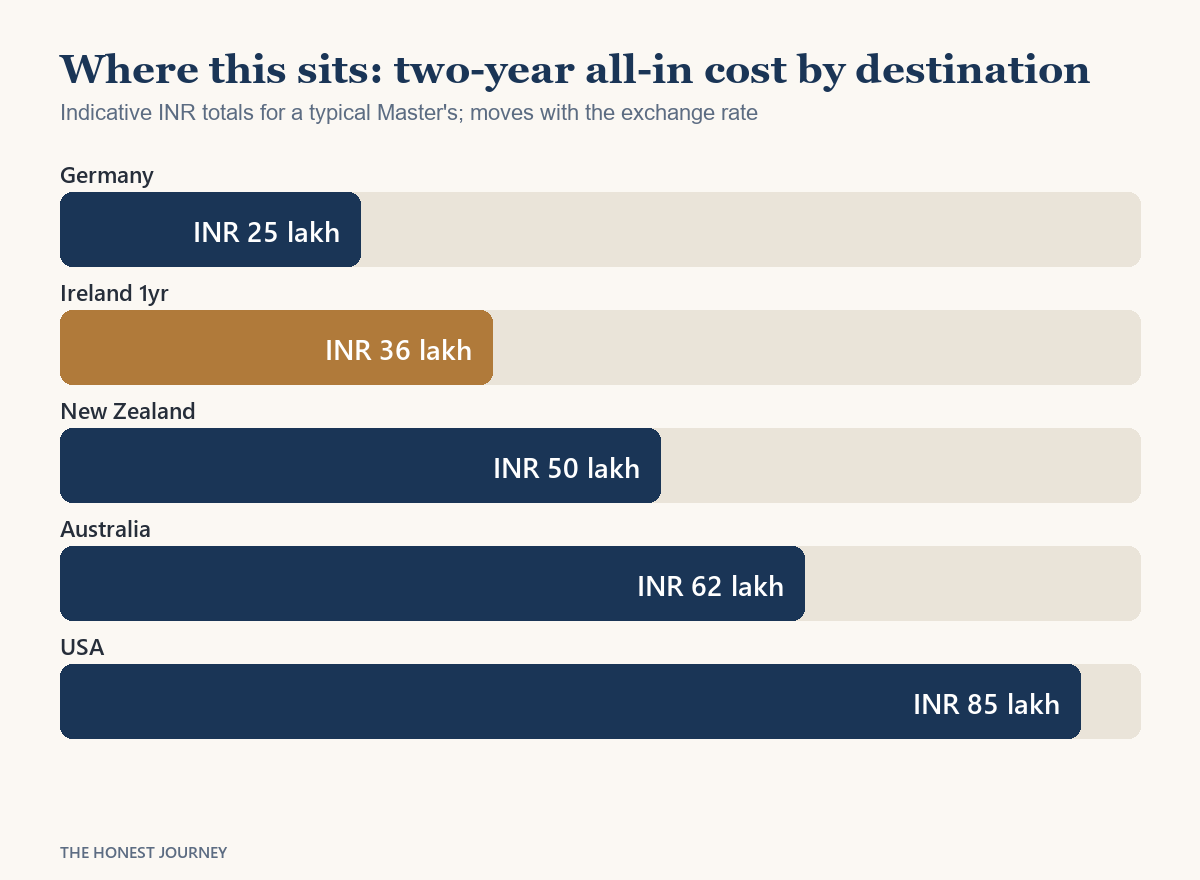
People compare Ireland’s annual tuition to a two-year US or Australian Master’s and conclude Ireland is only a bit cheaper. That misses the point. The one-year format means one year of living cost, one year of loan interest, and an earlier salary. On a full-program basis, that compression is worth ₹15 lakh or more against a two-year degree.
Living costs, Dublin versus the rest
Dublin is the expensive part of the Irish equation, with a housing shortage as acute as the Netherlands. Cork, Galway and Limerick are noticeably cheaper and easier for accommodation, though Dublin still hosts the largest concentration of tech and finance employers for post-study work.
| City | Rent (room) | Total monthly living | Rupees per month |
|---|---|---|---|
| Dublin (expensive) | €800 to €1,200 | €1,500 to €1,900 | ₹1.38 lakh to ₹1.75 lakh |
| Cork, Galway (mid) | €600 to €850 | €1,200 to €1,500 | ₹1.1 lakh to ₹1.38 lakh |
| Limerick, smaller towns (affordable) | €500 to €700 | €1,000 to €1,300 | ₹92,000 to ₹1.2 lakh |
Over a one-year Master’s the Dublin premium is smaller in absolute terms than it would be over two years, which slightly softens the case for choosing a cheaper city. But Dublin housing is genuinely hard to find, so the same rule as the Netherlands applies: secure accommodation early, because the cost of a temporary stay while you search can wipe out the savings from a cheaper city.
Faz's ruleTreat €10,000 as a hard cash requirement, not a formality. Ireland wants to see it as genuine, available funds, and the IRP renewal adds €300 every year you stay, including the post-study period.
The €10,000 proof-of-funds figure is a liquidity test, not an estimate of what you will spend, which in Dublin is far more. Students underestimate the recurring IRP registration too. It is €300 to register on arrival and €300 again for each renewal, including during your two-year Stamp 1G, so budget for it across the whole stay, not just year one.
Proof of funds, the IRP and visa fees
Ireland’s cost structure has a few specific line items Indian students must plan for: the visa fee, the proof-of-funds threshold, and the recurring IRP registration that every non-EU student pays on arrival and at each renewal.
| Item | Amount | What it is |
|---|---|---|
| Proof of funds threshold | €10,000 | A hard liquidity requirement shown as available funds, separate from tuition. |
| Student visa (single entry) | €60 (multi-entry €100) | Non-refundable visa application fee to the Irish immigration service. |
| IRP registration | €300 per year | Irish Residence Permit, paid on arrival and renewed each year, including during Stamp 1G. |
| Private medical insurance | €150 to €500 per year | Mandatory health cover for the visa. |
The IRP is the recurring one to remember. At €300 on arrival plus €300 for each renewal, a student who does a one-year Master’s and then stays two years on Stamp 1G pays it three times. Medical insurance is mandatory for the visa, and the broader picture on cover is in the health insurance for study abroad guide. The proof-of-funds details are in the proof of funds for student visa guide.
Part-time work and the Stamp 1G post-study visa
Indian students in Ireland can work 20 hours a week during term and 40 hours a week during holidays. With the 2026 minimum wage at €14.15 an hour, a student working the full allowance earns a substantial share of monthly living costs, and many Indian students cover 60 to 90 percent of their living expenses through part-time work. The realistic earnings picture is in part-time work while studying abroad.
The post-study payoff is strong. The Third Level Graduate Scheme (Stamp 1G) gives Level 9 Master’s graduates 24 months of post-study work permission, in two twelve-month blocks. Ireland hosts the European headquarters of many large tech and pharma companies, so a graduate earning an Irish starting salary of €35,000 to €50,000 across those two years can repay a large part of the loan before deciding whether to stay longer. The one-year degree plus two-year work window is the combination that makes Ireland attractive despite Dublin’s cost.
A worked rupee total: one-year taught Master’s in 2026
The cleanest way to make it concrete is a specific case. A one-year taught Master’s in Business Analytics or Computing at a strong university in Cork or Galway, €20,000 tuition, part-time work through the year.
| Line item | Euro | Rupees (at ₹92 per euro) |
|---|---|---|
| Tuition (one-year Master’s) | €20,000 | ₹18.4 lakh |
| Living + rent (12 months, mid city) | €15,600 | ₹14.4 lakh |
| Medical insurance | €350 | ₹32,200 |
| Visa + IRP (arrival) | €400 | ₹36,800 |
| Round-trip flight | €600 | ₹55,200 |
| Initial settlement (deposit, setup) | €1,400 | ₹1.3 lakh |
| Forex spread + remittance | €450 | ₹41,400 |
| One-year all-in total | €38,800 | ₹35.7 lakh |
A one-year taught Master’s lands around ₹32 lakh to ₹40 lakh all-in in 2026. A cheaper field and city (arts in Limerick) can pull it toward ₹28 lakh to ₹30 lakh, while a computing Master’s in Dublin climbs to ₹42 lakh to ₹45 lakh. Because the program is one year, the total is far lower than a two-year US or Australian Master’s even though Dublin’s monthly costs are high. Forex is small per transfer but consistent, so understand the A2 form and LRS rules for sending money abroad and pick an efficient route. The best forex card for students post covers the options.
Faz's ruleThe honest Ireland number is ₹32 lakh to ₹40 lakh for a one-year Master's, which buys an English-taught degree, a two-year work visa, and access to the European tech and pharma hub. For that package, it is fair value even though Dublin itself is not cheap.
Ireland looks expensive if you only read the monthly rent, and looks cheap if you only read the one-year tuition. The truth is in the middle: a fair-value package where the compressed timeline and the strong post-study visa do the heavy lifting, not a low sticker price. Judge it on the full-program total and the work window, not the Dublin rent.
Funding it: loan and savings
A one-year Irish Master’s at ₹32 lakh to ₹40 lakh usually needs a sanctioned loan for the bulk, though the one-year format keeps it smaller than a two-year destination. Collateral-free loans reach the lower end of this range for strong university and course lists, while PSU secured loans cover the full amount comfortably. The sanctioned loan letter also helps satisfy the €10,000 proof-of-funds requirement. See the education loan for Ireland guide for lender specifics, and the broader studying abroad from India cost and funding guide and education loan India complete guide for the full picture. Irish university scholarships and the Government of Ireland scholarships, listed in scholarships for Indian students to study abroad, can cut the tuition line meaningfully.
The honest closing take
Ireland is a fair-value package rather than a bargain, and the value is structural, not in the price. A one-year English-taught Master’s, a two-year Stamp 1G work visa, and a location at the European base of global tech and pharma companies add up to a strong proposition for around ₹32 lakh to ₹40 lakh.
The two honest cautions are Dublin housing and the recurring IRP cost. Dublin accommodation is genuinely scarce and expensive, so either secure it early or lean toward Cork, Galway or Limerick. And remember the IRP is a repeating €300, including through your post-study years, not a one-time fee. Neither changes the fundamental appeal, but both catch students who plan only for tuition and rent.
For an Indian student who wants an English-taught European degree, a fast one-year timeline, and a genuine post-study work runway, Ireland is one of the most sensible choices in this cluster, provided you go in with eyes open about Dublin’s cost of living.
Once the budget is clear, the visa is the next hurdle. The funds proof, IRP and processing are in the Ireland student visa guide.
Ready to fund it? Most Indian students route the loan through the PM Vidyalakshmi portal. That guide covers the step by step application and the 13 banks linked to it.
FAQ
How much does it cost to study in Ireland from India in 2026?
A one-year taught Master’s in Ireland typically costs ₹30 lakh to ₹45 lakh all-in for an Indian student, including tuition, living, insurance, visa, the IRP, flights and forex. Tuition for a one-year Master’s runs €13,000 to €28,000 depending on the field, and Dublin living is €1,500 to €1,900 a month. Because most Irish Master’s are a single year, the full-program total is far lower than a two-year US or Australian Master’s, even though Dublin’s monthly costs are high. A cheaper field and city can land near ₹28 lakh to ₹30 lakh.
Are Irish Master’s degrees one year?
Yes, most taught Master’s (Level 9) in Ireland are a single year, which is Ireland’s biggest cost advantage. It means you pay one year of tuition and one year of living rather than two, and you enter the job market a full year sooner. On a full-program basis this compression is worth ₹15 lakh or more against a two-year degree elsewhere. Some research Master’s and specialised programs run longer, so confirm your specific program’s length, but the one-year format is the norm for taught Master’s.
How much money do I need to show for an Ireland student visa?
Ireland requires a proof-of-funds threshold of €10,000, shown as genuine available funds separate from your tuition, which must generally be paid before the visa. This is a hard liquidity requirement, not an estimate of spending, since Dublin living costs far exceed it. The visa application fee is €60 for single entry or €100 for multiple entry. On arrival you also register for the Irish Residence Permit (IRP) at €300, which renews at €300 each year, including during your post-study Stamp 1G period.
What is the Stamp 1G post-study visa in Ireland?
Stamp 1G is the permission granted under Ireland’s Third Level Graduate Scheme, and it gives Level 9 Master’s graduates 24 months of post-study work permission, in two twelve-month blocks. During this time you can work full time for any employer. Ireland hosts the European headquarters of many large tech and pharma companies, so graduates earning an Irish starting salary of €35,000 to €50,000 can repay a significant part of their loan across the two years, which is a major reason Ireland is popular despite Dublin’s cost.
Can Indian students work part-time in Ireland?
Yes. Indian students in Ireland can work 20 hours a week during term time and 40 hours a week during holidays. With the 2026 minimum wage at €14.15 an hour, working the full allowance covers a substantial share of living costs, and many Indian students report covering 60 to 90 percent of their monthly expenses through part-time work. This meaningfully reduces the amount you need to fund from a loan or savings, especially over a compressed one-year Master’s.
Is Ireland cheaper than the UK for Indian students?
Often yes, but mainly because of the timeline rather than the annual price. Both have one-year taught Master’s and similar tuition bands, and Dublin rents rival London. Where Ireland can pull ahead is the Stamp 1G post-study work visa of 24 months, compared to the UK Graduate Route, and the concentration of tech and pharma employers. On a strict cost-per-year basis the two are close, so the decision usually comes down to the post-study work offer and the specific universities and courses rather than a large price gap.
Which Irish city is cheapest for Indian students?
Limerick and smaller university towns are the most affordable, followed by Cork and Galway, all noticeably cheaper than Dublin for both rent and, often, tuition, since Dublin institutions charge 15 to 20 percent more. In Cork or Galway total monthly living runs €1,200 to €1,500 against €1,500 to €1,900 in Dublin. Over a one-year Master’s the absolute saving is smaller than it would be over two years, but the bigger benefit of a non-Dublin city is an easier housing search, since Dublin accommodation is genuinely scarce.
Faz · The Honest Journey · 2026