Short answer. The Netherlands does not ban student dependants. There is no rule like the UK’s, which closed the door to taught master’s students in January 2024, and no PhD only restriction like Ireland’s. On paper, family reunification is available.
In practice it is closed to almost every Indian student, and the reason is a number rather than a rule. Family reunification in the Netherlands carries a hard minimum income requirement of roughly EUR 2,294 a month. A student cannot earn that. That is the whole story, and it is why the Dutch position is more misleading than the British one: the UK tells you no, and the Netherlands lets you assume yes.
This page covers the income threshold, why student income does not qualify, what a partner can and cannot do if they do get here, and the one route that genuinely works.
The same question, answered by country
The rules differ enormously, and four of the eight changed in the last two years. If a different destination is on your list, start there instead, or see the full country comparison.
- New Zealand, the most generous of the eight
- Germany, with full spousal work rights
- Australia, where partners work capped hours
- Canada, where the 16 month rule decides it
- the USA, where an F-2 spouse cannot work
- the UK, where taught masters cannot bring family
- Ireland, where only PhD students qualify
The rule, and the number that closes it
Family reunification in the Netherlands has three main conditions.
- A genuine, exclusive, durable relationship. A marriage certificate covers married couples. Unmarried partners need real evidence of a lasting relationship, typically a year or more of cohabitation or documented correspondence.
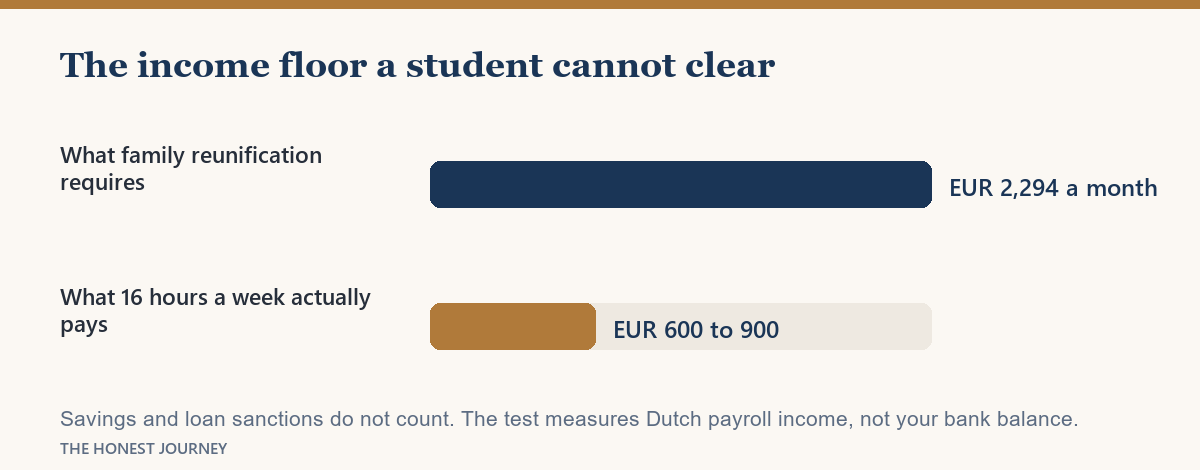
- Sufficient, stable income to support the family without recourse to public funds. This is the binding condition and it is roughly EUR 2,294 a month, measured as SV income, which is income subject to Dutch social security contributions. Below that, the application is refused.
- Suitable accommodation for the family.
Read the second one again, because it is what decides your case. It is not a guideline or a target. It is a hard floor.
Why a student cannot meet it
An international student in the Netherlands is limited in what they can earn. Students from outside the EU can work either a maximum of 16 hours a week during the year, or full time during the summer months only, and in either case a work permit is involved.
Sixteen hours a week at a typical Dutch student wage produces somewhere around EUR 600 to 900 a month. Against a threshold of EUR 2,294, that is roughly a third of what is required.
Money in a blocked account does not fix this either. The threshold is about income, specifically SV income that flows through Dutch payroll and social security. Savings, a loan sanction, or parental support are not income, however large the balance. A student with EUR 40 lakh in the bank and a part time job still fails this test, because the test is measuring the wrong thing from their point of view.
Faz's ruleThe Netherlands does not refuse student families. It sets an income bar that a student cannot legally earn enough to clear, which produces the same outcome with none of the warning.
The UK at least tells you no in plain language. The Dutch rules read as open, and applicants only discover the income floor after they have committed. That is the more expensive kind of no.
What a partner can do if they are here
Worth covering, because a small number of people do arrive through other routes, and because the work position is widely misunderstood.
A partner on a family reunification permit tied to a student does not get free access to the labour market. This is the second surprise. Unlike Germany, where the spouse’s work right attaches to their own permit, and unlike New Zealand, where a master’s student’s partner gets an open work visa, a dependent partner in the Netherlands generally needs their employer to apply for a work permit on their behalf.
That is a meaningful barrier. It means your partner is not simply job hunting, they are looking for an employer willing to file paperwork for them, which narrows the field sharply for entry level roles.
| Country, taught master’s student | Partner’s work position |
|---|---|
| New Zealand | Open work visa, no cap |
| Germany | Full work rights on the permit |
| Australia | 48 hours per fortnight |
| Netherlands | Employer must apply for a work permit |
| USA | No work permitted at all |
The route that actually works
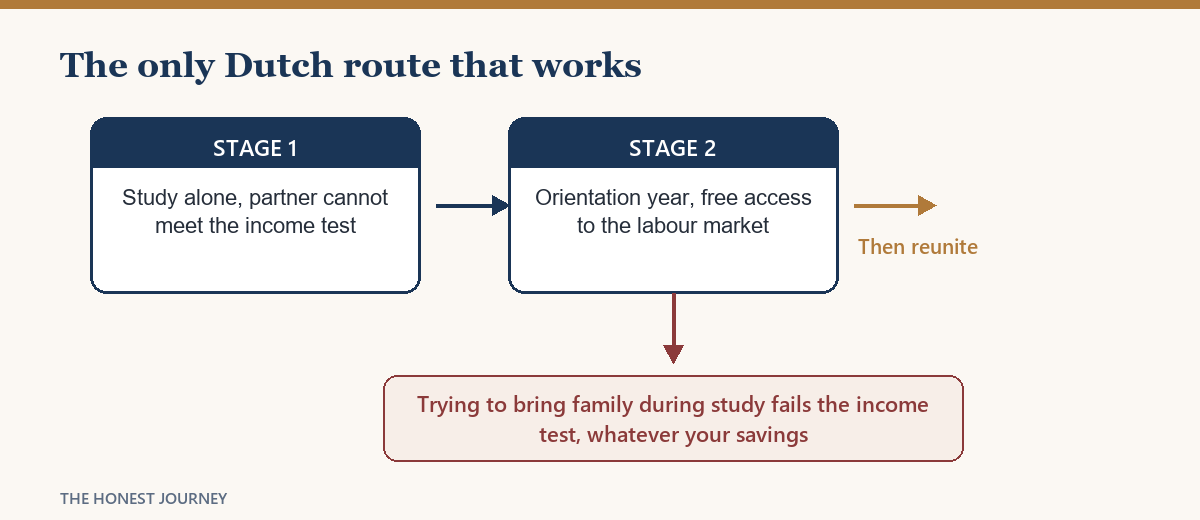
There is one, and it is the same shape as the Irish answer: finish first, then reunite.
The Netherlands offers the orientation year, the zoekjaar, to graduates of Dutch institutions. It is a residence permit for up to a year to find work, and crucially it carries free access to the labour market, with no separate work permit needed.
Once you are in skilled employment, the income picture changes completely. A graduate in a Dutch technical or commercial role typically earns EUR 3,000 to 4,000 a month, comfortably above the EUR 2,294 threshold. At that point family reunification becomes achievable rather than theoretical, and the highly skilled migrant route opens up as well, which carries its own family provisions.
So the honest Dutch sequence is: study alone for one to two years, move onto the orientation year, find skilled work, then bring your family. It is slower than most people want. It is also the only version that does not end in a refusal.
Two household outcomes
Numeric archetypes, not people. As with Ireland there are only two, because the third is not legally available.
The one that works. A two year master’s taken alone. Tuition for a non EU student runs EUR 15,000 to 20,000 a year at a research university, living costs around EUR 1,100 to 1,400 a month. The student graduates, takes the orientation year, lands a role at EUR 3,400 a month, clears the income threshold with margin, and brings their partner in year three. Total time apart is roughly two years. The loan is sized for one person, not two, which keeps it near ₹30 to 38 lakh rather than well over ₹50 lakh.
The one that strains. A household that assumed the Netherlands was as open as Germany, budgeted for two people, and discovers the income threshold after the deposit is paid. The partner either cannot come at all, or comes and cannot work without an employer sponsoring a permit. The household then funds two adults in a country with a serious housing shortage on a single student budget. Amsterdam and Utrecht rents make this materially worse than the equivalent mistake in Germany.
The housing problem, which compounds it
Worth its own mention because it interacts badly with the accommodation requirement.
The Dutch student housing shortage is severe and well documented. Universities routinely warn incoming international students that they may not find accommodation before term starts, and some institutions decline to guarantee housing at all.
Family reunification additionally requires suitable accommodation for the family. So a route that is already blocked by income is, for anyone who somehow clears that, blocked again by a housing market where a single student struggles to find a room. If you are seriously considering bringing family to the Netherlands, secure the accommodation question before anything else, because it is the constraint that does not improve with a better job offer.
Children, and the one thing the Netherlands does well
If a family does get here, the position for children is genuinely good, and it is worth knowing because it is the opposite of the Australian answer.
Dutch state schools are publicly funded and children of residence permit holders attend without paying international fees. Newcomer children typically start in a schakelklas, a transition class focused on Dutch language, before moving into mainstream schooling. The system is well organised for this because the Netherlands has long experience with international families.
International schools exist as an alternative and charge accordingly, EUR 8,000 to 20,000 a year, which most student households cannot consider. The state route is the realistic one and it works.
Childcare for younger children is subsidised through a benefits system, though eligibility depends on both parents working or studying, and the rules are genuinely complicated. Do not assume you qualify without checking your specific situation.
None of this changes the core problem. Free schooling is excellent, and it is unreachable if the income test blocks the family from arriving in the first place. It becomes relevant at the stage where you are working, not while you are studying.
How the Netherlands compares to Germany
This is the comparison that matters most, because the two get shortlisted together constantly and are assumed to be similar. On family, they are not close.
| Factor | Netherlands | Germany |
|---|---|---|
| Can a taught master’s student bring a spouse? | Only if income clears EUR 2,294 a month | Yes, via family reunion |
| Can the spouse work? | Employer must file a work permit | Yes, full rights, no cap |
| Tuition for a non EU master’s | EUR 15,000 to 20,000 a year | Near zero at public universities |
| Language requirement for the spouse | None at this stage | Usually A1 German |
| Realistic family position while studying | Closed | Workable |
Germany asks for A1 German and a blocked account. The Netherlands asks for an income a student cannot legally earn. If your family is coming with you, that is not a close call, and the tuition difference points the same way.
The honest case for the Netherlands is that it is excellent for a single student: strong universities, courses taught in English, a good graduate job market, and the orientation year. It is simply a poor destination for a household that needs to move together on day one.
Faz's ruleThe Netherlands and Germany get shortlisted as interchangeable European options. On family they are opposites, and the tuition gap points the same way.
One charges twenty thousand euro a year and blocks your spouse behind an income test. The other charges almost nothing and gives your spouse full work rights. If the household is moving together, that comparison is not close.
Frequently asked questions
Can I bring my spouse on a Netherlands student visa?
In theory yes, in practice almost never. Dutch family reunification requires a hard minimum income of roughly EUR 2,294 a month in SV income, and a student restricted to 16 hours of work a week cannot earn that. There is no ban, but the income floor produces the same result.
Does money in a blocked account count toward the income requirement?
No. The test measures income subject to Dutch social security, not savings or a loan sanction. A large bank balance does not help, which surprises applicants who cleared their student visa on exactly that basis.
Can my partner work in the Netherlands on a dependent permit?
Not freely. A dependent partner of a student generally needs their employer to apply for a work permit on their behalf, unlike Germany where work rights attach to the permit itself, or New Zealand where a master’s student’s partner gets an open work visa.
When can I bring my family to the Netherlands?
Realistically after you graduate and are working. The orientation year gives Dutch graduates free access to the labour market, and a skilled graduate salary of EUR 3,000 to 4,000 a month clears the income threshold comfortably. That is the point at which family reunification becomes achievable.
Is the Netherlands stricter than Germany on dependants?
Substantially, despite both being EU countries with similar reputations. Germany gives spouses full work rights on family reunion during your studies. The Netherlands sets an income floor a student cannot reach, and restricts dependent work even when the permit is granted.
How much do I need to earn to bring my family to the Netherlands?
Roughly EUR 2,294 a month as SV income, measured through Dutch payroll. Verify the current figure at the time you apply, since it is tied to wage benchmarks that are revised periodically.
The honest closing
The Netherlands is a good place to study and a poor place to bring a family while you are studying. Those two facts sit together uncomfortably, and the marketing only mentions the first.
What makes this worth knowing early is that the Dutch no is quiet. The UK announces its restriction. Ireland states plainly that only PhD students qualify. The Netherlands publishes a set of reasonable sounding conditions, one of which happens to be arithmetically impossible for the applicant reading them.
If your family coming with you is essential, Germany is next door, gives spouses full work rights, and charges near zero tuition. If the Netherlands is the right country for your field, then plan for the three stage route: study alone, orientation year, then reunite once you are earning. That path works reliably. The compressed version does not.
For the full picture see the country by country comparison, the Germany family reunion page, and for the rest of the Dutch route, the Netherlands student visa guide, cost of studying in the Netherlands and the Netherlands education loan guide.