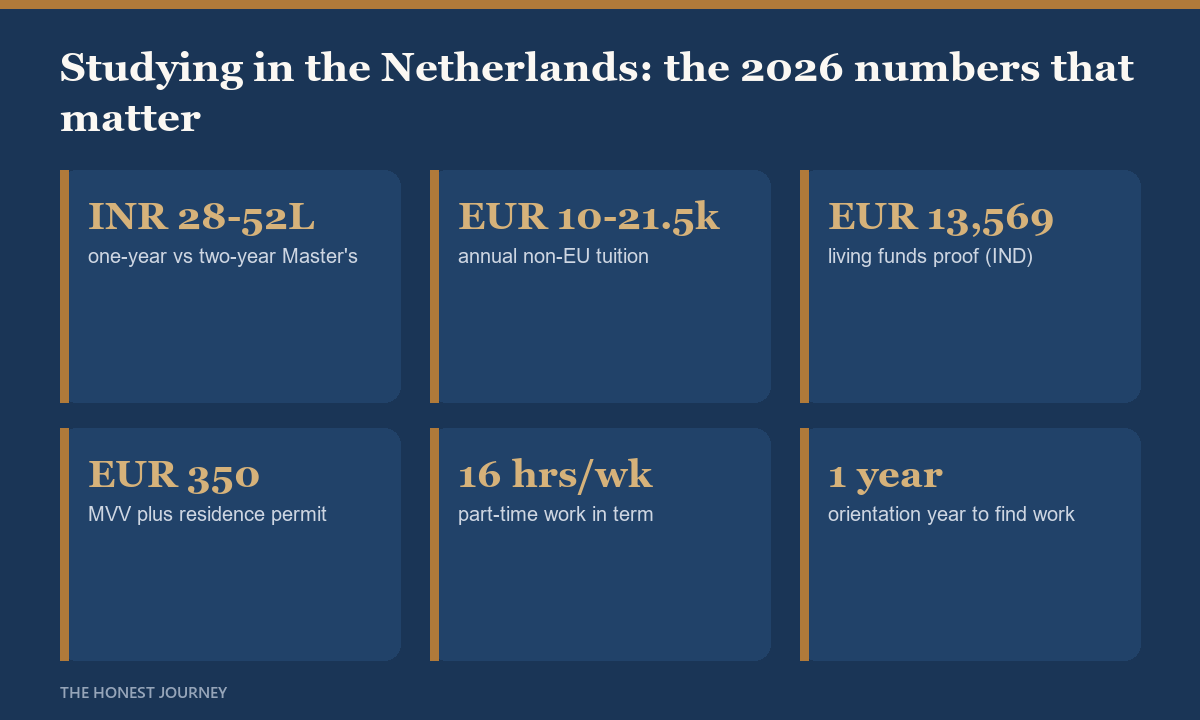
Short answer. The all-in cost of studying in the Netherlands for Indian students in 2026 runs roughly ₹28 lakh for a one-year taught Master’s to ₹52 lakh for a two-year technical Master’s.
Unlike Germany, Dutch public universities do charge non-EU tuition, typically €10,000 to €21,500 a year, and living runs €1,000 to €1,500 a month. The visa needs proof of €13,569 for the year. At ₹92 to the euro, program length is the single biggest swing on your total.
The Netherlands sits in an interesting middle ground that confuses a lot of families. It is not near-free like Germany, but it is not USA-expensive either, and the fact that many Dutch Master’s take only one year changes the whole calculation. When a parent asks me “is Holland cheap or costly?” the honest answer is: it depends almost entirely on whether your program is one year or two. The cost of studying in the Netherlands for Indian students is really a question about program length first, and city second.
This post walks through Dutch tuition for non-EU students, the proof-of-funds figure the visa needs, living costs by city, the one-year versus two-year distinction that dominates the total, part-time work and the post-study orientation year, and the honest rupee number in 2026. If you are still mapping the bigger picture, the full guide on studying in the Netherlands for Indian students covers admissions, the visa and timelines end to end.
If cost is the deciding factor across your shortlist, it helps to see where the Netherlands sits against the alternatives: the best country to study abroad for Indian students.
Budgeting for a partner or children? The Netherlands sets a hard income requirement for family reunification, and savings do not count toward it. The dependants page has the numbers.
Tuition: the Netherlands does charge non-EU students
This is the first thing to get straight, because people confuse the Netherlands with Germany. Dutch public universities charge international (non-EEA) students a real tuition fee, and there are no tuition-free Master’s programs for Indian students. What the Netherlands offers instead is strong English-taught programs, a one-year format for many Master’s, and tuition that is still well below the USA, UK or Australia.
| Program type | Annual tuition (non-EU) | Rupees per year (at ₹92 per euro) |
|---|---|---|
| Master’s, social sciences / humanities | €10,000 to €15,000 | ₹9.2 lakh to ₹13.8 lakh |
| Master’s, business / management | €14,000 to €20,000 | ₹12.9 lakh to ₹18.4 lakh |
| Master’s, engineering / technical | €16,000 to €21,500 | ₹14.7 lakh to ₹19.8 lakh |
| Bachelor’s (3 years) | €8,000 to €15,000 | ₹7.4 lakh to ₹13.8 lakh |
The universities behind these numbers are genuinely strong. TU Delft, Eindhoven, Wageningen, Amsterdam and Groningen all rank well globally and teach extensively in English. For an Indian student, a Dutch Master’s buys a respected European degree at roughly half the tuition of a comparable UK or Australian program, and often in half the time.
Faz's ruleBefore you compare the Netherlands to anywhere else on cost, find out if your specific Master's is one year or two. A one-year taught Master's and a two-year technical Master's at the same university differ by ₹20 lakh or more in total.
Families compare annual tuition and stop there, then get surprised by the total. In the Netherlands the duration is the real variable. Many business and social-science Master’s finish in twelve months, while technical and research Master’s run two years. Always compute the full-program number, not the per-year one.
Proof of funds: the €13,569 the visa needs
The Netherlands does not use a blocked account like Germany. Instead, the immigration service (IND) sets a minimum living-cost figure you must show, and the university usually handles the residence-permit application on your behalf as part of enrolment.
| Requirement | Amount | Rupees (at ₹92 per euro) |
|---|---|---|
| Proof of living funds (IND, per year) | €13,569 (€1,130.77 per month) | ₹12.5 lakh |
| Entry visa (MVV) + residence permit (VVR) | Roughly €350 total | ₹32,200 |
| Tuition deposit / first instalment | Set by the university | Varies |
The €13,569 figure is a proof requirement, not a fee, and often you show it via bank statements rather than transferring it anywhere. Most universities collect it as evidence during enrolment, and some ask you to transfer the first period of living costs to a Dutch account. A sanctioned Indian education loan letter is accepted as proof. The full breakdown of what counts is in the proof of funds for student visa guide.
Living costs, city by city
Dutch living costs are moderate by Northern European standards, but the housing shortage is real, especially in Amsterdam and Utrecht, where finding a room is often harder than affording it. Smaller university cities are both cheaper and easier for housing.
| City | Rent (room) | Total monthly living | Rupees per month |
|---|---|---|---|
| Amsterdam, Utrecht (expensive) | €700 to €1,000 | €1,300 to €1,600 | ₹1.2 lakh to ₹1.47 lakh |
| Rotterdam, Eindhoven, Delft (mid) | €550 to €750 | €1,050 to €1,350 | ₹96,600 to ₹1.24 lakh |
| Groningen, Maastricht, Enschede (affordable) | €400 to €600 | €850 to €1,150 | ₹78,200 to ₹1.06 lakh |
Groningen and Maastricht are the value picks, both strong university cities with rents well below Amsterdam. The bigger practical issue than price is availability. Dutch student housing is genuinely scarce, so start the housing search the moment you accept an admit, not after the visa. A cheaper room you actually secured beats an expensive one you are still hunting for in September.
Faz's ruleIn the Netherlands, housing is a bigger risk than housing cost. Budget for a room, but plan for the search. Students who leave it late end up in temporary hostels at double the rent for the first two months.
The Dutch housing shortage is not a rumour. Universities in Amsterdam and Utrecht openly warn incoming international students that they cannot guarantee accommodation. The financial hit is not the monthly rent, it is the emergency short-term stay you pay for while you keep looking. Secure housing early and this whole risk disappears.
Part-time work and the orientation year
Indian students in the Netherlands can work up to 16 hours per week during term, or full time during June, July and August. With the Dutch minimum wage now above €14 an hour, term-time work brings in roughly €800 to €900 a month, and a full-time summer can add meaningfully more. The rules and realistic earnings are in part-time work while studying abroad. Note that if you work, Dutch law usually requires you to take out local health insurance, an extra cost worth planning for, covered in the health insurance for study abroad guide.
After graduation, the Netherlands offers the orientation year (zoekjaar), a one-year residence permit to find skilled work, which you can activate any time within three years of graduating. Combined with the 30 percent tax ruling that reduces income tax for eligible skilled migrants, the post-study economics are strong. A one-year Master’s that costs ₹30 lakh, followed by a skilled Dutch salary, is one of the faster payback structures in this whole cluster.
A worked rupee total: one-year taught Master’s in 2026
The cleanest way to make it concrete is a specific case. A one-year taught Master’s in Business or Data Science at a strong public university in a mid-cost city like Rotterdam or Eindhoven, €16,000 tuition, modest part-time work through the year.
| Line item | Euro | Rupees (at ₹92 per euro) |
|---|---|---|
| Tuition (one year) | €16,000 | ₹14.7 lakh |
| Living + rent (12 months) | €14,000 | ₹12.9 lakh |
| Health insurance (if working) | €750 | ₹69,000 |
| MVV + residence permit | €350 | ₹32,200 |
| Round-trip flight | €600 | ₹55,200 |
| Initial settlement (deposit, setup) | €1,300 | ₹1.2 lakh |
| Forex spread + remittance | €400 | ₹36,800 |
| One-year all-in total | €33,400 | ₹30.7 lakh |
A one-year taught Master’s in a mid-cost city lands around ₹28 lakh to ₹32 lakh all-in in 2026. Choose an affordable city like Groningen and it drops toward ₹26 lakh. A two-year technical Master’s at TU Delft or Eindhoven roughly doubles the tuition and living lines, landing at ₹48 lakh to ₹52 lakh. The duration of your specific program is the dominant driver, then the city, then tuition band. Forex is small per transfer but consistent, so understand the A2 form and LRS rules for sending money abroad and pick an efficient route. The best forex card for students post covers the options.
Faz's ruleA one-year Dutch Master's at ₹30 lakh is one of the best value bets in Europe, because you pay for twelve months of living, not twenty-four, and you start earning a year sooner. The compressed timeline is worth as much as the moderate tuition.
People undervalue the one-year format. It is not just ₹13 lakh less living cost than a two-year program. It is also a full extra year of a European salary and a year less of loan interest accruing. Two identical students, one on a one-year Dutch Master’s and one on a two-year program elsewhere, can be ₹25 lakh apart by the time both are working.
Funding it: loan and savings
A one-year Dutch Master’s at roughly ₹30 lakh is often part-funded from savings with a modest loan, while a two-year technical Master’s at ₹50 lakh usually needs a full sanctioned loan. A collateral-free loan comfortably covers the one-year format, and PSU secured loans cover the two-year technical route. Lenders treat Dutch public universities well because tuition and the IND living figure are both clearly documented. See the education loan for the Netherlands guide for lender specifics, and the broader studying abroad from India cost and funding guide and education loan India complete guide for the full picture. It is also worth checking Dutch and EU scholarships, listed in scholarships for Indian students to study abroad, because Holland Scholarship and university grants can meaningfully cut the tuition line.
The honest closing take
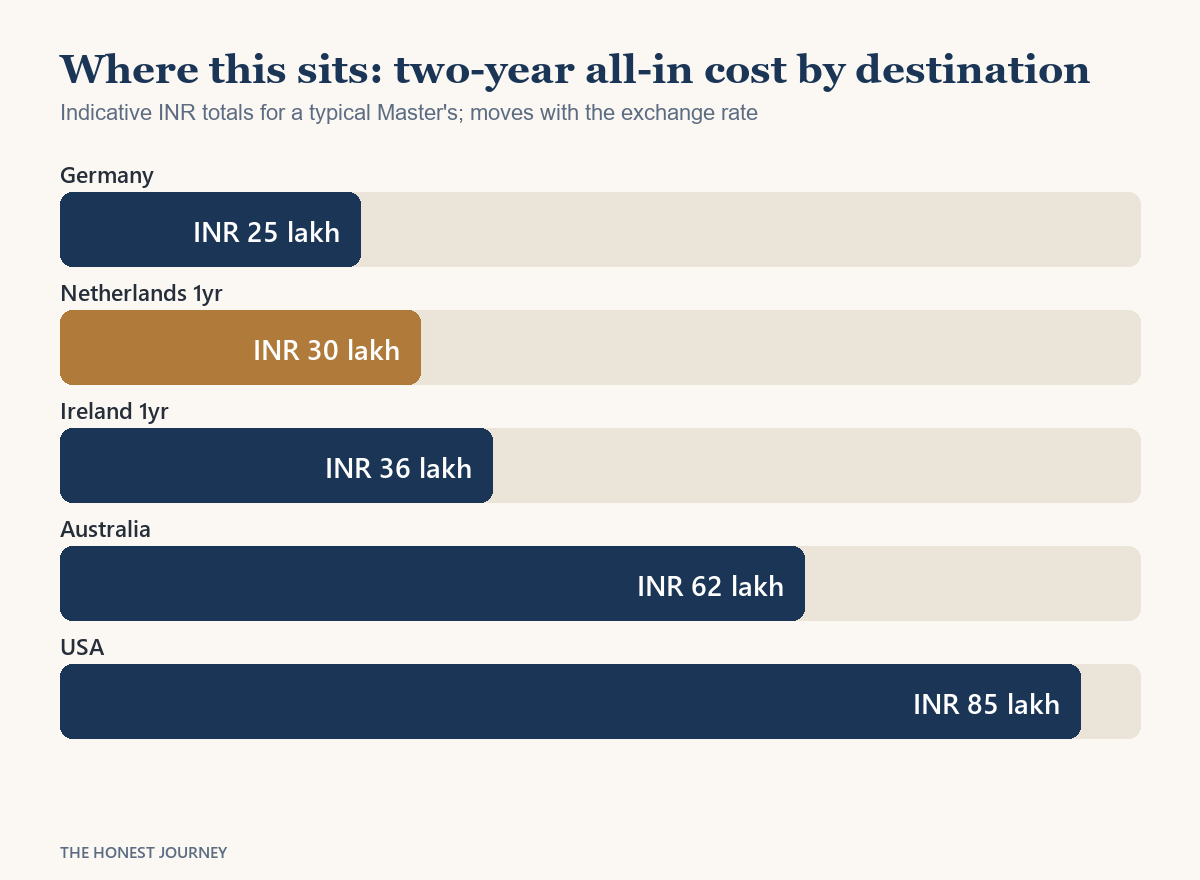
The Netherlands is the quietly sensible option in this cluster. It is not the cheapest, Germany is, and it is not the highest-earning, the USA is, but it combines a respected English-taught European degree, a one-year format for many Master’s, a moderate total cost, and a genuinely good post-study pathway through the orientation year and the 30 percent ruling.
The two honest cautions are program length and housing. Confirm whether your Master’s is one year or two before you compare it to anything, because that single fact moves the total by ₹20 lakh. And start the housing search the day you accept, because the Dutch shortage is the one part of this that money alone does not solve quickly.
For an Indian student who wants Europe, values speed, and does not want either a crore-sized loan or a language barrier, a one-year Dutch Master’s at around ₹30 lakh is one of the most balanced choices on the table in 2026.
Once the budget is clear, the visa is the next hurdle. The MVV, residence permit and funds proof are in the Netherlands student visa guide.
Ready to fund it? Most Indian students route the loan through the PM Vidyalakshmi portal. That guide covers the step by step application and the 13 banks linked to it.
FAQ
How much does it cost to study in the Netherlands from India in 2026?
A one-year taught Master’s in the Netherlands typically costs ₹28 lakh to ₹32 lakh all-in for an Indian student, including tuition, living, visa, flights and forex. A two-year technical Master’s at a university like TU Delft or Eindhoven roughly doubles the tuition and living, landing at ₹48 lakh to ₹52 lakh. Non-EU tuition runs €10,000 to €21,500 a year depending on the field, and the visa requires proof of €13,569 in living funds for the year, which is about ₹12.5 lakh at ₹92 to the euro.
Is tuition free in the Netherlands like in Germany?
No. This is a common confusion. Unlike Germany, Dutch public universities charge international (non-EEA) students real tuition, typically €10,000 to €21,500 a year for a Master’s depending on the field. There are no tuition-free Master’s programs for Indian students in the Netherlands. What the Netherlands offers instead is strong English-taught programs, a one-year format for many Master’s that cuts total cost, and tuition still well below the UK, USA or Australia.
How much money do I need to show for a Netherlands student visa?
The Dutch immigration service (IND) requires proof of living funds of €1,130.77 per month, which is €13,569 for a full year, roughly ₹12.5 lakh at ₹92 to the euro. Unlike Germany, this is not a blocked account. You typically show it through bank statements, and the university usually handles the residence-permit application on your behalf during enrolment. A sanctioned Indian education loan letter is accepted as proof of these funds.
Are Dutch Master’s degrees one year or two years?
It depends on the field. Many taught Master’s in business, humanities and social sciences in the Netherlands are one year (60 ECTS), while technical, engineering and research Master’s are usually two years (120 ECTS). This single fact is the biggest driver of your total cost, because a two-year program roughly doubles both the tuition and living lines. Always confirm your specific program’s length before comparing the Netherlands to other destinations on cost.
Can Indian students work part-time in the Netherlands?
Yes. Indian students can work up to 16 hours per week during term time, or full time during June, July and August. With the Dutch minimum wage now above €14 an hour, term-time work brings in roughly €800 to €900 a month. Note that if you take a part-time job, Dutch law generally requires you to take out local health insurance, which is an additional cost. After graduation, the orientation year (zoekjaar) gives you a one-year permit to find skilled work.
What is the orientation year in the Netherlands?
The orientation year, or zoekjaar, is a one-year residence permit that lets international graduates stay in the Netherlands to look for skilled work, and you can activate it any time within three years of graduating. During this year you have full access to the Dutch labour market. Combined with the 30 percent tax ruling, which reduces income tax for eligible skilled migrants, it makes the post-study economics strong, especially after a low-cost one-year Master’s.
Which is the cheapest Dutch city for Indian students?
The most affordable major university cities are Groningen, Maastricht and Enschede, where a student room runs €400 to €600 a month and total living can stay under €1,150, compared to €1,300 to €1,600 in Amsterdam or Utrecht. Beyond cost, these smaller cities also have a less severe housing shortage, which is often the harder problem in the Netherlands. Choosing Groningen over Amsterdam can save several lakh rupees across a Master’s while making the housing search significantly easier.
Faz · The Honest Journey · 2026