Short answer. For an Indian student, the Netherlands route is unusual: your university, as a recognised sponsor, applies to the IND on your behalf for the entry visa (MVV) and the residence permit (VVR) together, so there is no separate embassy interview.
You mainly supply documents and proof of funds of roughly EUR 14,000 or more for the year (tuition plus living), and the permit fee is paid through the university. At ₹90 per euro that funds floor is about ₹12.6 lakh.
A boy I mentored from my cousin’s college applied to a Dutch university last year and kept asking me which embassy slot he should book and how to prepare for the visa interview. I had to stop him. There is no slot to book and no interview to prepare for. His university did the immigration application for him while he was still revising his statement of purpose. He spent two weeks anxious about a step that, in the Netherlands, simply does not exist for the student. That confusion is the most common thing I see with this country, and it is exactly why this post matters.
This post stays strictly in the visa lane. It is the MVV and VVR mechanics, the funds proof, the fees, the timeline, and the work rules. If you want admissions, programmes and the decision side of the Netherlands, that lives in the study in Netherlands for Indian students guide. Here we only talk about the permit.
If you are married, the Dutch answer is quieter than it looks. There is no ban, but family reunification carries an income floor a student cannot earn. See the Netherlands dependants page.
The core difference: the university applies, not you
Let me put the one fact that changes everything on the table first, because the rest of the post is just unpacking it. In most countries you, the student, run the visa process. You book the appointment, you sit the interview, you submit to an embassy. The Netherlands is built the other way around. Dutch higher-education institutions are registered with the IND (Immigration and Naturalisation Service) as recognised sponsors, and a recognised sponsor applies for your immigration documents directly with the IND. You are not in the queue at a consulate. You are handing your documents to the university’s international office, and they file with the IND for you.
This is the single most reassuring thing about the Dutch route and also the thing that catches people out. Reassuring, because the bureaucracy is fast and predictable when a sponsor runs it. Catching people out, because everything now depends on choosing a recognised-sponsor university early and coordinating with them tightly. The official register of recognised sponsors and the rules that govern them live on ind.nl. Confirm your university is on that list before you do anything else, because the whole smooth process hangs on it.
MVV and VVR: what the two documents actually are
You will see two acronyms over and over, and people mix them up constantly. They are different things, and the IND issues them as a single combined application for most Indian students.
The MVV, the Machtiging tot Voorlopig Verblijf, is the entry visa. It is a sticker placed in your passport that lets you travel to the Netherlands and enter the country legally for a long stay. Indian nationals are MVV-required, so you cannot simply fly in on a tourist basis and convert. The VVR, the residence permit, is the actual card that proves your right to live and study in the Netherlands for the duration of your course. You collect the physical VVR card after you arrive.
Because India is an MVV-required country, your university applies for both at once under the combined procedure often called TEV (Toegang en Verblijf, entry and residence). One application, filed by the sponsor, covers your entry sticker and your residence permit. As of the 2026 intake this combined route is the standard path for Indian degree students, but confirm the current procedure name and any changes on ind.nl, because the IND adjusts terminology and process from time to time.
Faz's rulePick a recognised-sponsor university first. The smooth Dutch process exists only because a sponsor files for you, so the choice of institution is the visa decision.
Everything downstream depends on this. A recognised sponsor can file the combined MVV plus VVR application; a non-sponsor cannot, and then you are back to a slower, manual route. Check the IND sponsor register before you fall in love with a programme, not after.
The fees, in INR
Let me put the cost of the permit on the table. The planning rate through this article is ₹90 per euro. It moves, so re-check it the week the university asks you to transfer. These are the immigration fees only. Tuition and living costs belong on the cost page, not here, except where they form the funds-proof figure.
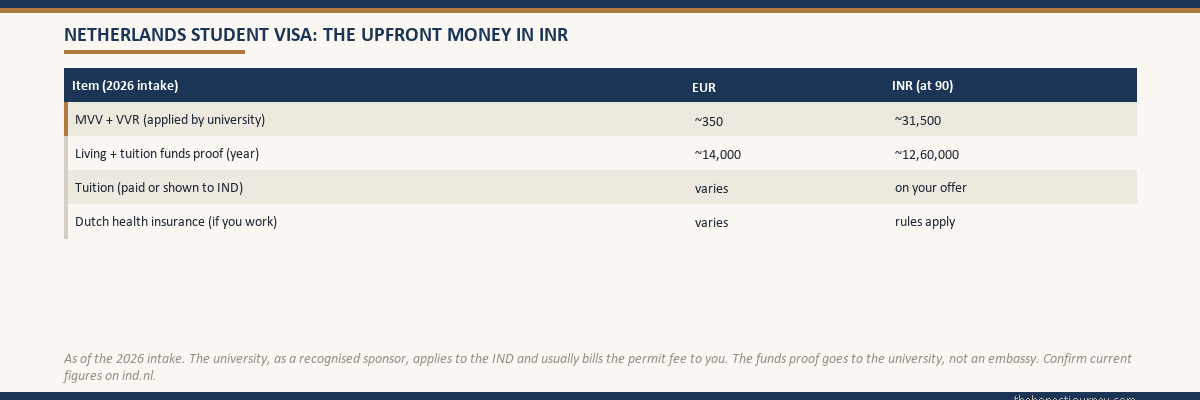
| Item | EUR | INR (at 90) |
|---|---|---|
| IND application fee, combined MVV plus VVR (study) | ~350 | ~31,500 |
| Funds proof shown to university and IND (year) | ~14,000 or more | ~12,60,000 or more |
| Residence document / card production | included in IND fee | included |
| Dutch health insurance (only once you work) | ~1,500/year if applicable | ~1,35,000 if applicable |
The IND application fee is the real out-of-pocket permit cost, and as of the 2026 intake it sits in the region of EUR 350 for the combined study application, around ₹31,500. The crucial detail for the Netherlands is that you usually do not pay the IND directly. You pay the university, and the university settles the immigration fee with the IND as part of filing for you. Confirm the current fee on ind.nl, because the IND revises its fee schedule each year and the published number is the only one that counts.
Proof of funds: the number the university holds for you
Here is where the Dutch route is genuinely different from, say, a blocked account in Germany or a 28-day maintenance balance for the UK. In the Netherlands the funds requirement is set by the institution to meet IND norms, and you typically transfer the money to the university, which holds it and confirms to the IND that you have the means to support yourself. The institution becomes the keeper of your funds proof.
As of the 2026 intake the figure most universities ask for is roughly EUR 14,000 or more for the year, which is intended to cover living costs alongside your tuition. At ₹90 per euro that is about ₹12.6 lakh held or demonstrated for the year. The exact amount varies by university because each institution sets its figure to satisfy the IND norm, so the precise number on your offer letter is the one that binds, not a national average. Nuffic, the Dutch organisation for internationalisation in education, publishes neutral guidance on studying in the Netherlands as an international student on nuffic.nl, and the funds rules sit alongside the immigration rules on ind.nl.
The mechanism matters as much as the number. Because the university holds the proof, your job is to have clean, transferable funds ready on the university’s timeline, not to assemble a bank statement for an embassy. That usually means a tuition-plus-living transfer well before the intake. The synthesised view below shows how the funds-proof figure splits in practice between the tuition portion and the living portion, so you can see what you are actually demonstrating.
Faz's ruleIn the Netherlands your money proof goes to the university, not to a visa officer. Have clean, transferable funds ready on the university's deadline, not the embassy's.
This trips up families who plan around a blocked account or a frozen bank balance. The Dutch model routes the proof through the institution. If your funds are tied up in a way that cannot be transferred to the university on time, the smooth process stalls, so plan the liquidity early.
The step-by-step process, sponsor-led
The sequence is short precisely because the university carries the immigration weight. Here is the honest order of operations for an Indian student at a recognised-sponsor university, as of the 2026 intake.
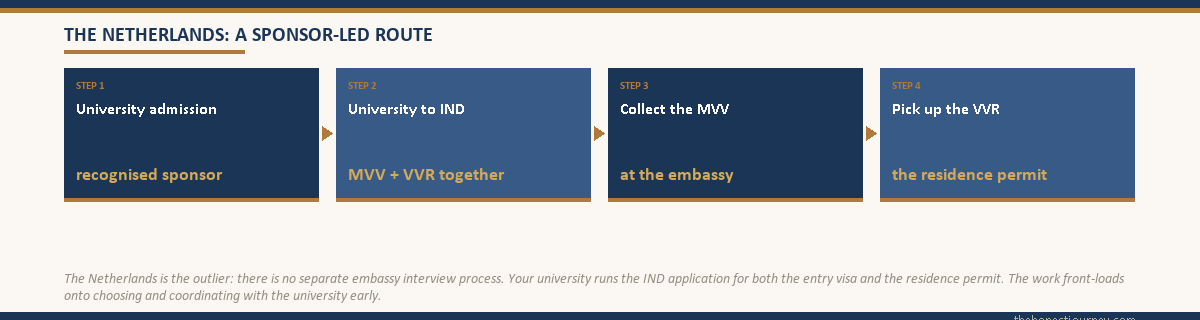
- Secure admission at a recognised-sponsor university. This is the gate. Only a recognised sponsor can file your combined MVV and VVR application with the IND, so confirm sponsor status on ind.nl before you accept.
- Submit your documents and funds to the university. You hand over passport details, photos, your admission paperwork, and the proof of funds the institution requires. The international office assembles the IND application.
- The university applies to the IND for the combined MVV plus VVR. The sponsor files on your behalf and pays the IND fee from what you transferred. You do not visit a consulate to lodge the application.
- Collect your MVV sticker. Once the IND approves, you are notified to collect the MVV entry visa, usually at the Dutch embassy or a designated visa centre in India. This is a collection step, not an interview.
- Travel, register, and pick up your VVR card. You enter on the MVV, complete arrival formalities including municipal registration, and collect the physical VVR residence card the university and IND have arranged.
Notice what is missing from that list: no embassy interview, no separate visa appointment where you argue your case, no consular officer judging your intent the way an F-1 or a study-permit applicant faces. The judgment happens through the sponsor relationship and your documents, not across a counter. The flow below lays out the same five stages visually.
Processing time and what can slow it
The legal decision period for the IND on a sponsor-filed application is up to 90 days, but in practice recognised sponsors usually see decisions well inside that window, often in a few weeks, because the file is complete and filed by a trusted party. As of the 2026 intake, plan on a comfortable buffer of two to three months from when the university has all your documents to when you hold the MVV, and confirm current timelines on ind.nl.
What slows it down is almost always on your side, not the IND’s. Missing or mismatched documents, funds that are not transferred on time, a passport with too little validity left, or accepting your offer too late in the cycle. Because the sponsor cannot file until your file is complete, every day you delay handing over documents is a day added to the back end. The Dutch process is fast when you are fast, and it stalls quietly when you are slow.
Work rules on the student permit
Work is where the Netherlands is stricter than its reputation suggests, so be clear-eyed about it. As a degree student on a residence permit you may work, but it is restricted and it requires your employer to hold a work permit for you, the TWV (Tewerkstellingsvergunning). With that employer-held permit in place, you may work either up to 16 hours per week during the academic term, or full-time during the summer months of June, July and August. You cannot mix the two: it is one or the other in a given period.
Two honest consequences follow. First, because the employer must arrange the TWV, casual jobs are harder to pick up than in countries with an open right to work, since the employer has to be willing to do the paperwork. Second, the moment you start working you become subject to Dutch health insurance rules, and you will typically need to take out Dutch public health insurance rather than relying on your student travel or private policy. That insurance is a real recurring cost, roughly EUR 1,500 a year, about ₹1.35 lakh, that only switches on when you work. Treat part-time work as a supplement to your living costs, never as a way to fund tuition. For the wider picture of how families assemble the full pot across savings and loan, see the studying abroad from India cost and funding guide.
The honest take on the Dutch route
The Netherlands has the smoothest student-immigration process of the major English-taught destinations, and that is not marketing, it is structural. When a recognised sponsor files your combined MVV and VVR with the IND, you skip the interview anxiety, the consular gatekeeping, and the document-by-document scrutiny that defines the F-1 or the study permit. For a well-prepared student at a good university, the permit almost takes care of itself.
The catch is that the smoothness front-loads everything onto one decision: choosing and coordinating with the university early. The whole machine only runs if your institution is a recognised sponsor, if you transfer funds on their deadline, and if your documents are complete when they need them. There is no late scramble that a consular officer might forgive. You either set it up right at the start or you lose the speed advantage entirely. If you are financing the funds proof, the mechanics for the Netherlands specifically sit in the education loan for Netherlands post, and the general rules on demonstrating funds for any student visa are in the proof of funds for a student visa guide. The full rupee budget, which is a separate question from this permit, lives in the cost of studying in Netherlands for Indian students post.
If the Netherlands is your base but the cost gives you pause, two northern neighbours are worth a look. The funds proof and permit routes for the Denmark student visa and the Finland student visa are set out step by step.
FAQ
Who applies for the Netherlands student visa, me or my university?
Your university applies, not you. Dutch higher-education institutions registered with the IND as recognised sponsors file the combined entry visa and residence permit application on your behalf. You supply documents and proof of funds to the university’s international office, and they lodge the application with the IND. This is why there is no separate embassy process for the student. Confirm your university is a recognised sponsor on ind.nl before you accept your offer.
What is the difference between the MVV and the VVR?
The MVV (Machtiging tot Voorlopig Verblijf) is the entry visa sticker placed in your passport that lets you travel to and enter the Netherlands for a long stay. The VVR is the residence permit card that proves your right to live and study there for the course. Because India is an MVV-required country, the university applies for both together in one combined procedure, and you collect the MVV before travel and the VVR card after arrival.
How much money do I need to show for a Netherlands student visa?
As of the 2026 intake, the funds proof is roughly EUR 14,000 or more for the year, about ₹12.6 lakh at ₹90 per euro, covering tuition and living. The exact figure is set by your institution to meet IND norms, so the number on your offer is what binds. You typically transfer this to the university, which holds it and confirms your means to the IND. Confirm the current figure on ind.nl.
What is the application fee for the Netherlands student permit?
As of the 2026 intake the IND application fee for the combined MVV plus VVR study application is in the region of EUR 350, about ₹31,500 at ₹90 per euro. The important detail is that you usually pay the university, not the IND directly, and the university settles the immigration fee as part of filing for you. The IND revises its fee schedule yearly, so confirm the current amount on ind.nl before you transfer.
How long does the Netherlands student visa take to process?
The legal decision period for the IND is up to 90 days, but recognised sponsors usually see decisions well inside that, often within a few weeks, because the file is complete and filed by a trusted party. Plan a buffer of two to three months from when the university has all your documents to holding the MVV. Delays are almost always on the applicant’s side, so submit documents and funds early. Confirm current timelines on ind.nl.
Can I work on a Netherlands student residence permit?
Yes, but it is restricted and your employer must hold a work permit for you, the TWV. With that in place you may work either up to 16 hours per week during term, or full-time during June, July and August, not both in the same period. Because the employer must arrange the permit, casual jobs are harder to find. Treat work as a living-cost supplement, never as a way to fund tuition.
Do I need Dutch health insurance as a student?
If you only study, your student or private travel policy generally suffices. The moment you start working, however, Dutch health insurance rules apply, and you will typically need to take out Dutch public health insurance instead. That is a recurring cost of roughly EUR 1,500 a year, about ₹1.35 lakh at ₹90 per euro, that only switches on once you work. Confirm the current insurance rules on ind.nl, since the obligation is tied to your work status.
How and when do I collect my residence permit in the Netherlands?
You collect the MVV entry sticker in India after the IND approves, usually at the Dutch embassy or a designated visa centre, as a collection step rather than an interview. You then travel on the MVV, complete arrival formalities including municipal registration, and pick up the physical VVR residence card that the university and IND have arranged. The international office tells you exactly when and where. Confirm the current collection process on ind.nl.
Faz · The Honest Journey · 2026