Short answer. If you are married, or you have a child, nobody in the study abroad industry is going to open the conversation with this. They will talk about universities, rankings, intakes and loans, and somewhere in month four you will ask whether your spouse can come with you. The answer you get will be vague, cheerful, and years out of date.
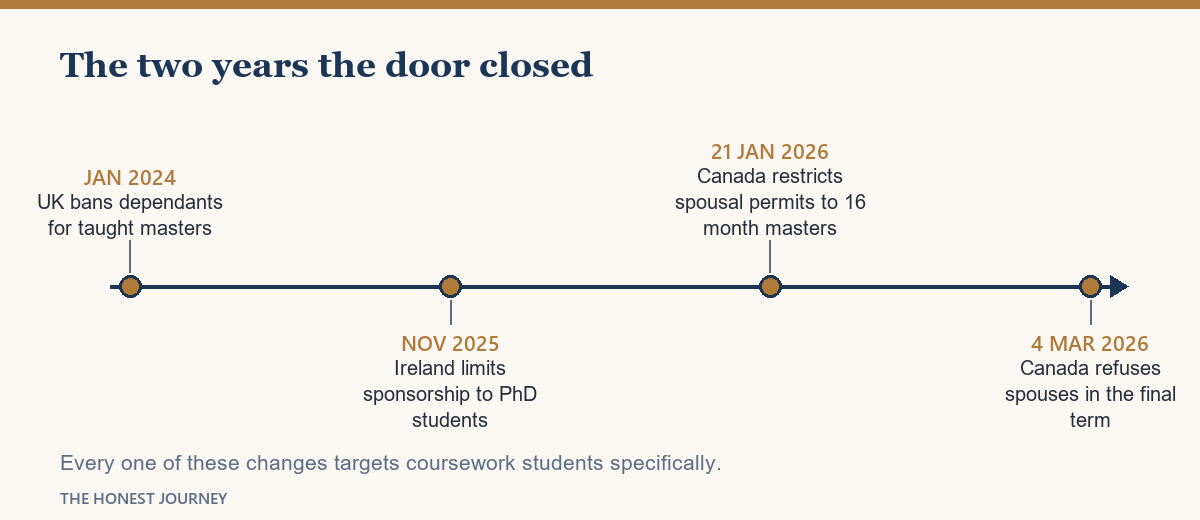
Here is the version nobody leads with. Between January 2024 and March 2026, four of the eight most popular destinations for Indian students quietly rewrote their rules on bringing family. They did not rewrite them evenly. They rewrote them against one specific group: people doing a one year taught master’s. Which is, of course, exactly what most Indian students go abroad to do.
This page is the honest map. Where you can still bring a spouse, where you cannot, where you can bring them but they are legally barred from earning a rupee, and what all of that does to the loan you were planning to take.
The one sentence version
The taught master’s has been repriced. Not in tuition, in family rights.
The UK and Ireland now say no outright to coursework master’s students. The Netherlands says yes and then sets an income floor a student cannot earn. The USA says yes, then bars your spouse from working at all. Canada says yes only if your programme runs 16 months or longer, and says no if you are in your final term. New Zealand, Germany and Australia are the three that still genuinely work, and New Zealand is the most generous of the eight for anyone doing a master’s.
If your household plan involved your partner earning abroad while you studied, that plan survives in three countries out of eight. It is worth knowing that before you pick a country, not after you have paid a deposit.
Faz's rulePick the country before you check the family rules and you may have chosen a country that will not let your family come.
Most people research universities first and dependants last. For a married applicant that order is backwards. The family rule eliminates entire countries, and it eliminates them before ranking, tuition or course content matter at all.
Which country allows a dependent on a student visa
Every rule below carries its effective date, because these move. Canada alone changed twice inside the first quarter of 2026.
| Country | Can a taught master’s student bring a spouse? | Can that spouse work? | Rule in force since |
|---|---|---|---|
| UK | No. Research degrees and doctorates only | Not applicable | 1 January 2024 |
| Ireland | No. PhD sponsors only | Not applicable | November 2025 policy update |
| USA | Yes, on an F-2 visa | No. Zero work rights, no exceptions | Long standing |
| Canada | Only if the master’s runs 16 months or longer | Yes, but refused in the final term | 21 January and 4 March 2026 |
| Australia | Yes | Yes, 48 hours per fortnight | Current |
| Germany | Yes, via family reunion | Yes, full work rights | Current |
| New Zealand | Yes, at master’s level | Yes, open work rights, no cap | Current |
| Netherlands | No income floor of EUR 2,294 a month | Only if an employer files a work permit | Current |
The UK: the hardest no
For courses starting on or after 1 January 2024, only students on a PhD, another doctorate at RQF level 8, or a research based higher degree can bring dependants. Government sponsored students on courses longer than six months also qualify. Everyone else cannot, and that includes the one year MSc, MA and MBA programmes that make up the overwhelming majority of Indian enrolment in the UK.
There is no workaround inside the student route. If you are married and set on the UK, your realistic options are to switch to a research degree, go alone, or pick a different country. We cover the detail, including the transitional cases and the cost comparison, on the UK dependants page, and the wider route rules on the UK student visa guide.
Ireland: PhD only
Ireland is stricter than most people realise. Only PhD students whose doctorate is accredited in Ireland can sponsor immediate family. Under the November 2025 policy update they are treated as Category B sponsors, which is actually generous once you qualify: no waiting period and no minimum income threshold for a spouse, civil partner or children under 18.
The problem is qualifying. Students on Stamp 2, which covers undergraduate, taught master’s and English language programmes, cannot bring family at the study stage at all. And Stamp 3, the dependant permission, does not carry an automatic right to work. A 2025 change did move some spouses onto Stamp 1G with work rights, but that applies to employment permit holders, not to students. The Ireland dependants page covers the PhD sponsor route, and the Ireland student visa guide covers the rest.
The USA: the cruellest yes
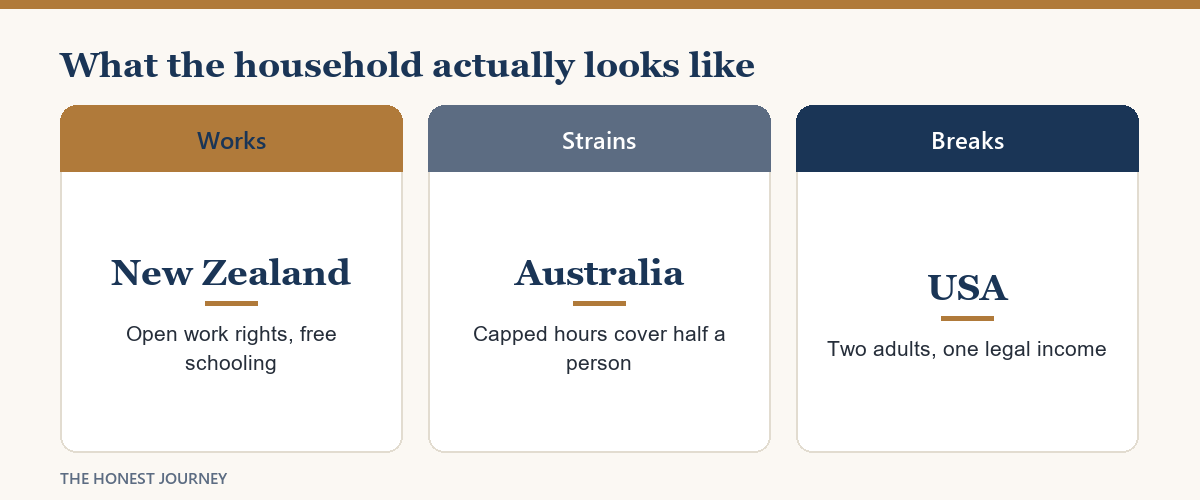
The US will let your spouse come. On an F-2 visa they can live with you for the length of your programme. They simply cannot work. Not part time, not remotely for an Indian employer, not at all. Volunteer work is permitted only where the role is genuinely a volunteer role that nobody is paid to do.
Study is restricted too. An F-2 spouse can only study less than full time, or take avocational and recreational courses. Full time study requires changing status to F-1 in their own right.
And F-2 status is entirely derivative. If you lose F-1 status, your spouse loses status the same day. One household, one immigration risk, no second income to absorb it. The F-2 page works through what that actually looks like month to month.
Canada: the moving target
Canada used to be the easy answer for married applicants. It is not any more, and it changed twice in three months.
Since 21 January 2026, a spousal open work permit is available only if you are enrolled in a master’s programme of at least 16 months, a doctoral programme, or one of the professional degree programmes on the IRCC list. College diplomas, general bachelor’s degrees and undergraduate programmes no longer qualify at all.
Then, effective 4 March 2026, spouses of students in their final academic term are refused, including on renewal applications. IRCC has not defined “final term” as a specific number of days, which is a genuine problem for anyone timing a renewal. If your partner is close to your graduation date, get advice before applying rather than after a refusal.
The practical consequence is that in Canada your choice of programme now decides your household income. A 12 month master’s and a 16 month master’s are no longer the same decision. The Canada spousal work permit page works through the programme length trap in detail.
Australia: workable, with a split
Australia allows a spouse, de facto partner and dependent children to accompany you for the duration of your subclass 500 visa. Work rights exist, but they are split by what you are studying. Dependants can work 48 hours per fortnight, and that cap is lifted entirely only if you are on a master’s by research or a doctorate. Coursework master’s students’ partners stay capped.
Forty eight hours a fortnight is real money, roughly a half time job, but it is not a full second salary. Budget it as a supplement, not a solution. Full detail on the Australia dependants page.
Germany: the outlier that still works
Germany is second only to New Zealand, and by a clear margin over the rest. Under family reunion rules, once the residence permit is granted, your spouse has the right to work. Full rights, not a capped number of hours, not tied to your degree type.
The trade is that the entry conditions are heavier. A blocked account, health insurance for every dependant, adequate housing of roughly 12 square metres per person, and usually A1 level German for the spouse before arrival, with some exceptions. It is more paperwork upfront in exchange for a genuinely working household on the other side. The Germany family reunion page walks through the blocked account maths, and the cost of studying in Germany gives the baseline.
New Zealand: the one nobody shortlists
New Zealand barely appears on Indian shortlists and, on this specific question, it beats every other English speaking option.
If you are studying at level 9 or 10, which covers master’s and doctoral programmes, your partner can get a Partner of a Student Work Visa with open work rights. No hours cap, no employer restriction, and no taught versus research test. At level 7 or 8 the qualification must be on the Green List, which is a real constraint worth checking early.
Children do better here than anywhere else too. School age children of eligible students are treated as domestic students, so state school is free. Australia, by contrast, charges international fees in most states. For a family with two children over two years that difference alone is around ₹22 lakh.
The trade is a small economy, lower salaries than Australia, and narrower post study migration pathways. But for a family that needs two incomes to make this survivable, it is the strongest answer available in English. Full detail on the New Zealand dependants page.
The Netherlands: the quiet no
The Dutch position is the most misleading of the eight, because nothing about it reads as a refusal.
There is no ban. Family reunification exists and is open to students on paper. But it carries a hard minimum income requirement of roughly EUR 2,294 a month, measured as Dutch payroll income. A student restricted to 16 hours of work a week earns EUR 600 to 900. Savings and loan sanctions do not count, because the test measures income rather than funds.
Even for the few who clear it, a dependent partner does not get free labour market access. Their employer must apply for a work permit, which narrows the field sharply at entry level.
The route that works is the three stage one: study alone, take the orientation year with its free labour market access, then reunite once you are earning a graduate salary. Detail on the Netherlands dependants page.
What this does to the money
This is the part that matters for anyone taking a loan, and it moves in two directions at once. Dependants raise what you must prove upfront, and depending on the country they either add a second income or they do not.
| Country | Extra funds you must show | Roughly in INR | Second income possible? |
|---|---|---|---|
| UK (research students only) | £845 per month London, £680 outside, up to 9 months | ₹8.0 lakh London, ₹6.4 lakh outside | Yes, for those who qualify |
| Australia | AUD 10,394 partner, AUD 4,449 per child | ₹5.7 lakh partner, ₹2.4 lakh per child | Partial, 48 hrs per fortnight |
| Germany | Roughly 75% of the EUR 992 monthly rate per dependant | ₹7.5 lakh or so per year, per dependant | Yes, full rights |
| Canada | Standard dependant funds, plus permit fees | Varies by family size | Conditional, 16 month rule |
| USA | Full support for the dependant, no offsetting income | Whole cost of living, doubled | No |
INR figures use mid 2026 rates and will drift. Treat them as sizing, not quotes. The mechanics of showing these funds, including how banks and consulates treat a loan sanction letter, are covered in the proof of funds guide.
The number that catches people is the UK one, and it catches them for the wrong reason. £845 a month for nine months is roughly ₹8 lakh you must show on top of your own funds, and people quote it constantly. But it only applies to the small minority still eligible. If you are doing a taught master’s, the relevant figure is not £845, it is that the door is closed.
The USA figure is the one that deserves more attention than it gets. There is no headline number because the cost is structural. You are funding two adults on one income, or on a loan, in one of the most expensive countries in the world, with a legal bar on the second adult earning anything. That is not a line item. It is a different financial plan entirely.
Faz's ruleA spouse who cannot work is not a neutral addition to the plan. They are a second full cost of living with zero offsetting income.
People model the visa fee and the proof of funds and stop there. The real number is 24 months of rent, food, insurance and transport for a second adult, funded entirely by your loan or your savings. In the US that is frequently 30 to 40 lakh that nobody budgeted for.
Three household scenarios
These are numeric archetypes, not people. The point is the shape of the outcome, not the story.
The one that works: Germany, both earning. One partner does a master’s, tuition near zero at a public university, living costs around EUR 992 a month. The other partner arrives on family reunion, has full work rights, and lands work at EUR 2,200 to 2,800 a month within six months. The household is net positive on the second income alone while the student studies. A loan of ₹15 to 20 lakh covers the blocked account and setup, and it is being serviced from month eight rather than month thirty. This is the case where bringing a spouse improves the finances rather than straining them.
The one that strains: Australia, coursework master’s. Tuition AUD 35,000 to 45,000, living costs for two around AUD 3,200 a month, and a partner capped at 48 hours a fortnight earning maybe AUD 1,800 a month at award rates. That income is real and it materially helps, but it covers roughly half of the second person’s cost, not all of it. The loan needs to be sized as if the partner earns nothing, with their income treated as the buffer that absorbs a bad semester. Households that budget the partner’s income as core rather than buffer are the ones that get into trouble.
The one that breaks: USA, single income, F-2 spouse. A ₹60 lakh loan against a two year master’s, EMI around ₹65,000 once repayment starts, two adults living on one student budget in a high cost metro, no second income legally possible. If the student lands a strong role on OPT the plan recovers. If the job search runs long, or the H-1B lottery does not come through, the household is carrying two people’s costs and a large EMI on an uncertain income. This is the specific combination where an education loan turns into a decade long problem, and it is nearly always avoidable by choosing a different country rather than a different loan.
What married applicants actually do
Four realistic paths, in rough order of how often they work out.
Choose the country around the family rule. The cleanest option and the least popular, because people fall in love with a destination first. If a working spouse is central to your plan, New Zealand, Germany and Australia are where that plan holds, in that order for families with children. Starting from the family rule and working backwards to the university list is unusual, and it produces better outcomes than the reverse.
Go alone, reunite later. Common and underrated. You study for one to two years alone, then bring your partner once you are on a post study work visa, where dependant rules are usually far more generous than on a student visa. It costs you time apart. It saves you the entire second cost of living during the most cash constrained period of the whole journey.
Switch to a research degree. This unlocks the UK and Ireland, and lifts Australia’s work cap. It is a real option only if you genuinely want research. Choosing a PhD to solve a visa problem is a four year answer to a two year question, and it usually goes badly.
Accept the single income, with eyes open. Sometimes the US programme is worth it and the family wants to be together. That is a legitimate choice. It is only a bad one when it is made without pricing the second adult properly. If you take this path, size the loan for two people and assume no partner income for the full duration.
If you are weighing these against each other, two other pages here are directly relevant. The family financial decision guide covers how a household should size a bet like this, and should I study abroad is the wider framework this sits inside. If you are a working professional or applying in your thirties, which is when most people are asking this question, see MBA abroad for working professionals and studying abroad in your 30s.
Frequently asked questions
Can my spouse come with me on a UK student visa in 2026?
Only if you are on a PhD, another doctorate at RQF level 8, or a research based higher degree, or you are government sponsored on a course longer than six months. For courses starting on or after 1 January 2024, taught master’s and undergraduate students cannot bring dependants.
Can an F-2 spouse work in the USA?
No. F-2 holders cannot work under any circumstances, including remote work for an employer outside the US. Genuine volunteer roles are permitted. Full time study requires changing to F-1 status.
Which country is best if I want my spouse to work while I study?
New Zealand and Germany. A New Zealand master’s at level 9 gives your partner open work rights with no cap and no language requirement, and free state schooling for your children. Germany gives full work rights but usually requires A1 German. Australia is third, capping coursework students’ partners at 48 hours per fortnight.
Which country is cheapest for a family?
New Zealand, for a family with school age children, because partner earnings are uncapped and state school is free. For a family of three over a two year master’s it can run roughly ₹45 lakh cheaper than Australia. Germany is comparable for couples without children, since tuition is near zero.
Does bringing a dependant increase my education loan?
Almost always, yes, in two ways. You must show additional funds at the visa stage, and you must fund a second person’s living costs for the whole programme. Whether that is offset depends entirely on whether your spouse can legally work in that country.
Can I bring my spouse to Canada on a study permit?
Only if you are enrolled in a master’s of at least 16 months, a doctoral programme, or a listed professional degree programme, under rules effective 21 January 2026. Since 4 March 2026, spouses of students in their final academic term are refused, including renewals.
Can I bring my family to Ireland as a master’s student?
No. Only PhD students whose doctorate is accredited in Ireland can sponsor immediate family. Students on Stamp 2, which includes taught master’s programmes, are not eligible at the study stage.
The honest closing
This is not a topic where more research produces a clever answer. The rules are the rules, they are published, and four of the eight big destinations have moved against taught master’s students in the last two years.
What research does buy you is order of operations. If your partner coming with you and working is central to the plan, that fact should sit at the top of your country shortlist, above ranking and above tuition. It eliminates the UK and Ireland immediately, makes the US a single income calculation, and makes your Canadian programme length a financial decision rather than an academic one.
And if you find that the country you wanted does not allow it, that is worth knowing now. Going a year alone and reuniting on a post study work visa is a genuinely good plan that a lot of families end up at eventually. Arriving at it deliberately, before the deposit and before the loan, is much better than arriving at it after.