Short answer. The UK Student visa, formerly Tier 4, costs an application fee of GBP 558 from outside the UK, plus the Immigration Health Surcharge at GBP 776 for every year of your visa, which runs a few months past your course, paid upfront in one go.
You also need a CAS from a licensed university and maintenance funds of one year’s tuition plus GBP 1,334 a month for London or GBP 1,023 outside London. Confirm every figure on gov.uk.
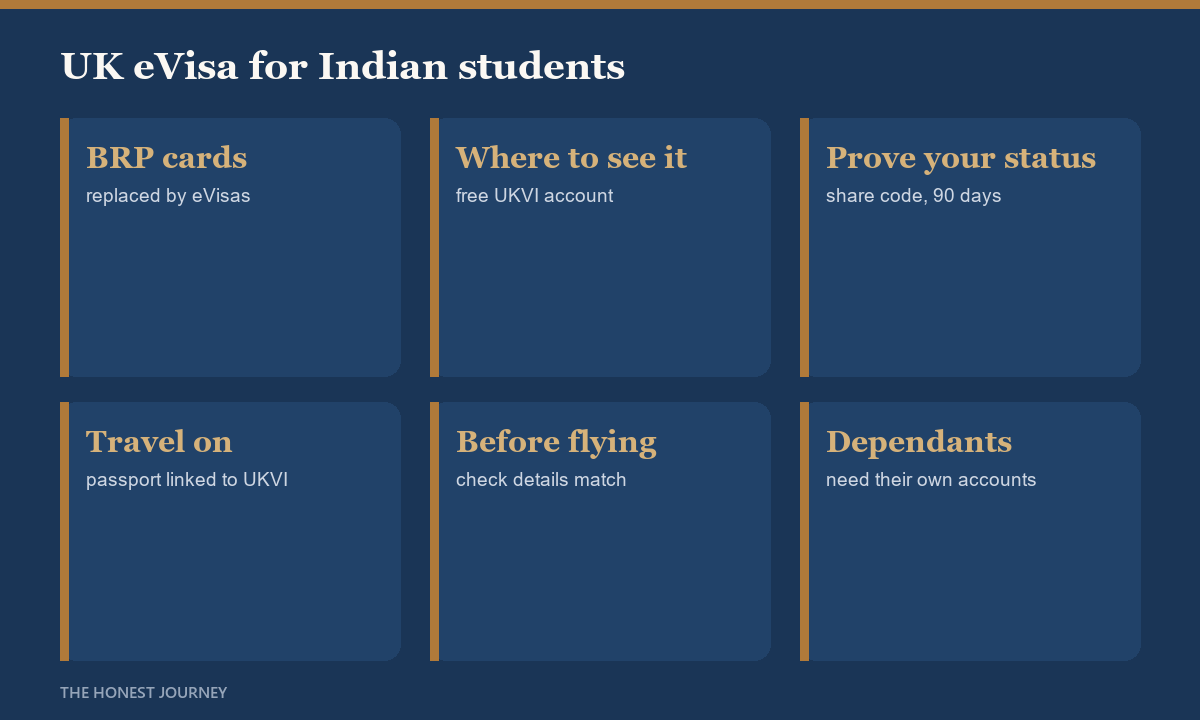
Approved? Your visa now comes as an eVisa, not a BRP. See the UK eVisa guide for Indian students.
To work out the UK maintenance and tuition you must show, use the student visa proof of funds calculator.
Out of education for a year or more? See how UK visa officers assess a study gap.
For the work rights after your course, see the UK Graduate Route 18 month cut.
Got your admit? Next, plan the move with our pre-departure checklist and what to carry to the UK.
A cousin of a friend applied for his UK Student visa last year, sailed through the maintenance maths, then froze when the online form asked him to pay the Immigration Health Surcharge for the full course at once. He had budgeted the visa fee. He had not budgeted a near GBP 1,600 health charge landing in the same week, and it nearly broke his transfer plan. That single line, paid upfront for every year of study, is the one most Indian families do not see coming.
This post stays strictly in the visa lane. It is the Student visa route, the fee, the surcharge, the maintenance rule and the steps, nothing else. If you want admissions, universities and the wider decision side of Britain, that lives in the study in UK for Indian students guide. For the full rupee budget of tuition and living, see the cost of studying in UK for Indian students post. Here we only talk visa.
What the UK Student visa actually is
The route most Indian degree students use is simply called the Student visa. It replaced the old Tier 4 (General) name a few years ago, so if an agent or an old blog still says Tier 4, they mean the same thing. It lets you come to the UK to study a course at a licensed student sponsor, usually a university, and it is the standard path for a Bachelor’s, a Master’s or a PhD.
The whole route hangs on one document: the Confirmation of Acceptance for Studies, or CAS. This is a reference number your university issues once you have a firm offer and have usually paid a tuition deposit. Without a CAS from a licensed sponsor, there is no visa application to make. Everything else, the fee, the surcharge, the funds proof, comes after the CAS, and the official starting point for the rules is the Student visa page on gov.uk.
The fees, in INR
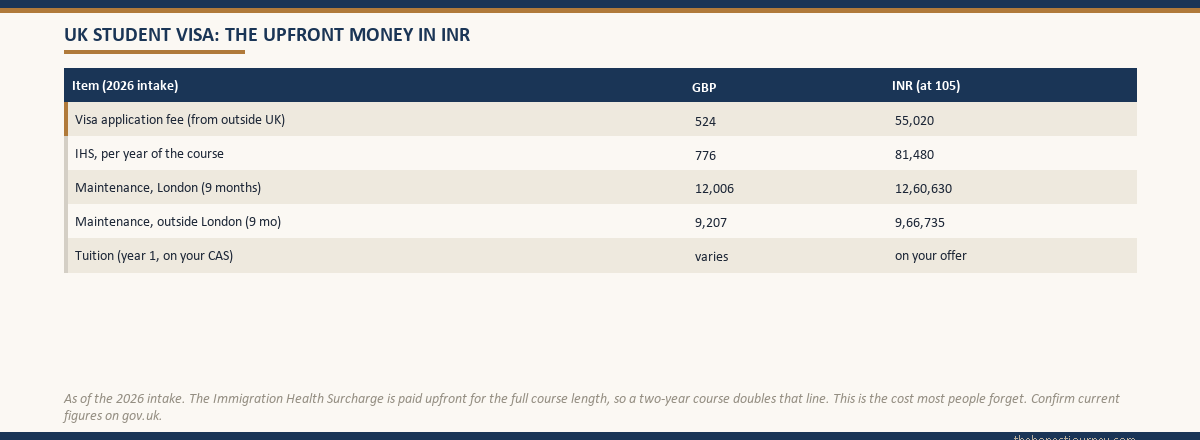
Let me put the money on the table first, because the rest of the post just unpacks these rows. The planning rate through this article is ₹105 per GBP. It moves, so re-check it the week you pay. Every figure here is the 2026-intake number as I write, so confirm the current amount on gov.uk before you transfer anything.
| Visa cost | GBP | INR (at 105) |
|---|---|---|
| Student visa application fee (from outside UK) | 558 | ~58,600 |
| Immigration Health Surcharge, per year of visa | 776 | ~81,500 |
| IHS for a one-year Master’s (17 month visa) | 1,164 | ~1,22,200 |
| IHS for a three-year Bachelor’s (41 month visa) | 2,716 | ~2,85,200 |
| Visa fee plus IHS, one-year course | 1,722 | ~1,80,800 |
So before a single rupee of tuition or rent, the pure visa layer for a one-year Master’s is around ₹1.36 lakh, and for a three-year Bachelor’s it is closer to ₹3 lakh because the surcharge multiplies by the years. This is the part the brochure number never shows you. The fee you can find anywhere. The surcharge, paid for the full course length in one upfront payment inside the online form, is the line that ambushes people.
The Immigration Health Surcharge: the line people miss
The Immigration Health Surcharge, or IHS, is what gives you access to the National Health Service while you study. It is roughly GBP 776 per year of your course, and the part that catches everyone is that you pay the whole thing upfront, for the entire length of your visa, inside the visa application itself. You do not pay it yearly. You pay it once, in full, before the visa is granted.
Run the numbers and you see why it stings. The surcharge is charged on the length of your visa, not your course, and a Student visa runs a month before the course and up to four months after it. So a one-year Master’s gets a visa of about 17 months and pays GBP 1,164, roughly ₹1.22 lakh: one full year plus half a year for the part year of 6 months or less. A three-year undergraduate degree means GBP 2,716, roughly ₹2.85 lakh, due in one go. The UK student visa and IHS calculator works it out from your course dates. The current rate and exactly how it is calculated are on the IHS page at gov.uk, and you should treat that page as the source of truth, not any third-party calculator.
Faz's ruleBudget the IHS as a single upfront lump for the whole visa, not as a yearly cost. For a multi-year degree it is the second biggest pre-departure cheque after first-year tuition.
People plan the GBP 558 fee and forget the surcharge entirely. Then the form asks for GBP 776 for every year of the visa, which is longer than the course, in one payment, and the transfer plan wobbles. Add the full surcharge to your pre-departure cash pile from day one, so it is a tick-box on the day, not a shock.
Maintenance funds: the money you must show
This is the part that decides most refusals, so go slow here. To grant the visa, the Home Office wants proof that you can pay for your course and support yourself. The maintenance requirement has two parts added together.
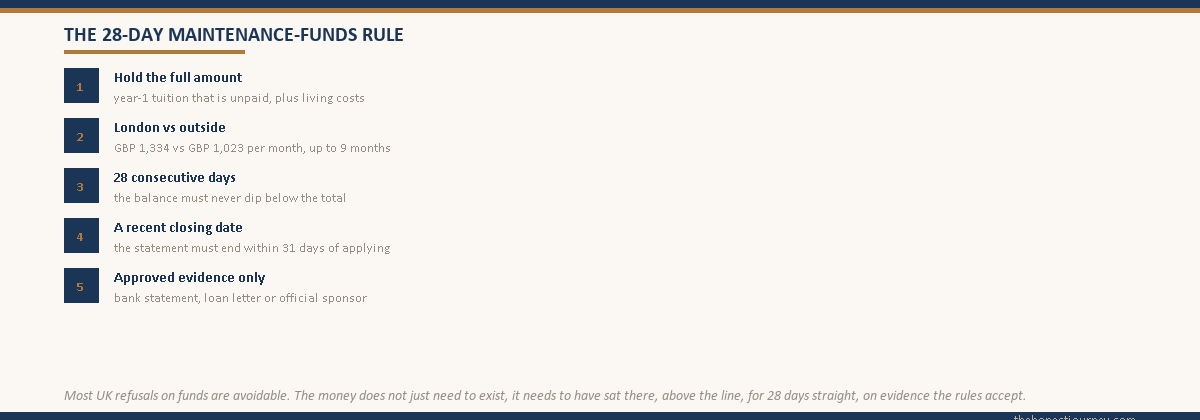
First, your course fees for one year, or the outstanding balance after any deposit you have already paid, which your CAS will state. Second, living costs at a fixed monthly rate set by the Home Office: GBP 1,334 per month if you will be studying in London, or GBP 1,023 per month if you will be studying outside London. You show this living-cost amount for the length of your course up to a maximum of nine months. So the living-cost ceiling is roughly GBP 12,006 for London or GBP 9,207 outside London for a full nine months.
| Maintenance component | London | Outside London |
|---|---|---|
| Living cost per month | GBP 1,334 | GBP 1,023 |
| Months you must show (max) | 9 | 9 |
| Living-cost total (9 months) | ~GBP 12,006 | ~GBP 9,207 |
| Living total in INR (at 105) | ~₹12.6 lakh | ~₹9.67 lakh |
| Plus | one year of course fees (per your CAS) | |
So the total funds you prove is one year’s tuition plus the living ceiling for your location. For a London Master’s with GBP 18,000 tuition, that is roughly GBP 30,000, about ₹31.5 lakh, that must sit in an acceptable account. This is a funds-proof figure, not a spending budget. It is what the Home Office wants to see, and the rules sit on the gov.uk money page for the Student visa.
The 28-day rule that quietly fails people
Here is the rule that catches careful applicants. The maintenance money must have been held in an acceptable account for at least 28 consecutive days, and the closing balance on your most recent statement must be dated within 31 days of your application. The money cannot dip below the required amount on any single day inside that 28-day window. One transfer in, one big payment out, and the clock resets.
The synthesised checklist below lays out the proof rules in the order the Home Office reads them, so you can audit your own statement before you apply.
A few practical things that quietly cause refusals. The account must be in your name or a parent’s name, and if it is a parent’s, you need a birth certificate and a letter of consent. Some account types, like certain investment or shared accounts, are not accepted. Cash that suddenly appears just before the 28 days, without an explainable source, raises a flag. The detail of what counts as acceptable evidence is on the same gov.uk money page, and it is worth reading line by line rather than trusting a summary.
Faz's ruleFreeze the maintenance money 28 clear days before you apply and do not touch the account. The funds proof fails on timing far more often than on amount.
Families get the total right and still get refused because money landed on day 20, or the balance dipped for a single afternoon. Park the full required amount in one acceptable account, leave a cushion above the threshold, and let it sit untouched for a clean 28 days plus a buffer. Boring beats clever here.
The application steps, in order
The route is more procedural than dramatic. Unlike the United States, there is usually no make-or-break interview for most applicants, though a short credibility interview can happen. The sequence runs like this.
- Get your CAS. Accept your offer, pay any required tuition deposit, and the university issues your Confirmation of Acceptance for Studies reference number. This is the gate to the whole application.
- Hold your maintenance funds for 28 days. Get the required amount sitting clean in an acceptable account well before you apply, per the rule above.
- Apply online and pay. Complete the Student visa form on gov.uk, pay the application fee and pay the full Immigration Health Surcharge inside the form.
- Biometrics and documents. Book and attend a biometric appointment at a visa application centre in India, and submit or upload your CAS, financial evidence, passport, English-language proof and any academic documents.
- Decision. Wait for the outcome, then collect your visa or, increasingly, activate your digital immigration status.
Some applicants from India may also need a tuberculosis test certificate from an approved clinic, and certain courses require an ATAS certificate. Both are listed in the document checklist on gov.uk for your specific situation, so check before you book anything.
Processing time and the honest refusal reality
For applications made from outside the UK, the standard service usually returns a decision within about three weeks, though it varies by season and by visa centre load, and priority services can be faster for an extra fee. Apply with a comfortable margin before your course start date, because the biometric appointment and any TB or document follow-up eat into the timeline.
On refusals, the honest picture is calmer than the internet suggests. The UK Student route has a high grant rate for genuine, well-documented applicants, and most refusals are not about your intent being doubted. They are about the funds proof: the 28-day window broken, the wrong account type, a missing consent letter, or a statement dated outside the window. Get the maintenance evidence clean and the rest of the application is mostly careful form-filling. The wider rules and current processing guidance are on gov.uk.
Work rights and the Graduate Route
On a Student visa for a full-time degree at a university, you can usually work up to 20 hours per week during term time, and full-time outside term, during holidays. The 20-hour cap is strict and counted carefully, and breaching it is a serious immigration matter, not a grey area. Some study levels and institution types carry tighter or no work rights, so your CAS and visa conditions are the final word on what you are allowed.
The real prize sits after the course. The Graduate Route lets eligible students stay in the UK for two years after finishing a degree, three years after a PhD, to work or look for work, with no employer sponsorship needed during that window. That post-study runway is a large part of why the British ticket can repay, but it belongs to the decision conversation, not this visa page. If you are weighing Britain against the other big destination, that comparison sits in the UK vs Canada for Indian students post.
The honest take on the UK Student visa
The UK Student visa is one of the more predictable routes for a well-prepared Indian applicant. There is no high-stakes interview lottery, the steps are clear, and the grant rate for clean files is high. What trips families is not the difficulty of the process, it is the size of the upfront cash demand. The visa fee plus the full Immigration Health Surcharge plus first-year tuition plus the maintenance proof all stack into the same few weeks, and the total is larger than the brochure ever suggested.
So plan the visa as a cash-flow problem, not a paperwork problem. Stage the money early, freeze the maintenance funds for a clean 28 days, and treat the surcharge as a single upfront lump from day one. If you are financing the gap, how the loan is sized against these certified numbers sits in the education loan for UK post, and the mechanics of funds proof across destinations are in the proof of funds for student visa guide. Get the cash staged right and the British visa becomes the calm, procedural step it is supposed to be.
If you are married, check this before anything else. Since 1 January 2024 a taught masters cannot bring dependants to the UK. The detail, and what applicants do instead, is on the UK student dependent visa page.
FAQ
How much is the UK Student visa fee in INR for Indian students?
The Student visa application fee from outside the UK is GBP 558 for the 2026 intake, which is roughly ₹58,600 at ₹105 per pound. That is only the application fee, though. You also pay the Immigration Health Surcharge separately inside the same form, which adds far more. Confirm the current fee on gov.uk before you apply, since the Home Office adjusts it from time to time and the rupee rate moves week to week.
What is the Immigration Health Surcharge for a UK student visa?
The Immigration Health Surcharge, or IHS, is GBP 776 per year of your visa and gives you access to the NHS. You pay it upfront for the whole visa length in one payment inside the visa form, not yearly. Because the visa runs past your course, a one-year Master’s is GBP 1,164, about ₹1.22 lakh, while a three-year Bachelor’s is GBP 2,716, about ₹2.85 lakh. This is the cost most families miss, so check the live figure on gov.uk.
How much money do I need to show for a UK student visa?
You must prove one year of course fees, or the balance after any deposit, plus living costs at a fixed monthly rate. That rate is GBP 1,334 per month for London or GBP 1,023 per month outside London, shown for up to nine months. So the living ceiling is about GBP 12,006 for London or GBP 9,207 elsewhere, added to your tuition. For a London Master’s this can total around ₹31 lakh. Confirm the current amounts on gov.uk.
What is the difference in maintenance funds for London versus outside London?
The Home Office sets a higher living-cost rate for study in London because it is more expensive. London applicants must show GBP 1,334 per month, while applicants studying outside London show GBP 1,023 per month, each for a maximum of nine months. That is a difference of roughly GBP 2,800 over the full period, about ₹2.9 lakh. The location is based on where your university campus sits, so check your course location before you calculate your funds.
What is the 28-day rule for UK student visa funds?
The maintenance money must sit in an acceptable account for at least 28 consecutive days, and your closing-balance statement must be dated within 31 days of applying. The balance must never dip below the required amount on any single day in that window. One large withdrawal resets the clock. Most funds-related refusals come from this timing rule, not the amount, so freeze the money early and leave it untouched. The detail is on the gov.uk money page.
What is a CAS for the UK student visa?
A CAS, or Confirmation of Acceptance for Studies, is a reference number your university issues once you have a firm offer and have usually paid a tuition deposit. It confirms the university, a licensed student sponsor, is sponsoring your study. You cannot apply for the Student visa without it, and the details on your CAS must match your application exactly. If anything on it is wrong, get the university to correct it before you apply, not after.
How long does the UK student visa take to process?
For applications from outside the UK, the standard service usually decides within about three weeks, though it varies by season and by how busy your visa application centre is. Priority and super-priority services can return a decision faster for an extra fee. Apply with a comfortable margin before your course start date, because biometrics and any tuberculosis test or document follow-up add time. Check the current processing guidance on gov.uk for your visa centre before you plan flights.
Can I work on a UK student visa and what is the Graduate Route?
On a Student visa for a full-time university degree you can usually work up to 20 hours per week during term and full-time in holidays, but the cap is strict and breaching it is serious. After finishing your degree, the Graduate Route lets eligible students stay two years to work or job-hunt, three years after a PhD, with no employer sponsorship needed. Your CAS and visa conditions confirm your exact work rights, and the current rules are on gov.uk.
Faz · The Honest Journey · 2026