Short answer. The honest USA versus Canada split for Indian students: the US offers the highest earnings and a 36-month STEM OPT runway but a brutal H-1B lottery and a ₹50 lakh-plus loan, while Canada costs less at roughly ₹30 to 45 lakh, pays lower salaries, but gives a clearer PGWP-to-PR pathway.
Choose the US for earning power, Canada for staying.
An old friend’s son agonised over exactly this choice last year. He had an admit to a STEM Master’s in the US and another in Canada. The US program promised the bigger salary and the famous OPT runway. The Canadian one cost less and, his uncle who already lived in Toronto kept saying, would actually let him stay. He chose the US, got through OPT fine, and is now in his second H-1B lottery, holding his breath. His decision was not wrong. But nobody had laid out the trade honestly before he made it.
That trade is what this post is about. The US and Canada are the two destinations most Indian students weigh against each other, and the comparison is almost always done on salary alone, which is the wrong lens. I will compare them honestly on total cost in rupees, the work window after graduation, the PR pathway and its odds, earnings, and the risk you are actually signing up for. The country-specific process detail stays on the dedicated pages.
For the math I use ₹84 per US dollar and ₹61 per Canadian dollar throughout. Rates move, so treat these as the planning frame.
If you are deciding on Canada, these go deeper: the UK vs Canada comparison and the GIC for Canada post.
The core tension in one paragraph
The US is the high-ceiling, high-risk option. Salaries are the highest in this comparison, a STEM degree buys 36 months of OPT work authorisation, and the long-term upside if you stay is enormous. But the loan is the biggest most Indian families take, usually ₹50 lakh-plus for a two-year Master’s, and staying past OPT depends on the H-1B lottery, which is luck, not merit. Capable graduates get sent home every year.
Canada is the lower-ceiling, lower-risk option. Tuition and living cost less, salaries are lower, and the pace is slower. But the Post-Graduation Work Permit feeds directly into permanent residence through Express Entry, so the path to staying is clearer and self-directed rather than left to a lottery. Canada has tightened since 2024, so the odds are not what they were, but the structure still beats the US on predictability of staying.
Total cost in INR, compared honestly
This is the first place the two diverge hard. The US ticket is structurally bigger because most US Master’s are two years and tuition runs high. Canada is meaningfully cheaper across the board.
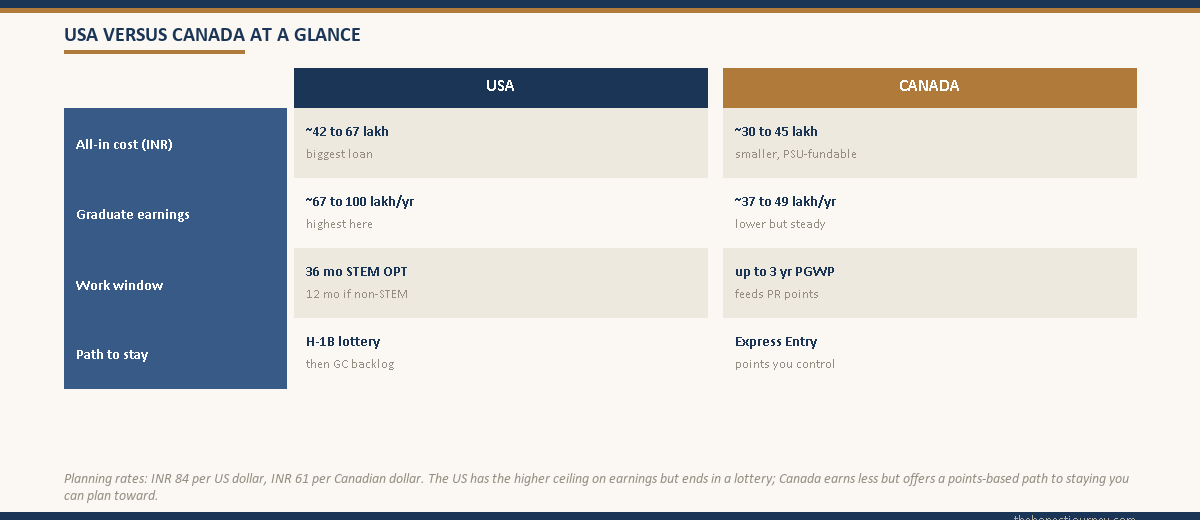
For the US, a two-year Master’s commonly shows a total cost of attendance of USD 50,000 to 80,000 on the Form I-20, which at ₹84 is roughly ₹42 to 67 lakh all-in including living. That is why the US almost always pushes families into collateral-backed or high-rate unsecured loans. The full US numbers are in the cost of studying in USA post.
For Canada, a Master’s runs roughly CAD 20,000 to 35,000 per year in tuition, about ₹12.2 to 21.35 lakh per year at ₹61, with living outside Toronto and Vancouver around CAD 15,000 to 18,000 a year, or ₹9.15 to 10.98 lakh. All-in, a two-year Canadian Master’s commonly lands around ₹30 to 45 lakh, clearly below the US. Canada also requires CAD 20,635 in proof of funds beyond tuition at the visa stage. The detail is in the cost of studying in Canada post.
| Item | USA (2-year Master’s) | Canada (2-year Master’s) |
|---|---|---|
| Tuition (full program) | ~₹32 to 50 lakh | ~₹24 to 42 lakh |
| Living (full program) | ~₹18 to 25 lakh | ~₹18 to 22 lakh |
| Rough all-in total | ~₹42 to 67 lakh | ~₹30 to 45 lakh |
| Typical loan shape | Collateral or high-rate NBFC | Often smaller, more PSU-fundable |
| Proof of funds at visa | Per I-20 cost of attendance | CAD 20,635 (~₹12.59L) |
The cost gap is real and it compounds. A bigger US loan at a higher interest rate means a heavier repayment burden, which is only justified if the US earning runway actually materialises. That is the whole gamble in one sentence: you pay more upfront for a higher ceiling that depends on a lottery. The loan-product side for both sits in the education loan for USA post and the education loan for Canada post.
Faz's ruleThe US ticket is bigger and the loan is heavier, which is only worth it if the longer earning runway actually materialises. You are paying more upfront for a higher ceiling that ends in a lottery.
A ₹60 lakh US loan against a ₹35 lakh Canada loan is a real cash difference, and the US one carries a higher rate. The bigger loan only makes sense if you can repay it on the 36 months of OPT you can count on, not on an H-1B you have not won. Run that number cold.
The work window after you graduate
Both countries give a decent post-study window, but they behave very differently.
In the US, an F-1 graduate gets 12 months of Optional Practical Training. If the degree is a designated STEM field, you can add a 24-month STEM OPT extension, for 36 months total of work authorisation. That three-year window is the engine that repays a large US loan, because US salaries during it are high. But OPT is a temporary work window, not a path to staying. To remain past it you need an H-1B visa, and the H-1B is awarded by lottery. The official student-visa framework is on travel.state.gov. A non-STEM US degree gives only the 12-month OPT, which is a much weaker runway against a large loan.
In Canada, the Post-Graduation Work Permit matches your program length up to three years, so a two-year Master’s typically earns a three-year PGWP. Crucially, the PGWP is designed to build the Canadian work experience that Express Entry rewards. It is not a holding pattern; it is the first step of the PR pathway. The official rules are on canada.ca. Canada narrowed PGWP eligibility for some programs in 2024, so confirm yours still qualifies.
| Work window factor | USA (STEM OPT) | Canada PGWP |
|---|---|---|
| Length after Master’s | 36 months (STEM), 12 (non-STEM) | Up to 3 years |
| Job offer needed to start | No | No |
| Next step to stay | H-1B lottery | Express Entry PR |
| Odds of staying | Luck-based | Points-based |
| Feeds PR directly | No | Yes |
The PR pathway and its odds, said plainly
This is the heart of the decision, and it is where the US and Canada are most different.
In the US, there is no direct study-to-PR pathway. After OPT you need an employer to sponsor an H-1B, which is selected by an annual lottery with far more applicants than visas. Plenty of strong candidates go three years and never get picked. Even if you win the H-1B, the employment-based green card backlog for Indian nationals is famously long, often measured in many years. So the honest US PR picture is two lotteries stacked: first the H-1B draw, then a green card queue that for Indians can stretch beyond a decade. The earning power is real; the staying is genuinely uncertain.
In Canada, PR runs through Express Entry, where your Canadian credential, PGWP work experience, and language scores raise your Comprehensive Ranking System score directly. No employer sponsorship is required for the PR application itself, and Provincial Nominee streams add a second path. Canada has cut immigration targets and raised CRS cut-offs since 2024, so it is harder than it was, but it remains a points system you can plan toward rather than a draw you can only hope for.
The plain version: in the US, staying depends on winning a lottery and then surviving a multi-year green card backlog. In Canada, staying depends mostly on accumulating points the system already rewards. The US has the higher ceiling if everything breaks your way. Canada has the higher probability of actually staying.
Faz's ruleUS permanent residence for an Indian student is two lotteries stacked: the H-1B draw, then a green card backlog that can run beyond a decade. Canada's PR is a points system you can plan toward. Know which kind of bet you are placing.
The US rewards you handsomely while you are on OPT and an H-1B, but the long-term green card queue for Indians is brutal. If your goal is genuinely to settle, Canada’s self-directed Express Entry path gives you far more control. If your goal is to earn hard for a few years and stay flexible, the US makes sense.
Earnings and risk
US graduate salaries, especially in tech, are the highest here. A STEM Master’s graduate commonly starts around USD 80,000 to 120,000, which at ₹84 is roughly ₹67 to 100 lakh a year gross. Canadian graduate salaries commonly start around CAD 60,000 to 80,000, about ₹36.6 to 48.8 lakh gross at ₹61. The US salary advantage is large and real, and it is the main reason the bigger US loan can pencil out.
But salary is not the whole risk picture. The US risk is the lottery cliff: high income for three OPT years, then a coin-flip on whether you can stay at all. The Canada risk is lower income and tightening rules, but with a far smaller chance of being forced out involuntarily after you have invested. The honest framing is to model your loan repayment on the income you are near-certain to earn, the 36 months of US OPT or the three years of Canadian PGWP, and to treat staying long-term as upside in both cases, not the base case.
A worked INR comparison for one candidate
Take one student, a computer-science graduate from India with a STEM admit to both a US state university and a Canadian university. Same person, two roads.
| Factor | USA (2-year STEM MS) | Canada (2-year MS) |
|---|---|---|
| Tuition | USD 60,000 = ~₹50.4L | CAD 50,000 = ~₹30.5L |
| Living | USD 25,000 = ~₹21L | CAD 34,000 = ~₹20.7L |
| All-in study cost | ~₹71.4 lakh | ~₹51.2 lakh |
| Post-study work window | 36 months (STEM OPT) | 3 years (PGWP) |
| Starting salary (gross) | ~₹67 to 100L/yr | ~₹36.6 to 48.8L/yr |
| Path to stay | H-1B lottery, then GC backlog | Express Entry, clearer |
The US road costs about ₹20 lakh more here and carries the bigger loan, but the salary can be roughly double, so on pure OPT-window earning the US repays faster despite the higher ticket. The catch is the lottery at the end. The Canada road is cheaper, earns less, but gives a self-directed PR runway. The numbers favour the US for earning and Canada for staying, which is exactly the trade. Whether the whole thing is worth it for you is the bigger question in the is studying abroad worth it post.
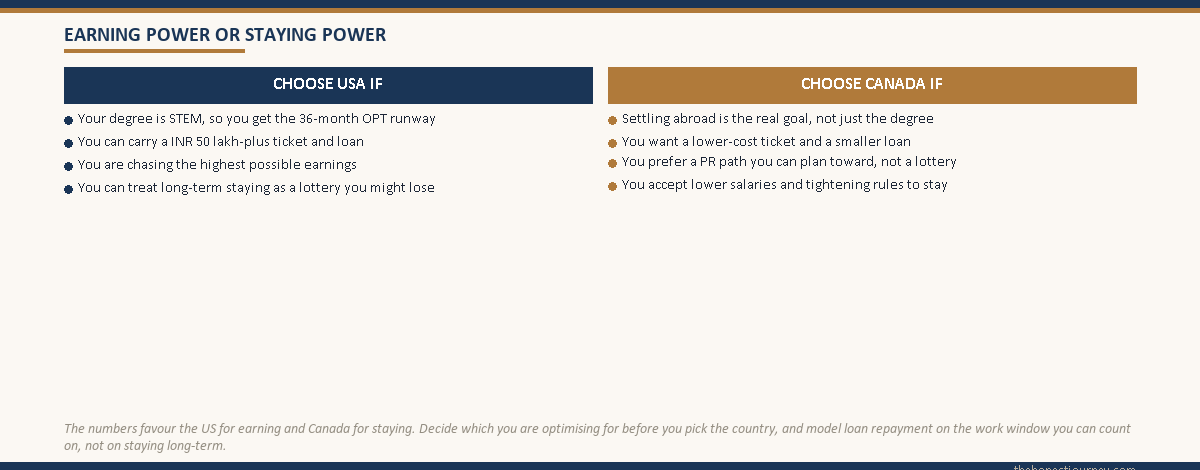
Choose USA if, choose Canada if
It comes down to what you are optimising for and how much risk you can carry.
Choose the US if your degree is STEM so you get the 36-month OPT runway, you can fund or borrow a ₹50 lakh-plus ticket without it crippling the family, you are chasing the highest possible earnings, and you are genuinely comfortable treating long-term staying as a lottery you might lose. The US rewards earning power and risk tolerance.
Choose Canada if settling abroad is the real goal, you want a lower-cost ticket and a smaller loan, you prefer a PR pathway you can plan toward rather than a lottery, and you accept lower salaries and tightening rules in exchange for far more control over whether you stay. Canada rewards patience and a program chosen deliberately for PGWP and PR eligibility.
One honest note for both: a US or Canadian Master’s plus a few years of real foreign work experience is also a strong route back into the Indian job market, and for many students that return is the smartest plan from the start. Do not assume staying abroad is the only good outcome.
The honest take
My friend’s son is not unhappy he chose the US. The salary is real and the experience is real. But he admits he did not weigh the H-1B lottery honestly going in, and now his whole future rests on a draw he cannot control. If staying had been his clear priority, Canada would have been the calmer, more probable bet.
So compress it to one question: are you going to earn hard and stay flexible, or are you going to settle? If it is earning and you can carry the loan and the lottery risk, the US has the higher ceiling. If it is settling, Canada’s PGWP-to-PR runway is the more controllable path despite the lower salary and the recent tightening. Decide your goal first, then pick. And read the process detail on the study in USA page and the study in Canada page before you commit a rupee.
Weighing more than two countries? See also USA vs Australia and Germany vs Canada for Indian students.
FAQ
Is the USA or Canada cheaper for Indian students?
Canada is clearly cheaper. A two-year Canadian Master’s commonly lands around ₹30 to 45 lakh all-in, while a US two-year Master’s runs roughly ₹42 to 67 lakh, often pushing families into collateral-backed or higher-rate loans. The US cost gap compounds because the bigger loan carries a higher interest rate. That extra cost is only justified if the higher US earning runway actually materialises, which depends on the H-1B lottery.
Which has the better post-study work window?
They are close in length but different in purpose. A US STEM degree gives 36 months of OPT, longer than a non-STEM US degree’s 12 months, while Canada’s PGWP runs up to three years for a two-year Master’s. The key difference is what comes next: US OPT leads to the H-1B lottery, while Canada’s PGWP is designed to build the work experience Express Entry rewards. Canada’s window feeds PR directly; the US window does not.
Is it easier to get PR in Canada or the USA?
Canada, by a clear margin. Canada’s Express Entry rewards your study, work experience, and language scores with points you can plan toward, and no employer sponsorship is needed for the PR application. The US has no direct study-to-PR path: you need an H-1B won by lottery, then face an employment-based green card backlog that for Indian nationals can run beyond a decade. The US offers a higher ceiling if everything breaks your way; Canada offers a higher probability of actually staying.
Do US salaries justify the higher cost?
Often yes, but only on the work window you can count on. US STEM graduates commonly start around USD 80,000 to 120,000, roughly ₹67 to 100 lakh gross, against Canadian starts of CAD 60,000 to 80,000, about ₹36.6 to 48.8 lakh gross. That gap lets a bigger US loan repay faster across 36 months of OPT. The catch is the H-1B lottery at the end, so model repayment on the OPT income, not on staying.
What is the H-1B lottery and why does it matter?
The H-1B is the main US work visa after OPT, and it is awarded by an annual lottery with far more applicants than available visas. Many capable graduates go through all three OPT years without being selected and must leave. It matters because it is the single biggest risk in choosing the US: your long-term stay depends on luck, not merit. Even winning leads to a long green card backlog for Indian nationals.
Has Canada become harder for Indian students?
Yes, somewhat. Since 2024 Canada has cut study permit numbers, raised proof of funds to CAD 20,635, narrowed PGWP eligibility for some programs, and lowered PR targets, which pushed Express Entry cut-off scores higher. The PR pathway still exists and remains clearer and more self-directed than the US route, but the odds are tighter than in 2022. Confirm your specific program still qualifies for the PGWP before committing.
Should I choose the US for earnings or Canada for staying?
Decide your goal first, because it settles the country. If you want the highest earnings, your degree is STEM, and you can carry the larger loan and the lottery risk, the US has the higher ceiling. If settling abroad is the actual goal, Canada’s PGWP-to-PR pathway is far more controllable despite lower salaries. Picking the country before deciding whether you are optimising for earning or staying is how students end up in the wrong trade.
Is a US or Canadian degree useful if I return to India?
Very much so. A Master’s from either country plus a few years of genuine foreign work experience is a strong re-entry into the Indian job market, and for many students that return is the smartest plan from the outset. Do not assume staying abroad is the only successful outcome. If returning is plausible for you, the lower-cost Canadian route carries less financial risk, since you are not betting a large US loan on an uncertain long-term stay.
Faz · The Honest Journey · 2026