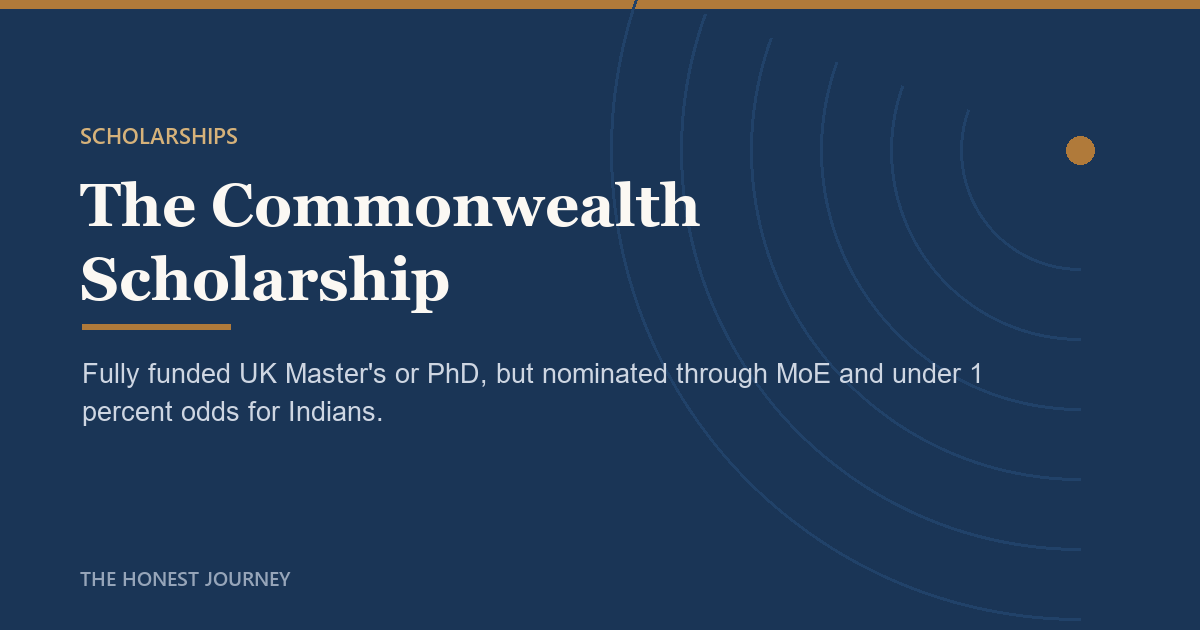
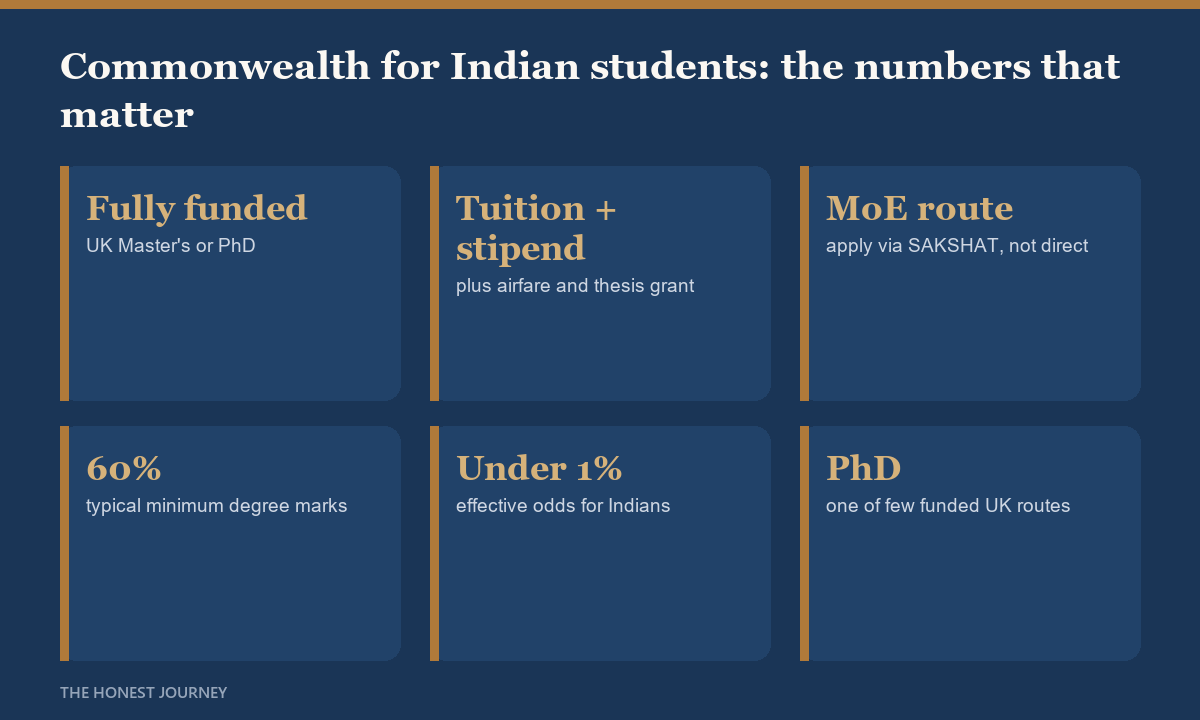
Short answer. The Commonwealth Scholarship is a fully funded UK government award for Master’s and PhD study, covering tuition, a monthly stipend, airfare and a thesis grant. For Indian students it is arguably the hardest major scholarship to win: every application routes through the Ministry of Education’s SAKSHAT portal, and effective odds sit under 1 percent.
The Commonwealth Scholarship is a fully funded UK government award for Master’s and PhD study that covers tuition, a monthly stipend, airfare and a thesis grant, but for Indian students it is arguably the hardest major scholarship to win: India is nominated through the Ministry of Education’s SAKSHAT portal, the number of nominations is tiny relative to the thousands who apply, and the effective odds sit under 1 percent. You cannot apply to it directly. Every Indian application is routed through a national nominating body, and only a small slate is forwarded to the Commonwealth Scholarship Commission in the UK. It rewards a development-focused study plan and a clear intent to return and serve India, far above raw academic marks. It is a wonderful award to win and a poor one to depend on.
Applying to Cambridge? The Gates Cambridge Scholarship closes in December or January.
Another fully funded route to a UK master’s or DPhil: the Rhodes Scholarship and how India’s round works.
Every year a few readers ask me why they never heard back on their Commonwealth application. Usually the honest answer is that they were never nominated at the national stage, which is where most Indian applications quietly end. It is not a rejection you get a letter for. Understanding that two-step gate, nomination first, then the UK selection, is the single most useful thing you can know before you spend weeks on the forms.
This guide explains what Commonwealth covers, the nomination route that trips people up, the brutal odds, and what you must fund yourself. For the wider view, see the scholarships for Indian students to study abroad list, the Chevening scholarship guide, and the study in the UK for Indian students guide.
What the Commonwealth Scholarship covers
Commonwealth Scholarships are funded by the UK Foreign, Commonwealth and Development Office and administered by the Commonwealth Scholarship Commission. For the students who win them, the package is complete.
| What it covers | Detail |
|---|---|
| Tuition fees | Full tuition for the approved Master’s or PhD, paid to the UK university |
| Monthly stipend | A living allowance, set higher for London-based study |
| Airfare | Return economy airfare to and from the UK |
| Thesis and study grants | A thesis grant for research students, plus study travel grants |
| Other allowances | Warm clothing and, where applicable, family allowances for eligible scholars |
Unlike Chevening, Commonwealth funds PhD study as well as Master’s, which makes it one of the few fully funded routes for Indian students pursuing UK doctoral research. The catch is not the coverage. It is the number of people who ever reach the point of being offered it. Understand the wider UK number in the cost of studying in the UK guide to see exactly what the award is standing in for.
Faz's ruleCommonwealth is the rare fully funded route that covers a UK PhD. If you are aiming at doctoral research and fit the development focus, it deserves a serious application, just never a sole one.
For a funded Master’s, Chevening is the more realistic UK target for most people. Commonwealth earns its place mainly when you want a fully funded PhD or your work is squarely development-focused. Match the award to your actual goal instead of applying to both on autopilot.
The nomination route that trips Indian applicants
This is the part that surprises people. For India, you do not apply to the Commonwealth Scholarship Commission directly. You apply through a national nominating body, in practice the Ministry of Education, using both the CSC’s own online system and the MoE’s SAKSHAT portal. The MoE screens applications and forwards only a limited slate of nominations to the UK.
| Stage | What happens |
|---|---|
| 1. Register on both portals | Apply on the CSC Central online system and the MoE SAKSHAT portal within the Indian deadline. |
| 2. National screening | The Ministry of Education evaluates Indian applicants and selects a small number to nominate. |
| 3. Nomination to the UK | Only nominated candidates are forwarded to the Commonwealth Scholarship Commission. |
| 4. UK selection | The CSC makes final selections from the nominations received across all eligible countries. |
The consequence is stark. Thousands of Indians apply, but only a small nominated slate ever reaches UK-level selection. Most Indian applications end at the national screening stage, without an individual rejection letter. Being “not selected” usually means “not nominated,” which is a different and earlier gate than most applicants realise. Confirm the current routes and eligibility with the British Council India and the official Commission guidance.
The honest odds and eligibility
Eligibility itself is not the hard part. You need Indian citizenship and residence, usually a minimum of around 60 percent in your qualifying degree, and for a PhD an appropriate Master’s. The award leans heavily toward development-relevant fields and candidates who will return and apply their learning in India.
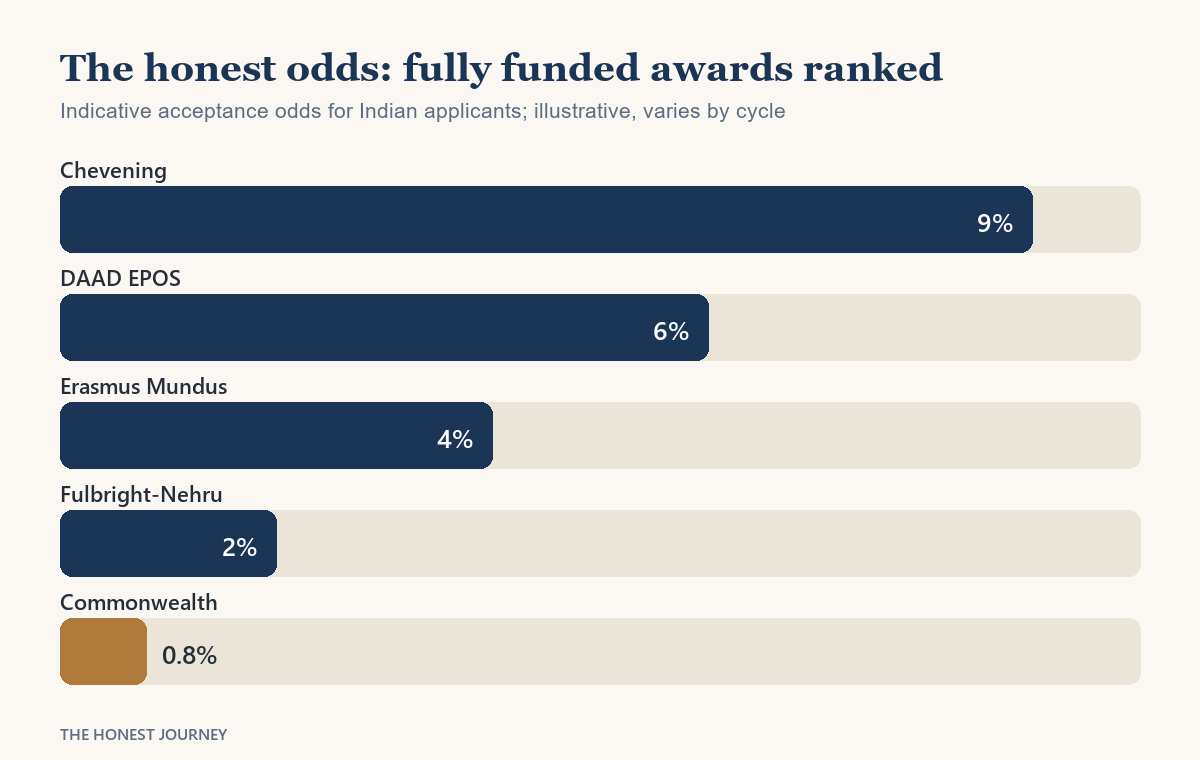
The odds are the hard part. Because India forwards only a small number of nominations against a very large applicant pool, the effective success rate for Indian applicants is under 1 percent, materially tougher than Chevening’s already-competitive sub-10 percent. This is not a reason to skip it if you genuinely fit, especially for a funded PhD. It is a reason never to treat it as anything but a long-shot bonus on top of a real funding plan.
Faz's ruleUnder 1 percent odds means you plan as if you will not get it, then apply anyway if you fit. Both halves of that sentence matter.
Sub-1-percent does not mean do not apply. Someone wins it, and the application cost is a few weeks. It means the plan that actually gets you to the UK, your loan and your admission, must be fully independent of the Commonwealth outcome. Treat a win as a refund on borrowing, not as the ticket itself.
Where it falls short, and what you still fund
The Commonwealth package is complete for winners, so the gaps are entirely about probability and timing.
- The sub-1-percent reality. The overwhelming majority of applicants are never nominated. If this is your only plan, you almost certainly have no plan.
- The nomination gate. National screening removes most applications before UK selection even sees them, and you may never get individual feedback.
- Fixed annual cycle. The Indian deadlines are firm and early. Miss the SAKSHAT window and you wait a full year.
- Development focus. Candidates and fields aligned to development priorities are favoured, so a purely commercial career plan is a weaker fit.
The honest structure is identical to every other elite scholarship: apply if you fit, and fund your UK degree as if the award will not come. A sanctioned education loan for the UK is the standard backstop, and it doubles as clean proof of funds for the student visa. If Commonwealth does come through, you simply borrow less or not at all.
The honest closing take
The Commonwealth Scholarship is a superb award, and for a development-focused candidate aiming at a fully funded UK PhD it is one of the very few routes that exist. If that describes you, apply with real care, understand the two-step nomination process, and give the development framing the weight it deserves.
But be clear-eyed about the numbers. This is a sub-1-percent outcome gated behind national nomination. It is the definition of an award you chase without depending on. Keep your loan and admission fully independent of it, run the honest study-abroad math, and let a Commonwealth win be the best kind of surprise, one that lowers a bill you were already prepared to pay.
FAQ
Can I apply for the Commonwealth Scholarship directly?
No. For India, the Commonwealth Scholarship Commission does not accept direct applications. You must apply through a national nominating body, in practice the Ministry of Education, using both the CSC Central online system and the MoE SAKSHAT portal. The Ministry screens Indian applications and forwards only a small nominated slate to the UK. Most Indian applications end at this national screening stage, which is why many applicants never hear an individual result.
What are the real odds of a Commonwealth Scholarship for Indian students?
Under 1 percent. India forwards only a small number of nominations to the UK against a very large pool of applicants, so the effective success rate is well below one in a hundred, materially harder than Chevening’s sub-10 percent. This does not mean you should not apply if you genuinely fit, particularly for a funded PhD, but it does mean the award must be treated as a long-shot bonus on top of an independent funding plan, never as the plan itself.
Does the Commonwealth Scholarship cover a PhD?
Yes. Unlike Chevening, which funds only a one-year Master’s, the Commonwealth Scholarship funds both Master’s and PhD study in the UK, covering tuition, a monthly stipend, airfare and a thesis grant for research students. This makes it one of the few fully funded routes available to Indian students pursuing UK doctoral research, and it is often the strongest reason to prioritise a Commonwealth application over other UK awards.
What does the Commonwealth Scholarship pay for?
It is fully funded. The package covers full tuition fees paid to the UK university, a monthly living stipend set higher for London, return economy airfare, a thesis grant for research students, study travel grants, and allowances such as warm clothing and, for eligible scholars, family support. For the students who win it, the money question is effectively solved. The difficulty is entirely in being nominated and then selected, not in the generosity of the award.
What is the eligibility for the Commonwealth Scholarship in India?
You must be an Indian citizen and resident in India, hold a qualifying degree usually with a minimum of around 60 percent, and for a PhD hold an appropriate Master’s degree. The award strongly favours development-relevant fields and candidates committed to returning and applying their learning in India. Meeting the basic eligibility is not the hard part; being selected for nomination by the Ministry of Education and then chosen by the UK Commission is where almost all applicants fall away.
When is the Commonwealth Scholarship deadline for Indian applicants?
The cycle is annual with firm, early Indian deadlines managed through the CSC Central system and the MoE SAKSHAT portal, typically in the last quarter of the year for study starting the following autumn, though the exact dates shift each cycle. Because the national nomination stage happens before UK selection, missing the Indian deadline means waiting a full year. Always confirm the current-cycle dates through the British Council India and official Commission channels.
Faz · The Honest Journey · 2026