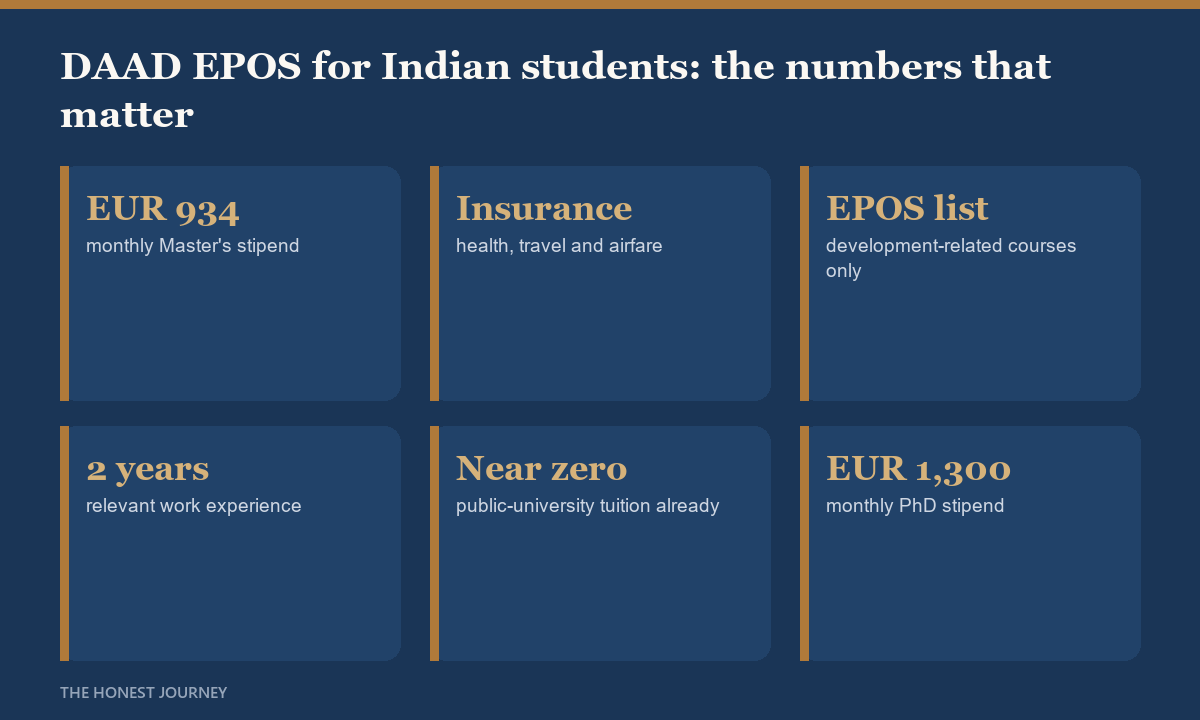
Short answer. The DAAD scholarship is Germany’s main government-funded route for Indian students. Its most relevant track, EPOS, pays a monthly stipend of around EUR 934 for Master’s scholars plus health insurance and travel. It funds a specific list of development-related courses and expects around two years of relevant work experience.
The DAAD scholarship is Germany’s main government-funded route for Indian students, and its most relevant track, EPOS, pays a monthly stipend of around EUR 934 for Master’s scholars plus health insurance, travel and often tuition, but it funds a specific list of development-related courses and expects around two years of relevant work experience, so it is not a general scholarship for every German Master’s. The honest framing most guides miss is this: German public universities already charge little or no tuition, so DAAD is mostly funding your living costs, not rescuing you from a huge fee. For the right development-focused applicant it is excellent. For a general engineering or tech Master’s at a public university, the smarter question is often whether you even need a scholarship, or just a plan for the blocked account.
A reader once asked me why he had been rejected by DAAD for a computer science Master’s in Munich. The answer was simple and no one had told him: his course was not on the EPOS list, and he had no relevant work experience. DAAD is not one scholarship. It is a database of programmes with different rules, and the fully funded EPOS track is narrow and specific. Applying to the wrong one wastes a cycle.
This guide explains what DAAD EPOS actually funds, who qualifies, how it fits Germany’s low-tuition reality, and what you still need to arrange yourself. For the wider picture, start with the scholarships for Indian students to study abroad list and the study in Germany for Indian students guide.
What DAAD EPOS actually covers
DAAD runs many funding lines, but the one people mean by “the DAAD scholarship” for a funded Master’s is usually EPOS, the Development-Related Postgraduate Courses programme. It is genuinely comprehensive for living costs.
| What EPOS covers | Detail |
|---|---|
| Monthly stipend | Around EUR 934 per month for Master’s scholars, and about EUR 1,300 for doctoral candidates |
| Health, accident and liability insurance | Provided or subsidised for the scholarship period |
| Travel allowance | A flat travel or airfare contribution, unless covered by another source |
| Tuition | Where a course does charge fees, DAAD may cover them; many public courses charge little to begin with |
| Extras | Study and research allowances, and in some cases rent or family subsidies |
The EUR 934 monthly stipend is the anchor. In most German cities outside Munich and Frankfurt, that covers rent in shared housing, food, transport and the mandatory health insurance with a little to spare. It is a livable, not luxurious, amount, and it is paid reliably. Understand the full German number in the cost of studying in Germany guide so you can see how far the stipend actually stretches.
Faz's ruleGermany’s public tuition is already near zero. DAAD is mostly paying your rent and food, not saving you from a huge fee. Judge it on that basis.
People compare DAAD to a US scholarship worth tens of thousands in tuition and feel it is small. That is the wrong comparison. In Germany the fee was never the problem. The living cost and the blocked account were. DAAD solves exactly those, which is genuinely valuable, just not in the way a US award is.
Who is eligible for DAAD EPOS
EPOS is targeted, and the targeting is the point. It funds professionals from developing and emerging economies to study development-relevant subjects and take that knowledge home.
| Requirement | The honest reading |
|---|---|
| A relevant Bachelor’s degree | Normally a four-year degree in a related subject, with above-average results. |
| Around two years of work experience | Relevant professional experience after your Bachelor’s. This is central, not optional, for EPOS. |
| An EPOS-listed course | You must apply to a course on the official EPOS list. A general Master’s not on the list is not EPOS-fundable. |
| Language proficiency | English proficiency, often IELTS around 6.0 or equivalent, for English-taught courses. |
| Development relevance | Your background and goals should fit the development focus of the programme. |
The two filters that catch Indian applicants are the course list and the work experience. If your target Master’s is not on the EPOS list, EPOS cannot fund it, full stop. And EPOS is built for working professionals in development-adjacent fields, not for fresh graduates heading into a general STEM Master’s. Check the official DAAD India scholarship database to confirm whether your exact course and profile qualify before you invest time in the application.
Deadlines, odds and the German reality
DAAD deadlines vary by course rather than following one national date, and they typically fall in the second half of the year for an intake the following autumn. Because each EPOS course manages its own selection, you apply to the specific programme, and the competition depends on that course rather than a single nationwide quota.
Here is the honest strategic point. For a development-focused professional, DAAD EPOS is one of the best-value awards available and well worth pursuing. But for a typical Indian student targeting a public-university engineering or computer science Master’s, Germany’s near-zero tuition means the real financial hurdle is the blocked account and living costs, not fees. In that case, the practical path is often a modest loan to fund the blocked account and living, rather than a long EPOS application for a course that may not even be on the list.
Faz's ruleCheck the EPOS course list first. If your Master’s is not on it, no essay, no profile and no amount of effort makes you EPOS-eligible.
The single most common DAAD disappointment is a strong applicant applying for a course that was never EPOS-funded in the first place. The programme list is the gate. Spend ten minutes confirming your course is on it before you spend ten days on the application.
Where DAAD falls short, and what you still fund
DAAD EPOS is well-designed for its purpose, but that purpose is narrow. Here is what it does not do.
- It is not for every course. Only EPOS-listed, development-relevant programmes qualify for this track. Most general Master’s do not.
- It expects work experience. Fresh graduates are largely outside EPOS eligibility.
- It does not remove the blocked account up front. Even funded students often need to show a blocked account for the visa before the stipend flows, so you may need bridging funds.
- It is one course’s decision. Selection sits with each programme, so a strong general profile does not guarantee an offer from any specific course.
For most Indian students heading to Germany, the workable plan is a small loan to cover the blocked account and initial living costs, with DAAD or a departmental scholarship as a welcome bonus if it comes through. See the education loan for Germany guide and the specific blocked account funding options, since a sanctioned loan also helps satisfy proof of funds for the student visa.
The honest closing take
DAAD is real, reliable and generous within its lane. For a development-focused professional with a couple of years of relevant work and a place on an EPOS-listed course, it removes the living-cost worry almost entirely and carries genuine prestige. If that is you, pursue it seriously.
For everyone else heading to Germany, keep perspective. The country’s low tuition already does most of the heavy lifting a scholarship would do elsewhere. Your real task is the blocked account and living costs, and those are usually solved more simply with a modest loan than with a scholarship your course may not qualify for. Confirm your EPOS eligibility honestly, and if it is not a fit, fund the blocked account cleanly and move on. Run the honest study-abroad math before you commit either way.
FAQ
How much does the DAAD scholarship pay per month?
The DAAD EPOS scholarship pays a monthly stipend of around EUR 934 for Master’s scholars and about EUR 1,300 for doctoral candidates. On top of the stipend it typically provides health, accident and liability insurance, a travel allowance, and study or research allowances. In most German cities outside the most expensive ones, the Master’s stipend comfortably covers shared accommodation, food, transport and mandatory insurance, making it a livable if not luxurious amount.
Is DAAD only for development-related courses?
The main fully funded Master’s track, EPOS, is specifically for development-related postgraduate courses on an official DAAD list. DAAD does run other funding lines, but if you mean the well-known fully funded Master’s scholarship, it applies only to EPOS-listed programmes. If your target Master’s is not on that list, EPOS cannot fund it, regardless of your profile. Always confirm your exact course is EPOS-listed before applying.
Do I need work experience for the DAAD scholarship?
For the EPOS track, yes. You typically need around two years of relevant professional work experience after your Bachelor’s degree. EPOS is designed for working professionals from developing and emerging economies, not for fresh graduates. This work-experience requirement, combined with the restricted course list, is one of the two main reasons Indian applicants are found ineligible, so check both before you invest in an application.
Does DAAD cover tuition in Germany?
Where a course charges tuition, DAAD may cover it, but the important context is that most German public universities charge little or no tuition to begin with. So DAAD is mostly funding your living costs, insurance and travel rather than rescuing you from a large fee. This is very different from a US or UK scholarship, where tuition is the biggest single number. In Germany, the living cost and the blocked account are the real hurdles DAAD helps with.
What are the DAAD application deadlines for 2026?
DAAD deadlines vary by course rather than following a single national date, and they generally fall in the second half of the year for an intake the following autumn. Because each EPOS programme manages its own selection and timeline, you apply to the specific course and follow its dates. Check the official DAAD India scholarship database for the exact deadline of the programme you are targeting, as these differ meaningfully between courses.
Do I still need a blocked account if I get DAAD?
Often, yes, at least initially. Even funded students may need to demonstrate financial means such as a blocked account for the German student visa before the stipend begins flowing. This means you can need bridging funds even as a scholarship holder. For most Indian students, the practical plan is a modest loan to cover the blocked account and early living costs, treating DAAD as a bonus that eases the ongoing months rather than the thing that clears the visa hurdle up front.
Faz · The Honest Journey · 2026