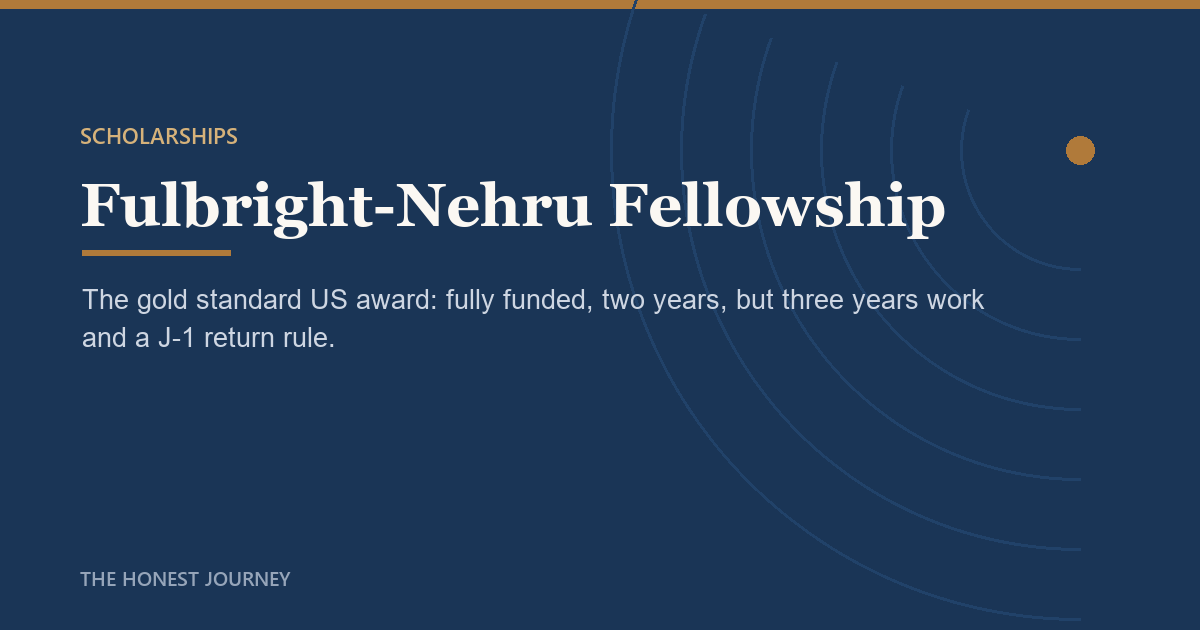
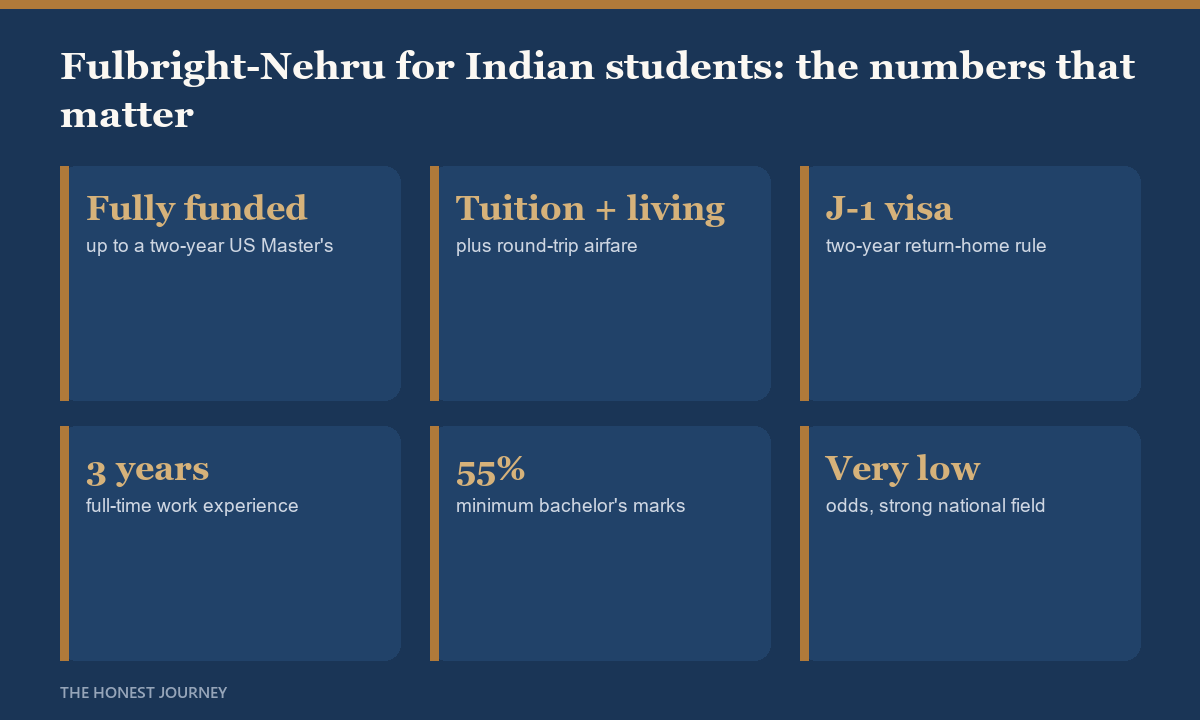
Short answer. The Fulbright-Nehru Master’s Fellowship is the most prestigious fully funded route to a US Master’s for Indian students, covering tuition, living, round-trip airfare, insurance and J-1 visa support for up to two years. It demands at least three years of full-time work experience and a clear plan to return and serve India.
The Fulbright-Nehru Master’s Fellowship is the most prestigious fully funded route to a US Master’s for Indian students: it covers tuition, living, round-trip airfare, insurance and J-1 visa support for up to two years, but it demands at least three years of full-time work experience, a clear plan to return and serve India, and it is one of the hardest awards in the country to win. Unlike Chevening, it funds a two-year US Master’s, not a one-year course. Unlike a loan, it is not something you can simply arrange. It is administered by the United States-India Educational Foundation (USIEF), it is fiercely competitive, and it favours a specific kind of applicant: the mid-career professional with a public-interest purpose, not the fresh graduate chasing a tech salary.
I once spent an hour talking a brilliant final-year student out of pinning her US plans on Fulbright-Nehru. She had the marks. She did not have the three years of work experience, and no essay closes that gap. She applied for it two years later, after real work in public health, and that time the story wrote itself. Fulbright is not a scholarship you win young. It is one you become eligible for.
This guide covers what the fellowship actually pays, the eligibility bar that rules most applicants out, how competitive it really is, the USIEF timeline, and what you still need to fund yourself. For the wider view, see the full list of scholarships for Indian students to study abroad and the guide to studying in the USA for Indian students.
What the Fulbright-Nehru Master’s Fellowship covers
Fulbright-Nehru is genuinely comprehensive. It is funded jointly by the US and Indian governments and is designed to remove the money question entirely for the students it selects, so they can focus on study and on the exchange purpose behind the programme.
| What it covers | Detail |
|---|---|
| Tuition and fees | Funded for the Master’s, coordinated through the host US institution |
| Living stipend | A monthly maintenance allowance set to the cost of the host city |
| Airfare | Round-trip economy travel from your home city in India to the host institution |
| Health cover | Accident and sickness benefit per US Government guidelines |
| Visa category | J-1 exchange visitor visa support, not the F1 student route |
| Duration | Up to two years for a full Master’s degree |
Two details matter more than the rest. First, it funds a full two-year Master’s, which is a real advantage over one-year-only awards. Second, it places you on a J-1 visa, not an F1. The J-1 usually carries a two-year home-country physical presence requirement, meaning you are expected to return to India for two years before you can move to certain US work or immigration statuses. That is a feature of Fulbright, not a bug: the entire programme exists to build people who go home and contribute.
Faz's ruleFulbright puts you on a J-1 with a two-year return rule. If your real plan is to stay and work in the US on OPT, this is the wrong award, no matter how prestigious.
The J-1 home-residency requirement is not a technicality you can wish away. It exists precisely to send you back. If your goal is a US career on an F1 to OPT to H-1B path, a Fulbright fellowship can actively work against you. Choose the award that matches your actual plan.
Who is eligible, and the three-year rule
The eligibility list is short, but two items on it filter out the majority of hopefuls: the work-experience requirement and the return commitment.
| Requirement | The honest reading |
|---|---|
| Indian citizenship, resident in India | Straightforward. |
| Bachelor’s degree, minimum 55 percent | Equivalent to a US bachelor’s from a recognised Indian university. The marks bar is lower than people fear; the rest is not. |
| At least three years of full-time paid work experience | Relevant to the field you propose to study. This is stricter than Chevening’s two years and rules out fresh graduates entirely. |
| Leadership and community commitment | Judged from your record and essays. Fulbright wants people who will lead and give back, not just high scorers. |
| Commitment to return to India | Non-negotiable. It is the purpose of the programme, reinforced by the J-1 visa. |
Notice what is not emphasised: a perfect GPA or a high GRE. Fulbright weighs purpose, experience and a credible plan to use the degree for India far above raw academic numbers. It is closer to a public-service fellowship than a merit scholarship. If you cannot answer “what will you do for India with this” in a specific, believable way, no amount of academic polish saves the application. Check the current cycle on the official USIEF website.
The honest odds and the timeline
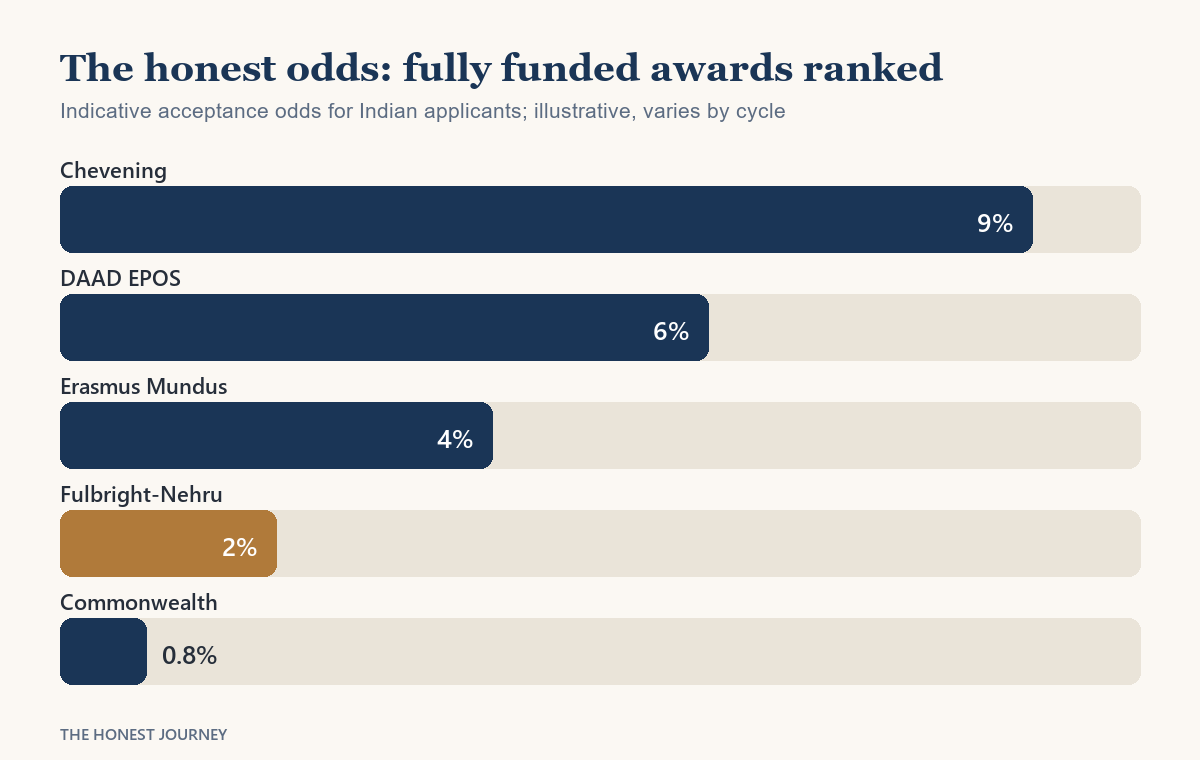
Fulbright-Nehru does not publish a simple acceptance percentage, but the reality is that only a small number of Master’s fellowships are awarded across all of India each year, against a large and highly qualified applicant pool. Assume it is one of the most competitive awards you can apply for, harder than Chevening on the strength-of-field measure, though slightly less brutal than the Commonwealth in raw numbers.
The USIEF cycle runs early. Applications for a given intake typically open in the first half of the year, roughly a year and a bit before you would start, with a mid-year deadline, interviews later in the year, and placement handled by USIEF and the Institute of International Education thereafter. Because USIEF also arranges your university placement in many cases, the timeline is longer and more involved than a standard self-managed application.
Faz's ruleFulbright runs on a year-plus timeline and often places you at the university itself. Start eighteen months out, and do not assume you also control which school you attend.
Applicants used to applying directly to universities are surprised that USIEF plays a large role in placement. That is part of the deal. If attending one specific dream university is non-negotiable for you, understand that Fulbright may not deliver exactly that school, and plan accordingly.
Where it falls short, and what you still fund
Fulbright, when you win it, is close to complete. The real gap is the probability of winning it at all, and the mismatch it can create with a US-career plan.
- The odds. Very few Master’s fellowships are awarded nationally. If Fulbright is your only route to the US, a rejection ends the plan for that year.
- The J-1 return rule. If your goal is to work in the US after graduating, the two-year home-residency requirement is a serious constraint that a loan-funded F1 route does not impose.
- The eligibility wall. Without three years of relevant work experience, you cannot apply at all, whatever your marks.
- Timing. The long cycle means you often cannot pivot quickly to a plan B in the same intake if you are not selected late in the process.
For almost everyone, the practical structure is the same as with any competitive scholarship: apply for Fulbright if you genuinely fit its purpose, and keep a US funding plan alive in parallel. A sanctioned education loan for the USA on an F1 route is the default backstop, and it also serves as proof of funds for the visa. Understand the full rupee number in the cost of studying in the USA guide so you know exactly what you are backstopping.
The honest closing take
Fulbright-Nehru is the gold standard, and it should be treated as such: a genuine honour that transforms the finances and the profile of the few who win it. For a mid-career professional with a public-interest purpose and a real intention to build something in India, there is no better award to aim for.
But it is a purpose fellowship, not a funding mechanism. It wants three years of work, it puts you on a return-oriented J-1, and it selects a handful of people from a strong national field. If that description is you, apply with everything you have. If it is not yet, work for a couple of years, then apply, and in the meantime plan your US degree on a loan that you can execute regardless of any scholarship outcome. Run the honest study-abroad math either way.
FAQ
Is the Fulbright-Nehru Master’s Fellowship fully funded?
Yes. It covers tuition and fees, a monthly living stipend, round-trip economy airfare from your home city in India, accident and sickness benefit, and J-1 visa support, for up to two years of a US Master’s. It is one of the most comprehensive awards available to Indian students. The main catch is not the coverage but the competition and the eligibility bar, particularly the requirement of at least three years of full-time professional work experience.
How much work experience do I need for Fulbright-Nehru?
At least three years of full-time paid professional work experience relevant to your proposed field of study. This is stricter than Chevening’s two-year requirement and it rules out fresh graduates completely, regardless of academic record. Fulbright is designed for mid-career professionals with leadership potential and a clear commitment to returning and contributing to India, so the work experience is central to eligibility, not a minor formality.
What is the J-1 two-year home residency requirement?
Fulbright fellows are placed on a J-1 exchange visitor visa, which usually carries a requirement to return to your home country for two years after the programme before you can move to certain US work or immigration statuses. This is intentional. The Fulbright programme exists to build people who take their US education back to India. If your real goal is to stay and work in the US, this requirement can conflict directly with that plan.
Does Fulbright-Nehru fund a two-year Master’s?
Yes, up to two years, which is a meaningful advantage over one-year-only awards such as Chevening. This makes it well suited to standard two-year US Master’s programmes. USIEF also plays a significant role in arranging university placement for many fellows, so the process is more managed and runs on a longer timeline than a self-directed application where you choose and apply to universities yourself.
How competitive is Fulbright-Nehru for Indian students?
Extremely. Only a small number of Master’s fellowships are awarded across all of India each year, against a large pool of highly qualified applicants. It is best treated as one of the hardest awards in the country to win. Because of that, it should never be your only funding plan. Apply if you genuinely match its purpose and eligibility, but keep a US education loan on an F1 route ready so a rejection does not cost you the intake.
Can I apply for Fulbright-Nehru with an education loan as backup?
Yes, and it is the sensible approach. Keep a sanctioned US education loan and an F1 admission plan moving in parallel with your Fulbright application. If you win the fellowship, you proceed on the J-1 and set the loan aside. If you do not, you still have a funded F1 route for the same intake. Just be clear that the J-1 fellowship and the F1 loan route carry different visa rules and different post-study work implications.
Faz · The Honest Journey · 2026