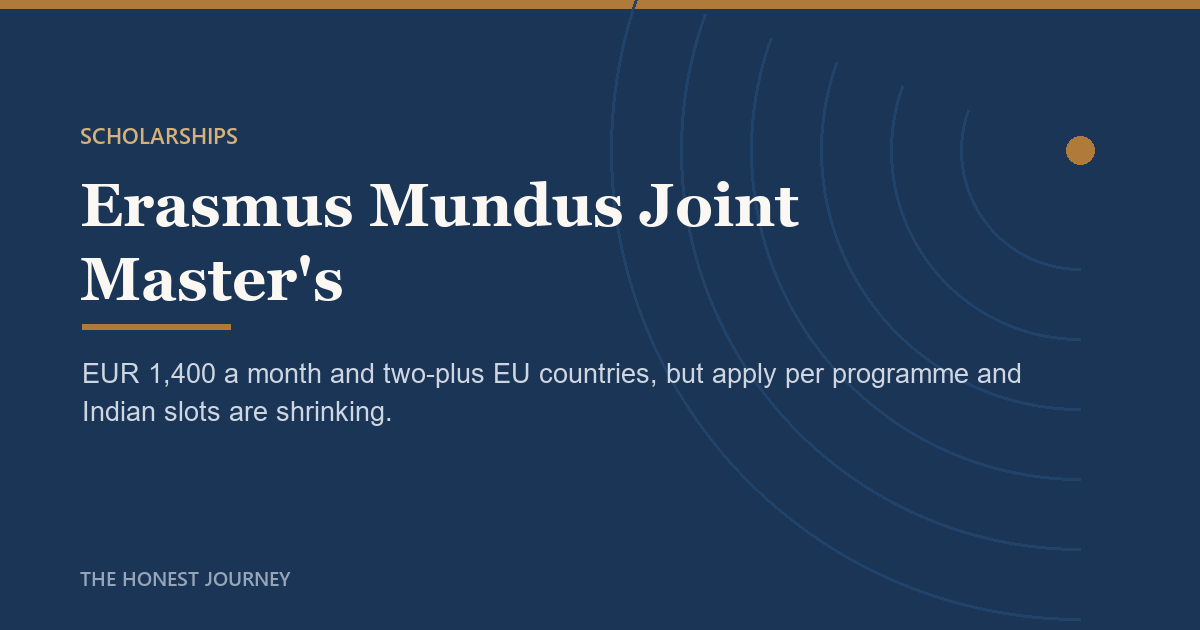
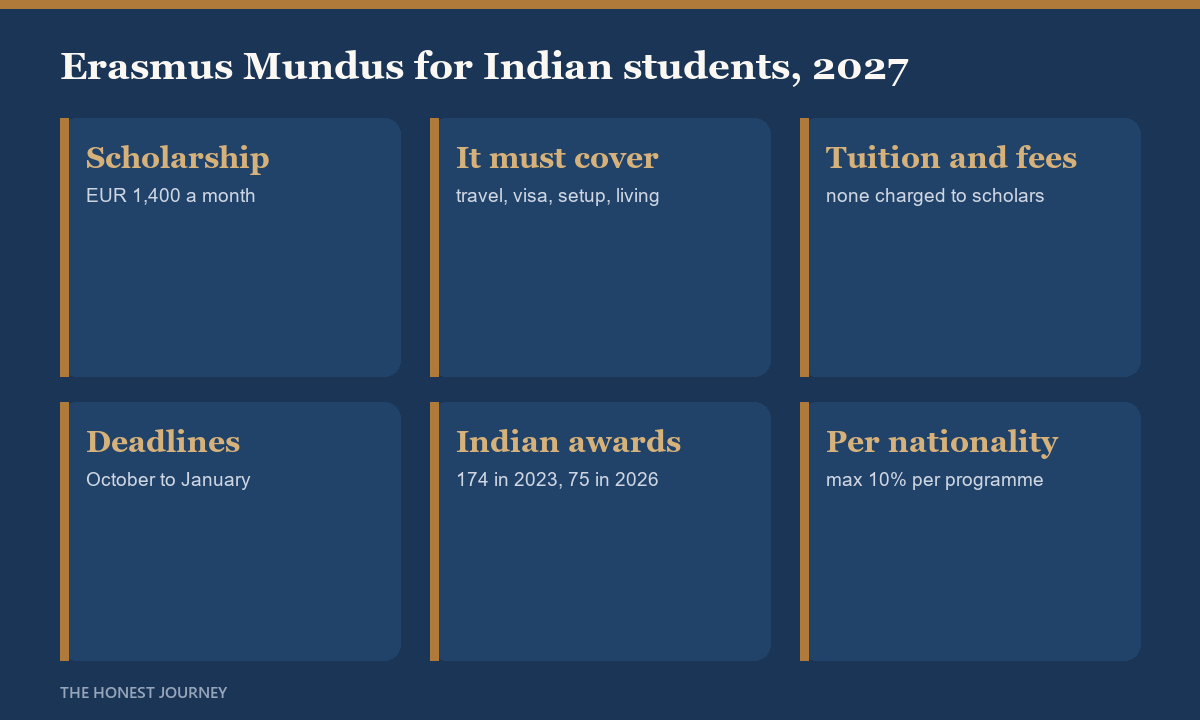
Short answer. An Erasmus Mundus Joint Master’s scholarship pays EUR 1,400 a month for the length of the programme, meant to cover travel, visa, settling in and living costs, and scholars pay no tuition. You apply to each joint programme separately, mostly between October and January for autumn 2027. Indian awards fell from 174 in 2023 to 75 in 2026.
The Erasmus Mundus Joint Master’s scholarship is the European Union’s flagship fully funded award for a master’s, and it is generous: EUR 1,400 a month for up to two years, no tuition or application fees, and a degree taken in at least two European countries. It is also getting harder for Indians to win. India was the largest recipient for years, but Indian awards fell from 174 in 2023 to 146 in 2024, 101 in 2025 and 75 in 2026. And a rule most guides miss caps how many Indians any one programme can fund: each programme can give no more than 10 percent of its scholarships to any one nationality. And there is no single application, only individual Joint Master’s programmes, each with its own consortium, deadline and selection.
Another government scholarship in the EU with a large Indian quota: Stipendium Hungaricum, nominated by UGC.
Applying to several funded programmes? Compare Erasmus Mundus with the Global Korea Scholarship, which gives India dozens of graduate places a year.
A reader once told me he was “applying to Erasmus Mundus” as if it were one form. It is not. He needed to pick specific Joint Master’s programmes that matched his field, apply to each on its own timeline, and rank them. Once he understood that, his application got far sharper, because he stopped writing one generic essay and started matching real programmes to a real plan. That structural understanding is what separates a strong Erasmus Mundus application from a wasted one.
This guide, updated in October 2026 for programmes starting in 2027, covers what the scholarship funds, how the Joint Master’s structure works, the rules that decide your odds, and what you still need to plan. Start with the broader scholarships for Indian students to study abroad list for context.
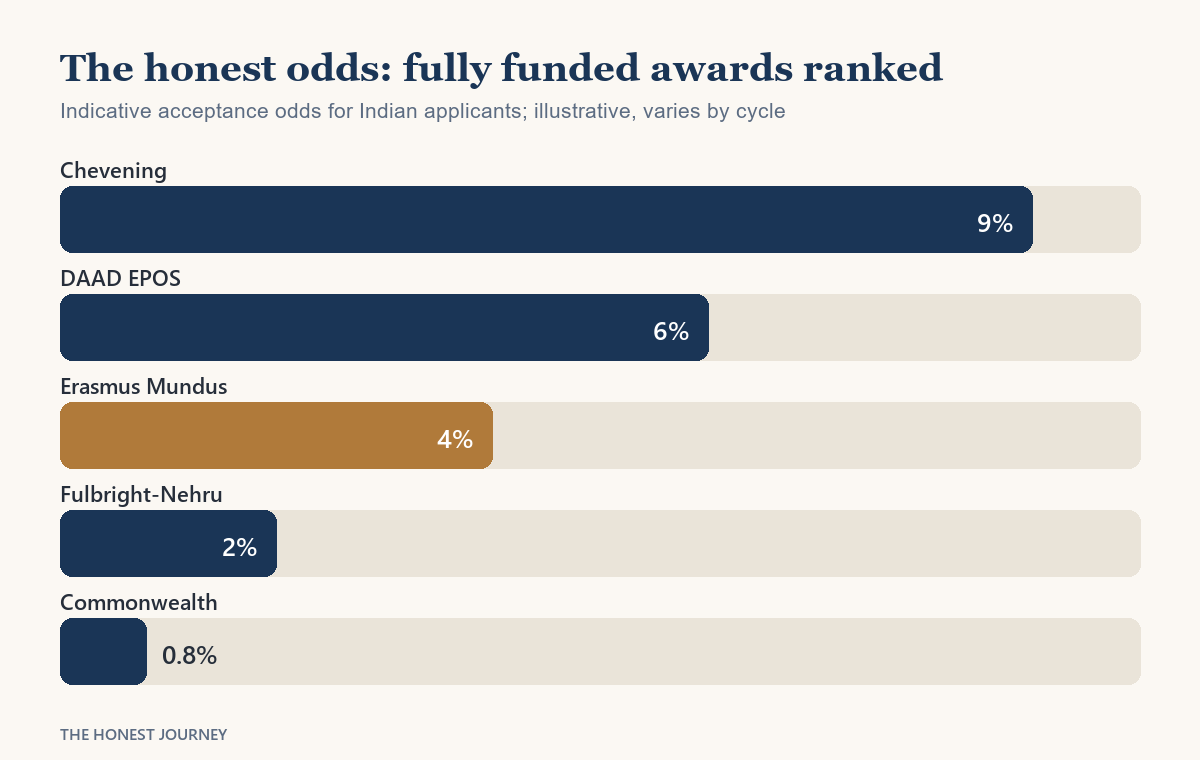
Erasmus Mundus is one of five big awards worth chasing. See how it ranks against the rest in our guide to fully funded scholarships for Indian students, and if the funding does not come through, how an education loan covers the gap.
What Erasmus Mundus actually funds
Erasmus Mundus Joint Master’s programmes are funded by the EU and delivered by consortiums of universities across several European countries. Under the current Erasmus+ rules the scholarship is a single monthly amount, and the same rate applies to students from every country, India included.
| What it covers | Detail |
|---|---|
| Scholarship | EUR 1,400 a month for the full length of the programme, so up to EUR 33,600 over 24 months |
| Tuition and fees | Consortia cannot charge scholarship holders tuition, application fees or other mandatory participation costs |
| Travel, visa and settling in | Paid out of the monthly scholarship; there is no separate travel allowance under the current rules |
| Insurance | The consortium arranges insurance cover for enrolled students |
EUR 1,400 a month is generous in most of the cities these programmes run in, but remember that it now has to cover your flights, visa fees and deposits as well as rent and food. Older guides, including an earlier version of this one, describe a separate travel allowance of up to EUR 3,000 a year; that belonged to the previous programme and no longer applies. Even so, with no tuition to pay, a full scholarship can make a two-year European master’s close to cost-neutral. Compare it against the unfunded numbers in the cost of studying in the Netherlands and cost of studying in France guides to see how much it removes.
Faz's ruleErasmus Mundus is not one scholarship. It is a scholarship attached to specific Joint Master’s programmes. Pick the programmes first, then the funding follows.
Applicants who treat it as a single central award write one vague application and lose. The winners identify three or four Joint Master’s that genuinely fit their field, apply to each on its own deadline, and tailor every application to that consortium. The structure is the strategy.
How the Joint Master’s structure works
The defining feature of Erasmus Mundus is mobility. A Joint Master’s is delivered by a consortium, so you study in at least two different European countries during the degree and graduate with a joint or multiple degree from the partner universities.
| Element | The honest reading |
|---|---|
| Multiple countries | You move between partner universities, often two or three countries across the programme. Exciting, but it means repeated relocation and visa steps. |
| Per-programme application | There is no single portal. You apply to each Joint Master’s directly, each with its own deadline, mostly between October and January. |
| Consortium selection | Each programme selects and ranks its own scholarship recipients. Fit with that specific consortium matters. |
| Limited scholarship slots | A programme can fund at most 50 scholars across its whole EU grant, which covers several intakes, and no more than 10 percent of them can share a nationality. |
The mobility is a genuine strength for the right person: exposure to multiple academic systems, countries and networks in one degree. It is also a practical load, with repeated moves, accommodation searches and, sometimes, additional residence formalities as you cross borders. Browse the official Erasmus Mundus catalogue to find programmes in your field and their individual deadlines.
Eligibility, odds and the shrinking Indian numbers
Eligibility is broad on paper: a bachelor’s degree, or being in the final year of one and graduating before the master’s starts, plus whatever each programme asks for in English and subject background. Two rules matter more than they look. You can hold an Erasmus Mundus Joint Master’s scholarship only once in your life. And each programme must keep geographical balance: no more than 10 percent of all the scholarships it awards may go to candidates of the same nationality. The old rule about having lived in Europe for more than 12 months no longer exists.
On the odds, be realistic. Worldwide, 2,603 students from 137 countries won the scholarship in 2024. India’s share has fallen every year since its 2023 peak: 174 awards in 2023, 146 in 2024, 101 in 2025 and 75 in 2026, though the EU still counts India among the top three countries for the 2026 intake. With at most 50 scholars per programme and a 10 percent cap per nationality, a programme can rarely fund more than a few Indians in total. Even a strong applicant needs several well-matched programmes to have a fair shot.
Faz's ruleIndian Erasmus Mundus awards have been shrinking, not growing. Apply to several matched programmes, and do not read “prestigious EU scholarship” as “good odds.”
The falling Indian numbers, 174 in 2023 to 75 in 2026, tell you the pool is getting tighter. A single application to one dream programme is a lottery ticket. Three or four genuine-fit applications is a strategy. Neither removes the need for a funding backstop.
Where it falls short, and what you still fund
A full Erasmus Mundus award is close to complete, so the gaps are about probability, structure and timing rather than coverage.
- No single application. You must find and apply to individual Joint Master’s programmes, each with its own deadline, mostly between October and January. Missing them is easy if you assume one central form.
- Shrinking Indian slots. Award numbers for Indians are trending down, so odds are tightening, not loosening.
- Relocation load. Studying across two or three countries means repeated moves and, at times, extra visa or residence steps.
- The 10 percent cap. Each programme can give only a small share of its scholarships to Indians, however many strong Indian applicants it receives.
As always, the honest structure is scholarship plus backstop. If your target is a European Master’s, keep a plan that works without the award, whether that is Germany’s low-tuition route, a self-funded EU Master’s, or a modest education loan for abroad studies. A sanctioned loan also helps with proof of funds for the student visa in each country you move to.
The honest closing take
Erasmus Mundus is one of the most rewarding awards a European-bound Indian student can win. The money is generous, the multi-country experience is genuinely unique, and for the right field it is close to unbeatable value. If you understand that it lives inside specific Joint Master’s programmes and apply to several that truly fit, it deserves a serious effort.
Just do not misread it as a single easy scholarship with rising Indian numbers. It is a set of competitive, per-programme awards whose Indian slots have been shrinking. Pick your programmes carefully, respect each deadline, keep a funding backstop that works without the award, and run the honest study-abroad math before you build your year around it.
FAQ
How much does the Erasmus Mundus scholarship pay?
EUR 1,400 a month for the full length of the programme, up to EUR 33,600 over 24 months. The scholarship has to cover travel, visa, settling in and living costs, and consortia cannot charge scholarship holders tuition or application fees. Insurance is arranged by the consortium. There is no longer a separate travel allowance.
Is there one Erasmus Mundus application or many?
Many. There is no single central Erasmus Mundus scholarship application. Instead there are dozens of individual Joint Master’s programmes, each run by a consortium of European universities with its own deadline, selection process and scholarship slots. You apply to each programme directly, mostly between October and January, and each consortium selects and ranks its own funded students. Treating it as one form is the most common and most costly mistake Indian applicants make.
Do Indian students get the full Erasmus Mundus stipend?
Yes. Under the current rules every scholarship holder receives the same EUR 1,400 a month, whatever their nationality. The old distinction between Partner Country and Programme Country students, and the 12 month residence rule that went with it, no longer apply. What does apply is that you can hold the scholarship only once, and each programme can award no more than 10 percent of its scholarships to one nationality.
What does studying in two countries mean for Erasmus Mundus?
Erasmus Mundus Joint Master’s programmes are built around mobility. You study at two or more partner universities in different European countries during the degree, and you graduate with a joint or multiple degree from those institutions. This gives you exposure to several academic systems and networks in one programme, which is a genuine strength. It also means repeated relocation, fresh accommodation searches, and sometimes additional visa or residence steps as you move between countries.
Are Erasmus Mundus scholarships getting harder for Indian students?
Yes. Indian awards have fallen from 174 in 2023 to 146 in 2024, 101 in 2025 and 75 in 2026, according to the EU Delegation to India. Worldwide, around 2,600 students win the scholarship each year, and each programme can give at most 10 percent of its scholarships to one nationality. Applying to several well-matched programmes improves your chances, but a backstop plan remains essential.
When are Erasmus Mundus deadlines for 2027 entry?
Each programme sets its own deadline, and most fall between October 2026 and January 2027 for study starting in autumn 2027. Some programmes close as early as October or November, so if you are reading this in late 2026, check every programme on your list now. The official catalogue links to each programme’s own site and deadline.
Where these figures come from
- European Commission, Erasmus+ Programme Guide, Erasmus Mundus action
- European Commission, Erasmus Mundus Joint Masters scholarships for students
- EU Delegation to India, 75 Indian students awarded, June 2026, and the releases for 2025, 2024, 2023 and 2022
Updated in October 2026 for programmes starting in 2027. Faz, The Honest Journey.