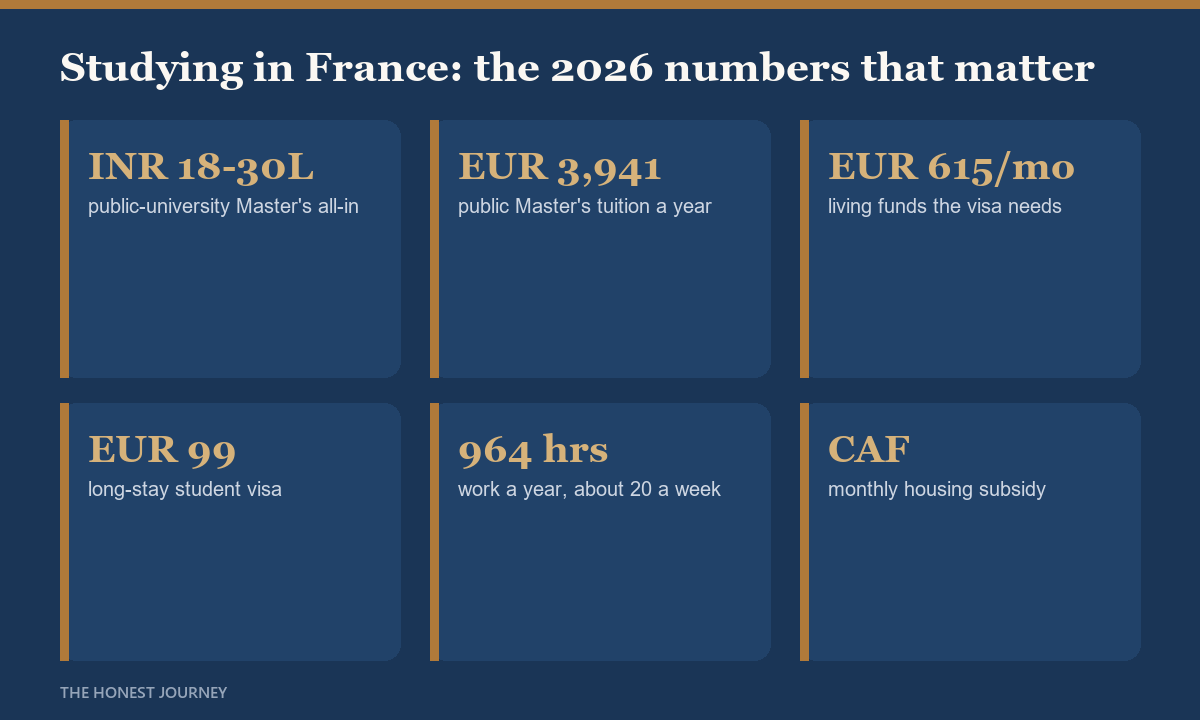
Short answer. The all-in cost of studying in France for Indian students in 2026 runs roughly ₹18 lakh to ₹30 lakh for a two-year public-university Master’s, or ₹45 lakh to ₹90 lakh at a grande école or business school.
Public tuition is heavily subsidised even at the differentiated non-EU rate (about €3,941 a year for a Master’s), so living is the main cost. At ₹92 to the euro, France splits sharply into an affordable public track and a premium private one.
France is the destination where the single most important question is not the city or the program length, but whether you are going public or private. A public university and a grande école in the same city can differ by ₹60 lakh over two years. Every year I see families quote a “France cost” number without saying which track they mean, and the number is meaningless without it. The cost of studying in France for Indian students is really two very different budgets wearing the same flag.
This post walks through the public versus private tuition split, the Campus France and CVEC fees unique to France, living costs in Paris versus the regions, the visa and proof of funds, part-time work and the post-study stay, and the honest rupee total for each track in 2026. If you are still mapping the bigger picture, the full guide on studying in France for Indian students covers admissions, the visa and timelines end to end.
If you are weighing France mainly because it is affordable, it is worth seeing where it ranks overall: the cheapest country to study abroad for Indian students.
The public versus private split: two different budgets
France runs two parallel higher-education systems, and they cost very different amounts. Public universities are state-subsidised, so even the differentiated non-EU tuition is low. Grandes écoles and private business and engineering schools charge market rates that rival the UK or Australia. Your first decision, before anything else, is which track you are on.
| Institution type | Annual tuition | Rupees per year (at ₹92 per euro) |
|---|---|---|
| Public university, Master’s (non-EU rate) | €3,941 | ₹3.6 lakh |
| Public university, Bachelor’s (non-EU rate) | €2,895 | ₹2.7 lakh |
| Grande école / engineering school | €10,000 to €20,000 | ₹9.2 lakh to ₹18.4 lakh |
| Top business school (MSc / MBA) | €20,000 to €45,000 | ₹18.4 lakh to ₹41.4 lakh |
Note that many public universities still charge the lower EU rate (about €243 for a Master’s) or waive the differentiated fee entirely through exemptions, though France is tightening enforcement of the non-EU differentiated rate from the September 2026 intake. Either way, a public Master’s tuition of €3,941 is roughly ₹3.6 lakh a year, a fraction of what a business school like HEC, INSEAD or ESSEC charges. Both are genuinely French degrees, but the price tags live in different universes.
Faz's ruleNever quote a “cost of studying in France” number without first saying public or private. A public Master's at ₹20 lakh all-in and an HEC MSc at ₹75 lakh are both France, and confusing them wrecks your whole budget.
The French public system is one of the best-value routes in the world for an Indian student, and the grande école system is a premium product with premium outcomes. Both are legitimate, but they are different financial decisions with different loan sizes. Decide which one you are actually applying to before you plan the money.
Campus France, CVEC and the fees unique to France
France has a couple of mandatory charges that no other country in this cluster has, and Indian students must budget for both. Neither is large, but the Campus France procedure is a required step, not an optional service.
| Fee | Amount | What it is |
|---|---|---|
| Campus France (Études en France) processing | About ₹18,500 | Mandatory application procedure for Indian students through Campus France, required before the visa. |
| CVEC (student and campus life contribution) | €105 per year | Compulsory annual contribution funding student services, health and campus culture. |
| Long-stay student visa (VLS-TS) | €99 | The student visa fee, which doubles as a residence permit once validated online after arrival. |
| Residence permit validation | About €225 | Online validation of the VLS-TS after you arrive in France. |
The Campus France step is the one to start early. Every Indian student applying to France must go through the Études en France procedure, which includes the processing fee and an interview, and it gates the visa application. The CVEC at €105 is a small annual charge but you cannot enrol without the receipt, so pay it as soon as you have your admission.
Living costs: Paris versus the regions
France living costs are moderate outside Paris and steep inside it. Paris rents and daily costs can be double those of a regional city like Toulouse, Lyon or Grenoble, so where you study inside France matters as much as the public-versus-private choice on the living side.
| Location | Rent (room / studio) | Total monthly living | Rupees per month |
|---|---|---|---|
| Paris (expensive) | €700 to €1,100 | €1,100 to €1,500 | ₹1.01 lakh to ₹1.38 lakh |
| Lyon, Bordeaux, Nice (mid) | €500 to €700 | €850 to €1,150 | ₹78,200 to ₹1.06 lakh |
| Toulouse, Grenoble, Rennes (affordable) | €400 to €550 | €700 to €950 | ₹64,400 to ₹87,400 |
A useful French quirk works in your favour here: the CAF housing allowance. Most international students in France, including Indians, can claim a monthly housing subsidy from the government that often covers €100 to €200 of rent. It is a genuine reduction that many students forget to claim, so factor it in and apply for it once you have a lease.
Faz's ruleClaim the CAF housing allowance. It is free money the French state gives international students toward rent, and skipping it leaves €1,500 to €2,500 on the table over a two-year Master's.
Indian students often do not know CAF exists, or assume it is only for locals. It is not. Once you have a lease and a French bank account, you apply and the subsidy lands monthly. Over two years it is a meaningful cut to your living cost, and it is one of the reasons a French public Master’s ends up cheaper than the headline rent suggests.
Proof of funds, part-time work and the post-study stay
For the visa, France requires proof of about €615 per month, which is €7,380 for a year, one of the lower proof-of-funds thresholds in this cluster. A sanctioned Indian education loan letter or bank statements satisfy it, and the details are in the proof of funds for student visa guide.
Indian students can work up to 964 hours a year, roughly 20 hours a week, which at French student wages brings in around €700 to €900 a month. After a Master’s, France grants a post-study residence authorisation (APS) that lets graduates stay to look for work or start a business, and strong French or a degree from a grande école makes the local job market much more accessible. The realistic earnings picture is in part-time work while studying abroad.
A worked rupee total: two-year public Master’s in 2026
The cleanest way to make it concrete is a specific case. A two-year public-university Master’s (M1 plus M2) in a mid-cost city like Lyon or Toulouse, differentiated non-EU tuition, CAF claimed, modest part-time work.
| Line item | Euro | Rupees (at ₹92 per euro) |
|---|---|---|
| Tuition (2 years, non-EU Master’s rate) | €7,882 | ₹7.3 lakh |
| Living + rent (2 years, net of CAF) | €18,000 | ₹16.6 lakh |
| Campus France + CVEC (2 years) | €410 | ₹38,000 |
| Visa + residence validation | €324 | ₹30,000 |
| Round-trip flights (2 trips home) | €1,100 | ₹1.01 lakh |
| Initial settlement (deposit, setup) | €1,300 | ₹1.2 lakh |
| Forex spread + remittance | €450 | ₹41,400 |
| Two-year all-in total | €29,466 | ₹27.1 lakh |
A two-year public-university Master’s lands around ₹24 lakh to ₹30 lakh all-in in 2026, and an affordable city like Toulouse with CAF claimed can pull it toward ₹18 lakh to ₹22 lakh. A grande école or top business school is a completely different number: tuition alone can be ₹40 lakh to ₹80 lakh over two years, taking the all-in total to ₹55 lakh to ₹90 lakh. The track you choose dwarfs every other variable. Forex is small per transfer but consistent, so understand the A2 form and LRS rules for sending money abroad and pick an efficient route. The best forex card for students post covers the options.
Faz's ruleA French public Master's at ₹20 lakh to ₹25 lakh all-in is one of the great value degrees in the world, on par with Germany. The catch is not cost, it is that you will get far more out of France if you learn French.
The public-university route is genuinely cheap and genuinely good, but the job market, the part-time work, and daily life all reward French fluency in a way they do not in Ireland or the Netherlands. English-taught programs exist, but the students who thrive financially in France are the ones who put in the language work before and during the degree.
Funding it: loan and savings
A public-university Master’s at roughly ₹20 lakh to ₹30 lakh is often part-funded from savings with a small collateral-free loan, much like Germany. A grande école or business school at ₹55 lakh to ₹90 lakh needs a full sanctioned loan, usually secured, and here the school’s brand and placement record matter to lenders. See the education loan for France guide for lender specifics, and the broader studying abroad from India cost and funding guide and education loan India complete guide for the full picture. France also offers strong scholarships for Indian students, including the Charpak and Eiffel programs, listed in scholarships for Indian students to study abroad, which can cover living costs or waive tuition entirely.
The honest closing take
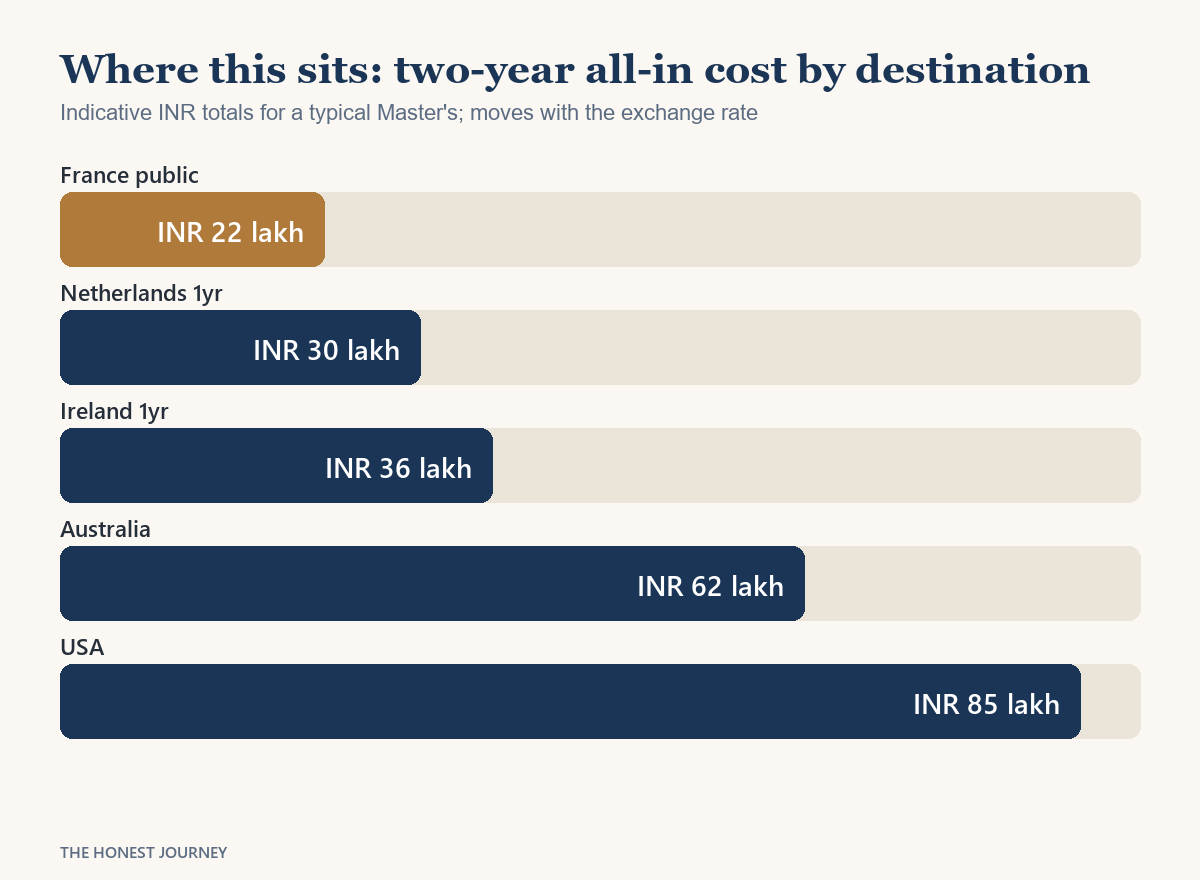
France is two destinations in one. The public-university track is a Germany-tier bargain: heavily subsidised tuition, moderate living, the CAF housing subsidy, and a respected European degree for around ₹20 lakh to ₹25 lakh all-in. The grande école and business-school track is a premium product at ₹55 lakh to ₹90 lakh, justified only by the specific school’s placement outcomes.
The honest deciding factors are your track and your French. If you choose the public route, learn the language and you have one of the best value degrees anywhere. If you choose a top business school, treat it like any premium investment and check that the placement data justifies the loan. Either way, start the Campus France procedure early, because it gates everything else.
For a cost-conscious Indian student who is willing to learn French, the public-university route makes France one of the smartest financial choices in this entire cluster, sitting right alongside Germany at the affordable end.
Once the budget is clear, the visa is the next hurdle. The Campus France procedure, VLS-TS and funds proof are in the France student visa guide.
Ready to fund it? Most Indian students route the loan through the PM Vidyalakshmi portal. That guide covers the step by step application and the 13 banks linked to it.
FAQ
How much does it cost to study in France from India in 2026?
A two-year public-university Master’s in France typically costs ₹18 lakh to ₹30 lakh all-in for an Indian student, including tuition, living, the Campus France and CVEC fees, visa, flights and forex. A grande école or top business school is far higher, at ₹45 lakh to ₹90 lakh, because tuition alone can be ₹40 lakh to ₹80 lakh over two years. Public tuition at the non-EU Master’s rate is only about €3,941 a year, roughly ₹3.6 lakh, so on the public track living costs are the main expense, not tuition.
Is studying at a French public university really that cheap?
Yes. French public universities are state-subsidised, so even the differentiated non-EU tuition for a Master’s is only about €3,941 a year, roughly ₹3.6 lakh, and many universities still charge the lower EU rate or waive the difference. That puts French public tuition in the same value bracket as Germany. The catch is that France is tightening enforcement of the non-EU rate from the September 2026 intake, and that the public route rewards French fluency for work and daily life far more than English-taught private schools do.
What are the Campus France and CVEC fees?
Campus France runs the mandatory Études en France procedure that every Indian student must complete before applying for a French student visa, with a processing fee of about ₹18,500 and an interview. CVEC is a compulsory annual student and campus life contribution of €105 that funds student services and health, and you cannot enrol without paying it. Both are unique to France, and the Campus France step in particular gates the whole visa timeline, so start it early.
How much money do I need to show for a France student visa?
France requires proof of about €615 per month of living funds, which is €7,380 for a full year, roughly ₹6.8 lakh at ₹92 to the euro. This is one of the lower proof-of-funds thresholds among study destinations. You can demonstrate it through bank statements, a sanctioned Indian education loan letter, or a scholarship award. The long-stay student visa (VLS-TS) itself costs €99 and doubles as a residence permit once you validate it online after arriving in France.
Can Indian students work part-time in France?
Yes. Indian students in France can work up to 964 hours per year, which is roughly 20 hours a week, at French student wages of around €700 to €900 a month when working regularly. Many students also claim the CAF housing allowance, a government subsidy that covers €100 to €200 of monthly rent. After a Master’s, France grants a post-study residence authorisation (APS) to stay and look for work, and French fluency makes a large difference to how accessible the job market is.
Is France cheaper than Germany for Indian students?
They are close, and both are the affordable end of this cluster. A French public-university Master’s at ₹18 lakh to ₹30 lakh all-in is comparable to a German public Master’s at ₹18 lakh to ₹28 lakh. Germany has near-zero tuition but requires the €11,904 blocked account upfront, while France charges a low subsidised tuition but offers the CAF housing subsidy that reduces living costs. The deciding factor is usually language and program fit rather than a few lakh of cost difference, since both are genuine bargains.
How much does a French business school or grande école cost?
A top French business school or grande école is a premium destination, with tuition of €20,000 to €45,000 a year for an MSc or MBA, which is ₹18 lakh to ₹41 lakh annually. Over a two-year program, the all-in cost including living reaches ₹55 lakh to ₹90 lakh, comparable to the UK or Australia. This is a completely different budget from the public-university route, and it is justified only by the specific school’s placement outcomes, so check the placement data before taking on a loan of that size.
Faz · The Honest Journey · 2026