Short answer. For an Indian student, France issues the VLS-TS long-stay student visa, which doubles as your residence permit for the first year. The visa fee is about EUR 50, but the real gate comes earlier: you must complete the mandatory Campus France “Etudes en France” procedure, interview included, before you can even apply.
Plan to show roughly EUR 615 per month of stay as financial proof.
A cousin’s friend applied for France two years ago and almost missed his intake, not because his profile was weak but because he treated the visa as the first step. He booked a VFS slot, got everything ready, then found out he could not apply at all until his Campus France account was approved and the interview was done. That sequencing mistake cost him three weeks he did not have. In France, the order of operations is the whole game, and almost nobody tells you that up front.
This post stays strictly in the visa lane. It is the VLS-TS route, the Campus France gate, the fees, the funds proof, and the arrival registration. If you want the admissions and university side of France, that lives in the study in France for Indian students guide, and the full rupee budget sits in the cost of studying in France post. Here we only talk visa.
What the France student visa actually is
For a course longer than six months, the document you need is the VLS-TS, the visa de long sejour valant titre de sejour. The mouthful matters because of what it does: it is a long-stay visa that also serves as your residence permit once you validate it after arrival. You do not run to a prefecture in your first weeks to get a separate residence card. The visa is the card, provided you complete one online step within three months of landing.
This is genuinely simpler than several other destinations where the visa and the residence permit are two different battles. France folds them into one for your first year. The trade-off is that France front-loads the difficulty onto a step that happens before the visa application even opens. That step is Campus France, and it is where most Indian applicants either sail through or stall.
Everything here is framed for the 2026 intake. Visa fees and funds-proof figures change every year, so treat each number as a planning figure and confirm the current one on campusfrance.org and france-visas.gouv.fr before you act. The planning FX rate through this article is ₹90 per euro. It moves, so re-check it the week you pay.
The fees, in INR
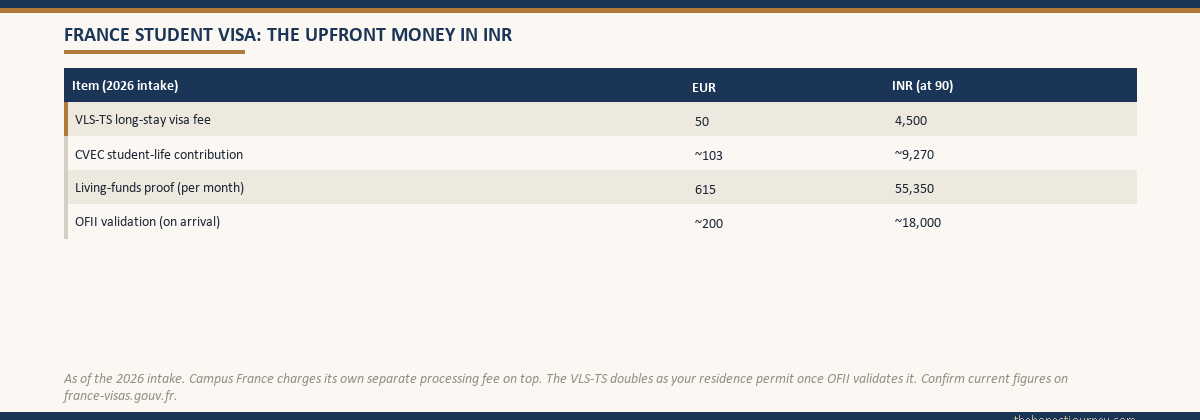
Let me put the money on the table first, because France has a few separate charges that people lump together and then underestimate. The headline visa fee is small. What surprises applicants is that Campus France carries its own processing fee, and the CVEC student-life contribution is a third, separate line. None of these is the tuition or living cost, those live on the cost page. These are purely the visa-and-arrival charges.
| Charge (as of 2026 intake) | EUR | INR (at 90) |
|---|---|---|
| VLS-TS long-stay visa fee | ~50 | ~4,500 |
| Campus France processing fee (separate) | ~min 7,000 (INR direct) | ~7,000 |
| CVEC student-life contribution | ~103 | ~9,300 |
| VFS service fee (logistics) | ~30 to 35 | ~2,700 to 3,200 |
| OFII validation after arrival | fee varies, confirm current | confirm current |
| Pre-departure visa-side total (approx) | ~190 plus Campus France INR fee | ~24,000 to 27,000 |
So the visa stamp itself is cheap. The cluster of mandatory fees around it, Campus France, CVEC, VFS logistics, is what you actually budget for. The Campus France fee for Indian students is charged in rupees directly and is not the same as the EUR 50 visa fee, which is the single most common point of confusion I see. Confirm both current amounts on the official portals before you transfer anything.
The Campus France gate: the step that trips everyone
Here is the part that decides your timeline. Before you can apply for the VLS-TS, you must complete the “Etudes en France” procedure through Campus France India. This is not optional and it is not a formality you do alongside the visa. It is the prerequisite that unlocks the visa application. No completed Campus France procedure, no visa appointment.
The procedure runs through your Campus France online account. You build your profile, upload your academic documents, list your chosen programmes, pay the Campus France fee, and then attend an interview at the Campus France office. The interview is real. A counsellor checks that your academic path makes sense, that your choice of course is coherent, and that you understand what you are signing up for. Once your file is validated and your university admission is confirmed, Campus France clears you to move to the actual visa application on the France-Visas portal.
Faz's ruleCampus France is the first move, not the visa. Open your Campus France account the day you start applying to universities, because the procedure and the interview sit on the critical path and cannot be rushed at the end.
Every year someone messages me in a panic because their intake is three weeks away and they just realised the visa cannot be booked until Campus France clears them. The procedure takes time. Start it early, treat the interview as a real conversation about your study plan, and you remove the single biggest cause of France timeline disasters.
The application flow, in order
Because sequencing is everything for France, here is the route laid out in the exact order it actually happens. Do not jump steps. Each one unlocks the next.
First, get your university admission and complete the Campus France “Etudes en France” procedure, including the interview. Second, once Campus France validates your file, apply for the VLS-TS on the France-Visas portal and generate your application form. Third, book and attend your VFS appointment for biometrics and document submission, paying the EUR 50 visa fee. Fourth, after the visa is granted and you land in France, validate the VLS-TS online with OFII within three months. The synthesised flow below shows the four stages from Campus France through to OFII validation.
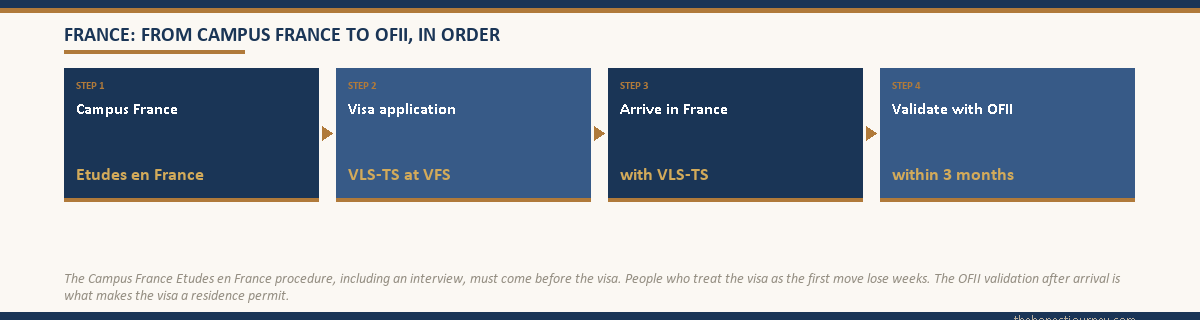
The thing to internalise is that the visa application on France-Visas is step two, not step one. The portal will reference your Campus France file. Trying to start at France-Visas without the Campus France procedure done is the mistake that wastes weeks. The official application route and document checklist are published on france-visas.gouv.fr, and the Campus France procedure itself is detailed on campusfrance.org.
The financial proof requirement
France wants to see that you can support yourself, and the benchmark is roughly EUR 615 per month of your stay. For a typical academic year that means showing funds covering the months you will be in France, on top of having your tuition arrangements in order. At ₹90 per euro, EUR 615 a month is about ₹55,000 a month, so a year of proof sits in the region of ₹6.5 lakh to ₹7 lakh as the funds-proof floor.
Treat that EUR 615 figure as a minimum the authorities want to see, not as a real Paris budget. What France actually costs to live on, especially in Paris, is higher, and that real number belongs on the cost page, not here. For the visa, the question is narrower: can you evidence the required monthly figure for your period of stay through bank statements, a scholarship, a guarantor, or a combination. The synthesised funds-proof view sits in the fees image above. The exact current monthly figure should always be confirmed on the official portal, because it is adjusted from time to time.
| Funds-proof element | EUR | INR (at 90) |
|---|---|---|
| Monthly support benchmark | ~615 | ~55,350 |
| Indicative one-year proof (12 months) | ~7,380 | ~6,64,000 |
| Acceptable evidence | Bank statements, scholarship award, financial guarantor, or a mix | |
Faz's ruleThe EUR 615 a month is a visa floor, not a living budget. Show the required proof cleanly for your full stay, then plan your actual money, especially Paris rent, separately on the cost page.
People see EUR 615 and assume that is what France costs. It is not. It is what the authorities want evidenced to grant the visa. Your real monthly outflow in Paris will be higher. Keep the two ideas apart: satisfy the proof as a compliance box, and budget your true cost honestly using the funding guides.
If you are still working out how much money to physically arrange and carry for the first weeks, the practical mechanics are in the how much money to carry abroad post, and the broad rules for what counts as acceptable funds proof across destinations are in the proof of funds for a student visa guide.
CVEC, OFII, and the steps after the visa
Two acronyms catch French applicants off guard because they are not part of the visa stamp itself but are mandatory all the same.
The first is the CVEC, the Contribution Vie Etudiante et de Campus, a student-life contribution of around EUR 103 that almost every student must pay and show proof of at enrolment. You pay it online and receive a certificate, which your university will ask for. It is small, around ₹9,300, but skipping it stalls your enrolment.
The second is the OFII validation, the one that turns your VLS-TS into a valid residence permit. Within three months of arriving in France, you must validate the visa online through the OFII process, pay the validation fee, and provide your French address. Miss this window and your residence status becomes irregular even though your visa was granted. This is the single most important post-arrival task, and it is purely your responsibility once you land. Set a reminder for your first week in France so it does not slip.
Work rights on the visa
The VLS-TS comes with the right to work up to 964 hours per year, which works out to roughly 60 percent of a full-time schedule across the year. That is a genuinely useful allowance, more flexible than the fixed weekly caps some countries impose, because it lets you work lighter during exam terms and heavier in holidays as long as the annual total holds.
Be honest with yourself about what those hours fund. Part-time work in France is a living-cost supplement that can ease rent and groceries, not a tuition fund and not the thing that closes your financial-proof gap. For the visa, what matters is that you arrive with funds evidenced and tuition arranged. The work right is breathing room on top of that, not the plan. How students should finance the tuition side specifically, including the loan route for France, is covered in the education loan for France post.
Processing time and the refusal reality
The honest answer on timelines is that the visa stamp itself is usually not the slow part. Once your Campus France file is validated and you submit a complete application at VFS, the VLS-TS decision often comes within a couple of weeks. The slow part, the part you must plan around, is the Campus France procedure before it. Between building the account, the interview, validation, and confirming admission, the front end can take weeks, and it is entirely on the critical path.
On refusals, France is not a country where the visa officer interrogates your intent at length the way some consular interviews do. The Campus France interview is the place your academic coherence is tested, so by the time you reach the visa stage, much of the screening is done. Where applications come unstuck is on incomplete files, weak or unclear financial proof, and gaps in academic logic that should have been resolved at the Campus France stage. Get Campus France right and the visa itself is usually a clean step.
The honest take on the France student visa
France is, on paper, one of the friendlier student-visa routes for Indian students. The fee is low, the VLS-TS doubles as your residence permit, the work allowance is generous, and the consular stage is rarely the bottleneck. None of that is the catch. The catch is purely sequencing.
The mistake that costs people their intake is treating the visa as move one. It is not. Campus France is move one, with its own fee, its own timeline, and a real interview, and the visa cannot even be booked until that is cleared. Internalise that order, open your Campus France account early, take the interview seriously, and keep your funds proof and your CVEC and OFII steps on a checklist. Do that, and France is one of the smoother tickets to hold. Skip it, and you will spend the weeks before your flight in the panic my cousin’s friend did.
If France is on your shortlist, its neighbours are natural comparisons. The consular steps and funds proof for the Spain student visa and the Switzerland student visa are laid out the same way, so you can line them up side by side.
FAQ
What is the France student visa fee for Indian students?
The VLS-TS long-stay student visa fee is approximately EUR 50, about ₹4,500 at ₹90 per euro, as of the 2026 intake. Note that Campus France charges its own separate processing fee, billed to Indian applicants in rupees, and the CVEC student-life contribution of around EUR 103 is a third charge. The visa stamp is cheap, but the cluster of mandatory fees around it is what you budget for. Confirm the current figures on france-visas.gouv.fr.
What is the Campus France procedure and is it mandatory?
Yes, it is mandatory. The “Etudes en France” procedure through Campus France must be completed before you can apply for the visa. You create an online account, upload academic documents, list your chosen programmes, pay the Campus France fee, and attend an interview with a counsellor. Once your file is validated and admission confirmed, you are cleared to apply on France-Visas. No completed Campus France procedure means no visa appointment, so start it early.
How much money do I need to show for a France student visa?
France expects financial proof of roughly EUR 615 per month of your stay, about ₹55,000 a month at ₹90 per euro. For a full academic year that lands near ₹6.5 lakh to ₹7 lakh as the funds-proof floor. Acceptable evidence includes bank statements, a scholarship award, or a financial guarantor. Treat this as a visa minimum, not a real Paris budget, and confirm the current monthly figure on the official portal before applying.
What is the CVEC and do I have to pay it?
The CVEC is the Contribution Vie Etudiante et de Campus, a student-life contribution of around EUR 103, about ₹9,300 at ₹90 per euro. Almost every student must pay it and show proof at enrolment. You pay online and receive a certificate that your university will request. It is a small amount, but skipping it stalls your enrolment, so treat it as a mandatory step rather than an optional fee and keep the certificate handy.
What is OFII validation and when must I do it?
OFII validation is the online step that turns your VLS-TS into a valid residence permit. Within three months of arriving in France, you must validate the visa through the OFII process, pay the validation fee, and provide your French address. Miss this window and your residence status becomes irregular even though the visa was granted. It is purely your responsibility after landing, so set a reminder for your first week in France to complete it.
How many hours can I work on a France student visa?
The VLS-TS allows you to work up to 964 hours per year, roughly 60 percent of a full-time schedule across the year. This is more flexible than fixed weekly caps because you can work lighter during exam terms and heavier in holidays as long as the annual total holds. It is a useful living-cost supplement, but it does not fund tuition or replace your financial proof, so arrive with funds evidenced and treat work as breathing room.
How long does the France student visa take to process?
The visa stamp itself is usually not the slow part. Once Campus France validates your file and you submit a complete application at VFS, the VLS-TS decision often comes within a couple of weeks. The slow part is the Campus France procedure beforehand, including the account, interview, and validation, which can take several weeks and sits on the critical path. Plan your timeline backward from your intake and start Campus France early.
Is there an interview for the France student visa?
The key interview happens at the Campus France stage, not the visa stage. A Campus France counsellor checks that your academic path is coherent, your course choice makes sense, and you understand your study plan. By the time you reach the visa application, much of the screening is already done. Treat the Campus France interview as the real conversation about your studies, because passing it cleanly is what unlocks a smooth visa step afterward.
Faz · The Honest Journey · 2026