Short answer. For Indian students, Switzerland issues a National D long-stay visa for study, applied for at the Swiss embassy after a university admission. As of the 2026 intake the visa fee is roughly CHF 88, and you must prove funds of about CHF 21,000 per year, near CHF 1,750 a month, through a bank statement or blocked funds.
After you land you register at the cantonal migration office within 14 days for a permit B.
A girl from my extended family got her Zurich admission and assumed the Swiss visa would work like the Schengen tourist visa her uncle once got in a fortnight. She had the money, she had the offer, and she thought the rest was a formality. What caught her off guard was the funds figure, which was far higher than the European average she had read about, and the fact that her canton wanted a confirmation from a Swiss-domiciled bank, not just her Indian statement. The plan was sound. It was the size of the funds bar and the canton-level detail that she had underestimated, and Switzerland punishes that underestimation quietly.
This post stays strictly in the visa lane: the permit type, the embassy route, fees, the funds proof, cantonal registration, processing reality, and work rights. It does not cover tuition or city living costs. Switzerland is one of the pricier places to fund, and if you are still weighing whether that outlay makes sense, the general principles of showing money for a study visa sit in the proof of funds for a student visa guide. Here we only talk about getting the D visa and the permit B.
The National D long-stay study visa, and the canton system
People say “Switzerland student visa” out of habit, and that is close enough, but the precise document is a National D long-stay visa, the entry document that lets you stay beyond 90 days for study. It is different from a Schengen C short-stay visa. The D visa gets you into the country. The thing that actually governs your stay once you are there is the residence permit, the permit B, which you collect from your canton after arrival. So you are dealing with two documents in sequence, the D visa first, the permit B second.
The part that trips up almost every Indian applicant is that Switzerland is federal, and immigration is run canton by canton. The State Secretariat for Migration sets the national frame, and its official information lives at sem.admin.ch, but the canton where your university sits, Zurich, Geneva, Vaud, Ticino and so on, handles your actual case, sets its own funds threshold, and issues your permit. That means the funds figure, the exact documents, and the fees can vary between cantons. Treat sem.admin.ch and your canton’s migration office page as your source of truth, and confirm the current numbers there, because as of the 2026 intake every figure in this post is a planning number, not a permanent one.
For the admission side, the official body listing Swiss universities and their entry requirements is swissuniversities.ch. Your admission has to come first. There is no visa without a confirmed university place, and the visa application is built around that acceptance.
Applying at the Swiss embassy after admission
The order matters, so hold it clearly. You secure your admission from a recognised Swiss university, and only then do you approach the Swiss embassy or consulate in India to apply for the National D visa. This is not an online-only process the way some countries now run. The D visa is a consular application, lodged at the Swiss representation, and the canton behind it makes the real decision on whether you can stay.
What that means in practice is that after you submit at the embassy, your file is forwarded to the cantonal migration authority for approval. The embassy issues the visa once the canton has cleared it. So the timeline is not purely in the embassy’s hands, and this two-layer process is one reason Swiss student visas can take a while, which I will come back to. Book your embassy appointment early, because slots for the D visa are fewer than for tourist visas, and the canton approval adds weeks on top.
The fees, in INR
Let me put the government-side money on the table first. These are the visa and permit fees, not your tuition or living costs. The planning rate through this article is ₹95 per Swiss franc. It moves, so re-check it the week you transfer money or pay a fee.
| Fee (Switzerland study route) | CHF | INR (at 95) |
|---|---|---|
| National D visa application fee | ~88 | ~8,360 |
| Residence permit B (issued by canton, typical) | ~160 | ~15,200 |
| Annual funds proof (shown, not spent) | ~21,000 | ~19,95,000 |
| Government fees only (excl. funds proof) | ~248 | ~23,560 |
The honest read of this table: the visa fee and the permit fee are small, together a little over ₹23,000. Some cantons process the visa faster for an extra charge, up to roughly half again on top, and the permit fee varies by canton, so treat CHF 160 as a typical figure and confirm your canton’s number. The huge line is the funds proof, but that is not a fee. It is your own money you must show, not hand over. The body image below breaks the outlay apart so you can see what you actually spend versus what you merely prove.
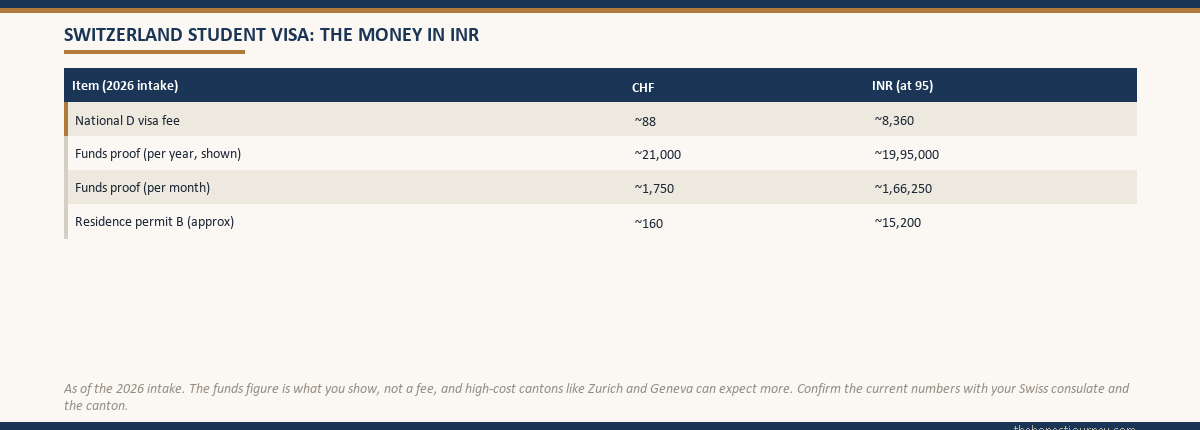
Note what is not here. Your tuition is paid to the university, and your monthly living costs are separate again. On this page, money appears only as the funds you must prove to get the visa, not as a cost breakdown.
Faz's ruleSwitzerland is federal, so the canton, not the embassy, sets your real funds bar and issues your permit. Read your specific canton's migration page, not a generic Swiss visa article.
The single most common surprise I see is students who prepared to a national figure and then found their canton, often Zurich or Geneva, wanted more, sometimes CHF 24,000 rather than 21,000. The country-level number is a starting point. Your canton’s page is the number that decides your case, so find it early.
The funds proof: the part that decides your case
If a Swiss student visa stalls, it is most often about money, specifically whether the canton is satisfied you can genuinely support yourself without falling into difficulty. So this is the section to get right.
As of the 2026 intake you must show funds of roughly CHF 21,000 per academic year, which works out to about CHF 1,750 a month. At ₹95 per franc that annual figure is close to ₹20 lakh, purely as maintenance proof, before tuition. Some cantons set the bar higher: Zurich and Geneva have been known to ask for evidence closer to CHF 24,000. Confirm the exact number your canton wants, because this is the figure that varies most, and it is the one that trips people.
You prove this in one of two main ways. The first is a bank statement showing you hold the funds, which some cantons accept, ideally a confirmation from a Swiss-domiciled bank stating you have access to the required amount. The second, which some cantons require, is blocked funds: money deposited in a designated account and released to you in monthly instalments after you arrive, similar to the German blocked-account model. It is your money throughout, parked as proof, not spent. The general principles of arranging and presenting funds proof from India are in the proof of funds for a student visa guide, and the practical question of what cash to move at the start sits in the how much money to carry abroad guide.
What the canton actually wants is money that makes sense, not just a large balance. A lump sum that appeared last week with no story reads as borrowed-for-show and weakens you. Seasoned savings, a clear source, and a loan sanction letter if you are financing together build credibility. Switzerland’s high funds bar means this scrutiny is real, so build the story before you build the balance.
Faz's ruleBlocked funds are your own money, not a fee. Do not let the CHF 21,000 line scare you into thinking Switzerland costs twenty lakh in fees, it does not.
The funds proof is the one number that makes families panic, because it looks like a spend. It is not. It is a balance you show, and in the blocked-account version it comes back to you in monthly slices after you land. Plan the liquidity, but do not confuse it with the actual cost of the visa, which is small.
The four-step process, end to end
Here is how the Swiss study route actually runs, in the order it happens. The step flow below maps the same four stages at a glance.
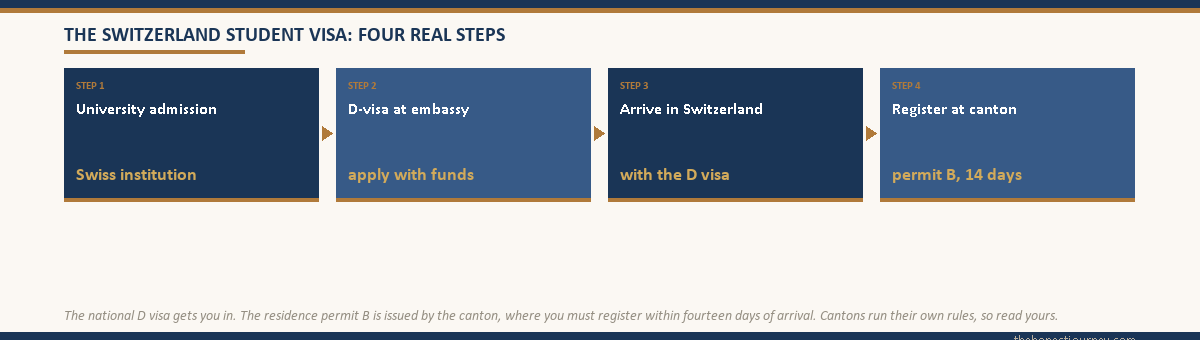
Step one: secure your university admission. You apply to a recognised Swiss university and receive a confirmed admission. There is no visa route without this, and the whole file is built around your acceptance letter, so this is the hard first gate.
Step two: apply for the D visa at the Swiss embassy. With your admission in hand, you book an appointment at the Swiss embassy or consulate in India and lodge the National D long-stay visa application, with your acceptance letter, proof of funds, passport, and the supporting documents your canton lists. Your file is forwarded to the cantonal authority for approval, and the visa is issued once the canton clears it.
Step three: arrive in Switzerland. With the D visa in your passport you travel to Switzerland. The visa is your entry document, but it is not yet your permission to stay long-term. That comes next, and the clock on it starts the moment you land.
Step four: register at the canton and collect permit B. Within 14 days of arrival you present yourself at your cantonal migration office to register and apply for the residence permit. Once processed, you receive the permit B, valid for a year and renewable, which is the document that actually governs your stay.
Cantonal registration within 14 days, and the permit B
This is the step most students underestimate, because it happens after the visa, when the relief has set in and the guard is down. The D visa gets you into Switzerland. It does not, by itself, complete your legal stay. Within 14 days of arriving you must register at the cantonal migration office of the place you will live, and apply for your residence permit.
The permit you receive is a permit B, the residence permit for foreign nationals staying longer than a year for a defined purpose such as study. It is valid for one year and renewable through your studies, provided you keep meeting the conditions, which include making genuine academic progress. Miss the 14-day window or skip the registration and you create a problem that is entirely avoidable, so put it at the very top of your arrival checklist, above finding a flat or buying a SIM.
Processing reality
Swiss student visa processing is not fast, and the two-layer structure is why. Your embassy application is forwarded to the canton, the canton decides, and only then does the embassy issue the visa. That round trip commonly takes several weeks, and for some cantons and busy intakes it can stretch longer. There is no fixed universal timeline, so check the current estimate with the specific Swiss representation you will apply through and your canton, rather than trusting a forum number.
The practical takeaway is the same one that holds everywhere: apply early. The moment you have your admission, start the visa. The crush before an autumn intake is real, and the canton-approval step means you cannot compress the timeline at the end the way you might with a single-authority visa. Leaving it late is how a strong, well-funded applicant ends up deferring a semester for no reason other than the calendar.
Work rights on the student permit
Your permit does allow work, but the rules for non-EU students, which includes Indians, are tighter than for EU nationals, so read this carefully. Term-time work is capped at 15 hours per week. On top of that, and this is the part people miss, non-EU students are generally only permitted to work after the first six months of study. So for your first semester you should plan to fund yourself fully, without leaning on a part-time wage that you are not yet allowed to earn.
The honest framing on work is the same as everywhere. It is a living-cost supplement, not a tuition fund, and in Switzerland’s case it is one you cannot even start for half a year. Treat it as breathing room later, never as the plan that closes a funding gap now. How work hours and rights compare across countries sits in the part-time work while studying abroad guide, which is worth reading before you build any budget around a wage.
After studies, and the honest take
After you graduate, staying on to work in Switzerland is possible but not automatic, and the rules for non-EU graduates are stricter than in more openly recruiting countries. There is a window to seek qualified employment after graduation, but it is governed by cantonal and federal labour-market rules rather than a simple post-study work visa, so treat any career-after plan as a separate, canton-specific question to research nearer the time, not a promise baked into the student permit.
Now the honest take. Switzerland is one of the harder European destinations to fund, and pretending otherwise helps nobody. The visa fee itself is small, but the funds bar, near CHF 21,000 a year and higher in some cantons, is one of the steepest in Europe, and the canton-by-canton variation means there is no single clean checklist you can follow blind. That is the real cost of Switzerland: not the visa fee, but the maintenance you must prove and the federal complexity you must navigate. If your funding is genuine and seasoned, and you are prepared to work to your specific canton’s rules, it is very doable. If you are stretching to hit the funds figure, Switzerland will expose that stretch faster than most. For students weighing the outlay, the honest comparison of where the money goes furthest is in the cheapest country to study abroad guide.
The move, then, is simple. Confirm your specific canton’s funds figure and document list, build your funds early and make them credible, apply at the embassy the moment your admission is confirmed, and register at the canton within 14 days of landing. Confirm every figure on sem.admin.ch and your cantonal page, because they shift between intakes. Do that, and Switzerland becomes a process you execute rather than a lottery you enter.
FAQ
How much is the Switzerland student visa fee for Indian students?
As of the 2026 intake, the National D long-stay study visa fee is roughly CHF 88, about ₹8,360 at ₹95 per franc, paid at the Swiss embassy when you apply. Some cantons charge more for faster processing, up to around half again on top. Confirm the current fee on the official portal at sem.admin.ch before you pay, as these figures are revised between intakes and can vary by representation.
How much proof of funds do I need for a Switzerland student visa?
As of the 2026 intake you must show funds of roughly CHF 21,000 per academic year, near CHF 1,750 a month, about ₹20 lakh at ₹95 per franc, purely as maintenance proof on top of tuition. Some cantons, including Zurich and Geneva, ask for closer to CHF 24,000. It is money you show, not spend, so verify your specific canton’s figure on its migration office page, because this is the number that varies most.
Do I register with the canton after arriving in Switzerland?
Yes, and quickly. Within 14 days of arriving you must register at the cantonal migration office of the place you will live and apply for your residence permit. The D visa only gets you into the country. The registration is what completes your legal long-stay status, so put it at the top of your arrival checklist, above finding accommodation, and do not let the 14-day window slip.
How long does a Switzerland student visa take to process?
There is no single fixed timeline, because your embassy application is forwarded to your canton for approval before the visa is issued, and that round trip commonly takes several weeks, sometimes longer for busy cantons and intakes. Check the current estimate with the specific Swiss representation you apply through and your canton rather than a forum number, and apply the moment your admission is confirmed, because the canton step cannot be rushed at the end.
How many hours can I work on a Switzerland student permit?
Term-time work is capped at 15 hours per week. For non-EU students, which includes Indians, work is generally only permitted after the first six months of study, so you must plan to fund your first semester without a part-time wage. Confirm the current rules with your canton, and treat work as a living-cost supplement later, never as a tuition fund or as how you present your ability to pay.
What is the permit B for Switzerland students?
The permit B is the residence permit issued by your canton for a stay longer than a year for a defined purpose such as study. You apply for it when you register at the cantonal migration office within 14 days of arrival. It is valid for one year and renewable through your studies, provided you keep meeting the conditions, including genuine academic progress. The typical permit fee is around CHF 160, though it varies by canton.
Is Switzerland harder to get a student visa for than other European countries?
The visa itself is straightforward once your admission and funds are in order, but Switzerland’s funds bar, near CHF 21,000 a year and higher in some cantons, is one of the steepest in Europe, and the canton-by-canton variation means there is no single national checklist. That federal complexity, not the visa fee, is the real hurdle. A genuine, well-funded applicant who reads their specific canton’s rules will find it very doable.
Do I need a medical test for a Switzerland student visa?
Switzerland does not run the same mandatory panel-physician medical that some destinations require for a study visa, but health insurance is compulsory and specific requirements can vary by canton and by your circumstances, so confirm what your canton expects. If you are comparing destinations on the medical step, the general picture of what a study visa medical involves is set out in the medical test for a student visa guide.
Faz · The Honest Journey · 2026