Short answer. Study in France for Indian students in 2026 splits into two very different price tags: a public-university Master’s runs roughly ₹25 lakh to ₹35 lakh all-in over two years, while a Grande Ecole or private business school runs ₹50 lakh to ₹75 lakh.
Public tuition is EUR 250 to 4,000 a year (₹22,750 to ₹3.64 lakh), private and business-school tuition is EUR 15,000 to 40,000 a year (₹13.65 lakh to ₹36.4 lakh). Living costs sit at EUR 12,000 to 15,000 a year, the visa needs about EUR 615 a month in proof of funds, and a Master’s graduate gets a 2-year post-study job-search permit called the APS.
The number of parents asking me about France instead of the UK has roughly doubled in the last two years. The reason is simple. A public-university Master’s in France can cost less than a single year of UK tuition, and the post-study work permit is genuinely generous. The part nobody mentions on the first call is that “France” is two countries financially, and that the job market quietly runs on French.
This post walks through what a French Master’s actually costs across the public and private split, the mandatory Campus France process, the VLS-TS student visa and its proof-of-funds rule, the 2-year APS work-search permit, how to fund it from India, and the honest weak spot most brochures skip: the French-language factor.
The public versus Grande Ecole split, which is the whole story
France does not have one tuition system. It has two that barely resemble each other, and choosing between them is the single biggest financial decision an Indian student makes here.
Public universities (the University of Paris-Saclay, Sorbonne University, Aix-Marseille, Grenoble Alpes and dozens more) charge state-set tuition. For non-EU students the official 2026 rate is around EUR 3,770 a year for a Master’s, though many universities have kept the older EUR 243 to EUR 391 rate through partial-exemption schemes, and a number of programmes charge somewhere in between. So a public Master’s realistically costs EUR 250 to EUR 4,000 a year depending on the institution’s exemption policy.
Grandes Ecoles and private business schools are the other France. HEC Paris, INSEAD, ESSEC, ESCP, emlyon, Sciences Po and the engineering Grandes Ecoles charge market tuition: EUR 15,000 to EUR 40,000 a year, with the top MBAs and Masters in Management at the upper end. These are the schools with the global rankings and the recruiter relationships, and they cost roughly what a UK or US programme costs.
| Institution type | Examples | Master’s tuition (EUR/yr) | Rs (at ₹91/EUR) |
|---|---|---|---|
| Public university (with exemption) | Sorbonne, Aix-Marseille, many regional universities | 250 to 1,000 | ₹22,750 to ₹91,000 |
| Public university (full non-EU rate) | Paris-Saclay, Grenoble Alpes | 3,770 | ₹3.43 lakh |
| Engineering Grande Ecole | CentraleSupelec, Mines, Polytechnique programmes | 10,000 to 15,000 | ₹9.1 lakh to ₹13.65 lakh |
| Business school (MiM / MSc) | ESSEC, ESCP, emlyon, EDHEC | 18,000 to 30,000 | ₹16.38 lakh to ₹27.3 lakh |
| Top MBA | HEC Paris, INSEAD | 30,000 to 40,000+ | ₹27.3 lakh to ₹36.4 lakh+ |
The full official list of accredited institutions and programmes, public and private, sits with Campus France, the French government agency for international students. The higher-education ministry’s portal at enseignementsup-recherche.gouv.fr publishes the official non-EU tuition rates each year.
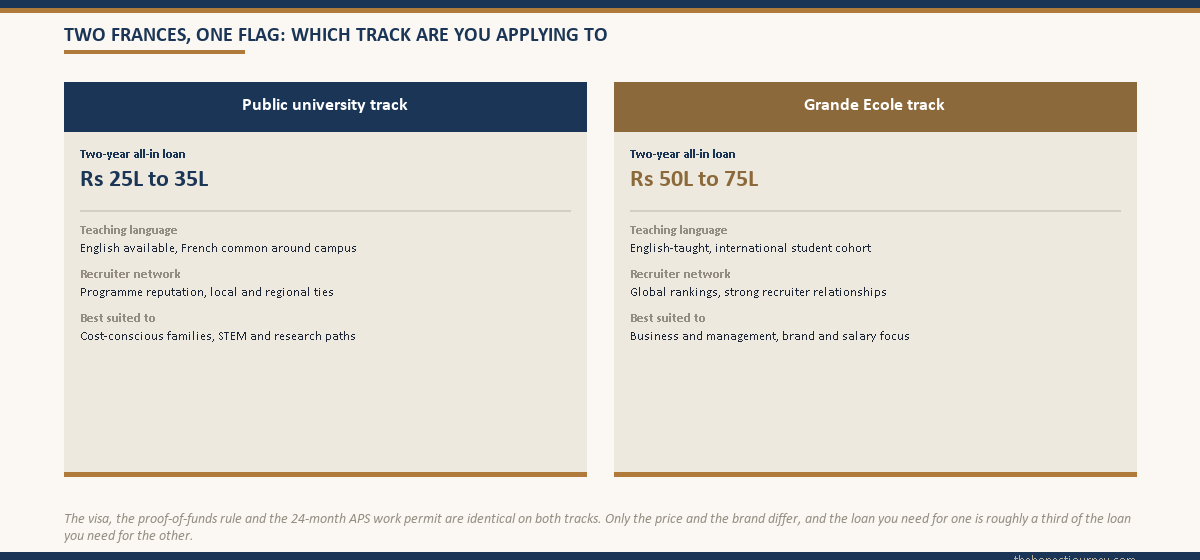
Faz's ruleDecide which France you are applying to before you fall in love with any one school. A public-university Master's and a business-school Master's are different financial products, and the loan you need for one is a third of the loan you need for the other.
Most families come to me having already screenshotted a Grande Ecole ranking, then get a shock at the EUR 30,000 tuition. The honest move is to first ask whether your field has a strong public-university programme that teaches in English. If it does, the same two years can cost ₹30 lakh instead of ₹70 lakh, and the visa and post-study rights are identical.
What a two-year Master’s actually costs in 2026
Tuition is only one line. Living in France, especially Paris, is the part Indian students underestimate. Outside Paris the cost drops noticeably, which is worth weighing when two universities offer the same programme.
Living costs run EUR 12,000 to EUR 15,000 a year for a student in a mid-size city like Lyon, Toulouse or Grenoble, covering rent, food, transport and a phone plan. Paris pushes this to EUR 15,000 to EUR 18,000 a year, mostly because of rent. The CAF housing allowance (Aide Personnalisee au Logement) can reimburse a meaningful slice of rent for students who apply, often EUR 100 to EUR 200 a month, which is one of the genuine cost advantages France offers.
Below is a worked rupee total for a typical two-year public-university Master of Science in a mid-size city, where most cost-conscious Indian students actually end up.
| Line item | EUR | Rs (at ₹91/EUR) |
|---|---|---|
| Year 1 tuition (public, full rate) | 3,770 | ₹3.43 lakh |
| Year 2 tuition | 3,770 | ₹3.43 lakh |
| Year 1 living (rent, food, transport) | 13,500 | ₹12.29 lakh |
| Year 2 living | 13,500 | ₹12.29 lakh |
| Campus France + VLS-TS visa fees | 199 | ₹18,100 |
| Student social security (CVEC + health) | 200 | ₹18,200 |
| Mutuelle top-up insurance (2 years) | 600 | ₹54,600 |
| Return flights (2 trips home) | 1,200 | ₹1.09 lakh |
| Initial settlement (deposit, furniture, sim) | 1,800 | ₹1.64 lakh |
| Forex spread and wire charges | 900 | ₹81,900 |
| Two-year all-in total | EUR 39,239 | ₹35.71 lakh |
A public Master’s at a heavily exempted university, in a non-Paris city, with consistent part-time work and the CAF allowance, can drop the all-in to ₹25 lakh to ₹28 lakh. A business-school Master’s in Paris, with EUR 28,000 tuition and Paris living, pushes the same two years to ₹65 lakh to ₹75 lakh. The gap between these two French realities is wider than the gap between many whole countries. If you want the numbers laid out in full, the cost of studying in France for Indian students walks through both routes in detail.
The Campus France process is mandatory, not optional
Indian students cannot skip Campus France. Before you apply for a student visa, you must complete the Etudes en France procedure through Campus France India. This is the official government channel, and the visa application literally requires a Campus France NOC (No Objection Certificate) number.
The process runs through an online account on the Campus France Etudes en France portal. You build an academic profile, list the programmes you are applying to, upload transcripts and a Statement of Purpose, pay the Campus France fee (around EUR 99 for India), and attend a short interview at a Campus France office or online. Once your university admission is confirmed and the interview clears, Campus France issues the NOC that unlocks the visa step at the consulate.
The timeline matters. The Campus France procedure and interview can take several weeks, and it must finish before the visa appointment, so the sequence is admission, then Campus France NOC, then visa. Students who treat Campus France as paperwork they will do “later” routinely miss intakes. Start it the moment you have an admission offer in hand.
The VLS-TS student visa and the proof-of-funds rule
The student visa for a course longer than 6 months is the VLS-TS (Visa de Long Sejour valant Titre de Sejour), a long-stay visa that doubles as a residence permit once you validate it online after arriving. The application runs through France-Visas, the official government visa portal, and the visa fee is EUR 50 plus a small service charge.
Proof of funds is the line that catches people. France expects evidence of roughly EUR 615 a month for the duration of your stay, which works out to about EUR 7,380 for a year. This is the minimum living-cost benchmark, and you show it through a sanctioned education loan from an Indian bank, a scholarship letter, a sponsor’s bank statements, or a combination. A sanctioned education loan is the cleanest single document because it covers both tuition and the living-cost benchmark in one letter.
| Requirement | 2026 figure | Notes |
|---|---|---|
| Proof of funds (monthly) | about EUR 615 | roughly EUR 7,380 for a year |
| VLS-TS visa fee | EUR 50 | plus VFS service charge |
| Campus France fee (India) | about EUR 99 | paid before visa step |
| CVEC student life contribution | about EUR 103 | mandatory, paid yearly |
| OFII validation after arrival | EUR 50 to 60 | validates the VLS-TS as residence permit |
After you land, you validate the VLS-TS online and pay the OFII tax stamp, which converts the visa into your residence permit for the year. The official residence and student-rights rules are published on service-public.fr, the French government’s public-service portal. For the broader picture of how the funds requirement compares across countries, see the proof of funds for student visa guide.
Faz's ruleThe EUR 615 a month proof-of-funds figure is the floor for the visa, not a realistic budget for living in France. Showing exactly the minimum gets the visa but does not feed you in Lyon, let alone Paris. Plan to the real cost, not the visa minimum.
I have seen students arrange documents that show precisely EUR 615 a month, clear the visa, then arrive and realise rent alone in their city is EUR 600. The proof-of-funds number is what France needs to see to be satisfied you will not become destitute. Your actual monthly spend will be EUR 1,000 to EUR 1,400. Budget for the second number.
The 2-year APS post-study work permit
This is where France competes hard with the UK and Ireland. A Master’s graduate from a French institution is eligible for the APS (Autorisation Provisoire de Sejour), a temporary residence permit that gives you up to 24 months to look for a job or start a business related to your studies.
The APS lets you work full time while you search, and once you find a qualified job that meets the salary threshold, you transition to a regular work residence permit (the “talent passport” or salaried-worker permit, depending on the role and pay). The 24-month window is a genuine runway, longer than the UK’s narrowed Graduate Route and comparable to the better post-study schemes in the region.
| Qualification level | Post-study permit | Duration |
|---|---|---|
| Master’s degree | APS | up to 24 months |
| Licence professionnelle (vocational bachelor) | APS | up to 12 months |
| Doctorate | APS / talent passport route | up to 12 months, strong transition routes |
The honest catch is what “qualified job” means in practice. The APS gives you time, but converting it into a long-term work permit needs a real employment contract at a salary level the prefecture accepts, and in most non-tech sectors that contract is far easier to land if you can work in French. The permit is generous. The job market behind it has a language gate. The official rules on the APS and the talent-passport transition are on service-public.fr.
The French-language factor, told honestly
This is the section that should change how you read every glowing France post. France has thousands of English-taught Master’s programmes now, especially at business schools and in STEM at the Grandes Ecoles, so you can absolutely complete a degree in English. Getting a job afterward is a different question.
Outside the international-facing tech and finance roles in Paris, the French workplace runs on French. A consulting, marketing, public-sector, or general-management role will almost always require professional French, often at B2 level or higher. Engineering and software roles at multinationals and startups are the most English-tolerant, and that is exactly where Indian graduates have the best post-study outcomes. In most other fields, the APS gives you 24 months, and a chunk of that time goes into reaching working French.
The students who do well in France either pick a genuinely English-operating sector (tech, data, R&D, international business at large firms), or they start French early and treat reaching B2 as part of the plan, not an afterthought. The ones who struggle are those who assumed an English-taught degree meant an English-speaking job market. It does not, and pretending otherwise does nobody a favour.
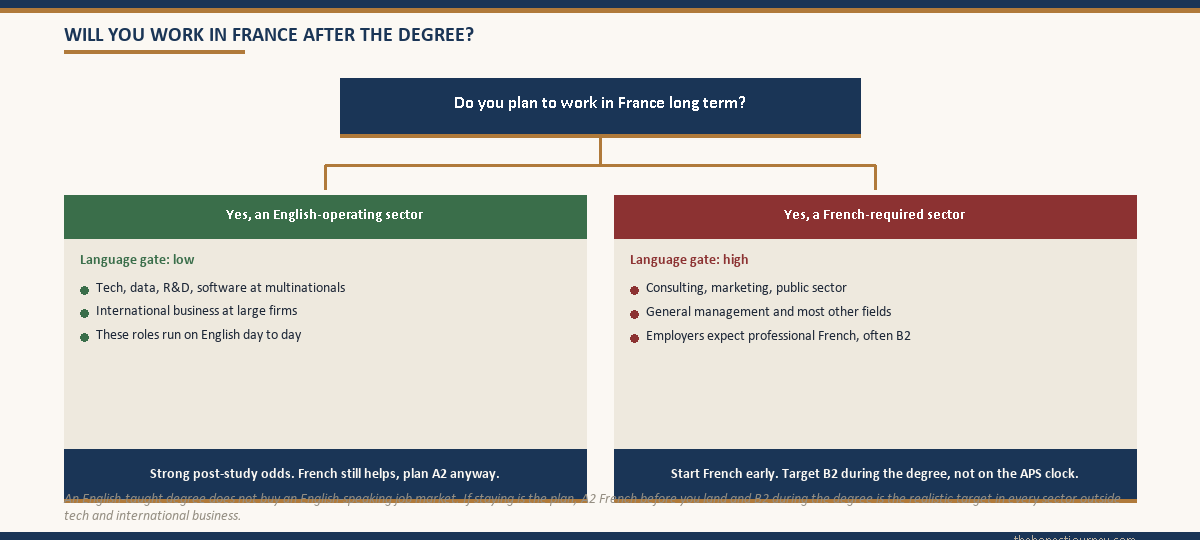
Faz's ruleIf your plan is to study in France and work in France long term, French is not optional, it is the second tuition you pay in time. Start it the year before you fly, not the month you start job-hunting on the APS clock.
The single most common regret I hear from Indians a year into France is “I should have learned French sooner.” The degree opened the door. The language decides whether you walk through it into a career or spend the APS window in survival jobs. If France is the long-term plan, A2 before you land and B2 during the degree is the realistic target.
Funding the French Master’s from India
Arranging an education loan for France follows the standard PSU-bank framework, but the loan size depends entirely on which France you chose. SBI Global Ed-Vantage, Bank of Baroda Vidya and Canara Bank all treat recognised French institutions as approved destinations. SBI’s education loan product page lists eligibility, collateral norms and sanction caps.
For a public-university Master’s at a ₹30 lakh to ₹35 lakh requirement, the loan story is comfortable. Much of that amount can sit in the unsecured or partially secured band, because the figure is well below the abroad-study ceilings, and the low tuition means the bank is mainly funding living costs. For a Grande Ecole or business-school Master’s at a ₹60 lakh to ₹75 lakh requirement, you are into secured-loan territory, typically a loan against residential property at 9.5 to 10.5 percent from a PSU bank, with the moratorium covering the course plus six months.
The sanction letter doubles as proof of funds for the France-Visas file, provided the amount covers tuition plus the EUR 615 a month living benchmark for the year. If the loan covers only tuition, you document family savings for the living component separately. The lower the public-university tuition, the easier the whole funding picture becomes, which is the quiet reason France works so well for cost-conscious families. For how the funds piece interacts with a comparable European route, see the education loan for Ireland guide, and for the mandatory cover, the health insurance for study abroad post.
What part-time work during study actually pays
Student visa holders in France can work up to 964 hours a year, which works out to roughly 20 hours a week across the year. The 2026 minimum wage (SMIC) is around EUR 11.90 an hour gross, and typical student roles in retail, hospitality, tutoring and on-campus work pay close to the minimum, with private tutoring and English-teaching paying more.
A consistent 20-hour week earns roughly EUR 700 to EUR 900 a month after social contributions, which covers a meaningful share of living costs in a mid-size city, especially once the CAF housing allowance is added. In Paris, the same earnings cover less because rent is higher. Part-time work does not offset tuition in any serious way, but at a public university where tuition is low, the living-cost offset from part-time work plus CAF can make the year genuinely manageable.
The 964-hour limit is enforced, and exceeding it is a residence-permit breach. The official student work rules are published on service-public.fr. For comparison with how the funding maths plays out in a higher-tuition destination, the cost of studying in the UK for Indian students post is the useful contrast.
The honest closing take
France is two destinations wearing one flag. The public-university route is one of the best-value developed-country options an Indian student has in 2026: a Master’s all-in for ₹25 lakh to ₹35 lakh, a 24-month APS work permit, CAF housing support, and a low-tuition base that makes the loan small. The Grande Ecole and business-school route is a premium product priced like the UK or the US, bought for the ranking, the recruiter network and the global brand.
The single honest qualifier sits on both: the French-language factor. The degree can be in English. The long-term job, in most sectors outside tech and international business, runs on French. France rewards students who treat the language as part of the plan and penalises those who assume an English degree buys an English-speaking career.
For an Indian student who picks an English-operating field or commits to French, who values a long post-study runway and a low-tuition base, France holds up as one of the smartest cost decisions in Europe. For someone who wants a guaranteed English-only job market and the highest entry salaries, the UK, Ireland or the US still answer more directly. Choose which France you are applying to, fund it accordingly, and start the language clock early if staying is the plan.
Sorting the visa is the step most people underestimate. The full process, fees and funds proof for France sit in the France student visa guide.
FAQ
Is France cheap for Indian students?
A public-university Master’s is genuinely cheap by developed-country standards, with tuition of EUR 250 to EUR 4,000 a year and an all-in two-year cost of ₹25 lakh to ₹35 lakh. A Grande Ecole or business school is not cheap at all, costing EUR 15,000 to EUR 40,000 a year and ₹50 lakh to ₹75 lakh all-in. So the answer depends entirely on which institution type you choose. The public route is one of Europe’s best-value options, while the private route is priced like the UK.
What is Campus France?
Campus France is the French government agency that manages international student admissions and visa preliminaries. For Indian students the Etudes en France procedure through Campus France India is mandatory before applying for a student visa. You build an online profile, list programmes, upload documents, pay a fee of around EUR 99, and attend an interview. Campus France then issues a No Objection Certificate number that the consulate requires for the visa step. You cannot skip it, and you should start it as soon as you have an admission offer.
How much proof of funds is needed for a France student visa?
France expects evidence of roughly EUR 615 a month for the duration of stay, about EUR 7,380 for a year. You can show this through a sanctioned education loan from an Indian bank, a scholarship letter, a sponsor’s bank statements, or a combination. A sanctioned education loan is the cleanest single document because it covers both tuition and the living benchmark in one letter. Remember that EUR 615 is the visa minimum, not a realistic budget. Actual monthly spend is EUR 1,000 to EUR 1,400 depending on the city, with Paris at the top.
Can I work in France on a student visa?
Yes. Student residence permit holders can work up to 964 hours a year, which is roughly 20 hours a week across the year. The 2026 minimum wage (SMIC) is around EUR 11.90 an hour gross, so a consistent 20-hour week earns roughly EUR 700 to EUR 900 a month after contributions. This covers a meaningful share of living costs in a mid-size city, especially with the CAF housing allowance added, but it does not offset tuition seriously. The 964-hour limit is enforced and exceeding it breaches your residence permit.
Do I need French to study in France?
To study, no. France offers thousands of English-taught Master’s programmes, especially at business schools and in STEM at the Grandes Ecoles, so you can complete a degree entirely in English. To work afterward, usually yes. Outside international-facing tech and finance roles in Paris, the French workplace runs on French, often requiring B2 level. Engineering and software roles at multinationals are the most English-tolerant. If your plan is to stay and work long term, treat reaching B2 French as part of the plan, not an afterthought.
What is APS in France?
APS stands for Autorisation Provisoire de Sejour, a temporary residence permit for graduates of French institutions. A Master’s graduate gets up to 24 months to search for a job or start a business related to their studies, and can work full time during this window. Once you find a qualified job meeting the salary threshold, you transition to a regular work or talent-passport residence permit. The 24-month runway is longer than the UK Graduate Route. The catch is that converting it needs a real contract, which in most non-tech sectors is far easier with working French.
Is a public university or a Grande Ecole better for Indian students?
It depends on your goal and budget. Public universities offer very low tuition (EUR 250 to EUR 4,000 a year) and the same visa and APS rights, making them ideal for cost-conscious students, particularly in STEM where strong English-taught programmes exist. Grandes Ecoles and business schools cost EUR 15,000 to EUR 40,000 a year but bring global rankings, strong recruiter networks and brand value, especially valuable in business and management. Decide which France you are applying to before falling in love with any single school, because the loan you need differs by a factor of three.
How long does the Campus France and visa process take?
Plan for two to three months from admission to visa. The Campus France Etudes en France procedure, including document review and the interview, can take several weeks and must finish before the visa appointment. The sequence is fixed: admission first, then the Campus France No Objection Certificate, then the VLS-TS visa application through France-Visas. Students who treat Campus France as later paperwork routinely miss intakes. Start the Campus France procedure the moment you have an admission offer in hand, and book the visa appointment only after the NOC is issued.
Faz · The Honest Journey · 2026