Short answer. Your marksheet is not going to win any arguments. A 62 percent aggregate, maybe a couple of backlogs you cleared late, a gap year you have to explain. And every study-abroad conversation you have had assumes a profile that is not yours. The toppers get the counseling.
You get a vague sense that abroad is either your escape hatch or a door that is quietly closed to you. Both of those beliefs are wrong, and the truth is more useful than either.
This is the version for students with an average academic record. Not the 9-CGPA version. A modest marksheet does not close the abroad door, but it does change which doors are open, what they cost, and which ones are traps dressed up as opportunities. Knowing the difference is the whole game for you.
A modest marksheet is best addressed head on rather than hidden. the statement of purpose covers how to explain it in one honest sentence, and the letter of recommendation covers getting a recommender to corroborate it.
If a modest record is why the no-test route appeals, read the honest version first: studying abroad without IELTS covers what the waiver does and does not buy.
What an average record actually changes
Start with the honest mechanics. Your grades do two things in this process. They filter which universities admit you, and they signal risk to lenders sizing your loan. A weak record narrows your admit list toward less selective schools and can push you toward higher-cost unsecured loans. Neither of those is fatal. Both of them shape your options in ways you need to see clearly.
Here is what an average record does not do: it does not doom you to the struggle scenario, and it does not mean abroad is off the table. Plenty of students with modest grades build good outcomes abroad. What it does mean is that the margin for error is thinner. A strong student can recover from picking a mediocre school or an oversized loan. You have less cushion, so the same mistakes cost you more.
The other honest point: the schools most eager to admit an average-record student are often the ones you should be most cautious about. Universities that admit almost everyone, market aggressively to Indian students, and promise easy visas are selling access, not outcomes. Your weak marksheet makes their easy admit feel like a lifeline. It is usually the most expensive door in the building.
Faz's ruleThe schools most eager to admit a weak marksheet are often the ones least able to change your outcome. An easy admit is not the same as a good one.
When your grades are modest, an unconditional offer feels like validation. Ask a colder question: where do this school graduates actually work. If the honest answer is nowhere you would want, the easy admit is the trap, not the escape.
The basic numbers, laid out honestly
Your record changes the loan side more than the cost side. Tuition and living are the same as for anyone: ₹42 to 92 lakh for the US, ₹18 to 28 lakh for Germany and public Europe, ₹35 to 55 lakh for a one-year UK degree. But a weak academic profile, especially without strong collateral, often pushes you toward NBFC unsecured loans at 12 to 14 percent rather than the 9 to 10.5 percent a strong profile gets from a public bank. On a ₹35 lakh loan, that rate gap alone adds lakhs over the tenure.
So for an average-record student, keeping the loan small is not just prudent, it is close to mandatory, because your loan is likely more expensive per rupee than a topper’s. That points you strongly toward the low-tuition options: a public university in Germany or elsewhere in Europe where near-zero tuition keeps the borrowed amount low, so even a modest outcome clears the debt.
It also points away from the ₹50 lakh US bet at a school that admitted you precisely because your grades let it. That combination, high loan, weak school, high interest rate, is the exact recipe for the struggle scenario, and average-record students are the ones most often steered into it.
The levers that outweigh your grades
Your marksheet is one input into the decision, and not the one you should spend your energy worrying about. These are the levers that actually move your admits, your loan cost, and your outcome, and every one of them is still in your hands.
| Lever | Why it outweighs the marksheet |
|---|---|
| Test score (GRE / IELTS / GMAT) | A strong score offsets weak grades at many schools and signals current ability |
| Real projects or work experience | Evidence you have grown since the marksheet was written |
| An honest, well-argued statement of purpose | Explains the record and the growth instead of hiding it |
| School choice | A respected school converts; an easy-admit school does not, whatever your grades |
| Loan size | A small loan makes even a modest outcome pay off; a large one needs the dream |
Notice that four of the five levers have nothing to do with your past marks and everything to do with choices you make now. The student with a 62 percent aggregate who pulls these levers hard ends up with better admits, a cheaper loan, and a stronger outcome than the topper who coasts on grades and picks a weak school. Your record is fixed. The levers are not.
Faz's ruleFour of the five things that decide your outcome have nothing to do with your marksheet. Spend your energy on those, not on the number you cannot change.
You cannot rewrite your grades. You can post a strong test score, build real projects, write an honest statement, pick a respected school, and keep the loan small. Those levers, not the aggregate, decide where you land.
Success scenario: what it looks like when this works
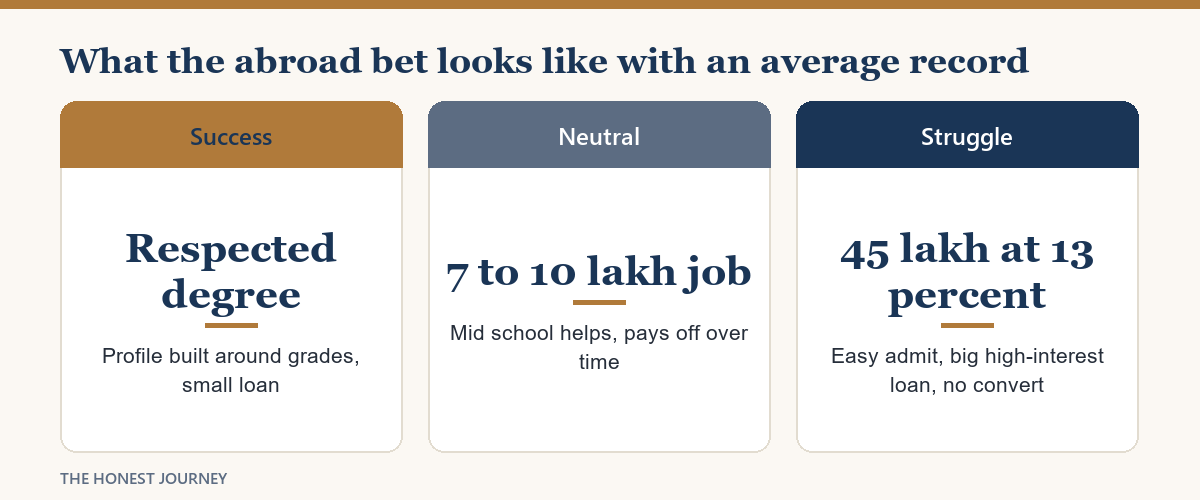
A student with a 63 percent aggregate and one cleared backlog decides to go, and plays the profile game correctly. They know grades alone will not carry them, so they spend a year building the rest of the profile: a solid test score, a genuine project or two, a clear statement of purpose that explains the marksheet honestly rather than hiding it. They target a low-tuition public university in Europe with a respected name, keeping the loan under ₹15 lakh.
They get in on the strength of the whole profile, not just the grades. The degree is respected, the debt is small, and when they graduate the modest marksheet is now three years and one foreign master’s in the past, weighted far less than it was. They land a job that pays a real multiple of their Indian starting point, and the small loan clears quickly. The average record turned out to be a footnote, because they refused to let it push them into an expensive, weak-school corner.
Neutral scenario: the outcome nobody plans for but many get
A student with a modest record takes a moderate loan for a mid-ranked school in a country with a limited job market. They finish, the degree helps somewhat, and they return to India to a ₹7 to 10 lakh role, better than the ₹4 lakh they might have started at, but not a leap. The ₹25 lakh loan gets serviced over years and eventually pays for itself, mostly because the Indian alternative was genuinely weak.
This is a real and acceptable outcome for someone whose domestic prospects were poor, as long as the loan stayed moderate. The degree did buy an improvement. It just was not a transformation, and the person needs to have wanted the improvement enough to justify the debt and the two years. Where the marksheet was the main obstacle to a decent Indian job, this trade often makes sense. Where the person simply wanted an adventure, the math is harder to defend.
Struggle scenario: what it looks like when it does not work
The one the easy-admit agents will never show you. A student with a weak record and no strong collateral is steered toward a ₹45 lakh unsecured loan at 13 percent for a low-ranked US or UK school that admitted them on the strength of their ability to pay, not their profile. The degree, when it comes, carries a brand nobody weights. In the destination country, that tier of school does not convert, and the visa runs out.
They return to India. The foreign degree from an unrecognised school does almost nothing to offset the weak marksheet, so the Indian salary is barely improved. But the loan is ₹45 lakh at 13 percent, and after the study-period moratorium capitalises the interest, the EMI is around ₹65,000 a month. On the ₹6 lakh job the degree actually unlocked, that is impossible. The average record did not cause this. The combination of a big expensive loan and a weak school did, and the student was funnelled into exactly that combination because their profile made them an easy sale.
The decision framework: questions an average-record student should answer
Am I building the rest of my profile, or just relying on schools that ignore grades? Your marksheet is one input. A strong test score, real projects, and an honest, well-argued statement of purpose can earn you respected admits. If your plan is only to find schools that will overlook the grades, you are heading for the weak-brand trap.
Is my loan small enough for a realistic outcome? Because your likely outcome is incremental and your loan may carry a higher interest rate, the loan has to be modest. Low-tuition Europe is your friend here. A ₹15 lakh loan for a ₹9 lakh outcome works. A ₹45 lakh loan for the same outcome is a trap.
Who actually employs graduates of the school admitting me? Ignore the marketing and the ease of the admit. Look at outcomes. If you cannot find graduates working where you would want to, the admit is access, not opportunity.
Would a year of strengthening my profile change my options? For an average-record student, a year spent on a good test score and real experience often unlocks meaningfully better admits and cheaper loans. That year is usually the highest-return part of the plan.
Profile factors: which average-record students land in which scenario
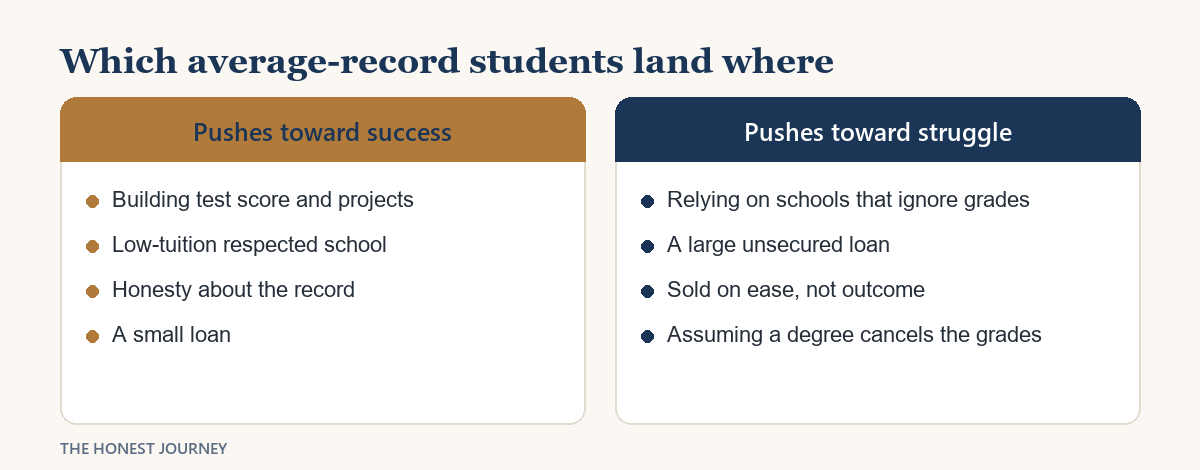
Pushes you toward success: actively building the non-grade parts of your profile; choosing low-tuition respected schools to keep the loan small; honesty about the marksheet in your applications rather than concealment; and skills that make the degree convert.
Pushes you toward struggle: taking an easy admit from an unknown school; a large, high-interest unsecured loan; being sold on the ease of the process rather than the quality of the outcome; and assuming any foreign degree cancels the grades. If these describe you, the fix is a stronger profile and a smaller loan, not a faster visa.
The backlog and gap question: cleared backlogs and explained gaps are manageable and many universities accept them. What matters is a coherent, honest narrative. Trying to hide them tends to backfire. Owning them in a clear statement of purpose, alongside evidence you have grown since, is the stronger play.
The honest closing take
An average academic record does not close the study-abroad door. It narrows it, and it raises the cost of getting the choice wrong. That is the honest truth, and it is more useful than either the false hope that any foreign degree will fix everything or the false despair that abroad is not for people like you.
You can build a genuinely good outcome abroad. The path runs through strengthening the rest of your profile, choosing a respected school rather than an easy one, and keeping the loan small enough that even a modest result pays off. The students with average records who struggle are almost never the ones who could not get in. They are the ones who let a weak marksheet push them into an expensive loan for a school that could not change their outcome.
Build the profile around the grades. Pick the school for its outcomes, not its ease. Keep the loan modest. Do those three things and the marksheet becomes a footnote. Skip them and it becomes the least expensive part of a very expensive mistake. If you are still deciding whether the whole move clears the bar for you, the study abroad decision guide and the education loan with backlogs guide take the practical steps from here.
Same decision, different starting point
The honest answer changes with who is asking. If one of these fits you better, start there instead.
- engineering graduates
- working professionals doing an MBA
- tier-2 college students
- parents funding the whole thing
- applicants in their 30s
- non-STEM and commerce graduates
FAQ
Can I study abroad with an average academic record or backlogs?
Yes. A modest marksheet and cleared backlogs do not close the door, but they narrow your admit list and can push you toward higher-cost loans. Many universities accept average records and explained backlogs if the rest of your profile is strong. The key is to build the non-grade parts of your application (test scores, projects, a clear statement of purpose) and to choose a respected school rather than the easiest admit.
Do foreign universities care about low percentage or backlogs?
Some do heavily, many weigh the whole profile. Universities vary widely, and a strong test score, relevant experience, and an honest, coherent narrative about your record can offset weaker grades at many schools. Hiding backlogs tends to backfire. Owning them with evidence of growth is the stronger approach.
Is it worth taking a big education loan with an average academic record?
Usually not. An average record often means a more expensive loan and a more incremental outcome, so a large loan is high-risk. Keeping the loan small, for example through low-tuition options in Germany or public Europe, means even a modest result pays off. A large, high-interest loan for a weak-brand school is the most common way average-record students end up in financial trouble.
Should I improve my profile before applying to study abroad?
For an average-record student, a year spent on a strong test score, real projects, and work experience often unlocks meaningfully better university admits and cheaper loans. That preparation is frequently the highest-return part of the entire plan, because it moves you from easy weak-brand admits to respected schools that can actually change your outcome.