Short answer. Almost every honest study-abroad breakdown you find quietly assumes you did engineering. The salary numbers are software salaries. The stay-back logic runs on STEM visa rules. The whole confident math is built for a computer-science graduate, and you did B.Com, or English, or economics, or psychology.
So you are left guessing whether the same conclusions apply to you, and mostly they do not. Your version of this decision is real and workable, but it runs on different numbers and different rules, and nobody writes it down.
This is the version for non-STEM graduates: commerce, humanities, social sciences, arts, and the business-adjacent fields that are not engineering. The abroad path is genuinely open to you. It is just narrower, more field-dependent, and less forgiving of a large loan than the engineer’s path, and pretending your math is the same as theirs is how non-STEM students end up over-borrowing for outcomes that were never going to look like a software salary.
Why the non-STEM path runs on different rules
Two structural things separate your decision from an engineer’s, and both matter more than anything on a brochure.
First, the salary ceiling. Software and allied STEM roles abroad start high, which is what makes an engineer’s big loan defensible. Many non-STEM fields, marketing, HR, communications, social work, general management at entry level, pay meaningfully less abroad, especially at the start. That does not make them bad choices. It means the same ₹45 lakh loan that a $120,000 software salary services comfortably is a very different weight on a €40,000 marketing salary. Your loan has to be sized to your field’s actual pay, not to the engineer’s.
Second, the visa and stay-back rules. In several countries, STEM degrees get longer post-study work windows and smoother routes precisely because those economies want technical workers. Non-STEM graduates sometimes face shorter work windows and tougher paths to stay. So the stay-back part of the plan, the thing that turns a foreign degree into a foreign career, can be structurally harder for you, and you need to check the actual rules for your field and country rather than assuming the engineer’s timeline applies.
Faz's ruleDo not size your loan to an engineer salary. Size it to what your field actually pays abroad in its first two years, which is often much less.
The confident abroad math online is built on software salaries. If you borrow like a software engineer but earn like an entry-level marketer, the loan that was comfortable for them is a trap for you. Your field is the number that matters.
The basic numbers, laid out honestly
The costs are the same regardless of field: a US masters at ₹42 to 92 lakh, the UK at ₹35 to 55 lakh for a one-year degree, Germany and public Europe at ₹18 to 28 lakh with low tuition. The difference for you is entirely on the payoff and stay-back side.
Some non-STEM paths convert well. A strong MBA or a specialised business masters, a data-heavy economics or analytics program, a well-targeted public-policy or design degree at a respected school can lead to solid salaries and reasonable stay-back. Others convert poorly for international students: general humanities masters, fields with small job markets, or programs at schools without employer relationships can leave you with a respected-sounding degree and no route to a job that pays back the loan.
So the single most important move for a non-STEM student is to pick a field-and-school combination that actually converts into employment for international graduates, and to keep the loan sized to that field’s real starting pay. The low-tuition route through Germany or public Europe is often especially smart for you, because it keeps the loan small enough that even a modest non-STEM salary services it comfortably.
Which non-STEM paths convert, and which do not
The single most useful thing a non-STEM student can do is be honest about whether their specific field converts into a job abroad, or mainly improves an Indian career. Both are valid, but they call for very different loan sizes.
| Field type | Realistic outcome | Loan guidance |
|---|---|---|
| Quantitative or specialised (analytics, quant finance, strong MBA) | Often converts to an abroad job | A larger loan can be defensible if pay is genuinely high |
| Business-adjacent (marketing, HR, management) | Mixed; lower starting pay abroad | Keep the loan moderate, size to real entry pay |
| General humanities and small-market fields | Mostly improves an Indian career | Keep the loan small; low-tuition Europe fits best |
The mistake is not choosing a non-STEM field. It is borrowing as if a small-market humanities degree paid like quant finance. Match the loan to the row you are actually in, and even the improve-your-Indian-career outcome pays off. Mismatch them, and a respected-sounding degree becomes an EMI your field cannot service.
Faz's ruleBe honest about whether your field converts abroad or mainly improves your Indian career. Both are fine. They just call for very different loan sizes.
A quant finance masters and a general humanities masters are not the same bet with different subjects. One can service a big loan on an abroad salary. The other pays off only if the loan stays small. Know which row you are in before you sign.
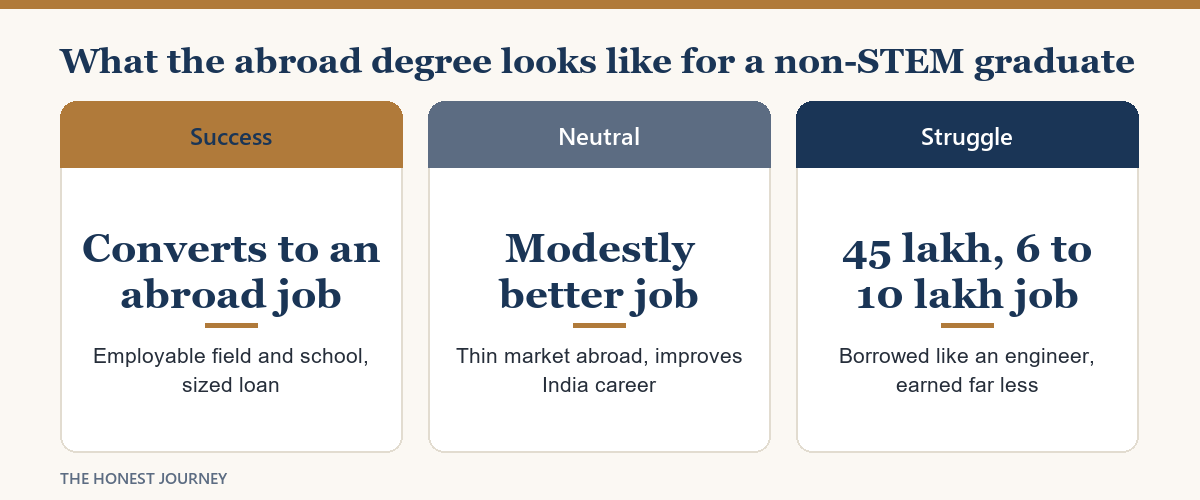
Success scenario: what it looks like when this works
A commerce graduate targets a specialised, employable masters, say business analytics or a quantitative finance program, at a respected school with real employer relationships. They pick a country and field with a workable post-study-work route, and they keep the loan modest by choosing a program where the cost matches the realistic salary. They graduate with skills employers actively want, land a role at a good local salary, use the stay-back window to build experience, and the sensible loan clears without strain.
The key was that they treated employability as the core of the choice. They did not pick the most prestigious-sounding humanities program. They picked the field-and-school combination that converts into a job for an international graduate, and they sized the loan to that job. The non-STEM label was never the problem. The specificity of the choice made it work.
Neutral scenario: the outcome nobody plans for but many get
A humanities graduate does a one-year masters in their field at a decent overseas school, funded by a moderate loan. They get an enriching education and a respected credential, but the job market for that field abroad is thin for international graduates, so they return to India. Back home, the foreign masters does help, it opens some doors in academia, content, research, or the development sector that the Indian degree alone might not have, and they land at a modestly better salary than before.
The degree paid off in the ordinary sense, over time, because the loan was moderate and the Indian alternative was genuinely improved. But it did not produce a foreign career or a dramatic salary jump, because the field did not convert abroad. For a student who valued the education and the credential for its own sake and kept the loan sane, this is a reasonable outcome. For one who expected a foreign career, the field’s structural limits made that unlikely from the start.
Struggle scenario: what it looks like when it does not work
A non-STEM graduate borrows like an engineer without earning like one. They take a ₹45 lakh loan for a general masters in a field with a small international job market, at a school without strong employer relationships, in a country where their field gets a short post-study-work window. The degree does not convert into a local job, the short work window closes, and they return to India.
Now the mismatch bites. The Indian salary the degree unlocks in their field is modest, maybe ₹6 to 10 lakh, but the EMI on a ₹45 lakh loan after moratorium capitalisation is around ₹60,000 a month. That EMI was defensible on an imagined foreign salary that their field was never likely to pay. On the actual Indian salary, it is crushing. The degree did not fail because non-STEM fields are worthless. It failed because the loan was sized to a STEM outcome while the field, school, and visa rules all pointed to a non-STEM reality.
The decision framework: questions a non-STEM graduate should answer
Does my specific field and school actually convert into a job for international graduates? This is the whole game. Look at where graduates of this exact program work, not at the school’s general reputation. Employable non-STEM paths exist, but so do dead ends that sound prestigious. Verify conversion before you commit.
What does my field really pay abroad in its first two years, and have I sized the loan to that? Do not use software salaries as your benchmark. Find the real entry pay for your field and country, and make sure the loan EMI is comfortable on that number, not on an engineer’s.
What are the actual post-study-work rules for my field? STEM often gets longer, smoother stay-back. Check whether your field and country give you a realistic window to convert the degree into a career, or whether you are structurally likely to return. Plan for the honest answer.
Would the low-tuition route protect me? Because non-STEM salaries are often lower, keeping the loan small matters even more for you. A low-tuition masters in Germany or public Europe can make even a modest outcome pay off, where a large US or UK loan for the same field would not.
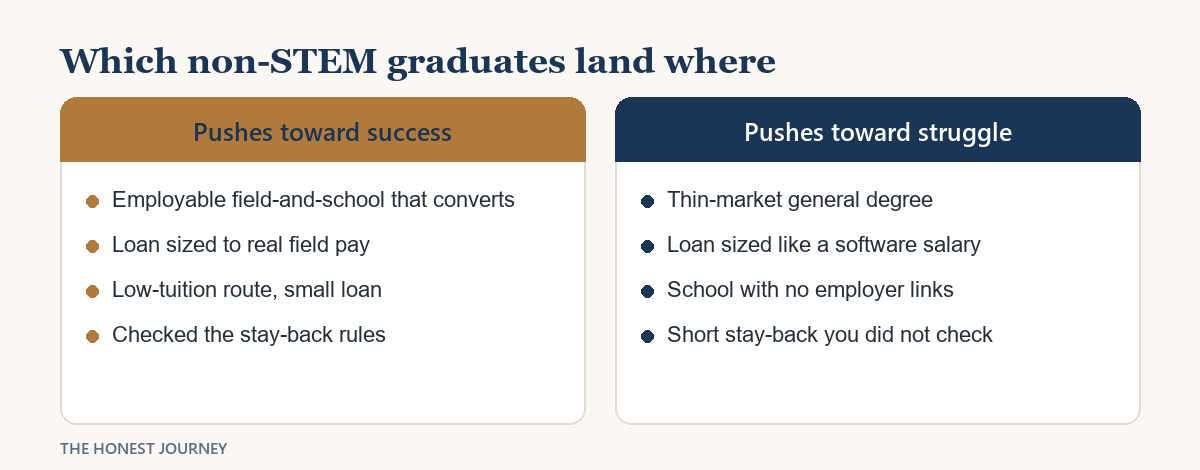
Profile factors: which non-STEM graduates land in which scenario
Pushes you toward success: choosing an employable, often specialised or quantitative, field-and-school combination that converts for international graduates; sizing the loan to your field’s real starting pay; using low-tuition routes to keep the loan small; and checking the actual post-study-work rules for your field rather than assuming the engineer’s timeline.
Pushes you toward struggle: a general degree in a field with a thin international job market; a large loan sized as if you would earn a software salary; a school without employer relationships; and a short stay-back window you did not check. If these describe your plan, the fix is a more employable field-and-school choice and a smaller loan, not just a different country.
The reframe that helps: for many non-STEM graduates, the honest best case is a respected credential and an improved Indian career, not a foreign one. If you plan around that as the realistic outcome and keep the loan sized for it, the abroad degree is a sound bet. Trouble comes from borrowing for a foreign-career outcome the field was never structurally likely to deliver.
The honest closing take
The study-abroad path is genuinely open to non-STEM graduates. Employable fields, respected credentials, and real careers abroad all exist outside engineering. But your version of the decision runs on lower salary ceilings and tougher stay-back rules than the software-salary math that dominates every guide, and the single biggest mistake you can make is to borrow as if those rules did not apply to you.
The non-STEM students who win this bet choose employability over prestige, size the loan to what their field actually pays, and use low-tuition routes to keep the debt small enough that even a return to India pays off. The ones who struggle borrow like engineers, pick fields that do not convert, and discover too late that a respected-sounding degree does not service a large loan on a modest salary. Your field was never the problem. Treating it like an engineer’s was.
Verify that your field and school convert. Size the loan to your real pay. Keep it small through low-tuition routes if you can. Do that, and a non-STEM degree abroad is a genuinely good investment. Skip it, and you will have paid an engineer’s price for an outcome your field was never going to match. For where specific countries and courses actually lead, the best-country breakdown and the study abroad decision guide carry it forward.
Same decision, different starting point
The honest answer changes with who is asking. If one of these fits you better, start there instead.
- engineering graduates
- working professionals doing an MBA
- tier-2 college students
- students with an average academic record
- parents funding the whole thing
- applicants in their 30s
FAQ
Is studying abroad worth it for non-STEM and commerce graduates from India?
It can be, but the math is different from an engineer’s. Non-STEM fields often have lower starting salaries abroad and sometimes shorter post-study-work windows, so the same loan that a software salary services easily can be a heavy burden on a marketing or humanities salary. The key is choosing an employable field-and-school combination and sizing the loan to your field’s real pay, not to STEM salaries.
Which non-STEM fields have good job prospects abroad?
Specialised and quantitative programs tend to convert better: business analytics, quantitative finance, a strong MBA, well-targeted public policy, economics, or design at schools with real employer relationships. General humanities and fields with small international job markets convert poorly for foreign graduates. Always look at where a specific program’s graduates actually work rather than at the school’s general reputation.
How much education loan is safe for a non-STEM degree abroad?
Size it to your field’s actual starting salary abroad, which is often well below software salaries, and keep it comfortable even if you return to India. Low-tuition routes through Germany or public Europe are especially useful for non-STEM students, because a small loan means even a modest outcome pays off. Borrowing a STEM-sized loan for a non-STEM salary is the most common non-STEM mistake.
Do non-STEM graduates get post-study work visas abroad?
Often yes, but the rules can be less generous than for STEM graduates, who frequently get longer work windows because those economies prioritise technical workers. Post-study-work eligibility varies by country and sometimes by field, so check the actual rules for your specific field and destination rather than assuming the longer STEM timelines apply to you, and plan around the honest answer.