Short answer. Studying abroad is usually framed as the student’s decision, but when the money comes from family savings, a broken fixed deposit or pledged property, it is a family decision too. This is the parent’s side of the maths: what the loan actually costs, what is realistic to recover, and what to ask before committing.
Your child got the admit. The WhatsApp forwards have started, the relatives are impressed, and somewhere in the middle of the pride is a number you have not said out loud yet: the loan, or the savings, or the fixed deposit you would have to break, or the property you would have to pledge. Studying abroad is usually framed as the student’s decision. When the money comes from the family, it is your decision too, and it deserves the same honest math the student’s ambition gets.
This is the version for the parents and the co-applicants, the people whose signature and whose assets actually make it possible. Not the student’s version. Your question is not “which university.” It is “can our family carry this, and what happens to us if the outcome is not the one in the brochure.” Nobody asks you that gently, so I will.
Why the family is taking a bigger risk than the student
Here is the part that gets lost in the excitement. When a family funds an abroad education, the student carries the ambition, but the family carries the downside. If the degree does not convert into the job everyone expects, the student can restart their career. The parents who pledged the house or drained the retirement fund cannot restart their retirement. The asymmetry is real and it is rarely discussed.
As a co-applicant, you are not a formality. You are legally and financially on the hook for the entire loan. If the EMIs do not get paid, the bank comes to you, not to some abstract entity. Your CIBIL score, your assets, and in a secured loan your pledged property are directly exposed. A parent who co-signs a ₹45 lakh loan has taken on a ₹45 lakh obligation, full stop, regardless of how the degree turns out.
This does not mean do not do it. Families fund abroad education successfully all the time. It means the decision has to be made with the family downside in full view, not just the student upside, because you are the one holding the downside.
Faz's ruleThe student carries the ambition. The family carries the downside. A co-applicant is on the hook for the whole loan whether or not the degree pays off.
If it works, the student thrives and everyone celebrates. If it does not, the parent who pledged the house is the one who cannot restart. Make this decision looking at your downside, not only their upside.
The basic numbers, laid out honestly
Whatever the total, funding usually comes from one of three sources, and each has a different real cost to the family.
An education loan. A ₹40 lakh loan at 11 percent over 10 years, after the study-period moratorium capitalises interest, means an EMI in the region of ₹55,000 to 60,000 a month for a decade. If the student earns well abroad, they service it. If they cannot, that EMI lands on you. The question is not whether ₹40 lakh is affordable in the abstract. It is whether your family could absorb that EMI if the student’s income did not arrive on schedule.
Breaking savings or fixed deposits. This feels safer because there is no interest and no lender. But it has a hidden cost: the returns you give up, and the safety buffer you erase. Draining the retirement corpus or the emergency fund to avoid a loan can leave the family exposed to a medical event or a job loss with no cushion. Sometimes a moderate loan that preserves the family safety net is the more conservative choice than self-funding that empties it.
Pledging or selling property. The highest-stakes option. A secured loan against the house gets a lower interest rate, which is genuinely valuable, but it puts the family home directly on the line if the loan sours. Selling an asset to fund tuition converts a permanent family asset into a one-time education bet. That can be the right call, but it should be a deliberate one, not a default reached because the loan felt scary.
The three funding sources, costed honestly
Families tend to compare funding options on the obvious number, the interest rate, and miss the cost that actually matters: what each option does to the family safety net. Here is the fuller picture.
| Source | Obvious cost | The hidden cost that matters |
|---|---|---|
| Education loan | Interest, roughly ₹55,000/month EMI on ₹40 lakh | Co-applicant is on the hook for the whole loan if the outcome fails |
| Breaking savings or FDs | No interest, feels free | Erases the emergency and retirement buffer that protects the family |
| Pledging or selling property | Lower secured-loan rate | Puts the family home on the line; a sold asset is gone for good |
The insight families miss is that avoiding a loan is not the same as reducing risk. Draining the retirement corpus to sidestep an EMI can leave the family more exposed than a moderate loan would, because it removes the cushion that a job loss or a medical event would otherwise land on. The safest structure is often a right-sized loan that keeps the buffer intact, not the option that feels debt-free.
Faz's ruleAvoiding a loan is not the same as reducing risk. Draining the emergency fund to skip an EMI can leave the family more exposed, not less.
The debt-free path feels safer because there is no lender to fear. But a family with no buffer is one hospital bill away from a crisis. Sometimes the moderate loan that preserves your cushion is the genuinely conservative choice.
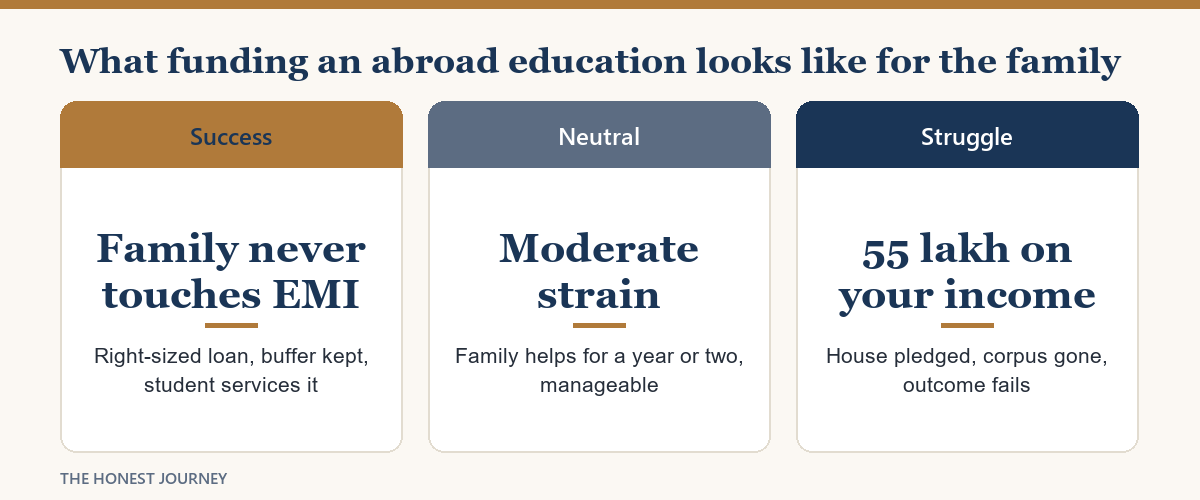
Success scenario: what it looks like when this works
A family funds a ₹35 lakh loan for a strong student going to a respected program. They size it deliberately: the student has a genuinely strong profile and a target-school admit, so the odds of a good outcome are high, and crucially the family confirms upfront that they could absorb the EMI for a year or two if the student’s income were delayed. They keep their emergency fund intact rather than draining it.
The student graduates, lands a well-paying job, and services the loan from their own salary within months. The family never has to touch the EMI. Their retirement fund was never at risk because they used a right-sized loan instead of emptying it, and their emergency buffer stayed in place the whole time. The bet paid off, and even if it had been delayed, the family had built in the room to survive the delay. That room is what made it a sound decision, not just a lucky one.
Neutral scenario: the outcome nobody plans for but many get
A family funds a ₹30 lakh loan. The student does fine but not spectacularly, taking a while to find a job and then earning modestly, so for the first couple of years the family helps with part of the EMI. It is a strain, but a manageable one, because the loan was moderate and the family had some cushion. Over time the student takes the EMI over fully, and the loan closes a few years later than hoped.
The degree paid off, but the family carried more of the load, for longer, than the brochure implied. This is a common and survivable outcome when the loan was sized sensibly and the family kept a buffer. It becomes a crisis only when the loan was large and the family had no room to absorb the shortfall. The lesson is not that the degree failed. It is that the family cushion is what turned a rough patch into a manageable one rather than a disaster.
Struggle scenario: what it looks like when it does not work
The one that keeps parents awake later. A family, swept up in the admit and reluctant to say no, funds a ₹55 lakh commitment by pledging the house for a secured loan and topping it up from the retirement corpus. The student goes to an expensive program, the outcome does not convert, no job abroad materialises, and they return to India to a modest salary that cannot cover the EMI.
Now the family is servicing a ₹55 lakh loan on their own income in their late fifties, the retirement corpus is gone, and the house is pledged against a debt the student’s salary cannot touch. The parents cannot restart their retirement the way the student can restart their career. What was meant to be the family’s proudest investment has become the thing that defines their sixties. The student will recover. The parents may not, financially.
This outcome is almost always the product of a loan sized to the dream, funded by draining the family safety net, decided under the emotional pressure of not wanting to deny an eager child. Every one of those factors was in the family’s control at the point of signing.
The decision framework: questions the family should answer
Could we absorb the EMI ourselves for a year or two if the student’s income were delayed? This is the core test. The loan is only safe if the answer is yes. If a delayed or weak outcome would sink the family finances, the commitment is too large, no matter how good the admit looks.
Are we keeping a safety net, or emptying it? Funding that drains the retirement corpus or the emergency fund to zero leaves the family exposed to any shock. Often a moderate loan that preserves the buffer is more conservative than self-funding that erases it. Do not confuse avoiding a loan with reducing risk.
Is the loan sized to the realistic outcome or the dream? A right-sized loan for a strong student with a target-school admit is a reasonable bet. A large loan for a weak profile at an expensive school is the family taking on the student’s downside. Size the commitment to what the student can realistically service, not to the best case.
Are we deciding this on the math, or on not wanting to disappoint? The emotional pressure of an eager child and impressed relatives is real, and it is exactly what pushes families into oversized commitments. Separate the pride from the math. Saying “yes, but at this size” or “yes, but to this school” is not denying your child. It is protecting the whole family.
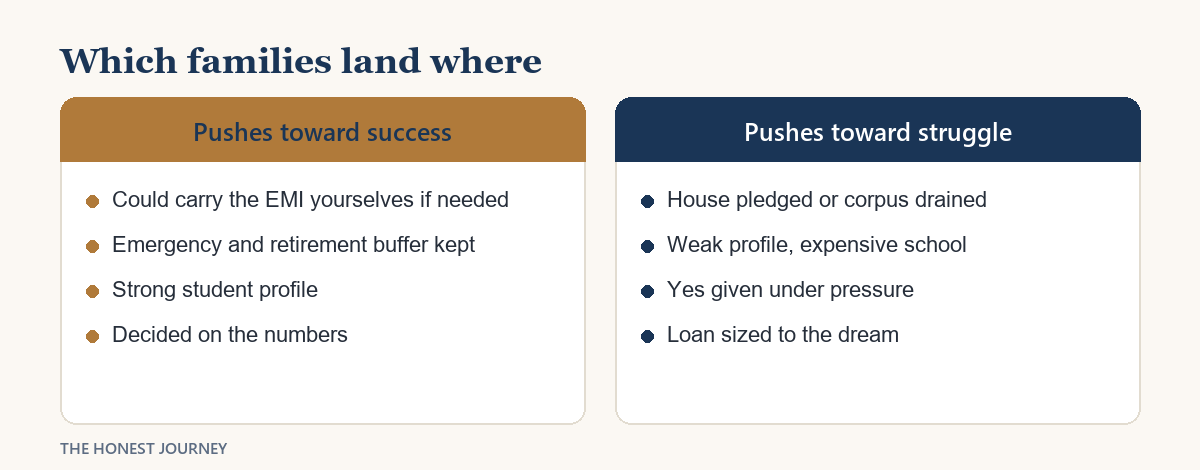
Profile factors: which families land in which scenario
Pushes you toward a good outcome: a loan or funding amount whose EMI you could carry yourselves if needed; keeping the emergency and retirement buffers intact; a genuinely strong student profile that makes a good outcome likely; and a decision made on the numbers rather than under emotional pressure.
Pushes you toward the struggle scenario: pledging the house or draining retirement to fund an oversized commitment; a weak student profile at an expensive school; and a yes given because refusing felt impossible. If these describe your situation, the protective move is to cap the amount, choose a lower-cost school or country, or ask the student to strengthen their profile first.
The co-applicant reality: if you are the co-applicant, understand that your credit and assets are fully committed for the loan’s life. That is not a reason to refuse. It is a reason to size the loan so that being on the hook for it would never break you.
The honest closing take
Funding a child’s education abroad can be one of the best investments a family ever makes. When the student is strong, the school is respected, and the loan is sized so the family could carry it in a bad year, the bet usually pays off and everyone is glad they made it.
But the family, not the student, holds the downside, and that changes what a responsible yes looks like. A responsible yes is sized to what you could survive if the outcome disappointed, funded in a way that keeps your safety net intact, and decided on the numbers rather than under the pressure of not wanting to say no. The families who get hurt are almost never the ones whose child failed. They are the ones who committed more than they could absorb, drained the buffer that would have saved them, and let pride set the number.
Say yes if the math says your family can carry the downside. Say “yes, but smaller” or “yes, but a cheaper path” if it cannot. That is not a lack of faith in your child. It is the version of support that does not put your own future on the line. For the loan mechanics behind these choices, the co-applicant guide and the loan versus self-funding breakdown are the next reads.
Same decision, different starting point
The honest answer changes with who is asking. If one of these fits you better, start there instead.
- engineering graduates
- working professionals doing an MBA
- tier-2 college students
- students with an average academic record
- applicants in their 30s
- non-STEM and commerce graduates
If the household is moving together, the family rules matter as much as the money. Four of the seven big destinations restricted dependants in the last two years. See what each country allows.
FAQ
Should a family take a large education loan to send a child to study abroad?
Only if the family could absorb the EMI themselves for a year or two if the student’s income were delayed. The family, as co-applicant, holds the downside: if the degree does not convert, the loan still has to be paid. A right-sized loan for a strong student with a good admit is a reasonable bet. A large loan for a weak profile, funded by draining the family safety net, is high-risk.
Is it better to break savings or take an education loan for studying abroad?
It depends on your safety net. Self-funding avoids interest but can erase the emergency and retirement buffers that protect the family from a medical event or job loss. Sometimes a moderate loan that preserves the buffer is more conservative than self-funding that empties it. Avoiding a loan is not automatically the lower-risk choice.
What is the risk of being a co-applicant on an education loan?
As a co-applicant you are legally and financially responsible for the entire loan. If the EMIs are not paid, the bank pursues you, your CIBIL score, your assets, and any pledged property. This is why the loan should be sized so that being on the hook for it would never break the family, even if the student’s outcome disappoints.
Should we pledge our house for a secured education loan?
A secured loan against property gets a lower interest rate, which is valuable, but it puts the family home directly at risk if the loan sours. It can be the right choice for a strong student and a sensible loan size, but it should be a deliberate decision made with the downside in view, not a default reached because an unsecured loan felt intimidating.