Short answer. Everyone in the study-abroad conversation seems to be 22. The forums, the counseling, the intake photos, all of it assumes a fresh graduate with a blank runway. You are 31, maybe 34. You have a career, possibly a spouse, possibly a child, definitely a salary you would be walking away from.
And the question underneath your research is one nobody addresses directly: is it too late, and does the math still work when you have fewer working years left to earn it back.
This is the version for people considering a masters abroad in their 30s. Not the 22-year-old version, where time is cheap and the runway is long. Your runway is shorter and your current life is more built, which changes the calculation in ways the generic advice completely ignores. It is not too late. But the reasons that make it worth it are different for you.
What being in your 30s actually changes
Three things shift when you do this later, and all three matter.
First, the runway. A 22-year-old has 35-plus working years to earn back a two-year investment. At 33 you have fewer, so the same degree has less time to pay off. This does not kill the case, but it raises the bar. The payoff has to be faster or larger to justify the same cost.
Second, the opportunity cost. You are giving up an established salary, not a fresher’s stipend. Walking away from a ₹20 lakh job for two years is a much bigger sacrifice than a new graduate leaving a ₹5 lakh one. Your forgone earnings are among the largest costs in the whole decision.
Third, the immigration clock. Several countries have age-related points in their permanent-residency systems, and PR points can start declining after your early 30s in places like Canada and Australia. If part of your goal is to settle abroad, age is not just a personal factor, it is a scoring factor in the system you are trying to enter. That is a real, mechanical consideration that a 22-year-old never has to think about.
Faz's ruleIn your 30s the degree does not need to be a general upgrade. It needs a specific reason: a career switch, a PR pathway, or a market you cannot reach from India.
A 22-year-old can afford a vague bet on a better future. With a shorter runway and a bigger salary to give up, you need a concrete reason the degree pays off, not just a feeling that it might.
The basic numbers, laid out honestly
The costs are the usual ones, but they land harder because of your forgone salary. A US master’s at ₹42 to 92 lakh plus two years of a ₹20 lakh salary given up means a true cost well over ₹1 crore. A one-year program in the UK or a low-tuition masters in Germany compresses that, because you lose one year of salary instead of two and the tuition is lower, which is often why the 30s cohort leans toward shorter or cheaper programs.
The payoff side depends heavily on your specific reason for going. If the degree enables a genuine career switch into a higher-paying field, or gives access to a job market you simply cannot reach from India, the shorter runway can still be worth it because the jump is large. If it is a general upgrade to a career already going fine, the shorter runway and bigger opportunity cost make the case weak.
For the PR-focused, the calculation is different again. Here the master’s is partly a tool to earn local qualifications and points in a country you intend to settle in. In that frame the ROI is measured over a life abroad, not a two-year payback, but the age-related points decline means the window to start is narrower than it looks, and delaying a few more years can quietly close it.
The runway math, by age
The reason your 30s changes the decision is arithmetic, not attitude. The same degree has fewer years to pay off and a larger salary to earn back. Seeing it laid out makes the sharper bar obvious.
| Factor | At 22 | At 32 |
|---|---|---|
| Working years to earn it back | 35-plus | 25 or fewer |
| Salary given up per year | ~₹5 lakh (fresher) | ~₹20 lakh (established) |
| PR points for age | Near maximum | Declining in several systems |
| What justifies it | A general bet on a better future | A specific switch, PR route, or closed market |
None of this says do not go. It says the reason has to be sharper and the cost lower, because both the payback time and the forgone salary work against you. The 30s applicant who names a specific, high-value reason and picks a shorter, cheaper program is doing exactly what the arithmetic demands. The one who goes for a vague upgrade on a two-year, full-price program is fighting the runway math head-on.
Faz's ruleYour 30s does not close the door. It raises the bar, because the degree has fewer years to pay off and a bigger salary to earn back.
This is arithmetic, not discouragement. A sharper reason and a cheaper, shorter program are how you clear the higher bar. Fight the runway math with a vague upgrade on a full-price program and it usually wins.

Success scenario: what it looks like when this works
A 32-year-old in a stagnating domain uses the masters as a deliberate career switch and a PR route. They pick a country with a clear post-study-work and PR pathway, choose a one-year or low-cost program to limit both tuition and forgone salary, and go in with a specific target field in mind. They finish, use the post-study-work visa to land a role in the new field at a solid local salary, and begin accumulating the local experience and points that lead to PR while their age still scores reasonably.
Five years later they are settled abroad in a career they could not have switched into from India, with PR in hand, and the modest loan is long closed. The shorter runway did not matter, because the degree bought two large things at once, a career change and a life abroad, that were genuinely unavailable otherwise. They went in their 30s not despite the timing but because that was when they knew exactly what they wanted from it.
Neutral scenario: the outcome nobody plans for but many get
A professional in their mid-30s does a one-year masters abroad, gets a job in the same field they were already in, at a salary that, after a higher cost of living, is comfortable but not transformative. They enjoy the international experience and the stability, but in pure financial terms, given the year of salary they gave up and the loan they took, they are roughly where a continued Indian career would have put them, just in a different country.
If they wanted the life abroad for its own sake, this is a win. If they expected the degree to also be a financial leap, the shorter runway meant it did not have enough years to become one. This is a common outcome for the 30s cohort who go for a general upgrade rather than a specific switch, and whether it counts as success depends entirely on whether the life abroad, rather than the money, was the real goal.
Struggle scenario: what it looks like when it does not work
A 35-year-old leaves a ₹25 lakh job and takes a ₹50 lakh loan for a two-year US masters, going for general career growth rather than a specific switch, and without a clear PR plan. The degree does not open a dramatically better door than the one they left, the US job does not convert through the visa lottery, and they return to India after two years.
Now the runway problem bites hardest. They restart in India in their late 30s, often at a salary not much above what they left, having given up two years of a strong salary and taken on a ₹50 lakh loan with an EMI near ₹70,000 a month. With fewer working years left to recover, the setback is harder to earn back than it would be for someone a decade younger. The degree did not just fail to pay off. It consumed a chunk of a shorter remaining runway.
The difference from the success scenario was not age itself. It was going without a specific, high-value reason, and taking a large two-year bet when a shorter, cheaper, more targeted one was the right shape for someone with less time to recover.
The decision framework: questions a 30s applicant should answer
What specific thing does this degree buy that I cannot get otherwise? At your age a general upgrade is not enough. A career switch, a PR pathway, or access to a market closed to you from India are the reasons that justify the shorter runway. If you cannot name a specific one, the case is weak.
Have I minimised the two biggest costs, forgone salary and tuition? A one-year or low-tuition program cuts both, and for the 30s cohort that shape usually fits better than a long, expensive one. The less runway you have, the more the cost side needs to be contained.
If PR is the goal, does the age math still work? Check the actual points systems of your target countries. Age-related points decline through your 30s, so confirm you still score enough, and recognise that waiting a few more years may close the window. This is mechanical, not emotional. Run the numbers.
Could I survive the downside on a shorter runway? If the outcome disappoints and you return to India, you have fewer years to recover than a younger person. That makes a modest, survivable loan even more important. Size the bet so a bad outcome is a setback, not a decade-defining one.
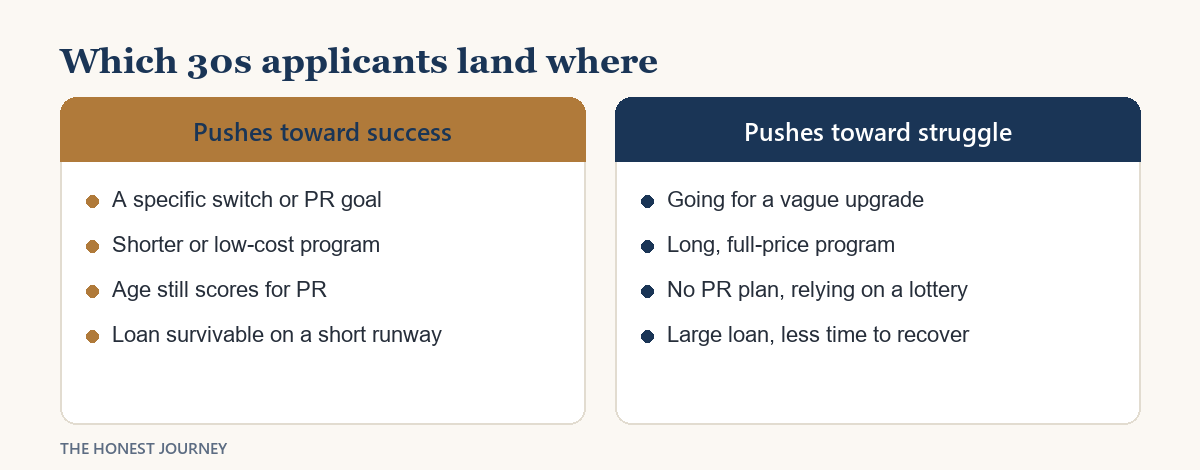
Profile factors: which 30s applicants land in which scenario
Pushes you toward success: a specific career switch or PR goal the degree genuinely enables; a shorter or low-cost program that limits forgone salary and tuition; target countries where your age still scores for PR; and a loan small enough to survive a disappointing outcome on a shorter runway.
Pushes you toward struggle: going for general growth rather than a specific reason; a long, expensive two-year program that maximises forgone salary; no clear PR plan while relying on a visa lottery; and a large loan that a shorter remaining career cannot comfortably earn back. If these describe you, the fix is a sharper reason, a cheaper program, or staying put.
The family factor: if you have a spouse or child, the move is not just yours. Their careers, schooling, and settling costs are part of the real price, and a supported family move to a PR-friendly country is a very different, often stronger, bet than a solo two-year study stint that uproots everyone with no settling plan.
The honest closing take
It is not too late to study abroad in your 30s. Plenty of people make the move later and build excellent outcomes from it. But the reasons that make it worth it are narrower and more specific than they are at 22, because your runway is shorter and the salary you are giving up is larger.
The 30s applicants who win this bet go for a concrete reason, a career switch, a PR pathway, a market they cannot reach from home, and they minimise the cost side with a shorter or cheaper program and a survivable loan. The ones who struggle go for a vague upgrade, pay full price for a long program, and find that a shorter runway leaves less room to recover when the outcome disappoints. Age did not decide their outcomes. The specificity of the reason and the size of the bet did.
Name the specific thing the degree buys. Contain the cost. Check the PR math if that is your goal. If a concrete, valuable reason survives all three, your 30s is a perfectly good time to go. If the reason is only that you feel behind, the degree is an expensive answer to a problem it may not solve. For the country-level PR and return math, the is studying abroad worth it breakdown and the return to India guide continue from here.
Same decision, different starting point
The honest answer changes with who is asking. If one of these fits you better, start there instead.
- engineering graduates
- working professionals doing an MBA
- tier-2 college students
- students with an average academic record
- parents funding the whole thing
- non-STEM and commerce graduates
Applicants in their 30s are the most likely to be bringing a partner or children. Whether that is even possible depends entirely on the country. See the dependants comparison.
FAQ
Is it too late to study abroad in your 30s as an Indian student?
No, but the case is narrower than at 22. A shorter working runway and a larger salary given up mean the degree needs a specific, high-value reason, a career switch, a PR pathway, or access to a market you cannot reach from India, rather than a general upgrade. With a concrete reason, a contained cost, and a survivable loan, studying abroad in your 30s can work very well.
Does age affect PR chances when studying abroad?
Yes. Several countries, including Canada and Australia, use points systems where age-related points decline through your 30s. If settling abroad is part of your goal, your age is a scoring factor in the system you are entering, not just a personal one. Check the actual points math for your target countries, and note that waiting a few more years can quietly narrow the window.
Should I quit a good job in India to study abroad in my 30s?
Only if the degree buys something specific you cannot get by staying, since you are giving up an established salary and two of a smaller number of remaining working years. Walking away from a 20 lakh job for a general upgrade rarely pays off on a shorter runway. Walking away for a genuine career switch or a clear PR route to a country you want to settle in can be worth it.
One-year or two-year masters abroad in your 30s?
For the 30s cohort a one-year or low-tuition program usually fits better, because it cuts the two largest costs: tuition and the salary you forgo while studying. A long, expensive two-year program maximises both, which is harder to justify with a shorter runway to earn it back. Choose the shortest program that still delivers your specific reason for going.