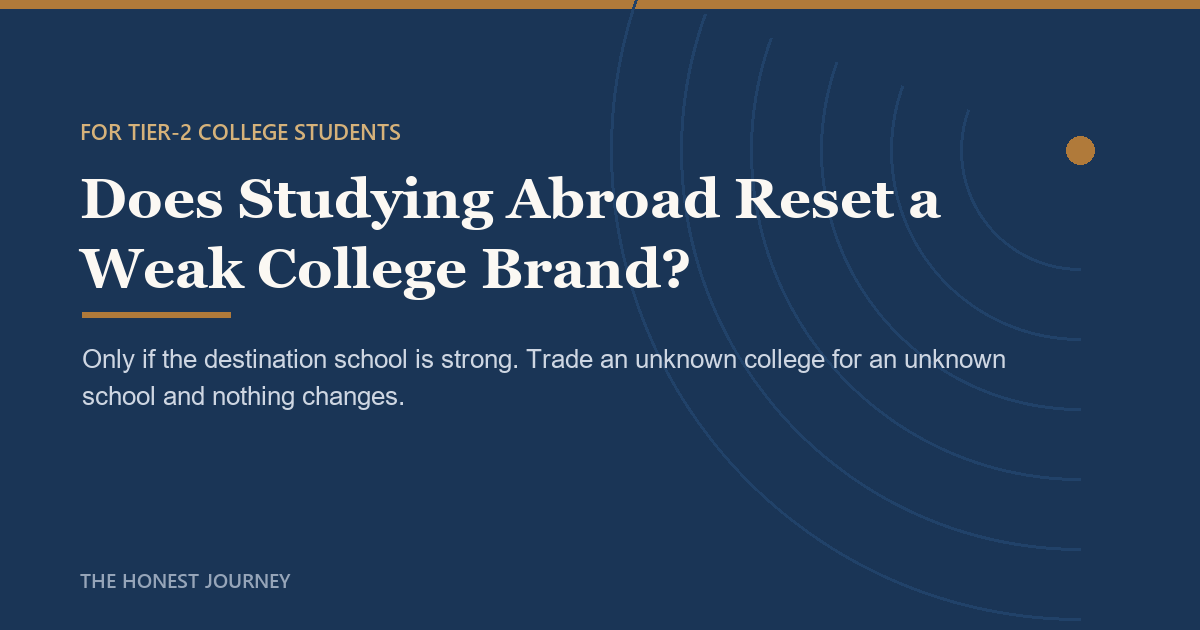
Short answer. A degree from a college without a brand name does limit you, and studying abroad can reset that, but only partly. The reset depends on choices made before you leave: which country, which course, and whether the destination has a post-study work route long enough to turn the degree into real experience.
You did your degree at a college nobody outside your state has heard of. Not a bad college. Just not a brand. And somewhere along the way you absorbed the idea that studying abroad is the reset button, the thing that finally puts a name on your resume that opens the doors your college kept shut. That instinct is half right and half a trap, and which half you land in depends on choices you make before you ever board the flight.
This is the version for students from tier-2 and tier-3 colleges. Not the IIT or NIT version, where the calculation is different because the brand already exists. If your college is your disadvantage, an abroad degree can genuinely fix it, or it can bury a fixable disadvantage under an unfixable loan. The difference is entirely in the execution.
Where a college brand is working against you, the application documents are the part you still control. See the statement of purpose and the letter of recommendation.
Tempted by a university that waives IELTS? A no-test offer can signal a less selective school, which matters most from a tier-2 start. Read what a no-IELTS offer really signals.
What an abroad degree actually resets, and what it does not
Here is the honest mechanism. In India, your undergraduate college brand follows you for years. Recruiters filter by it, and a tier-2 tag means you get filtered out of rooms before you can show what you can do. This is unfair and it is also real.
A foreign master’s from a well-regarded university genuinely overwrites that tag. Once you have an MS from a school that recruiters respect, the conversation shifts to that degree and your skills, and your undergraduate college recedes into a line at the bottom of the resume. That is the real, valuable reset, and it is why the abroad instinct is half right.
But it only works if the foreign university is itself a brand recruiters respect. If you trade an unknown Indian college for an unknown foreign one, chosen because it gave an easy admit and a visa, you have not reset anything. You have added ₹40 lakh of debt and a two-year gap to the same weak-brand problem. The tag did not change. It just got more expensive. That is the trap half, and it is the most common mistake students in your position make.
Faz's ruleAn abroad degree only overwrites a weak college brand if the new brand is strong. Trading an unknown Indian college for an unknown foreign one changes nothing but the loan.
The reset you are paying for is the reputation of the destination university. If that reputation is also weak, you bought a plane ticket and a debt, not a fresh start. The school you pick matters more for you than for anyone else.
The basic numbers, laid out honestly
Your decision has a specific shape because of your starting point. A tier-2 graduate often faces a soft Indian job market at ₹3.5 to 6 lakh, so the opportunity cost of leaving is low, which makes the abroad bet look attractive. That part is true. But the same weak-brand starting point also means you have to be more careful about the destination school than a IIT graduate does, because you are relying on the new brand to do all the lifting.
The money is the same as for anyone: a US master’s runs ₹42 to 92 lakh all in, Germany and much of Europe ₹18 to 28 lakh with low tuition, and the UK ₹35 to 55 lakh for a one-year degree. The loan of ₹30 to 50 lakh is the same loan. What is different for you is that the penalty for picking a weak destination school is higher, because you had less brand equity to fall back on if the degree does not convert.
So the counter-intuitive truth is that a tier-2 student should be more selective about university ranking than a tier-1 student, not less. The IIT graduate can survive a mediocre foreign school because their undergraduate brand still carries weight. You cannot. The destination school is your whole thesis.
Reset or no reset: the two outcomes side by side
The entire tier-2 decision comes down to one fork, and it is worth seeing in plain numbers. The variable is not effort or luck. It is the strength of the destination brand you choose.
| Factor | Respected destination school | Easy-admit unknown school |
|---|---|---|
| Brand reset | Yes, recruiters weight the degree | No, weak tag stays |
| Smart cost route | Low-tuition Europe, loan under ₹15 lakh | Often ₹35 lakh to ₹45 lakh loan |
| Job conversion abroad | Realistic | Poor for that tier of school |
| Outcome if you return to India | Degree offsets the tier-2 tag | Tag intact, plus a large EMI |
| The bet in one line | Small loan, real reset | Big loan, no reset |
Both students worked hard. Both got an admit and a visa. The only difference was that one refused to go until the destination brand was strong, and the other took the first door that opened. That single choice, made months before departure, decided everything downstream.
Faz's ruleLook at where a school graduates actually work before you accept its offer. That single check separates the reset from the trap for a tier-2 student.
The marketing brochure is designed to make a weak-brand school feel like a lifeline to someone with a weak-brand college. Ignore it. The employment page, or its absence, tells you whether the reset you are paying for is real.
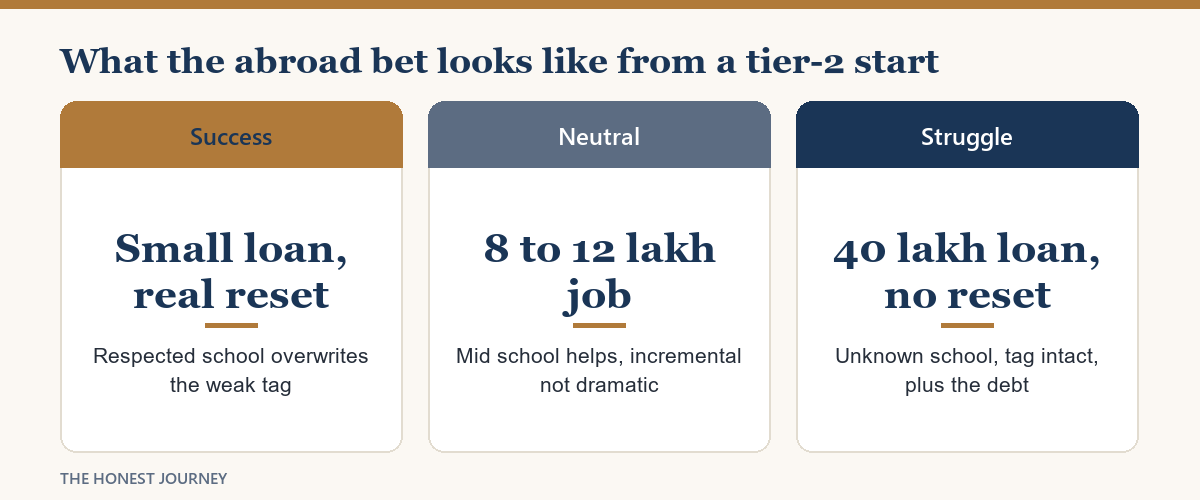
Success scenario: what it looks like when this works
A student from a tier-3 engineering college, ₹4.5 lakh job on the table, decides to go. Crucially, they treat the destination-school choice as the entire decision. They spend a year strengthening their profile, projects, a good GRE, targeted applications, and get into a solidly-ranked public university in Germany or a respected US state school with a real recruiting presence. Near-zero tuition in the German case keeps the loan small.
They graduate with a degree that recruiters actually respect. The first job is now a conversation about that degree and their skills, not about the college they left behind. Three years later they are earning a multiple of the ₹4.5 lakh they would have started at in India, and the weak-brand problem that would have followed them for a decade is simply gone. The abroad bet did exactly what it was supposed to do, because they made the destination brand strong and kept the loan sane.
Neutral scenario: the outcome nobody plans for but many get
A tier-2 student goes to a mid-ranked university in a country with limited stay-back, funds it with a moderate loan, and gets a decent but not transformative degree. They come back to India, and the foreign master’s does help. It gets them past some of the filters that the tier-2 undergraduate tag alone would have failed. They land at ₹8 to 12 lakh, better than the ₹5 lakh they would have started at.
But the loan was ₹30 lakh, and the improvement, while real, is incremental rather than transformative. They are ahead of where they would have been, and the degree paid for itself over time, but it did not vault them into a different class of outcome. For a student whose alternative was a genuinely weak Indian start, this is still a net positive. It just is not the dramatic reset the brochures imply. Whether it was worth it depends on how weak the Indian alternative honestly was.
Struggle scenario: what it looks like when it does not work
The trap in full. A tier-3 student, eager to go and light on options, takes an admit from a low-ranked foreign university, the kind that markets aggressively to Indian students and admits almost everyone. The loan is ₹40 lakh. The degree, when they finish, carries a brand recruiters do not recognise, so it does not overwrite the weak undergraduate tag at all. In the destination country, that tier of school does not convert into a job, and the stay-back window closes.
They return to India with the same weak-brand problem they left with, now plus a ₹40 lakh loan and a two-year gap. The EMI is around ₹55,000 a month. The Indian salary the degree unlocks is barely different from what they would have earned without it, because the foreign school was not one anyone weights. The reset never happened. They paid full price for a brand that did not exist.
This is the outcome that the “just get any admit and go” advice produces, and it is common precisely among students who feel they have the least to lose. The loan makes sure they had more to lose than they thought.
The decision framework: questions a tier-2 student should answer
Does the destination school actually carry a brand recruiters respect? This is your entire thesis. Look at where its graduates work, not at its marketing. If you cannot find evidence that employers you would want pipeline from it, the reset you are paying for does not exist.
Am I picking this school because it is strong, or because it admitted me easily? Easy admits to weak-brand schools are the trap. If your only admits are to schools nobody weights, the honest move is to strengthen your profile and reapply, not to go anyway because you are impatient.
Is the loan small enough that an incremental outcome still works? Because your starting point is weak, even the neutral outcome can be fine, if the loan is modest. A ₹15 lakh loan for a ₹9 lakh Indian outcome works. A ₹40 lakh loan for the same outcome does not. Keep the loan sized to the realistic, not the dream, result.
Would strengthening my profile in India first change my admits? A year of good work experience, a strong test score, and real projects can move you from weak-brand admits to respected-brand admits. For a tier-2 student, that year is often the highest-return move in the whole plan.
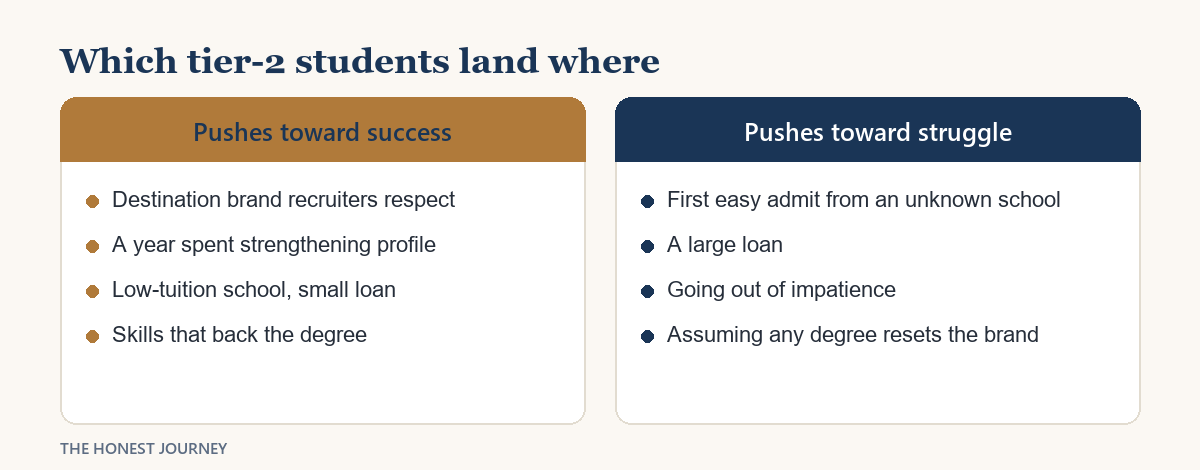
Profile factors: which tier-2 students land in which scenario
Pushes you toward success: treating the destination-school brand as the core decision; a willingness to spend a year strengthening your profile to earn a respected admit; choosing lower-cost strong schools (Germany and public Europe) to keep the loan small; and skills that back up the degree.
Pushes you toward struggle: taking the first easy admit from an unknown school; a large loan; going out of impatience with a weak Indian start; and assuming any foreign degree resets the brand. If these describe you, the fix is not a visa. It is a stronger application to a better school, or a smaller loan.
The thing tier-1 students get to ignore that you cannot: destination-school ranking. An IIT graduate can absorb a mediocre foreign school. You are relying on the new brand to do all the work, so it has to be a real one. Be more selective than your IIT peers, not less.
The honest closing take
For a student from a tier-2 or tier-3 college, studying abroad is one of the genuinely effective ways to overwrite a college-brand disadvantage that Indian recruiting will otherwise hold against you for years. That opportunity is real and I would not talk anyone out of it lightly.
But the entire value depends on the one variable you are most tempted to compromise on: the strength of the destination school. Go to a respected university and the reset works and the debt is worth it. Go to whichever school admitted you fastest, funded by a large loan, and you keep the exact problem you were trying to solve while adding a new one you cannot pay off. The tier-2 student who wins this bet is not the one who went. It is the one who refused to go until the destination brand was strong enough to justify it.
Strengthen your profile until you earn an admit that recruiters weight. Keep the loan modest. Then go. If the only door open is a weak-brand school and a big loan, waiting a year to earn a better admit is not losing time. It is the difference between a reset and a trap. To pressure-test where a given degree actually lands, the study abroad decision guide and the country best-country breakdown help you weigh the destination.
Same decision, different starting point
The honest answer changes with who is asking. If one of these fits you better, start there instead.
- engineering graduates
- working professionals doing an MBA
- students with an average academic record
- parents funding the whole thing
- applicants in their 30s
- non-STEM and commerce graduates
FAQ
Is studying abroad worth it for tier-2 and tier-3 college students in India?
It can be genuinely worth it, because a respected foreign master’s overwrites the weak-brand disadvantage that Indian recruiting holds against tier-2 and tier-3 graduates. But the value depends entirely on the destination school being a brand recruiters respect. Trading an unknown Indian college for an unknown foreign one adds a large loan without resetting anything, so destination-school selectivity matters more for you than for a tier-1 student.
Does a foreign degree remove my weak undergraduate college disadvantage?
Yes, but only if the foreign university itself carries a brand employers weight. Once you hold a master’s from a respected school, recruiters focus on that degree and your skills, and your undergraduate college recedes. If the foreign school is also low-ranked and unrecognised, the disadvantage stays and you have simply added debt.
Should tier-2 students pick the easiest admit to study abroad?
No. The easiest admits are usually to low-ranked schools that market heavily to Indian students, and those do not reset a weak college brand. A tier-2 student should be more selective about university ranking than a tier-1 student, because the destination brand is doing all the lifting. If your only admits are weak, strengthening your profile and reapplying is usually the higher-return move.
How large a loan is safe for a tier-2 student studying abroad?
Keep it modest, because your realistic outcome may be incremental rather than transformative. A smaller loan (for example via low-tuition options in Germany or public Europe) means even the neutral outcome pays off, whereas a 40 lakh loan requires the dream result to justify itself. Size the loan to the realistic outcome, not the best-case one.